Wednesday, November 6, 2013

Cisco Unveils its Application Centric Infrastructure

Cisco unveiled its Application Centric Infrastructure for data centers and clouds.

In a press event in New York, John Chambers described ACI as the next big transformation of the IT industry driven by imperatives of the application economy.

ACI is a step beyond virtualization and software-defined networks (SDN), said Chambers, because it brings agility and automation with full visibility and integrated management of both physical and virtual networked IT resources at the system, tenant, and application levels.  The architecture promises a pay-as-you-grow mode scaling to over 100,000 switch ports and capable of supporting more than one million IP end points in a data center spine with 60 Tbps capacity.  A key premise is that the network should adapt to application requirements through dynamic insertion and chaining of physical and virtual L4-7 network services including firewalls, application delivery controllers, and intrusion detection systems.  The new architecture is designed for multi-tenant cloud environments by providing real-time view of per tenant and per application health, statistics, and troubleshooting.  Real-time analytics will be used to drive intelligent application placement decisions.

The foundation for ACI is an Application Policy Infrastructure Controller (APIC), enhanced versions of the NX-OS data center switching operating system, and a new line of Nexus 9000 data center switches based on technology from Insieme Networks, the Cisco spin-in start-up that is being acquired and re-integrated into the company.

The Cisco APIC is a centralized clustered controller that is responsible for tasks ranging from fabric activation, maintenance of switch firmware, network policy configuration and instantiation. Cisco APIC is
completely removed from the data path.  The APIC exposes a northbound API through XML and JSON and provides both a command-line interface (CLI) and GUI that use this API to manage the
fabric. It will be delivered as an appliance.

The new Nexus 9000 platforms will be able to run both optimized NX-OS and an ACI-mode of NX-OS via the addition of APIC.  Cisco said this dual capability provides investment protection and a migration path to ACI though a software upgrade.

The new switches will use custom ASICs for scalable and merchant silicon for addressing time to market issues.  Cisco said its platforms will support 1/10/40G ports with support for future 100G transitions in existing and next generation data centers.  Another innovation in the Nexus 9000 portfolio is a backplane-free modular switch design that promises more efficient power and cooling.  Both the Cisco Nexus 9500 and 9300 platforms support VXLAN and NVGRE bridging and routing functions in hardware.

Highlights of the new Nexus 9000 platforms

  • Cisco Nexus 9508 Switch: an 8 slot, compact 13 RU form factor chassis designed for high density End-of-Row (EoR) and high performance 10/40GbE aggregation layer deployments.
  • Cisco Nexus 9300 Switches: fixed switches designed for top-of-rack and middle-of-row deployments.
  • Cisco Nexus 9396PX Switch - a 960G switch with 48 fixed 10GE  SFP+ ports and 12 40-Gbps QSFP+ ports
  • Cisco Nexus 93128TX - a 1.28T switch with 96 fixed 1/10GBASE-T ports and 8 40-Gbps QSFP+ ports

In the first half of 2014 Cisco expects to extend the Nexus 9000 switch family to include a four-slot and 16-slot system and additional top of rack switches.

Cisco acknowledged that the ecosystem will play a key role for ACI.  The company said it will offer an open sourced, southbound RESTful API.  It will also support Puppet, Chef, CFEngine, Python scripting, and other programming tools.  Partners include BMC, CA Technologies, Citrix, EMC, Embrane, Emulex, F5, IBM, Microsoft, NetApp, OpsCode, Panduit, Puppet Labs, NIKSUN, Red Hat, SAP, Splunk, Symantec, VCE, and VMware.

http://www.cisco.com

Cisco Acquires Insieme for $830 Million - Application Centric Infrastructure

Cisco will acquire the remaining interest that it does not yet hold in San Jose-based Insieme Networks, its in-house spin-in focused on application centric infrastructure products. Insieme was started by three Cisco insiders: Prem Jain, Mario Mazzola and Luca Cafiero.

Insieme's platform is being labeled the Nexus 9000 family of data center switches for End-of-Row (EoR), top-of-rack and middle-of-rack deployments.

Upon the close of the transaction, Insieme will become a wholly-owned business of Cisco. The maximum potential payout as a result of Cisco’s acquisition is $863 million, based primarily on the revenue achieved by the sale of Insieme products.

http://www.insiemenetworks.com/
http://www.cisco.com
  • In April 2012 Cisco announced it made an investment in Insieme Networks of $100 million, and agreed to commit an additional $35 million in November 2012 upon the satisfaction of certain conditions. 

Barracuda Networks Completes IPO

Barracuda Networks completed an initial public offering of 4,140,000 shares of its common stock at a price to the public of $18 per share. The shares are now traded under the symbol NYSE: CUDA.

Morgan Stanley & Co., J.P. Morgan Securities and BofA Merrill Lynch were lead joint bookrunners for the offering.

Barracuda provides cloud-connected security and storage solutions.

https://www.barracuda.com/news/press_release/115

Ericsson Investor Conference: Growing Twice as Fast as Market, Services & Support

Ericsson presented an update on its business fundamentals, market outlook, competitive positioning and investment strategy at its annual Investor Day conference in Stockholm.

"Looking at sales growth in a longer perspective, it is encouraging to see that we grew twice as fast as the market in 2010-2012, currency adjusted. This is proof that our strategy is effective and that we are delivering real value to our customers,"
stated Hans Vestberg, Ericsson's CEO.

Some notes on the event:

  • Ericsson's key competitive assets are (1) Technology leadership (2) Services leadership (3) Global scale.
  • Ericsson expects steady growth across all areas with no major changes in figures for the main compound annual growth rates (CAGR), compared with last year. Ericsson estimates that the total network equipment market will show a CAGR of 3-5%; telecom services is estimated to show a CAGR of 5-7%; and the market for support solutions is forecasted to show a CAGR of 9-11%.
  • Over 1 billion subscribers currently are directly managed by Ericsson and 2.5 billion subscribers are supported.
  • Ericsson has 64,000 service professionals in the field.  It has 114,00 employees in total in 180 countries. About 24,000 employees are in R&D.
  • 50% of LTE smartphone traffic traverses Ericsson equipment.
  • In the TV & Media Business, where Ericsson has recently acquired Microsoft's Mediaroom division, Ericsson claims 25% IPTV market share with over 13 million subscribers.
  • In patent licensing, Ericsson earned SEK 6.6 billion (US$1.02 billion) in 2012.  LTE smartphone uptake is a key driver going forward.
  • Services revenue will likely continue to increase as a % of total sales over time.  Software sales will also gradually increase as the company evolves.

  • Managed Services deals are characterized by long-term engagements, multi-vendor deployments, customer OPEX savings, and high renewal rates.  Ericsson's global scale is a key advantage.
  • By 2019, Ericsson expects about 65% of the world's population will be covered by LTE.
  • Ericsson invests 14.4% of its revenue in R&D.  About 80% of R&D is now focused on software.
  • The concept of "network slicing" will be key for how Service Provider leverage SDN and the cloud.
  • Service Provider networks need to become media-aware.
  • 5G, which is now in the earliest development stages, will aim for high-capacity, coverage everywhere, super low-latency, super high-speed and cost efficiency.
  • 70% of mobile traffic is generated indoors.
  • Ericsson now has 78 contracts for its SSR and 39 live networks.
  • Ericsson now has 21 VoLTE/ISMs contracts.

http://www.ericsson.com/ericsson/investors/events/2013/ericsson-investor-day-presentations.shtml

tw telecom Expands Metro and Regional Fiber Network into New Markets

tw telecom announced a multi-market expansion of its metro and regional fiber network into five new markets across the U.S.:  Boston, Cleveland, Salt Lake City, Philadelphia and Richmond.

The expansion increases its addressable market by expanding its metro fiber footprint approximately 17%.  tw telecom will also increase the density of its metro-fiber footprint in 27 existing markets.

"Our multi-market expansion will leverage our proven investment model, national network, Ethernet leadership and our powerful and scalable integrated nationwide platform to rapidly rollout products and services across our expanding footprint," said Larissa Herda, tw telecom's Chairman, CEO and President.

"Expanding our fiber infrastructure will allow us to build on our nationwide network by increasing our addressable market, extending our regional connectivity, and strengthening key corridors of commerce for our existing operations," said John Blount, tw telecom's Chief Operating Officer. "By accelerating the expansion of our existing markets using our established operational teams and infrastructure, as well as entering new cities where our customers already have networking needs, this expansion gives us quick access to current demand and an accelerated path to greater revenue opportunities."

http://www.twtelecom.com

Qualcomm's Sales Continue 33% YoY

Qualcomm reported quarterly revenue of $6.48 billion, up 33 percent year-over-year (y-o-y) and 4 percent sequentially. Net income was $1.50 billion, up 18 percent y-o-y and down 5 percent sequentially.

MSM chip shipments in the quarter came in at 190 million units, up 35 percent y-o-y and 10 percent sequentially.

"I am very pleased with our record financial performance this year as we delivered revenues of $25 billion, up 30% versus last year. Our technologies underpin the global growth of wireless data, and our semiconductor solutions are used across the industry's flagship smartphones," said Dr. Paul E. Jacobs, chairman and CEO of Qualcomm. "Looking forward, we expect continued strong growth of 3G and 3G/4G multimode devices around the world, particularly in China with the anticipated launch of LTE. Qualcomm remains well positioned from a growth standpoint, and we expect double-digit compound annual growth rates for both revenues and earnings per share over the next five years."

http://www.qualcomm.com

Huawei Plans US$600 Million Investment in 5G

Huawei plans to will invest a minimum of US$600 million in research and innovation for 5G technologies by 2018. The company predicts that the first 5G networks will be ready for commercial deployment starting in 2020 and will deliver peak data rates of over 10Gbps, 100 times faster than today's 4G networks.

Eric Xu, rotating CEO of Huawei, said: "Innovation is a continuous journey. While we continue to evolve our existing 4G network capabilities, we plan to invest a minimum of US$600 million over the next five years on research and innovation for 5G mobile network technologies to ensure that we are meeting the consumers' demands for increasingly faster and better connections. This number does not include investment to productize 5G technologies. 5G mobile networks with the peak data rates of over 10Gbps will allow people to download high-definition movies in one second and provide a true-to-life video communications experience."

"There are several issues that must be resolved before 5G can become a reality," said Mr Xu. "These include the availability of spectrum and technological challenges, such as how to engineer network architectures capable of handling increasingly higher data volumes and transmission speeds necessary to accommodate more users on the network. By 2020, it is estimated that 6.5 billion people worldwide will use mobile networks for data communications and 100 billion of additional ‘things', such as vehicles, meters, medical devices, and home appliances, will also be connected to the network over 5G. We have already achieved many technological breakthroughs in 5G research and innovation, but the majority of the work remains ahead of us."

Huawei noted that it began investing in 5G in 2009, and demonstrated the first prototypes at the Mobile World Congress in 2011 and 2012 with the capacity up to 50 Gbps.

http://pr.huawei.com/en/news/hw-314871-5g.htm#.UnqxdvnlZ8F


Tuesday, November 5, 2013

EE Launches First 300 Mbps LTE Service Using Carrier Aggregation

EE has launched a 300Mbps 4G in the Tech City neighbourhood of London -- the fastest, commercial service delivered over a mobile network to date.

EE service has a theoretical maximum downlink speed of 300Mbps that is enabled by carrier aggregation.  EE is combining 20MHz of 1800MHz spectrum and 20MHz of 2.6GHz spectrum using an LTE-Advanced architecture.  On the customer side, there is a CAT6 Huawei router with 802.11ac Wi-fi.  The device can provide a high speed mobile Wi-Fi connection to up to twenty devices, and devices enabled with 802.11ac can access speeds as high as 200Mbps.

EE expects that the the first commercially available Mobile Wi-Fi units will be introduced by summer 2014, also by Huawei, with handsets to follow in the second half of the year.

EE CEO Olaf Swantee showcased the launch at the Huawei Global Mobile Broadband Forum in London. Huawei is EE's 4G technology partner for this world-leading mobile innovation.

"Today we are introducing the next age of 4G mobile technology to the UK. Our existing 4G network delivers incredible mobile data speeds and covers millions of people across the country, but we never stand still. We know that mobile data usage is going to keep increasing, and rapidly so," stated Swantee.

"The network we're switching on today in Tech City uses the spectrum that we acquired in the Ofcom spectrum auction earlier this year, and is the first part of an infrastructure that can meet the future demands of an increasingly data-hungry nation, enabling us to stay one-step ahead of the demand."

The company noted that the BBC iPlayer streams at 5Mbps, whereas 4K TV will stream at 20Mbps, implying that applications will emerge to take advantage of LTE-A capabilities.

EE also said that it now has over 1.2 million 4G customers and a 4G network that covers 131 towns and cities - approximately 60% of the population. The network was launched one year ago.

http://www.ee.co.uk
http://www.huawei.com

MACOM to Acquire Mindspeed for $270 Million

M/A-COM Technology Solutions, a supplier of high performance RF, microwave, and millimeter wave products, agreed to acquire Mindspeed Technologies for $5.05 per share in a cash, a 66% premium over the company's previous close of $3.04 on November 4, 2013. This represents an enterprise value of $270 million.

Mindspeed, which is based in Newport Beach, California, supplies semiconductors for communications infrastructure, including broadband access networks (fixed and mobile), enterprise networks and metropolitan and wide area networks (fixed and mobile). Its main product lines include its Transcede family of low-power, multi-core system-on-chip (SoC) solutions for 3G and 4G/LTE small cell base stations, and its Comcerto family of processors for triple-play access gateways.

M/A-COM, which is based in Lowell, Massachusetts, supplies high performance RF, microwave, and millimeter wave products that enable next-generation internet and modern battlefield applications.

http://www.mindspeed.com/
https://www.macomtech.com/

F5 Outlines "Synthesis" Fabric for Software-defined Application Services

F5 Networks outlined its "Synthesis" architectural vision for building elastic, software-defined application services (SDAS).  F5's goal is to provide a high-performance services fabric across all types of systems and environments, including software defined networks (SDN), virtual infrastructures, and cloud.

F5 said its ScaleN services fabric can support up to 1.28 million instances in a combination of administrative domains and virtual instances with a combined throughput of 20.5 TB and connection capacity of 9.2 billion.  A centralized management system enables the automated discovery, topology, and provisioning of service fabric instances, reducing the operational overhead associated with manual processes.

In support of this vision, F5 is introducing a tiered licensing model to consolidate purchasing options for its solutions and significantly reduce customer costs when application services are deployed in concert versus individually.

“F5 is highly aware of the shifts transforming the Application Delivery Controller (ADC) market, based on ongoing dialogue with customers, partners, and industry influencers. With Synthesis, we are better aligning around the priorities and deployment preferences of enterprises and service providers to best address the direction IT is headed—billions of users, trillions of internet-connected devices, and millions of essential applications. To support this growth, we view the ability to massively scale services, elastically provision resources, and interoperate with a variety of open and proprietary platforms as non-negotiable. This announcement reflects our belief that F5 is ideally positioned to help organizations take advantage of today’s exciting and disruptive technologies, without prohibitive complexity or tradeoffs in application performance and security," stated Manny Rivelo, EVP of Strategic Solutions at F5.

http://synthesis.f5.com/

Amdocs Acquires Celcite for SON Software

Amdocs agreed to acquire Celcite Management Solutions LLC, for approximately $129 million in cash.

Celcite specializes in self-organizing / self optimizing network (SON) and network management solutions.  The company, offers a centralized, intelligent OSS system that leverages capabilities such as geo-location and intelligent automatic correlation systems to deliver network automation.  The company was founded in 2003 and is based in Herndon, Virginia.

Amdocs said the acquisition expands it customer experience portfolio further into network software.  The deal builds upon and enhances Amdocs' recent acquisition of Actix. The goal is to provide communication service providers with a wide range of product-led services to better optimize their hybrid mobile networks, including solutions that can accelerate the rollout of existing networks and new network deployments such as LTE, WiFi and small cells. These solutions will be agnostic to manufacturers of network equipment and components.

In addition, Amdocs will be expanding its CES (Customer Experience Systems) portfolio with QOS-focused, geo-located network data that will drive a variety of optimization use cases.

Amdocs believes it will be the first supplier to offer customer experience-driven network optimization software and services based on a holistic view of the customer experience across all domains.

"Together, Amdocs, Celcite and Actix will emerge as the preferred provider of network management and SON solutions to service providers worldwide," said Rahul Sharma, founder and chief executive officer at Celcite. "With the combination of our people, assets, and product/services expertise, we will offer unmatched end-to-end offerings to relieve customers' core network challenges, including capacity and rollout, and help them tie the customer experience to the network in real-time."

"Amdocs customers must optimize their networks to handle the data explosion and reduce associated costs," said Rebecca Prudhomme, vice president of product and solutions marketing at Amdocs. "One of their largest pain-points is dealing with issues that arise within the radio network, which are typically responsible for a large percentage of all customer satisfaction and churn problems.  The acquisition will enable Amdocs to better offer our customers solutions (both products and services) for the management and Radio Access Network (RAN) optimization of all mobile networks including 2G, 3G, LTE and small cells to maximize the return from their network assets."

http://www.celcite.com/
http://www.amdocs.com/
http://www.actix.com/

Pacnet Plans SDN-Powered, Pan-Asia Network Services with Vello Systems

Pacnet is building a pan-Asia Network-as-a-Service (NaaS) platform using Vello’s Connectivity Exchange software and OpenStack from Mirantis.

Pacnet Enabled Network (PEN) will provide carriers and large enterprises with the ability to provision network bandwidth on-demand across the Pacnet undersea cable system.
VellOS Connectivity Exchange also provides Pacnet with "intelligent overprovisioning."  Vello said this ensures that expensive WAN links between countries and data centers are always fully utilized and monetized via software control of data flows associated with tiered SLAs.

Pacnet will provide tiered SLAs with on-demand provisioning, just-in-time provisioning, bandwidth calendaring, and automatic path recalculation and failover. The network-as-a-service will be available via 10 data centers in Australia, Hong Kong, Japan and Singapore at launch in Q1 2014, followed by the US and China by first half of 2014, and eventually expand to all its interconnected data centers across 14 cities in the Asia-Pacific region.

“What we’ve achieved at Pacnet is a signal example of the significant economic and operational benefits that truly open systems can deliver,” said Karl May, Chief Executive Officer, Vello Systems. “The Pacnet PEN offering based on the VellOS Connectivity Exchange application represents what can be achieved in an application- and environment-aware network that can adapt dynamically to changing resource requirements of critical business applications.”

http://www.vellosystems.com/company/press-releases/pacnet-selects-vello/

Telefónica Deploys Ciena’s GeoMesh for 100G Submarine and Terrestrial Net

Telefónica Global Solutions has deployed Ciena’s 100G coherent optical transport technology on its SAm-1 submarine and terrestrial network, which is the largest submarine fiber network connecting the U.S. to Latin America. The network currently has an activated IP capacity that exceeds a total of 6 Tbps. Financial terms were not disclosed.

Specifically, Telefónica Global Solutions deployed Ciena’s 5400 Reconfigurable Switching System and 6500 Packet-Optical Platform, powered by WaveLogic 3 100G Coherent Optical Processors, including advanced ROADM features and GeoMesh optical bypass, to support its 25,000 km submarine and terrestrial network. The 5400 equipped with coherent optical processors provides 100G services across multiple network links, including a 6,700 km submarine network link that connects Boca Raton, Florida to Fortaleza in Brazil; and a 2,100 km unregenerated terrestrial network link that connects Buenos Aires in Argentina to Valparaiso in Chile, reducing network latency and complexity. The 5400 improves intelligent traffic management and bandwidth availability with 3.6T of switching capacity in eight of the Telefónica Global Solutions´ Central and South America landing stations, and 7.2T of switching capacity in the U.S. landing stations.

Telefónica is also leveraging Ciena’s OneControl Unified Management System that provides multi-layer service management capabilities to enable streamlined service activation, fault management and performance monitoring. Ciena is also providing consulting services, network engineering, project management, NOC contingency service, and First Line Maintenance services via its Specialist Services portfolio.

http://www.ciena.com

Big Switch Names Douglas Murray as New CEO

Big Switch Networks named Douglas Murray as its new CEO, replacing company co-founder Guido Appenzeller, who will continue with the company as Chief Technology Officer and board member.

Murray comes to Big Switch from Juniper Networks, where he most recently served as senior vice president of Asia Pacific, Japan and Greater China, and before that as senior vice president and GM of the data center security business. Prior to joining Juniper, Murray was the General Manager of the Volume Products Group at Extreme Networks.

"With Doug, we have found the right CEO to take Big Switch to the next level," said Big Switch Networks co-founder Guido Appenzeller. "His breadth of data center expertise led him to resonate with our goals for SDN, and his go-to-market experience is just what the company needs in this next phase of growth. His recent Asia experience has given him a front row seat to the most highly evolved market for SDN, and we could not be more thrilled with our choice. We are confident he is the right person to lead us forward."

http://www.bigswitch.com

Coho Data Raises $25 Million for Software-define Storage Architecture

Coho Data, a start-up based in Sunnyvale, California with R&D in Vancouver (Canada) and Cambridge (UK), announced $25 million Series B funding to support its new storage architecture that combines flash arrays for performance, COTS server hardware for scale-out sizing, and SDN intelligence.

"Storage is the final battleground in the datacenter, with expensive, outdated monolithic storage vendors fending off the advances of dozens of storage startups. Nearly all of these new product offerings are simply packaging flash technology into similar architectures with limited scalability and narrow applicability,” explained Ramana Jonnala, CEO and Co-Founder of Coho Data. “The Coho Data team believes that building a fundamentally different cloud-inspired software stack based on our experience developing the Xen hypervisor for Amazon is what will change storage in private clouds. With our unique use of software-defined networking to eliminate bottlenecks that flash creates in traditional arrays, flash will finally be able to be used in an efficient way to add value for any application at any scale.”

The funding round was led by new investor, Ignition Partners, and included existing investor, Andreessen Horowitz. The company plans to use the money to accelerate its go-to-market efforts as the it prepares for general availability of Coho DataStream later this year.

Coho Data, which was founded by key contributors to the Xen ecosystem, is taking a software-defined approach that combines commodity hardware with software that’s tuned for the latest PCIe flash technologies. The company said its team leveraged the experience of building the virtualization layer that powers Amazon’s EC2.  The goal is an on-premise storage solution for data centers that delivers twice the price/performance of all-flash arrays. OpenFlow is used to embed storage intelligence in the network. A 2U Coho DataStream appliance provides Up to 180K IOPS and can be scaled linearly.

The Coho DataStream product line is currently installed in large enterprise private cloud environments and will be general available later this year.

http://www.cohodata.com/

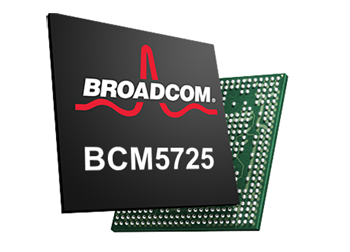
Broadcom Intros GbE Controller for Hyperscale Open Compute Servers

Broadcom introduced a Gigabit Ethernet (GbE) Controller that integrates a management controller with a high-performance network controller. The device features remote discovery, monitoring, control and management capabilities and is aimed at  hyper-scale server environments.

"Broadcom is delivering cost-effective, open and standards-based system management technologies to support emerging trends such as cloud computing," said Greg Scherer, Broadcom's vice president of server and storage strategy.  "We are enabling a new class of networking products, such as Open Compute Project AMD Open 3.0 Modular Server, through our advanced Ethernet controllers with enhanced manageability and features."

BCM5725 key features:
  • Integrated 10/100/1000BASE-T and transceiver
  • IEEE compliant with IEEE 802.3az-2010
  • Energy Efficient Ethernet (EEE)
  • x1 PCI Express+ v2.1 at 5.0 GT/s or 2.5 GT/s
  • SMASH 2.0/WS-Management and IPMI 2.0/DCMI 1.5 standards based system management
  • TruManage technology with system management features, including asset tracking of hardware/software inventory, sensors-based monitoring, power control (graceful and ungraceful), boot control, BIOS management, power consumption reporting, etc.
https://www.broadcom.com/press/release.php?id=s804380

Monday, November 4, 2013

Arista Introduces Switches for Cloud Network "Spline"

Arista Networks introduced its 7300 and 7250 high-density switching platforms for cloud and enterprise data centers.

Arista also introduces its "Single Tier Spline" architecture for simplifying data centers by simplifying cabling, consolidating servers, migrating between virtual to physical networks and controling IP storage.  The idea is to collapse the leaf and spine together into a single-tier network for performance and latency sensitive cloud applications.  Arista said its design can bring true deterministic performance for up to 2000 hosts in one cluster while lowering operating and capital asset costs by 40%.

The Arista 7300 and 7250X series feature resilient control planes for the Spline Network deployment model.  Key characteristics include:

  • Arista provides a single binary image of Arista EOS, purpose built for open cloud applications. Arista EOS’s unique foundation is a state-driven multiprocessing operating system.
  • "Zero Touch Provisioning" to simplify network deployment,
  • OpenWorkload to integrate with orchestration, virtualization, and provisioning tools in OpenStack, Microsoft System Center and VMware NSX;
  • Wireless/wired integration with Aruba
  • Partnerships with F5, Palo Alto Networks, Splunk and Riverbed.
  • The Arista 7300 is comprised of three chassis: the Arista 7304, 7308 and 7316 with 4, 8 and 16 line card slots respectively. All three share a common resilient architecture that scales up to 512 ports of 40GbE or 2,048 ports of 10GbE, with wirespeed performance of 40Tbps (terabits per second) of throughput. X Series line card modules for the Arista 7300 include 10GBASE-T, SFP and QSFP configurations. Front-to-rear and rear-to-front airflow options along with platinum rated power supplies allow for improved efficiency and middle-of-row Spline configurations. Two Arista 7316 Series systems can fit in a single 42RU rack supporting over 4000 10GbE ports. With power consumption under 3W per 10GbE port and latency under 2 microseconds, a pair of 7300 series switches replaces two Catalyst 6509Es with more than ten times the scale, throughput, latency improvement and power efficiency. The 7300X series are available in Q1 2014 from $500 per 10GbE port.
  • The Arista 7250X Series is a high density solution delivering 64 ports of wire-speed 40GbE or up to 256 Ports of 10GbE in a compact and power efficient two rack unit fixed form factor with redundant and hot-swap power supplies and fan modules. It offers a Layer 2 MAC table and Layer 3 routing tables that dynamically expand based on the application to support up to 288K MAC entries, or 144K routes.  It also supports Arista’s LRL4 QSFP optics that require a single pair of single mode fiber, reducing the fiber requirements by 75% compared to existing choices. The 7250QX-64 is available now and shipping for $1500 per 40GbE port

http://www.aristanetworks.com

Open Server Summit: Cloud Networking for Warehouse-sized Data Centers

The big six cloud companies are on CAPEX growth trajectories that will take them past the traditional telcos in a few years, said Andy Bechtolsheim, Chairman of Arista Networks.
There is a race to build gigantic data centers that are more efficient and powerful than anything seen before.  Speaking at the Open Server Summit in Santa Clara, California, Bechtolsheim said the expected gains from Moore's Law coupled with promising developments in silicon photonics and virtualization technologies, make it likely that the hyper-scale data centers will continue to hold a competitive advantage over the coming decade.

So, how do you build a network for a data center with 100,000+ servers and millions of VMs?  Bechtolsheim said his company has already seen (and won) competitive bids for 100,000+ ports of non-blocking 10 GigE server connections.  The ideal network, he said, should be truly transparent, flat and universal. This means the bandwidth and latency between any two servers in the data center should be the same.  A top-of-rack switching architecture is preferred.  To scale it for the biggest of data centers, Arista has developed a "Spine-of-Spine" network architecture that could scale to link up to 884,000 servers at 10G with a 3-1 oversubscription.

http://www.openserversummit.com/
http://www.aristanetworks.com/

Cambium's PTP 650 Radio Hits 450 Mbps in Sub 6 GHz Spectrum Bands

Cambium Networks introduced a sub-6 GHz addition to its field-proven PTP portfolio, which is designed for for wireless backhaul applications for public safety, government, utilities, oil and gas and service provider deployments.

The new wireless broadband platform offers throughput of up to 450 Mbps in a 45 MHz channel, delivers 10 bps/Hz and operates in any frequency between 4.9-6.05 GHz. The platform leverages Cambium's Dynamic Spectrum Optimization technology for maximum reliability through link optimization and offers a wealth of management services. The PTP 650 also offers data encryption and secure management features.  For spectrum-congested areas, it support a variety of channel widths -- 5, 10, 15, 20, 30, 40 and 45 MHz.

"Already, PTP 650's wide range of capabilities has resonated deeply with a number of tier one service providers across the globe. The product is being tested in over 20 lab trials with some of the world's most respected carriers in North America, Europe and Asia," said Atul Bhatnagar, president and CEO, Cambium Networks. "Tremendously applicable across verticals, distances and environments, PTP 650 is primed to make a significant difference in securely and safely connecting the world."

http://www.cambiumnetworks.com/

Google Expands its Data Center in Finland

Google disclosed plans to invest a further EUR 450 million to expand its data center in Hamina, Finland.

In 2009, Google acquired an abandoned paper mill on the Bay of Finland, investing an initial EUR 200 million to launch Phase I of the data center.  The facility takes advantage of the naturally chilly sea water for cooling. In August 2012, Google announced an additional EUR 150 million investment in Phase II of the data center.

http://www.google.com/about/datacenters/inside/locations/hamina/

NSN and China Mobile Research Institute Expand Partnership

Nokia Solutions and Networks and China Mobile Research Institute (CMRI) have expanded a Memorandum of Understanding (MoU) originally signed in 2010 to include advanced mobile broadband technologies in LTE as well as in 5G. The MoU reflects their vision of 2020 and outlines key focus areas for future mobile networks.

The parties agree to enhance joint research, standardization, and prototype development activities in advanced technologies such as 5G, LTE deployment optimization, cloud-based radio access network (C-RAN), the innovative “Nanocell” concept for next-generation small cell deployments, coexistence of 2G / 4G and core virtualization.

“Significant reduction of the unit cost of bandwidth is the key to success of future mobile networks,” said Bill Huang, General Manager of CMRI. “The alignment of NSN’s and CMRI’s technology vision on the future mobile networks is an important foundation for our long-term successful partnership. We are delighted to expand our MoU with NSN, the world’s specialist in mobile broadband, to keep pushing the limits of technology, shape the telco industry and explore new ways of helping operators reduce operational costs.”

“China Mobile Research Institute has paved the way for industry innovation in various aspects including TD-LTE, cloud-based RAN, IPv6 and packet networks. Since the outset, NSN and CMRI have consistently expanded and reinforced their collaboration to focus on leading research activities and to drive innovation and development of 4G technology and beyond,” said Markus Borchert, president of NSN Greater China. “We are proud of our long-term commitment to China, especially in the area of TD technology development, and specifically TD-LTE. Our leading global position in LTE, built on our strong technological capabilities and combined with our local service resources, makes us a strong partner for operators in China and globally.”

http://www.nsn.com
http://labs.chinamobile.com/