Showing posts with label China. Show all posts

Wednesday, August 31, 2022

U.S. blocks shipments of NVIDIA's A100 and H100 to China, Russia

The U.S. government has imposed an export restriction on NVIDIA's A100 and forthcoming H100 integrated circuits to China (including Hong Kong) and Russia. The license restriction also covers NVIDIA's DGX or any other systems which incorporate A100 or H100 integrated circuits, as well as any future NVIDIA integrated circuit achieving both peak performance and chip-to-chip I/O performance equal to or greater than thresholds that are roughly equivalent to the A100, as well as any system that includes those circuits. 

The new license requirement may require NVIDIA to transition certain operations out of China. 

NVIDIA said its financial outlook for its third fiscal quarter, provided on August 24, 2022, included approximately $400 million in potential sales to China which may be subject to the new license requirement if customers do not want to purchase the Ccmpany’s alternative product offerings or if the U.S. government does not grant licenses in a timely manner or denies licenses to significant customers.


https://investor.nvidia.com/financial-info/sec-filings/default.aspx

  • NVIDIA's A100, powered by itsAmpere Architecture, is the engine of the NVIDIA data center platform. A100 provides up to 20X higher performance over the prior generation and can be partitioned into seven GPU instances to dynamically adjust to shifting demands. It is available in 40GB and 80GB memory versions,the latter of which boasts the world’s fastest memory bandwidth at over 2 terabytes per second (TB/s).
  • NVIDIA's H100 features fourth-generation Tensor Cores and the Transformer Engine with FP8 precision. The company claims up to 9X faster training over the prior generation for mixture-of-experts (MoE) models. The design also leverages fourth-generation NVlink, which offers 900 GB/s of GPU-to-GPU interconnect and the NVLINK Switch System, which accelerates communication by every GPU across nodes.

NVIDIA posts revenue or $6.7B, decline in gaming revenue

In what it described as a "challenging quarter" driven primarily by weaker gaming revenue, NVIDIA reported revenue of $6.70 billion for the second quarter ended July 31, 2022, up 3% from a year ago and down 19% from the previous quarter.GAAP earnings per diluted share for the quarter were $0.26, down 72% from a year ago and down 59% from the previous quarter. Non-GAAP earnings per diluted share were $0.51, down 51% from a year ago and down 63% from...

NVIDIA trims outlook on lower gaming sales and supply disruptions

Citing macroeconomic headwins and lower gaming sales, NVIDIA trimmed its financial outlook for the second quarter ended July 31, 2022.Second quarter revenue is expected to be approximately $6.70 billion, down 19% sequentially and up 3% from the prior year, primarily reflecting weaker than forecasted Gaming revenue. Gaming revenue was $2.04 billion, down 44% sequentially and down 33% from the prior year. Data Center revenue was $3.81 billion, up 1%...

NVIDIA unveils Quantum Optimized Device Architecture

NVIDIA outlined a new Quantum Optimized Device Architecture (QODA) for creating a coherent hybrid quantum-classical programming model. QODA is an open, unified environment for quantum processors that aims to make it easier to add quantum computing to existing applications, leveraging both today’s quantum processors, as well as simulated future quantum machines using NVIDIA DGX systems and a large installed base of NVIDIA GPUs available in scientific...


Friday, August 19, 2022

ZTE tests co-routing detection in an existing optical network

ZTE completed a commercial trial of co-routing detection in China Mobile’s existing optical network in Yunnan Province, China. 

The trial with the Yunnan branch of China Mobile, involved two scenarios: co-cable routing detection and co-ditch routing detection. The trial result shows that there will be an early warning of active/standby paths in the same optical fiber or route so that it can be avoided in time based on fiber sensing.

According to the verification, ZTE's optical network co-routing detection function can exactly detect co-cable routing of 14 optical cables and 54 fiber cores by dynamic parameter optimization, AI algorithm and experience threshold adjustment. Also, ZTE takes analysis, contrast and on-site specialist inspection to exactly detect co-ditch routing of 12 optical cables and about 20 ditches in 4 core equipment rooms. The verification proves that ZTE can provide the operator with flexible optical network co-routing detection methods, along with real-time, accurate and reliable intelligent O&M measures, which well guarantees service survivability and alleviates the difficulty in dumb fiber resource management.

"The function can effectively solve actual problems in production and operation. Before this, active/standby routes are planned on the resource management map, and routing is determined manually, which leads to high error rate. Additionally, the accuracy of resource management information is hardly under control, thereby increasing routing risks,” said the leader of Network Management Center of China Mobile Yunnan.

“In the original routing detection, people pulled or pushed the cable underground manually, which resulted in low efficiency and service interruption. However, the co-routing detection now leverages dumb fiber resources without service switching. The innovative function remarkably reduces manpower and ensures service survivability while allowing resource management information modifications and route re-planning to avoid service interruption losses," he added.

https://www.zte.com.cn/global/about/news/20220818e1.html

Friday, July 15, 2022

China Unicom Beijing deploys Huawei's extremely-large antenna arrays

China Unicom Beijing is deploying Huawei's new extremely-large antenna array (ELAA) architecture at over 1,000 sites around the outskirts of Beijing.

The giant antenna arrays, which are called "metaverse-ready active antenna units - MetaAAUs", double the scale of arrays compared with the previous-generation AAU. Huawei says the increased size results in extended coverage because channel beams are narrower and energy is more focused. New algorithms improve network performance while slashing energy consumption. 

The companies claim the new MetaAAUs have delivered a 40% increase in coverage area, increased uplink and downlink user-perceived rates by 10%, and lowered network energy consumption by 5% over previous-generation AAUs. Since their deployment, user traffic has increased by 38% in their coverage areas and the carrier's user base has increased by 37%.

Ritchie Peng, President of Huawei 5G Product Line, said, "MetaAAU is one of our major innovations. With MetaAAU, we achieve great breakthroughs in network performance and energy efficiency, and this is attributed to our strong investment and continuous innovation in Massive MIMO. We are glad to cooperate with China Unicom Beijing on the thousand-site MetaAAU project, and proud to see that MetaAAU achieves the desired performance across the entire network. We believe this can provide a useful reference for global operators in selecting Massive MIMO technologies for different scenarios."

https://www.huawei.com/en/news/2022/7/beijing-metaaau-1000

Friday, July 8, 2022

India probes Chinese smartphone manufacturers

On July 6th, Indian authorities raided the local offices of Vivo accusing the Chinese smartphone manufacturer of money laundering and the forgery of identity papers. Vivo accounts for an estimated 15% of the smartphone market in India.

In December 2021, similar probes were launched into Xiaomi and Oppo for alleged tax evaion.  As a result, India seized Xiaomi assets valued at US$700 million.

In February 2022, the Indian offices of Huawei were raided by tax authorities.

India has also banned or restricted more than 200 smartphone owned or developed by Chinese entities, including banning TikTok.


Tuesday, May 17, 2022

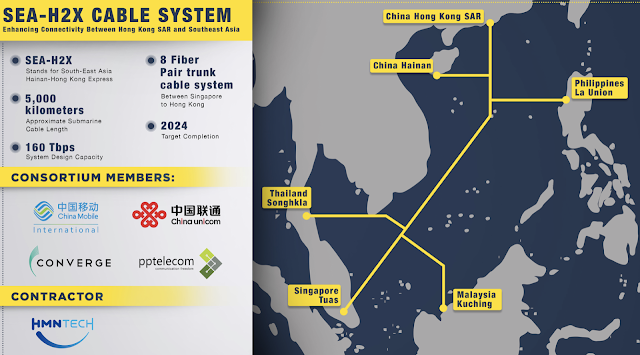
SEA H2X cable to link Hong Kong and Singapore with 8 fiber pairs

The SEA-H2X Consortium, which consists of China Mobile International, China Unicom Global, Converge Information and Communications Technology Solutions, and PPTEL SEA H2X Sdn. Bhd, announced plans for a new submarine cable system that will connect Hong Kong SAR China, Hainan China, Philippines, Thailand, East Malaysia and Singapore, with options to extend to Vietnam, Cambodia, West Malaysia and Indonesia. 

The parties to the SEA-H2X Project have appointed HMN Technologies Cto build the cable in a fully funded project. 

At approximately 5,000 kilometers in length, the SEA-H2X cable will consist of at least 8-fiber pairs between Hong Kong SAR and Singapore, with a design capacity of 160 Tbps to meet the growing bandwidth requirement in the region. The system is targeted to be ready-for-service in 2024 which help businesses and consumers benefit from increasing digital ties.

Notably, the SEA-H2X cable will connect Hainan (China), Kuching (Sarawak, Malaysia) and La Union (the Philippines), in addition to its trunk connecting the Hong Kong-Singapore corridor.

The SEA-H2X cable system will offer a diverse subsea cable connections to the Hainan Free Trade Zone, in addition to current Hainan to Hong Kong Express (H2HE) privately owned by China Mobile.

https://www.hmntechnologies.com/enPressReleases/37988.jhtml

Thursday, April 21, 2022

LuminWave raises $20 million for solid-state LiDAR

LuminWave, a start-up based in Hangzhou, China, raised more than $20 million in Series B financing for its Si-photonics 4D LiDAR.

LuminWave develops unique Si photonics-based frequency-modulated continuous wave (FMCW) coherent detection and solid-state scanning technologies and highly integrated LiDAR solutions. It currently has two product families: a solid-state large FOV (up to 120⁰x90⁰) Diversity Series (D-Series) and a FMCW 4D Foresight Series (F-Series).

The D-Series aims at collision avoidance and blind area detection applications for ADAS and autonomous driving as well as applications in industrial automation and smart infrastructures. Its large FOV, high resolution, compact size, and appealing price make it a perfect choice for a large variety of use cases. D1, the first product in this family, was released early last year and is currently in volume production. A next generation higher performance model is on its way.

The F-Series takes advantage of Si photonics-based solid-state FMCW to provide unique high accuracy, 

 "As more LiDARs are being deployed on the road, immunity from LiDAR crosstalk will become crucial to safety. Our FMCW LiDAR perfectly addresses this issue ," said Dr. Feng, CEO of LuminWave Technology.

http://www.LuminWave.com

Wednesday, March 16, 2022

FCC revokes licenses of China-based Pacific Networks

 The FCC revoked the license of Pacific Networks Corp. and its wholly-owned subsidiary, ComNet (USA) LLC, to provide domestic interstate and international telecommunications services within the United States.  

The FCC order directs the companies to discontinue any domestic or international services that they provide pursuant to their section 214 authority within sixty days following the release of the Order.  

The FCC said the comaphies are U.S. subsidiaries of a Chinese state-owned entity, and therefore they are subject to exploitation, influence, and control by the Chinese government and are highly likely to be forced to comply with Chinese government requests without sufficient legal procedures subject to independent judicial oversight.  

  • In March 2021, the Commission found that Pacific Networks and ComNet had failed to dispel serious concerns regarding their retention of their authority to provide telecommunications services in the United States.  


Monday, January 31, 2022

ZTE reports record profit for 2021

 ZTE expects its 2021 net profit attributable to holders of ordinary shares will be in range of RMB 6.5 billion to RMB 7.2 billion (US$1.02 billion to US$1.13 billion), an increase of 52.6% to 69.0% year on year. Net profit after extraordinary items for 2021 amounted to RMB 3.0 billion to RMB 3.5 billion, representing a year-on-year rise of 189.7% to 238.0%. Both of them were the highest in the history of the company. Basic earnings per share was RMB 1.40 to RMB 1.55.

ZTE said that despite complex external environment, it continued to solidify its position in 2021 with innovative initiatives while maintaining steady operations and optimizing its market structure. The company achieved double-digit year-on-year growth in operating revenue, with both domestic and international markets and all its three major businesses (operator networks, government and enterprise services and consumer services) seeing year-on-year growth in terms of operating revenue.

In domestic market, ZTE's key products of 5G, core network, transport network, and server & storage products have witnessed continued growth in terms of market share. 

In the overseas market, ZTE benefited from 4G modernization projects, 5G infrastructure deployments, fiber-based transformation of fixed networks, transport network upgrades and home broadband product upgrades. 

In the IT field, ZTE reported operating revenue of RMB10 billion (US$1.57 billion). 

https://www.zte.com.cn/global/about/news/20220128e2.html


Thursday, January 27, 2022

FCC revokes China Unicom's license

The FCC ordered China Unicom (Americas) Operations Limited to discontinue domestic interstate and international telecommunications services within the United States within 60 days.

The FCC said today's decision rests on the following:

• First, the Order finds that China Unicom Americas, a U.S. subsidiary of a Chinese state-owned enterprise, is subject to exploitation, influence, and control by the Chinese government and is highly likely to be forced to comply with Chinese government requests without sufficient legal procedures subject to independent judicial oversight.  

• Second, given the changed national security environment with respect to China since the Commission authorized China Unicom Americas to provide telecommunications services in the United States two decades ago, the Order finds that China Unicom Americas’ ownership and control by the Chinese government raise significant national security and law enforcement risks by providing opportunities for China Unicom Americas, its parent entities, and the Chinese government to access, store, disrupt, and/or misroute U.S. communications, which in turn allow them to engage in espionage and other harmful activities against the United States.  

• Third, China Unicom Americas’ conduct and representations to the Commission and Congress demonstrate a lack of candor, trustworthiness, and reliability that erodes the baseline level of trust that the Commission and other U.S. government agencies require of telecommunications carriers given the critical nature of the provision of telecommunications service in the United States.  

• Fourth, the Order finds that mitigation would not address these significant national security and law enforcement concerns.  

https://www.fcc.gov/document/fcc-revokes-china-unicom-americas-telecom-services-authority

Biden signs Secure Equipment Act

President Biden signed into law the “Secure Equipment Act of 2021,” which requires the Federal Communications Commission to adopt rules clarifying that it will no longer review or approve any authorization application for equipment that poses an unacceptable risk to national security.The bill would prevent further integration and sales of Huawei, ZTE, Hytera, Hikvision, and Dahua – all Chinese state-backed or directed firms – in the U.S. regardless...

FCC revokes China Telecom America's license

Citing national security concerns, the Federal Communications Commission a(FCC) revoked China Telecom (Americas) Corporation’s ability to provide domestic interstate and international telecommunications services within the United States.  China Telecom Americas has been ordered to discontinue any domestic or international services that it provides pursuant to its section 214 authority within sixty days following the release of the order.  The...


Monday, January 10, 2022

Beijing's Capital Online picks Nokia's 7750 Service Router

Capital Online, a cloud computing service provider headquartered in Beijing, will deploy the Nokia 7750 Service Router (SR) and 7250 IXR interconnect router platforms to upgrade its IP backbone network.

The network upgrade entails that the converged backbone provides performance certainty for all traffic flows under all network conditions, the versatility to converge edge and core routing functions onto a common platform, smart traffic engineering with segment routing-MPLS, and granular QoS to address different traffic demands for reliable service delivery.

Xu Xiaohu, Chief Architect of Capital Online, said: “As a trusted partner of critical networks, Nokia has abundant experiences helping its global customers build high capacity and quality IP networks. We’re looking forward to collaborating with Nokia to accelerate the transformation of our network to provide faster, more reliable network services for our global customers throughout the U.S., Europe and Asia.”

Markus Borchert, CEO of Nokia Shanghai Bell, said: “Capital Online is known for being specialists in delivering exceptional online experiences for global business. We are pleased to help it create an industry leading IP network that will upgrade its existing backbone network to the Network 2.0 era, paving the way to increase its footprint in the global Cloud market in the future.”

Tuesday, December 21, 2021

Rockley Photonics cancels sale of datacom assets to Chinese JV

Rockley Photonics announced its intention not to proceed, under current circumstances, with its data-communications-related technical sale to Hengtong Rockley Technology Co. Ltd., its joint venture with Jiangsu Hengtong Optic-Electric Co..

The announcement follows last week's decision by the U.S. Department of Commerce's Bureau of Industry and Security (BIS) to add Jiangsu Hengtong Optic-Electric to its Entity List because of national security and human rights concerns.

“Rockley’s primary focus has been and continues to be on the development and commercialization of our sensing platform in the health monitoring space. We continue to make outstanding progress in this arena, as outlined in our recent customer and technology announcements, and our outlook for this business continues to show momentum,” said Andrew Rickman, founder and chief executive officer of Rockley. “The technical sale to the JV was intended as an efficient way to monetize Rockley’s innovative data communications technology without distracting from our primary focus on our health and wellness solutions.”

Dr. Rickman went on to say, “We continue to fully comply with the regulations and have decided not to proceed with our technical sale to the JV under the current circumstances. The BIS action will require us to adjust our strategy for monetizing our communications technology. While we are disappointed in the near-term impact on our company, we believe that this decision will be a net positive for Rockley and will not affect the long-term outlook for our business because these solutions were not core to our future growth prospects. We will continue to focus our resources on bringing solutions to the health and wellness market to satisfy the significant consumer and medtech demand we have reported. We are evaluating options to monetize our ultra-high-speed fiber optic communication solutions, which we believe could have a net positive impact on our cash.”

http://www.rockleyphotonics.com

Thursday, December 16, 2021

U.S. adds Huawei Marine Networks to Entity List

The U.S. Commerce Department’s Bureau of Industry and Security (BIS) added several Chinese companies to its Entity List because of national security and human rights concerns.

The Entity List is a tool utilized by BIS to restrict the export, reexport, and in-country transfer of technology.

Among the newly listed companies are:

  • HMN International Co. (formerly Huawei Marine Networks), 
  • Jiangsu Hengtong Marine Cable Systems Co., a leading supplier of undersea cables, 
  • Jiangsu Hengtong Optic-Electric Co., a leading power and fiber optic cable manufacturer
  • Zhongtian Technology Submarine Cable Co.

Also added to the list were Chinese suppliers of microelectronics, sensing, underwater ROV equipment, including Zhongtian Technology Submarine Cable Co, as well as suppliers of biotechnology equipment from China, Georgia, Malaysia, and Turkey.

https://public-inspection.federalregister.gov/2021-27406.pdf

  • fhuy In November 2020, Huawei Marine was rebranded as HMN Technologies Co.. This followed Hengtong group completing its 81% shareholding acquisition of Huawei Marine Networks Co., Ltd. The remaining 19% balance was held by New Saxon 2019 Ltd. (UK).

HC2 agrees to sell its 49% interest in Huawei Marine

HC2 Holdings, a diversified holding company, announced that its Marine Services Segment, Global Marine Group has agreed to a sale of its stake in Huawei Marine Networks, its 49% joint venture with Huawei Technologies Co., to Hengtong Optic-Electric Co Ltd (“Hengtong”).  The sale of GMG’s interest values HMN at $285 million, and GMG’s 49% stake at approximately $140 million. Under the agreement, GMG will sell 30% of HMN to Hengtong at closing...

Huawei to sell its stake in subsea business to Hengtong

Huawei Technologies has agreed to sell its 51% stake in Huawei Marine Systems Co Ltd to Hengtong Optic-Electric Co Ltd, a supplier of optical networking products company based in Jiangsu province. The deal was disclosed in a filing by Hengtong to the Shanghai Financial Exchange. Financial terms were not disclosed.  The remaining 49% in Huawei Marine Systems is held by Global Marine. Hengtong is already a leading supplier of submarine power...


Tuesday, November 16, 2021

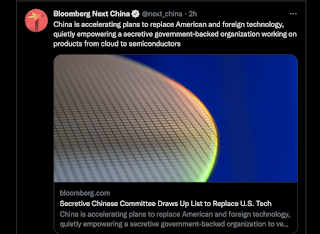
Bloomberg: Secretive Chinese Committee Draws Up List

China has formed a secretive Information Technology Application Innovation Working Committee with the goal of replacing foreign technology suppliers and boosting local competitors, according to Bloomberg. 

The report says the committee has developed an “IT Application Innovation” plan, known as Xinchuang in Chinese, that serves as a whitelist of approved vendors for government and private sector projects in the areas of telecom equipment, data center servers and switches, computing silicon, cloud servicesm and network security. 

The list is seen as a direct response to the Entity list developed by the U.S. government of non-trusted Chinese vendors.

https://www.bloomberg.com/news/articles/2021-11-16/secretive-chinese-committee-draws-up-list-to-replace-u-s-tech

Sunday, November 14, 2021

WSJ: U.S. Companies Aid China’s Bid for Chip Dominance

The Wall Street Journal looks at recent investments in China's semiconductor sector by U.S. venture capital firms, such as Sequoia Capital, Lightspeed Venture Partners, Matrix Partners and Redpoint Ventures, as well as Intel, and other key players. 

The article also discusses possible changes in U.S. national security policies led by officials in Washington who are alarmed by the deals which are said to have raised billions of dollars, potentially boosting Beijing's ambition to dominate the global semiconductor sector. 

https://www.wsj.com/articles/u-s-firms-aid-chinas-bid-for-chip-dominance-despite-security-concerns-11636718400?


Tuesday, October 26, 2021

FCC revokes China Telecom America's license

Citing national security concerns, the Federal Communications Commission a(FCC) revoked China Telecom (Americas) Corporation’s ability to provide domestic interstate and international telecommunications services within the United States.  


China Telecom Americas has been ordered to discontinue any domestic or international services that it provides pursuant to its section 214 authority within sixty days following the release of the order.  

The FCC noted several reasons for its decision, including:

China Telecom Americas, a U.S. subsidiary of a Chinese state-owned enterprise, is subject to exploitation, influence, and control by the Chinese government and is highly likely to be forced to comply with Chinese government requests without sufficient legal procedures subject to independent judicial oversight.  

China Telecom Americas’ ownership and control by the Chinese government raise significant national security and law enforcement risks by providing opportunities for China Telecom Americas, its parent entities, and the Chinese government to access, store, disrupt, and/or misroute U.S. communications, which in turn allow them to engage in espionage and other harmful activities against the United States.  

 China Telecom Americas’ conduct and representations to the Commission and other U.S. government agencies demonstrate a lack of candor, trustworthiness, and reliability that erodes the baseline level of trust that the Commission and other U.S. government agencies require of telecommunications carriers given the critical nature of the provision of telecommunications service in the United States.  


Monday, August 9, 2021

China Telecom's 1H2021 revenues rise 13%yoy

China Telecom reported operating revenues of RMB219.2 billion for the first half of 2021, representing an increase of 13.1% year-on-year. Service revenues amounted to RMB203.5 billion, representing an increase of 8.8% year-on-year and surpassing the industry’s average growth rate. EBITDA amounted to RMB66.3 billion, representing an increase of 5.1% over the same period of last year. Net profit amounted to RMB17.7 billion, representing an increase of 27.2% over the same period of last year. 


Some highlights:

  • China Telecom's 1H2021 capital expenditure was RMB27.0 billion.
  • In the first half of the year, China Telecom's mobile communications service revenues amounted to RMB93.3 billion, representing an increase of
  • 6.9% over the same period of last year. 
  • The total number of mobile subscribers reached 362 million, representing a net addition of 11.47 million. 
  • The number of 5G package subscribers reached 131 million with a penetration rate of 36.2%, which continued to surpass the industry
  • average level. 
  • The number of 5G feature-app subscribers increased rapidly, while users upgrading to 5G maintained sound value growth. 
  • Mobile ARPU has reversed its downward trend and continued to increase, which amounted to RMB45.7, representing an increase of 2.9% over the same period of last year.
  • 5G ARPU is RMB57.4


  • Wireline and Smart Family service revenues of the Company amounted to RMB57.4 billion, representing an increase of 5.2% year-on-year. 
  • The total number of wireline broadband subscribers reached 164 million, while revenue from broadband access reached RMB38.1 billion, representing a year-on-year growth of 7.9%. 
  • Broadband access ARPU maintained the rebounce momentum, reaching RMB39.4 and representing an increase of 2.9% over the same period of last year.

https://www.chinatelecom-h.com/en/global/home.php

Sunday, June 27, 2021

Huawei deploys massive MIMO in Chengdu airport

China Mobile has deployed Huawei's 5G distributed Massive MIMO solution inside Chengdu Tianfu International Airport to build the first Gigabit 5G airport in China. 

Huawei says the user-perceived rate across the check-in areas exceeds 1 Gbps, with the single-user rate increasing by 26% on average over common 5G networks up to a peak of 1.25 Gbps. Significant improvement was also displayed in both the perceived rate and overall network capacity in multi-user scenarios. 

Chengdu Tianfu International Airport is the second international air hub in Southwest China's Sichuan Province and has the capacity to support 40 million passenger trips, 700,000 tons of cargo and mail, and 320,000 aircraft movements annually. 

Monday, May 24, 2021

Ericsson warns of potential impact to its operations in China

 Ericsson warned that its economic interests in China may be at risk due to the decision by Sweden's Post and Telecommunication Authority (PTS) to exclude Chinese vendors’ products from 5G networks in Sweden. The financial disclosure warning comes as Ericsson is currently in the process of issuing a EUR 500 million unsecured 8-year bond.  


Ericsson notes that it has been invited to various ongoing tender processes in China, the final outcome remains uncertain and it is the company’s current assessment that the risk has increased that Ericsson will in those tenders be allocated a significantly lower market share than its current market share. 

"The geopolitical situation can have consequences on the entire industry, with an increased likelihood of further industry split, separation of global value chains and separation of global standards for mobile telecommunications. This overall development has also led to several countries evaluating how to ensure uninterrupted access to telecommunication network infrastructure, for example through promoting disaggregation of the Radio Access Network and support of national communication network infrastructure champions as alternative to the established global vendors such as Ericsson although the timing and extent of this remains unclear."

https://www.ericsson.com/en/press-releases/2021/5/ericsson-updates-risk-factors-for-euro-corporate-bond-prospectus

Thursday, April 8, 2021

U.S. adds seven Chinese supercomputing sites to Entity List

The Department of Commerce’s Bureau of Industry and Security (BIS) added the following seven Chinese supercomputing sites to its Entity List for conducting activities that are contrary to the national security or foreign policy interests of the United States:

Tianjin Phytium Information Technology, Shanghai High-Performance Integrated Circuit Design Center, Sunway Microelectronics, the National Supercomputing Center Jinan, the National Supercomputing Center Shenzhen, the National Supercomputing Center Wuxi, and the National Supercomputing Center Zhengzhou. 

U.S. Secretary of Commerce Gina M. Raimondo released the following statement:

“Supercomputing capabilities are vital for the development of many – perhaps almost all – modern weapons and national security systems, such as nuclear weapons and hypersonic weapons. The Department of Commerce will use the full extent of its authorities to prevent China from leveraging U.S. technologies to support these destabilizing military modernization efforts.”


https://www.commerce.gov/news/press-releases/2021/04/commerce-adds-seven-chinese-supercomputing-entities-entity-list-their

Tuesday, April 6, 2021

China’s 21Vianet data center operator upgrades with Juniper routers

21Vianet, the largest carrier-neutral data center service provider in China, has deployed Juniper Networks' MX Series Universal Routing Platforms using segment routing traffic engineering (SR-TE) protocols.

21Vianet operates a network of over 50 data centers in more than 20 cities nationwide where it houses more than 51,000 network cabinets offering over 2000G of port capacity and providing over 1000G of dedicated high-speed cloud access for its ever-growing user base across the world’s second largest economy.

Juniper says 21Vianet's latest upgrade has not just successfully increased the capacity, scale and stability of its network – but also provided the platform for much-improved efficiency and automation via the implementation of SR-TE protocols, allowing 21Vianet to pass on lower operational costs and management workloads to its customers, all while greatly improving the end-user experience. The implementation of the EVPN-MPLS/VXLAN protocol was applied to support application mobility, allowing network administrators to easily migrate applications within and between various data centers, allowing for operational efficiency while optimizing network traffic flow. The application of segment routing protocols has also enabled simplified traffic management across 21Vianet’s multiple network domains, all while fulfilling the demands of increased bandwidth capacity.

“21Vianet has rapidly established itself among the largest and most influential service providers within the IDC industry in China. We are proud to have helped drive that growth and data center development over the years and are honoured to have once again enabled their latest upgrades in support of their accelerated market expansion. We remain committed to our vision of enabling organizations with our experience-first approach toward networking and we are confident that this ever-deepening relationship with 21Vianet can be a continued growth catalyst for the long-term development of the IDC industry across China and beyond.”

https://newsroom.juniper.net/news/news-details/2021/Chinas-Largest-Carrier-Neutral-Data-Center-Service-Provider-21Vianet-Selects-Juniper-Networks-to-Power-Expanded-Interconnected-Data-Center/default.aspx