Thursday, September 10, 2015

Nokia Sees 5G Delivering 1 Gbps Home Broadband by 2017

Nokia Networks believes home broadband will be successful use case for 5G in areas with millions of homes near to fiber but without last hop connectivity via fiber to the home.

Nokia's solution bridges from the existing fiber network using high throughput 5G-ready hotspots placed, for example, on adjacent lamp posts to cover the last hop. Nokia Networks will start trialling a solution in 2016 that ensures at least 1 Gbps throughput for every home. The company is targeting commercial availability in 2017.

In April, 2015, at the Brooklyn Summit, Nokia Networks together with National Instruments demonstrated 10 Gbps speeds over the air with massive MIMO and beamsteering technologies, paving the way for meeting 5G requirements. It is a concrete proof point of our capability to deliver on the promise of a true 1 Gbps last hop connection to the home in the timeline outlined here today.

http://nokia.ly/1KVUBCE#sthash.ZL7Vr0VL.dpuf

Nokia Launches 1 Gbps Small Cell

Nokia Networks unveiled a new Flexi Zone outdoor modular base station that becomes the world’s first small cell to achieve over 1 Gbps peak data rate. 

The new Flexi Zone G2 Multi-Band Carrier Aggregation Outdoor Micro/Pico Base Station (BTS) offers three RF module slots, enabling operators to deploy and aggregate between various radio access technologies and spectrum combinations including up to three LTE licensed carrier bands or configurations offering a combination of LTE licensed carrier bands, unlicensed LTE bands (LTE-U or LAA) and Wi-Fi.

Nokia also announced a number of innovations to simplify small cell deployment and help operators to evolve to Ultra-Dense Networks. These include the optimal selection of viable sites, more efficient backhaul, improved plug and play technology, new energy-saving features and simplified synchronization between base stations. The company said its HetNet Engine Room allows operators to deploy small cells 30% faster, with 20% lower costs and serve 10% more subscribers. Using detailed 3-D street level maps, the service calculates a ‘Site Value Index’ that quantifies the likely return on investment (ROI) for operators from different locations.

Several other Nokia Networks innovations also focus on overcoming the technical and cost barriers of deploying small cells:
  • A point-to-multipoint non-line-of-sight (NLoS) wireless backhaul option from Nokia Networks partner Tarana Wireless. Fast high-performance fiber-like backhaul can now be deployed to sites that are difficult to reach cost-effectively with fiber or line-of-sight  technologies.
  • New Intelligent Self Organizing Networks (iSON) capabilities enable rapid small cell deployments with backhaul over public networks* and for operator networks that do not use Dynamic Host Configuration Protocol  (DHCP). In these two more complex environments, small cells can now be operational in under 20 minutes after being powered up.
  • An integrated Grand Master Clock function added to the Flexi Zone Controller that distributes a high accuracy clock to all Flexi Zone AP** within the cluster. This functionality offers significant CapEx and OpEx savings by eliminating the need for an external timing solution or GPS antenna  for each small cell.
“Deploying a small cell on one side of a road can cost ten times more than at a location just a few meters away on the other side of the road. We are bringing a new approach that enables operators to pick the best sites and then deploy small cells and their backhaul quickly and at a much lower cost. Now operators can justify the business case for small cells and improve the return on their network investments,” stated Randy Cox, head of Small Cell Product Management at Nokia Networks.

Innovation Pact: Singtel, Orange, Deutsche Telekom and Telefónica

The start-up innovation arms of Singtel (Singtel Innov8), Orange (Orange Fab), Deutsche Telekom (hub:raum) and Telefónica (Telefónica Open Future) have joined forces to bridge the start-up ecosystems across Southeast Asia, Africa, Europe, Latin America and the Middle East.

The carriers aim to accelerate the growth of eligible start-ups by tapping into the resources and network of the four leading communications companies. This includes market insights, introductions to partners, the use of co-working spaces and access to the companies’ operating businesses. Selected start-ups may also have the opportunity to gain access to the operators’ collective mobile customer base of over one billion people across four continents.

Mr Edgar Hardless, CEO, Singtel Innov8, said: “This is a great opportunity for us to deepen our connections with leading innovation hubs around the world. More start-ups harbour aspirations to venture beyond their own markets and go global. Through Singtel Innov8’s deep connections in Southeast Asia, we can help open doors for African, European, Middle Eastern and Latin American start-ups to the region. Similarly, our portfolio companies can leverage this partnership to expand beyond their home markets.”

Ms Nathalie Boulanger, Start-up Ecosystem Director, Orange said: “Having built up extensive experience of working hand-in-glove with start-ups across the world, Orange sees the formation of global partnerships such as this as the critical next step to ensure that digital innovators continue to flourish. With our collective and complementary footprints spanning four continents, we can provide start-ups with access to new markets, thereby enabling them to accelerate their growth further.”
Mr Min-Kin Mak, VP, hub:raum, Deutsche Telekom said: “With the partnership between Deutsche Telekom, Orange, Singtel and Telefónica, we see a huge opportunity to develop the bridges between the ecosystems in Asia, Africa, Europe and Latin America and to provide start-ups with critical market access, funding and expertise to become more successful with their international expansion.”

http://pressoffice.telefonica.com/

NEC Supplies Juniper and Infinera Gear to Telenor

Norway's Telenor Group signed a global framework agreement with NEC covering all major aspects of the operator’s transport network, including microwave, IP routers and optical and will manage the delivery, installation and commission of equipment.

NEC has supported Telenor Group’s successful rollout of 3G and 4G mobile services across the globe as a global supplier of microwave communications systems since 2006.

Under the new contract, NEC, Juniper Networks and Infinera will provide IP transport routers and wavelength division multiplexing (WDM) optical communications equipment to the Telenor Group’s 13 telecommunications affiliates worldwide to handle the ever increasing volume of traffic and content over today’s networks.

“Today’s announcement further reinforces our 30-year plus relationship with Telenor that started when NEC provided satellite communications systems to the operator in the 1980s,” said Takayuki Morita, executive vice president, NEC Corporation. “NEC, together with its partners Juniper Networks and Infinera, are fully committed to helping Telenor maintain its competitive edge through the provision of highly-reliable, market-leading transport network solutions.”

http://jpn.nec.com/press/201509/20150909_01.html

Telefónica Completes SDN/NFV Proof of Concept with NEC and NetCracker

Telefónica Business Solutions completed a Proof of Concept (PoC) based on SDN/NFV aimed at enabling new agile WAN for the business market.

Telefónica partnered with NEC and NetCracker on this PoC, combining software-defined networking (SDN) and network functions virtualization (NFV) to provide more dynamic services on the worldwide WAN portfolio for enterprises. The PoC built an end-to-end solution for a virtualized VPN service over a virtual CPE. The solution includes a full orchestration and self-care stack from NEC/NetCracker, integrated with Telefónica’s virtual infrastructure solution and several virtual network functions, such as virtual SSL termination gateway, virtual firewall, etc. The orchestration solution successfully handled automated provisioning and the activation of both virtualized and traditional networks to establish virtualized VPN service and deploy the virtual network functions on the cloud.

NEC said the solution enabled the fully automated provisioning of a virtualized VPN service triggered by customers from a self-care portal, as well as fully automated value-added service provisioning and configuration.

“Given the increasing demand for virtualized solutions, we are excited to work with Telefónica and demonstrate the in-depth capabilities of our innovative SDN/NFV solutions,” said Frank DeTraglia, Chief Customer Officer at NetCracker. “We are pleased with the results of this PoC and look forward to expanding our relationship with Telefónica as the market and demand for virtualized technologies grow.”

http://www.netcracker.com/

IHS: Big Spending on GPON in China

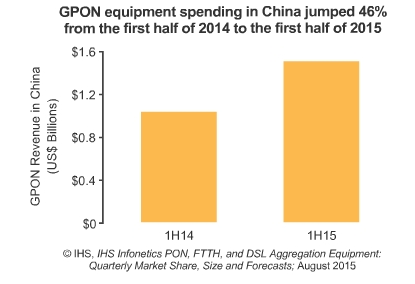
Global broadband aggregation equipment revenue (DSL, PON, and Ethernet FTTH) grew 12 percent sequentially in the second quarter of 2015 (2Q15) and 11 percent year-over-year, driven largely by record Gigabit Passive Optical Network (GPON) equipment shipments in China and an increase in very-high-bit-rate DSL (VDSL) deployments, according to newly published research from IHS (Infonetics).

Some highlights:

  • China set a record for PON equipment revenue in 2Q15, surpassing $1 billion in a quarter for the first time ever
  • Q2 spending on PON equipment globally was up both sequentially and on a year over-year basis, and IHS anticipates increased spending for the full-year 2015 as more operators deploy FTTH services
  • The 2Q15 spending environment in North America was very mixed: GPON expenditures were up 1 percent from 2Q14 but down 10 percent from 1Q15, while DSL spending plunged 18 percent from 2Q14 but grew 5 percent from 1Q15
  • Due to the tremendous, sustained investment in China, IHS now predicts the worldwide broadband aggregation market will reach $9 billion in 2019


http://www.infonetics.com

NoviFlow Raises $9 Million for SDN Switching

NoviFlow, a start-up based in Montreal, announced $9 million in Series A funding for its programmable, high-performance SDN forwarding plane solutions.

The company's NoviSwitch is an OpenFlow v1.3/1.4 switching solution boasting up to 240 Gbps of wire-speed performance, 1 million flow entries and over 12000 flowmods/sec. It is capable of wire speed packet payload (L2-L7) matching and flow handling and is powered by EZchip's NP-5 NPU.  NoviFlow also offers its OpenFlow v1.3/1.4 switching software for use in other embedded solutions.

The funding round was led by Fonds de solidarité FTQ and joined by W3 Investissement and Somel Investments Inc., with participation from previous investors and directors of NoviFlow Inc.

According to NoviFlow Inc. president and CEO Dominique Jodoin: "With this financing, we are well positioned to extend the reach of our SDN hardware and software offering beyond our existing client base in North America, Asia, and Europe.”

http://noviflow.com/products/our-products


  • NoviFlow was founded in March 2012 as a spin out of the Université du Québec à Montréal (UQAM), 


Wednesday, September 9, 2015

Google Cloud Builds Global Content Delivery Network Partnerships

Google announced collaborations with four of the industry’s leading content delivery network (CDN) providers: CloudFlare, Fastly, Highwinds, and Level 3 Communications.

The new CDN Interconnect program enables the customers of these CDN providers and the Google Cloud Platform to pay reduced prices for in-region Cloud Platform egress traffic (to approved CDN locations).

Google said this CDN Interconnect program will encourage the best practice of regularly distributing content originating from Cloud Platform out to the edge close to end-users. Google provides a private, high-performance link between Cloud Platform and the CDN providers, allowing content to travel a low-latency, reliable route from the Google data centers out to the end users. Google is recommending that publishers on the Google Cloud Platform to also use a CDN provider especially for heavy, frequently accessed content.

Google's network footprint currently extends to 70 PoPs in 33 countries.

Level 3 Content Delivery Network is in 90+ major metro cities globally.

CloudFlare posted the following explanation: 30 CloudFlare points of presence (PoPs) are directly connected to Google Cloud Platform’s infrastructure. When one of these CloudFlare PoPs requests content from a Google Cloud Platform origin, it’s routed through a high-performance interconnect instead of the public Internet. This dramatically reduces latency for origin requests, and it also enables discounted Google Cloud Platform egress pricing in the US, Europe and Asia regions.

As of May 1st, Fastly has nine points of presence (POPs) interconnected with Google: San Jose, Los Angeles, Dallas-Fort Worth, Chicago, New York, Ashburn, Frankfurt, London, and Tokyo.

http://googlecloudplatform.blogspot.com/2015/09/push-google-cloud-origin-content-out-to-users.html
http://your.level3.com/GoogleCloudPlatformCDN

Console Unveils its Cloud Direct Connect Platform

Console, a start-up based in Santa Clara, California, introduced its platform for directly connecting enterprise networks to other networks or cloud services while bypassing the public Internet.

The Console software and interconnection platform provides a one-click, Layer 2 & 3 provisioning process to networks in its directory using Autonomous System Numbers (ASNs).  Enterprise customers would not need to know the ASN because Console's provisioning process takes care of that as well as the BGP routing between domains. Users simply click on the service or network they wish to connect to, Console auto-provisions the ASN and sets up the connection.

The company announced a number of strategic partners and customers, including Microsoft Azure, Zayo Group, SummitIG, Hurricane Electric, velocloud, and numerous data center operators. The company says its approach results in improved security, faster speeds, and lower latency compared with connecting over the public Internet.

“Historically, security, performance and complexity concerns have always been barriers to enterprise cloud deployment. By enabling direct interconnection with Azure, the Console platform expels this notion, allowing our users to securely and directly connect to Azure with a click of a button,” says Al Burgio, CEO of Console Inc. “Our revolutionary Console platform, combined with Microsoft’s powerful cloud offerings, enable enterprises to realize the tangible business benefits of the cloud faster and easier than ever before.”

“Our collaboration with Console will expand the number of enterprises able to directly access Microsoft Azure through Azure ExpressRoute,” says Ross Ortega, Principal Product Manager, Networking, Microsoft Azure. “With Console’s direct connections customers can quickly provision and access Microsoft cloud services with better predictability, privacy, and performance.”

“Hurricane Electric is excited to join both the Console platform and Data Center Partner Program. The Console platform provides customers the opportunity to simplify the way they directly connect to SaaS and cloud providers, including our leading global IPv6 backbone,” states Mike Leber, President of Hurricane Electric.

http://console.to/

Paul Gampe: Console Uses ASN to Simplify Cloud Connect

Much like zip codes for the U.S. postal system, the Internet uses Autonomous System Numbers (ASNs).  Paul Gampe, CTO of Console Inc., explains the idea of automating of Layer 2 and Layer 3 connections so that enterprises no longer need to know about ASNs or BGP complexities when establishing a direct link to another enterprise or cloud service provider.

See 1-minute video:  https://youtu.be/aQbaSsOUfHM


Al Burgio: Console Aims for Enterprise Cloud Enablement

Console is a new start-up that is really about cloud enablement, says Al Burgio.  It's focus is on eliminating the complexity of establishing direct connections from enterprise networks to cloud services. The company's newly launched service is positioned as Interconnect 2.0

See 1 minute video: https://youtu.be/Z2kOPDb-UTw


Chef Raises $40 Million for DevOps Automation, Now Available via Azure

Chef, which offers DevOps automation tools, raised $40 million in Series E funding.

The funding round was led by DFJ Growth and included Millennium Technology Value Partners, as well as all existing investors: Battery Ventures, Citi Ventures, DFJ, Ignition Partners, and ScaleVP. Hewlett Packard Ventures also joined the round with a strategic investment. This new round will allow Chef to extend its leadership in the DevOps market by expanding Chef’s operations globally and accelerating product development amidst surging customer demand.

Chef cited strong growth in its annual recurring revenue.  The company says more than half of the Fortune 50 use its products and 80 percent of Chef’s revenue comes from enterprise businesses.

“This is an inflection point for Chef as a company. Our innovation is becoming the primary bridge between traditional IT and New IT in the enterprise,” said Barry Crist, CEO, Chef. “Today we enter a new era as the automation control plane for digital-first organizations everywhere, and this new capital will help us take DevOps mainstream.”

Separately, Chef announced availability of its tools in the Microsoft Azure Marketplace. Chef is already available in AWS and via HP.

https://www.chef.io

Chef was founded in 2008 and is based in Seattle.

Jim McNiel on the New NetScout

Big advances in information technology are changing the game, says James P. McNiel, Chief Marketing Officer for NetScout. Everybody is talking about SDN, NFV and software-defined data centers.  The new NetScout combines the old NetScout Systems, Tektronix Communications, Arbor Networks, Fluke Networks and VSS -- the result is a pure-play company dedicated to network-based traffic.

See 2 minute video:  https://youtu.be/7OyNz7uRR1A


  • In July 2015, NetScout Systems completed its acquisition of Danaher Corporation’s Communications Business. The deal was valued at $2.3 billion and involved the issuance of 62.5 million shares of NetScout common stock at $36.89 per share to Danaher’s shareholders. 


  • The acquisition includes Tektronix Communications, Arbor Networks and parts of the Fluke Networks businesses, all of which were owned by Danaher Corp.  The deal was first announced in October 2014.
  • Danaher’s Communications business generated revenue (unaudited) of approximately $836 million for the year ended December 31, 2013.  Danaher’s Communications business, which has over 2,000 employees worldwide, includes: 

    Tektronix Communications
    , based in Plano, Texas, which provides a comprehensive set of assurance, intelligence and test solutions and services support for a range of architectures and applications such as LTE, HSPA, 3G, IMS, mobile broadband, VoIP, video and triple play. Also included are VSS Monitoring and Newfield Wireless.

    Arbor Networks
    , based in Burlington, Massachusetts, which provides solutions that help secure the world’s largest enterprise and service provider networks from DDoS attacks and advanced threats.
    Fluke Networks
    , based in Everett, Washington, which delivers network monitoring solutions that speed the deployment and improve the performance of networks and applications. The data cabling tools business and carrier service provider (CSP) tools business within Fluke Networks are not included this transaction.
    NetScout also announced that it has secured a new five-year, $800 million senior secured revolving credit facility that replaces its previous revolving credit facility of $250 million.

    http://www.netscout.com
  • Danaher acquired Tektronix in 2007 for $1.1 billion.
  • Danaher acquired Arbor Networks in 2010


Quantenna Announces 802.11ac 10G Wave 3

Quantenna Communications introduced the first 10G Wave 3 Wi-Fi products supporting up to 12 streams for rates up to 10 Gbps. The products are built on Quantenna’s True 8x8 QSR10G Wi-Fi platform with multi-user MIMO (MU-MIMO) technology for home wireless access points and residential gateways.

Quantenna said its 10G Wave 3 platform delivers the maximum capacity within the minimum spectrum so that more streams can be simultaneously transmitted with improved range and reliability. Even single-user MIMO (SU-MIMO), 1x1 and 2x2 client performance is vastly improved, ensuring that the millions of currently shipping mainstream smart phones, tablets and notebook PCs will also benefit from an improved Wi-Fi experience. The QSR10G Wave 3 product family also supports a unique adaptive MIMO architecture. This enables 10G Wave 3 access points to maximize overall network performance, delivering the best possible capacity across all client devices.

“In Wi-Fi access points more antennas are always better, but 10G Wave 3 is not just about 8x8 MU-MIMO and faster speeds. It’s about making better use of network and airtime efficiency to support the growing number of connected devices, services and applications,” said Dr. Sam Heidari, Quantenna CEO. “After pioneering the Wi-Fi industry with 4x4 MIMO, we’ve gained a deep understanding of real-world channel behavior in crowded environments. These insights have led to the creation of 10G Wave 3 and the world’s first 8x8 MIMO, which are poised to revolutionize the Wi-Fi experience.”

Key Wave 3 features:

  • Integrated AP chipset for dual-band (5GHz and 2.4GHz), dual concurrent operation and management
  • 160MHz channel support for 5GHz networks. When combined with 8x8 MIMO configuration, this offers 4x the capacity of 80MHz 4x4 MIMO networks
  • Unique adaptive MIMO configuration
  • Up to 1024 QAM modulation for 2.4GHz and 5GHz transmissions
  • Supports rich set of interfaces to external hosts such as PCIe Gen3/Gen2, RXAUI, RGMII, and others

Sampling is underway.

http://www.quantenna.com

Skyport Names Art Gilliland as CEO

Skyport Systems, a start-up offering "hyper-secured" servers, announced the appointment of Art Gilliland to the position of CEO.

Gilliland most recently served as senior vice president and general manager of enterprise security at Hewlett-Packard. Prior to that, he held a number of top management positions at Symantec, including senior vice president and general manager of the Information Security Group. He earlier served as vice president of products and marketing and director of business development at IMlogic, which was acquired by Symantec in 2006. Gilliland holds a BA in economics from Carleton College and an MBA from Harvard Business School.

“Art’s extensive operating experience in the security industry, combined with his creative vision for Skyport and Skyport’s unique and powerful security offering make him a perfect fit as we move into this next phase of revenue growth and product development,” said Stefan Dyckerhoff, managing director at Sutter Hill Ventures, who served as interim CEO from the company’s inception until Gilliland’s appointment. “We are extremely pleased that he decided to join us, and we look forward to solving our customers’ most challenging infrastructure security problems.”

Skyport’s SkySecure solution is a cloud-managed secure server appliance for protecting an organization’s sensitive applications and infrastructure. It combines a hardened server platform with integrated security capabilities – a server that securely boots, detects and prevents malware and rootkits, wraps each application in a dedicated firewall, logs and records every transaction and is centrally managed to simplify operational complexity.

Skyport is based in Mountain View, California.
http://www.skyportsystems.com


Tuesday, September 8, 2015

Verizon Rolls Out Managed Software Defined WAN with Cisco

Verizon is rolling out a new, managed software-defined WAN service using Cisco’s Intelligent WAN (IWAN) technology.  The idea with a software-defined WAN is for enterprises to harnesses the ubiquity of broadband Internet connections with the performance and reliability of a private IP network.

The solution uses software-defined networking technology for intelligent path control over both MPLS and Internet connections depending on application needs and network performance.  It incorporates integrated application optimization for improved and faster application performance.

“With Verizon’s new service, we are taking our IWAN solution to the next level,” said Jeff Reed, vice president of the Cisco Enterprise Infrastructure Solutions Group. “Cisco IWAN’s open architecture enables Verizon to offer a flexible, highly secure and reliable service to its enterprise customers. With IWAN as the foundation and Verizon’s expertise in network management, the solution will enable enterprises to improve the application experience for their employees and customers.”

“Verizon and Cisco have joined forces to enable a whole new generation of networking solutions that help companies operate more efficiently and with greater agility,” said Shawn Hakl, vice president of enterprise networking and innovation, Verizon. “Our focus is to help enterprises improve the performance and security of their networks by using the most effective means of connecting mobile users to cloud applications. More than ever, today’s networks require rigorous oversight and expert management to meet the constant demands of the digital age.”

Verizon and Cisco will both market and sell the managed solution to their respective enterprise customer bases in the U.S. beginning in September. The companies plan to roll out the solution in EMEA by the end of the year. The new solution will be supported by Verizon’s IT consulting group which help enterprises manage their transition to SD-based networking.

http://news.verizonenterprise.com/2015/09/verizon-iwan-enterprise-managed-network/
http://newsroom.cisco.com/press-release-content?type=webcontent&articleId=1716521


Verizon Aims for 5G Field Trials in 2016

Verizon announced plans to begin 5G field trials in 2016. The benefits of 5G are expected to include 50x throughput performance over 4G, latency in the single milliseconds, and the ability to handle exponentially more Internet-connected devices to accommodate the expected explosion of the Internet of Everything.

Alcatel-Lucent, Cisco, Ericsson, Nokia, Qualcomm and Samsung participated in an inaugural Verizon 5G Technology Forum last month. The carrier is building "5G Sandboxes" at its Innovation Centers in Waltham, Mass. and San Francisco for collaborating with ecosystem partners and developers.

“5G is no longer a dream of the distant future,” said Roger Gurnani, executive vice president and chief information and technology architect for Verizon. “We feel a tremendous sense of urgency to push forward on 5G and mobilize the ecosystem by collaborating with industry leaders and developers to usher in a new generation of innovation.”

http://www.verizon.com/about/news/verizon-sets-roadmap-5g-technology-us-field-trials-start-2016

Intel Network Builders Fast Track Targets 5G


Intel intends to leverage its unique combination of computing, networking and wireless communications assets "to develop 5G solutions that integrate intelligence across the entire network, end-to-end, from the data center to device and throughout systems in between." Intel has launched a Network Builders Fast Track to guide its efforts with the networking industry in accelerating innovation in the 5G ecosystem. Under the program, Intel is collaborating...


EC Project SESAME Targets 5G with RAN Virtualization + Edge Computing


The European Commission has awarded EUR 8 million grant to a consortium of telecom industry vendors to develop the infrastructure required to support the future 5G network and communication systems. Project SESAME, which is led by Hellenic Telecommunications Organization (OTE) and funded under the EC Horizon 2020 programme (H2020), will design and demonstrate virtualised, cloud-enabled, multi-operator, frequency agile, 5G-oriented radio access and...


Ericsson and SK Telecom Collaborate on 5G Network Core Slicing


Ericsson and SK Telecom have signed agreed to collaborate on the development of a 5G core network that deploys network slicing technology.  The idea behind slicing is to use logical instead of physical resources to provide networks on an as-a-service basis. The instantiation of the network slicing will use the Ericsson Virtual Evolved Packet Core solution. The companies are building a test bed using Ericsson’s HDS 8000 Hyperscale Datacenter...


DOCOMO Expands 5G Collaboration Program


NTT DOCOMO is expanding its industry collaboration program for 5G.  The company announced individual collaborations with five additional vendors: Intel, Keysight Technologies, Panasonic Corporation, Qualcomm Technologies, and Rohde & Schwarz GmbH & Co. DOCOMO and its vendor-partners expect to begin technical discussions and various indoor trials at the DOCOMO R&D Center in Yokosuka, Kanagawa Prefecture within the current fiscal...


ZTE and KT Collaborate on 5G Research


ZTE has signed a strategic cooperation agreement with KT Corporation on research and commercialization of 5G technology. Specifically, ZTE and KT will launch 5G Test Bed construction in Seoul, and jointly develop, present, and design the future 5G network architecture based on the Test Bed. The partnership between ZTE and KT will help advance 5G standardization and the development of the industry ecosystem globally. The agreement was announced at...


FANTASTIC-5G Targets sub-6 Ghz Air Interface


A group of 16 leading players in the field of telecommunications kicked off the “FANTASTIC-5G Project” (Flexible Air iNTerfAce for Scalable service delivery wiThin wIreless Communication networks of the 5th Generation) with the aim of developing a new air interface below 6 GHz for 5G networks. Specifically, the 2-year FANTASTIC-5G project will develop a new multi-service air interface that is: Highly flexible, to support different types of data...


Ericsson Heads METIS-II 5G Radio Project


Ericsson will serve as coordinator of anew METIS-II EU project to develop the overall 5G radio system design and roadmap recommendation for 5G standardization. The METIS-II project brings together 23 partners from all regions with strong 5G R&D initiatives (China, the EU, Japan, South Korea and the US) and involving most of the major international vendors, major operators, and key researchers. On a strategic level, METIS-II will provide the...


Xilinx Collaborates with China Mobile on 5G Fronthaul Interface


Xilinx is working with China Mobile Research Institute (CMRI) for the development of the next generation fronthaul interface (NGFI) for 5G. Fronthaul is the link between the baseband and radio units, which are expected to be distributed in 5G architectures. Specifically, Xilinx is contributing to the NGFI eco-system with a validated NGFI reference design on its Zynq SoC platform. The reference design, which can easily be migrated to other Zynq and...


5G Novel Radio Multiservice Adaptive Network Project Gets Underway


to develop a novel, adaptive and future-proof mobile network architecture for the 5G era. As part of the 5GPPP initiative, vendors, operators, IT companies, enterprises and academia in Europe are joining forces to launch the 5G NORMA (5G Novel Radio Multiservice adaptive network Architecture) project. The 5G NORMA project, which is expected to run for 30 months, will propose an end-to-end architecture that takes into consideration both Radio Access...

Interoute to Acquire Easynet for £402 million

Interoute agreed to acquire European managed services provider Easynet for an enterprise value of £402 million.

Interoute said the acquisition will enable enterprise, government and service provider customers of the merged group to access a full suite of the combined companies products and services. In addition to increased products and services, the acquisition will bring an enhanced and expanded set of skills and capability to serve both companies’ existing customers and new prospects across the world. On a pro forma basis, after giving effect to the acquisition, Interoute would have had total revenue of over €700 million in the twelve months ended 30 June 2015.

Gareth Williams, Interoute's CEO commented, "These are exciting times for Interoute and our customers as we create a leading, independent European ICT provider. It's the next step in our acquisition strategy and moves us much closer to our goal of being the provider of choice to Europe’s digital economy."

Mark Thompson, CEO of Easynet, commented, "I believe this acquisition will bring great benefits to both Interoute's and Easynet’s customers. The combined companies can offer broader and deeper connectivity options, as well as an expanded portfolio of products and services, and the acquisition will further expand an already market-leading cloud hosting capability in Europe."

http://www.interoute.com
http://www.easynet.com/us/en/

Equinix Bids for Japan's Bit-isle Data Centers

Equinix announced a cash tender offer for all issued and outstanding shares of Tokyo-based Bit-isle Inc. The offer price is JPY 922 per share, in an all cash transaction totaling 33.3 billion Japanese Yen or approximately US$280 million.

Bit-isle operates five data centers in Tokyo and one in Osaka.  These facilities are in close proximity to the existing Equinix International Business Exchange (IBX) data centers in Japan creating campuses for customers’ future expansion needs. Bit-isle has a strong Japanese enterprise and system integrator customer base, including some of Japan’s largest businesses.

Equinix said the acquisition of Bit-isle will make it the fourth largest data center operator in Japan. After the completion of TY5 in Q1 2016, Equinix will have 10 IBX data centers in Tokyo and two in Osaka.

The Bank of Tokyo-Mitsubishi has committed to provide a one-year senior bridge term loan facility to fund the acquisition.

http://www.equinix.com/company/news-and-events/press-releases/equinix-plans-to-expand-data-center-footprint-in-japan-through-acquisition-of-bit-isle/

Fortinet Outlines Software-Defined Network Security Framework

Fortinet introduced its new Software-Defined Network Security (SDNS) framework for providing advanced threat protection in the modern, agile data center.

Fortinet said its goal is to provide actionable steps in delivering a comprehensive approach to securing the data center, while providing the most extensible platform for infrastructure integration with technology partners including HP, Ixia, PLUMgrid, Pluribus Networks, Extreme Networks and NTT.

Highlights of Fortinet's SDN Security framework:


  • Data Plane - the encapsulation of security engines from fixed hardware boxes into logical instances that can be more scalably distributed and embedded deep into virtualized switching fabric and abstracted network flows.
  • Control Plane - the orchestration and automation of security policy with provisioning of elastic workloads to eliminate security and compliance gaps in highly agile, dynamic environments.
  • Management Plane - a 'single pane-of-glass' for security policy and events across physical and virtual appliances, private and public clouds, and throughout converged infrastructure to ensure a consistent and compliant security posture.

"There is likely no single SDN platform that all enterprise and service provider customers are going to standardize on," said John Maddison, vice president of marketing for Fortinet. "Hence the reason we are developing an eco-system to support different SDN platforms through proprietary and open Application Programming Interfaces (API's). The key is providing scalable security modules that can be called on-demand, at the orchestration level."

Fortinet noted that it is working closely with a large number of partners to tightly integrate security within their key infrastructure platforms. These platforms include SDN controllers, orchestration frameworks, hypervisors, cloud management, security management and analytics. Fortinet is currently working with more than two-dozen technology providers to ensure protection from cyber threats through Fortinet's advanced SDN Security.

http://www.fortinet.com