Sunday, May 3, 2015

OpenStack Kilo Adds Support for NFV, Bare Metal Provisioning

The latest "Kilo" version of OpenStack released last week emphasizes the growing stability of core services, better driver compatibility and an extension of the platform to fit workloads with bare metal and containers.

"The ability to scale and operate efficiently is critical when you want to offer large data center footprint via services for mission-critical workloads. OpenStack Kilo delivers a robust set of enhancements and tooling to deploy and operate compute, storage and networking resources at scale. Kilo is the most robust, fully production hardened release of OpenStack, and we’re looking forward to putting it to work," said Subbu Allamaraju, chief engineer, cloud, eBay Inc.

Key New Features in OpenStack Kilo:

  • Nova Compute: Kilo offers new API versioning management with v2.1 and microversions to provide reliable, strongly validated API definitions. This makes it easier to write long-lived applications against compute functionality. Major operational improvements include live upgrades when a database schema change is required, in addition to better support for changing the resources of a running VM.
  • Swift Object Storage: Erasure coding provides efficient and cost-effective storage, and container-level temporary URLs allow time-limited access to a set of objects in a container. Kilo also offers improvements to global cluster replication, storage policy metrics and full Chinese translation.
  • Cinder Block Storage: Major updates to testing and validation requirements for backend storage systems across 70 options ensures consistency across storage choices as well as continuous testing of functionality for all included drivers. Also, users can now attach a volume to multiple compute instances to enable new high-availability and migration use cases.
  • Neutron Networking: The load-balancing-as-a-service API is now in its second version. Additional features support NFV, such as port security for OpenVSwitch, VLAN transparency and MTU API extensions. Additional architectural updates improve scale for future releases.
  • Ironic Bare-Metal Provisioning: Kilo sees the first full release of the Ironic bare-metal provisioning project with support for existing VM workloads and adoption of emerging technologies like Linux containers, platform-as-a-service and NFV. Users can place workloads in the best environment for their performance requirements. Ironic is already used in production environments including Rackspace OnMetal.
  • Keystone Identity Service: Identity federation enhancements work across public and private clouds to support hybrid workloads in multi-cloud environments.
  • For technical details or more information on specific project updates, see the complete Kilo release notes. Top contributing companies to the Kilo release include Red Hat, HP, IBM, Mirantis, Rackspace, OpenStack Foundation, Yahoo!, NEC, Huawei and SUSE.

https://www.openstack.org/news/view/43/openstack%C2%AE-kilo-release-balances-stable-core-with-support-for-innovative-services

HP Supports OpenStack Kilo for Cloud Computing

HP made multiple technical contributions to the OpenStack Kilo release, including new converged storage management automation and new flash storage technologies to support flexible, enterprise-class clouds.

HP said its storage contributions to the OpenStack Kilo release focus on two strategic goals: supporting application-centric, automated, converged storage management; and, helping make environments that use Kernel-based Virtual Machine (KVM) server virtualization technology truly enterprise-ready.

These contributions enable the following new capabilities:

  • Evaluator Scheduler—improves management productivity and increases resource efficiency by automatically assigning storage resources to meet incoming requests based on workload requirements.
  • Adaptive Flash Cache—reduces the overall cost of delivering I/O-intensive workloads in cloud environments by allowing “flash caching”—the use of flash capacity as a virtual extension to storage system DRAM cache.
  • Thin Deduplication with Express Indexing—drives up capacity utilization and increases the life of flash drives used for virtualized workloads by 75 percent via data compaction using inline, block-level deduplication.
  • Manila files services—allows HP 3PAR StoreServ Storage to serve both block and file workloads in open cloud and hybrid environments using a single, cost-optimized pool of storage that occupies one third less space.

“Enterprises today struggle with the ‘all-in-one’ cloud model because they don’t use a single operating system or database software or management tool,” said Eileen Evans, HP Vice President and Deputy General Counsel, Software, Cloud, and Open Source. “HP’s approach is to support a flexible hybrid cloud infrastructure with open source technologies as its core DNA, and this includes a commitment to supporting OpenStack technology at the storage layer.”

http://www8.hp.com/us/en/hp-news/press-release.html?id=1970852#.VUb2qSH49_A

DOCOMO's +D Initiative Aims for Co-Creation of New Services

NTT DOCOMO outlined a medium-term vision to widen the scope of its business and collaborate with new partners for valued-added networking services.

Under the +d (pronounced "plus d") initiative, DOCOMO will share its extensive business assets with partner companies for streamlined collaboration. Services co-created through such efforts will be branded with unified names that begin with the letter "d." DOCOMO will strive, together with its partners, to empower customers in ways that enable them "to realize more affordable, enjoyable and convenient lives."

The alignment of service brands under the "d" banner will include a unified docomo Point system (dPOINT), a docomo Premier Club membership program, a Docomo credit card service (dCARD), and a common docomo customer ID (dACCOUNT).  Docomo is hoping this approach can be adopted in a variety of fields, including medicine, agriculture, education, local governments, etc.

In view of its 2020 planning, Docomo expects its forthcoming 5G deployments will pave the way for partners to develop innovative services around its platform.

https://www.nttdocomo.co.jp/english/corporate/ir/library/presentation/index.html
https://www.nttdocomo.co.jp/english/info/media_center/pr/2015/pdf/20150428_attachment01.pdf

Concurrent Intros Software-defined Storage based on Ceph and Linux

Concurrent, which specializes in high-performance Linux and storage solutions, introduced a software-defined storage solution featuring an open-source Ceph-based object storage that supports the more demanding performance requirements of mission-critical applications.

Concurrent’s storage platform offers modular scaling, open hardware integration, on-the-fly capacity upgrades, and self-healing capabilities. Support is included for the latest disk drive and solid state storage technologies to enable ultra-high density configurations and scalable storage complexes reaching exabyte capacity levels. The system also includes an intuitive system dashboard and support for industry standard open interfaces such as OpenStack Swift, Amazon S3, HTTP, and FTP for easier installation, integration, and maintenance.

Concurrent’s object storage solution is powered by Concurrent’s open source, real-time Linux operating system, RedHawk, which boasts extremely low-latency operation, advanced tuning capabilities, and real-time determinism for guaranteed results. RedHawk and its associated optimization tools improve application performance by unleashing the untapped potential of commercial x86-based hardware platforms.

“Concurrent serves industries and customers that demand uncompromising performance, reliability, and flexibility,” said Derek Elder, President and CEO of Concurrent. “With our core Linux and storage expertise, we have developed a no-compromise software-defined storage architecture that satisfies the mission-critical performance requirements of a wide range of markets. With several large customers already signed up to deploy our new object storage solution, we are off to a great start and we look forward to continued progress as we approach the broader market.”

http://www.ccur.com/storage/

Infonetics: Virtualized Deep Packet Inspection (DPI) to Take Off

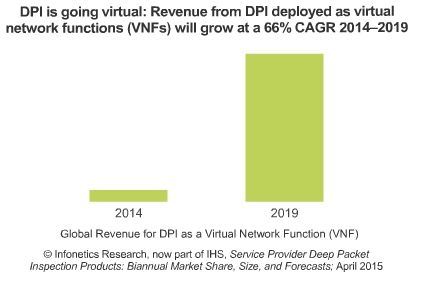
The market for deep packet inspection (DPI) solutions deployed as a virtual network function (VNF) will grow at a 66 percent compound annual growth rate from 2014 to 2019, according to a new report from Infonetics.

SERVICE PROVIDER DPI MARKET HIGHLIGHTS

  • The FCC has released its net neutrality rules in the US, but the issue is far from resolved and court challenges are underway; regulations in Western Europe are under reevaluation as well and the topic is rearing its head in emerging markets
  • The focus of the deep packet inspection market is shifting toward use cases such as video optimization, granular charging, network security and content connectivity
  • In machine-to-machine (M2M) applications, DPI technology is being used to enable better identification of traffic generated by connected devices and mitigate its impact on the network
  • Sandvine and Allot are neck-and-neck in the race for the DPI market share lead, followed by Cisco and Procera.

“As operators evaluate likely targets for virtualization as part of a larger network functions virtualization strategy, DPI is a clear target, though ongoing concerns around performance and capacity will constrain the market for virtualized DPI in the short term,” said Shira Levine, research director for service enablement and subscriber intelligence at Infonetics Research, now part of IHS.

http://www.infonetics.com/pr/2015/2H14-Service-Provider-DPI-Market-Highlights.asp

AT&T Expands Footprint of Business Fiber Internet Service

AT&T is now offering its Business Fiber Internet service in more than 180 U.S. cities at speeds of up to 300 Mbps, with plans to offer symmetrical 1 Gbps service soon.  The service is not available in all commercial buildings.

“Business owners constantly tell us that they need blazing fast Internet speeds to stay ahead," said Tom Hughes, vice president, AT&T Small Business. "AT&T Business Fiber in more than 180 cities helps give companies just that. The ability to upload and download at the same high speed allows companies to work faster with customers, partners and suppliers."

http://about.att.com/story/att_expands_high_speed_internet_service_for_businesses.html

AWS Adds SAP Business One, Version for SAP HANA

Amazon Web Services has added a Quick Start reference deployment for the new SAP Business One, Version for SAP HANA in-memory database.

The deployment builds on the existing SAP HANA on AWS Quick Start, which makes use of Amazon Elastic Compute Cloud (EC2) and Amazon Virtual Private Cloud.  The solution is launched via a AWS CloudFormation template.

https://aws.amazon.com/blogs/aws/
http://www.sap.com/solution/sme/software/erp/small-business-management/overview/industries.html

Thursday, April 30, 2015

Cisco Integrates ACI with FirePOWER Intrusion Prevention

Cisco is integrating its FirePOWER Next Generation Intrusion Prevention System (NGIPS) into its Application Centric Infrastructure (ACI) architecture.

The integrated ACI + firePOWER security solution, which will be available in June 2015, offers automated threat protection to combat emerging data center security threats. The idea is fine-grained control (including application level security), visibility and centralized automation all the way from infrastructure to the application level.

Cisco ACI also third-party ecosystem solutions from Check Point Software Technologies, Fortinet, Infoblox, Intel Security, Radware, and Symantec.

Cisco said ACI integration with FirePOWER NGIPS (including Advanced Malware Protection) provides security before, during and after an attack, enabling organizations to dynamically detect and block advanced threats with continuous visibility and control across the full attack continuum. These new security capabilities deliver unprecedented control, visibility and centralized security automation in the data center.

Cisco also announced that independent qualified security assessors have validated ACI for deployment in payment card industry (PCI) compliant networks. Managing and simplifying the scope of compliance can help reduce costs for these organizations.

http://newsroom.cisco.com/press-release-content?type=webcontent&articleId=1628097

XO Interconnects with Microsoft Azure through Equinix Cloud Exchange

XO Communications (XO) introduced direct links to Microsoft Azure through the Equinix Cloud Exchange.

XO now offers its customers dedicated connections to Azure at bandwidths of 200 Mbps, 500 Mbps and 1 Gbps in Equinix International Business Exchange (IBX) data centers in the Washington, D.C., area and Silicon Valley. Enterprises choosing 1 Gbps connectivity to the Azure platform also have the option of leveraging the XO Bandwidth on Demand service with usage-based billing and bandwidth commit rates ranging from 100-500 Mbps.

“Enterprises need to increase the velocity of their business growth while constraining total IT spending,” said Jake Heinz, senior vice president, marketing and product at XO Communications. “XO enables the evolution of the hybrid IT function whereby the IT organization becomes a trusted cloud services broker for the entire organization. With dedicated network connections to Azure, IT managers are now able to cost-effectively drive productivity by deploying true hybrid cloud architectures.”

http://www.xo.com

AT&T Completes Acquisition of Nextel Mexico

AT&T completed its previously announced acquisition of Nextel Mexico from NII Holdings for $1.875 billion, less approximately $427 million of net debt and other adjustments. The deal includes spectrum licenses, network assets, retail stores and subscribers in Mexico.

Earlier this year, AT&T acquired Mexican wireless provider Iusacell. AT&T will integrate Iusacell and Nextel into one company focused on bringing more choices, better service and faster mobile Internet speeds to more locations throughout Mexico. AT&T plans to create the first-ever North American Mobile Service area, which will cover more than 400 million consumers and businesses in Mexico and the United States.

Thaddeus Arroyo, Chief Executive Officer for AT&T Mexico, LLC and Iusacell, will lead the combined company.

http://www.att.com

Boingo Signs Sprint for Airport Wi-Fi

Boingo Wireless announced a multi-year Wi-Fi agreement for providing Sprint customers with access to seamless and secure Boingo Wi-Fi networks in 35 major U.S. airports.

Sprint devices within proximity of a Boingo hotspot can automatically connect to the Wi-Fi network seamlessly, providing service at the fastest speeds available, be that cellular from Sprint or Wi-Fi from Boingo. The auto-authenticating Wi-Fi connections are available at no additional charge to all Sprint customers with capable devices, and usage while connected to Wi-Fi does not count towards a customer’s monthly service plan.

“Boingo's relationship with Sprint removes the traditional barriers between Wi-Fi and cellular service,” said David Hagan, Chief Executive Officer for Boingo Wireless. “Sprint is a market leader with the integration of Wi-Fi and cellular, which is a very customer centric solution to provide an always-best-connected experience through either network.”

http://www.sprint.com
http://www.boingo.com

Amdocs to Acquire Comverse's BSS Unit for $272 Million

Amdocs agreed to acquire a substantial majority of Comverse's business support systems (BSS) business unit assets for approximately $272 million in cash.

Amdocs said it will maintain and support Comverse customers around the world. The acquisition geographically complements Amdocs' market focus by expanding and diversifying Amdocs' global customer base, particularly in Asia Pacific, Latin America and Europe, and including Europe's cable and satellite market.

"Amdocs is a leader in customer experience solutions for the communications industry. With Amdocs' broad range of products and services, this agreement will only serve to benefit existing Comverse BSS customers," said Philippe Tartavull, president and chief executive officer, Comverse. "Customers should feel assured by Amdocs' experience with smoothly integrating acquisitions and their commitment to maintaining and growing relationships."

Comverse will continue to exist as a separate company, with a singular focus on expanding its global market leadership in digital services.

“Size and scale in BSS are critical to succeed in today’s increasingly consolidating telecommunications service provider marketplace, while smaller, niche players face a more uncertain future,” said Philippe Tartavull, President and Chief Executive Officer, Comverse. “The combination of Comverse’s customer base with Amdocs’ BSS products and services creates new opportunities for our clients and Comverse employees joining Amdocs. Now, Comverse can focus exclusively on expanding our existing significant global market leadership in the Digital Services arena, and driving innovation in new segments of the IP communication industry that are expected to grow significantly as CSPs and enterprises take advantage of the rollout of 4G/Volte/LTE services.”

http://www.comverse.com/
http://www.amdocs.com

Midcontinent Deploys Infinera DTN-X

Midcontinent Communications has deployed the Infinera DTN-X packet optical transport networking platform in its Upper Midwest service area of the United States to deliver cable television, high-speed Internet and telecom services to its customers.

Midcontinent is one of the nation's largest independent telecommunications companies, with more than 300,000 residential and business customers in Minnesota, North Dakota, South Dakota and Wisconsin. Midcontinent operates one of the largest and most resilient optical networks in the region, a 7,800 fiber-mile network delivering services to urban and rural areas.

"We are pleased that Midcontinent is extending the benefits of the Infinera Intelligent Transport Network as the company expands," said Gaylord Hart, director of marketing, MSO market at Infinera. "The DTN-X platform offers cable operators the benefits of scalability, ease of use and superb reliability."

http://www.infinera.com/j7/servlet/NewsItem?newsItemID=456

Wednesday, April 29, 2015

IEEE 802.3 Amends Ethernet Standard for 4 x 25Gbps Lanes

IEEE announced the availability of 802.3bm, IEEE Standard for Ethernet Amendment: Physical Layer Specifications and Management Parameters for 40 Gbps and 100 Gbps Operation Over Fiber Optic Cables.

The amendment reduces “lane count” for 100 Gbps applications (from 10 lanes at 10 Gbps each to four lanes at 25 Gbps each),  expands the reach for 40 Gbps services to 40 kilometers and expands Energy Efficient Ethernet capability to include optical links.

IEEE said these modifications to the 802.3 standard for Ethernet are driven by a number of advances in optical networking, enabling migration to higher-density applications, reducing cost and power demand of 100 Gbps devices and simplified metropolitan services.

“Significantly higher Ethernet performance, capacity and reach in optical networking are needed especially inside and among data centers across metropolitan areas, given the ongoing proliferation of smartphones, video-on-demand, cloud computing and other bandwidth-intensive applications such as the Internet of Things,” said Dan Dove, chair of the IEEE P802.3bm Task Force and chief consultant with Dove Networking Solutions. “The project to develop IEEE 802.3bm addressed these market needs through a globally open, collaborative effort that drew contributions from a broad spectrum of engineers and end users across the Ethernet ecosystem.”

“The rapid growth of Internet traffic is driving the need for higher data rates, higher density and lower-cost fiber optic solutions for the data center,” said David Law, chair of the IEEE 802.3 Ethernet Working Group and distinguished engineer with HP Networking. “IEEE 802.3bm demonstrates how IEEE 802.3 is taking a forward-thinking approach to stay ahead of global demands on Ethernet networking, which paves the way for innovation in devices and services.”

http://www.ieee.org/

Video Set: More Changes coming to Ethernet Standards

In this set of four videos, John D'Ambrosia, Chairman of the Ethernet Alliance, discusses how new applications for Ethernet, including Internet of Things (IoT) and automotive Ethernet, are driving the need for more Ethernet speed standards.

Fundamental changes in Ethernet architecture, including the adoption of 25G and 50G signalling at the chip level, suggest that future Ethernet standards will not simply follow the 10X leaps we've seen in the past.

Filmed at the Ethernet Technology Summit in Santa Clara, California.

1. Ethernet Standardizes Lower Speeds - https://youtu.be/J0WnAfX7Hoc
2. Ethernet at 2.5 and 5 Gbps Rates - https://youtu.be/lc5TRUcciF8
3. 400 GbE Ethernet Architecture - https://youtu.be/GxPnYneDdn0
4. Ethernet Rate Roadmap - https://youtu.be/U_-n8FhV_Zs


HP Unveils Campus Switching Modules Optimized for SDN

HP unveiled new campus networking solutions and services including new switching modules powered by the 6th generation HP Networking ASIC, purpose built for SDN.

HP says its new chip delivers more than four times the performance of competitive solutions and three times lower latency.Its two terabits per second backplane supports increased bandwidth and performance requirements including high speed wireless connectivity.

The HP 5400R zl2 Switch Series v3 Modules fully support OpenFlow and can process up to 24 times more flows than it main competitor.The modules also offer programmable OpenFlow processing pipelines and ten parallel Advanced Packet Processor engines with dedicated resources provide scalability and flexibility to support the new wave of SDN applications.

Other key features of the 5400R v3 modules include HP Smart Rate multi-gigabit ports for supporting the next wave of high-speed 802.11 ac Wave 2 access points. The HP Smart Rate technology offers simple self-negotiating and flexible capacity from 1GbE, 2.5 GbE, 5 GbE to 10GbE with Power over Ethernet +.

In addition, HP is introducing a Network Visualizer SDN application that provides IT administrators with real-time detailed visibility of the network to monitor traffic flow and investigate issues. Administrators can identify user complaints without having to identify physical location or IP address, by centering visibility on the user experience rather than the physical network. The increased visibility afforded by SDN technology allows for rapid diagnosis and repair of network issues, without requiring additional costly overlay appliances or probes.

HP also announced enhancements to its HP Network Optimizer SDN application, which offers automated provisioning of network policy and Quality of Service  to ensure an enhanced user experience. The app now offers media path optimization as well as dynamic traffic periodization based on user or device. Other business applications will also be able to take full advantage of HP Network Optimizer through open API integration.

http://www.hp.com

IBM Announces Two Breakthroughs for Quantum Computing

Researchers at IBM have demonstrated for the first time the ability to detect and measure the two types of quantum errors (bit-flip and phase-flip) that will occur in any real quantum computer. The researchers have also shown a new, square quantum bit circuit design that could scale to larger dimensions.

“Quantum computing could be potentially transformative, enabling us to solve problems that are impossible or impractical to solve today," said Arvind Krishna, senior vice president and director of IBM Research. “While quantum computers have traditionally been explored for cryptography, one area we find very compelling is the potential for practical quantum systems to solve problems in physics and quantum chemistry that are unsolvable today. This could have enormous potential in materials or drug design, opening up a new realm of applications.”

The research is published in the April 29 issue of the journal Nature Communications (DOI: 10.1038/ncomms7979).

http://www-03.ibm.com/press/us/en/pressrelease/46725.wss

Telefónica Selects NetCracker for BSS in 7 Countries

Telefónica has selected NetCracker to transform its BSS platforms for wireless and fixed services in seven Latin American countries. This large-scale, multi-phase BSS and customer experience transformation program encompasses replacing existing billing systems and implementing new product catalog, ordering and omni-channel CRM platforms. The NetCracker BSS solution will support all customers and service offerings for seven LATAM operators. Financial terms were not disclosed.

“NetCracker’s pre-integrated BSS suite will enable our organization to improve customer experience and reduce time-to-market,” said Phil Jordan, Group CIO at Telefónica. “NetCracker’s implementation methodology will also help us standardize our systems and processes across multiple operators.”

“We look forward to delivering this large BSS transformation program for Telefónica, helping the service provider streamline operations and reduce complexity without impairing customer experience,” said Bob Titus, Vice President of Global Solutions at NetCracker. “This is another example of how our industry-leading technology enables service providers to be more nimble, competitive and customer-focused.”

NetCracker Technology is a subsidiary of NEC Corporation.

http://www.NetCracker.com

Broadcom Intros 5G WiFi Wave 2 Silicon

Broadcom introduced a new family of 5G WiFi Wave 2 solutions for enterprise wireless access points (APs).

Broadcom's expanded portfolio includes the BCM43465 (4x4 11ac MU-MIMO) and BCM43525 (3x3 11ac MU-MIMO) for high-performance access points. Sampling is underway.

The BCM43465 chip supports 2.2Gbps and four concurrent MU-MIMO (multi-user, multiple input, multiple output) devices. MU-MIMO combined with 160MHz enables devices to fully utilize available bandwidth to deliver more than 2x the performance.

The new chips are further enhanced by NitroQAM technology, Broadcom's 1024-QAM modulation scheme, which gives up to a 25 percent throughput boost over 802.11ac's 256-QAM. In addition, by using a powerful Digital Signal Processing (DSP) based architecture, Broadcom's silicon can perform advanced spectrum capture, analysis and classification right on the chip without impacting performance. Broadcom's Advanced Spectrum Capture Engine (AsCE) allows the chip to identify non-Wi-Fi interference and adjust accordingly, delivering improved reliability and quality.

"We're leaving no stone unturned in our mission to drive the transition to 802.11ac across all segments and markets," said Ed Redmond, Broadcom Vice President & General Manager, Compute and Connectivity. "We intend to continue doing so by offering differentiated, comprehensive solutions that assure our OEMs have future-proof solutions that provide end users the quality, reliability and capacity they increasingly demand across high-density applications."

http://www.broadcom.com

SanDisk's New Fusion ioMemory PCIe Bring 61% Price Cut

SanDisk unveiled a new generation of its Fusion ioMemory PCIe application accelerators — comprised of SanDisk NAND flash, and Virtual Storage Layer (VSL) data access acceleration software that bring up to a 4x price performance improvement, with up to a 61 percent list price reduction over the previous generation Fusion ioDrive product.

The Fusion ioMemory portfolio offers an array of form factors ranging from PCIe cards to mezzanine storage for HP and Cisco blade servers. Each card is optimized for mixed-use or read-intensive workloads and can also be paired with SanDisk’s recently announced next generation FlashSoft caching software, which reduces I/O latency in VMware vSphere, Windows Server and Linux environments, helping customers further accelerate enterprise applications.

“Fusion-io’s technology fundamentally transformed expectations about data center performance when it debuted eight years ago and it remains the standard by which all other PCIe products are judged,” said John Scaramuzzo, senior vice president and general manager, Enterprise Storage Solutions, SanDisk. “Combining the power of Fusion ioMemory technology with SanDisk’s vertically integrated NAND flash, our engineering talent and portfolio of SATA and SAS SSDs, provides customers with an unparalleled combination of flexibility, performance, scalability, quality and value to help solve their data center challenges.”

http://www.sandisk.com