Showing posts with label IEEE. Show all posts

Tuesday, July 13, 2021

IEEE adopts MIPI A-PHY spec for automotive networks

The MIPI A-PHY v1.0 specification, which is the first asymmetric, long-reach, serializer-deserializer (SerDes) physical layer interface for automotive applications has been adopted as an IEEE standard. 

The MIPI Alliance said applications for MIPI-APHY are expected to include bridges for advanced driver assistance systems (ADAS), autonomous driving systems (ADS) and in-vehicle infotainment (IVI). With a reach of up to 15 meters, MIPI A-PHY (and now also IEEE 2977) provides an asymmetric data link in point-to-point or daisy-chain topologies, with high-speed unidirectional data, embedded bidirectional control data, ultra-high noise immunity and optional power delivery over a single cable. It also offers an ultra-low packet error rate of 10‑19 for unprecedented performance over the vehicle lifetime, ultra-high immunity to electromagnetic interference (EMI) effects in demanding automotive conditions and data rate as high as 16 Gbps, with a roadmap to 48 Gbps and beyond. A-PHY also serves as the foundation of the MIPI Automotive SerDes Solutions (MASS) framework, which simplifies the integration of cameras, sensors and displays across a vehicle while adding functional safety and security. 

“This is the first time MIPI has sought adoption by another standards body for one of our specifications," said Joel Huloux, chairman of MIPI Alliance. "With the approval of IEEE 2977, MIPI A-PHY becomes accessible to a broader network of system engineers beyond the MIPI membership. This promises a tremendous expansion of the ecosystem of expertise around A-PHY, which will translate into greater interoperability, vendor choice and economies of scale for the global automotive industry, as well as users of the specification from other application spaces such as the IoT (Internet of Things) and industrial.” 

http://www.mipi.org

Thursday, December 3, 2020

IEEE forms 802.3 Beyond 400Gb/s Ethernet Study Group


IEEE has formed a study group within the IEEE 802.3 Ethernet Working Group with an aim to standardize capabilities exceeding today’s maximum data rate of 400 Gbps.

The first meeting of the newly launched IEEE 802.3 Beyond 400 Gb/s Ethernet Study Group is scheduled for the IEEE 802.3 Ethernet Working Group’s interim session the week of 18 January 2021.

“The path to beyond 400 Gb/s Ethernet exists, but there are a host of options and physical challenges that will need to be considered to take the next leap in speed rate for Ethernet,” said John D’Ambrosia, Distinguished Engineer, Futurewei Technologies, who led the call for interest in forming the IEEE 802.3 Beyond 400 Gb/s Ethernet Study Group. “Both the historical trend lines for Ethernet bandwidth demand and everything the industry understands today about its future needs and technology growth curves indicate that the time to take the next step is now, in order to satisfy humanity’s needs and desires for connectivity. It will be the responsibility of the study group to examine the problem and develop the project authorization documentation necessary to launch a new standard-development project.”


Tuesday, December 17, 2019

IEEE P802.11ax meets 5G Indoor Hotspot requirements

The IEEE P802.11ax draft standard meets or exceeds requirements specified by the International Telecommunications Union for the 5G Indoor Hotspot and Dense Urban test environments of the enhanced Mobile Broadband (eMBB) usage scenario.

IEEE said this establishes P802.11ax as a foundation for an advanced Wi-Fi technology capable of supporting 5G network performance.

“Achieving 5G performance at the cost points associated with Wi-Fi supports the continued advancement of wireless technology, as well as the exponential growth of mobile wireless device utilization,” said Dorothy Stanley, IEEE 802.11 Working Group chair. “The successful evaluation of IEEE P802.11ax meets the ever-increasing needs of wireless communication, providing higher data rates, increased reliability, and lower latency to better serve the entire industry.”

The methodology specified in the IMT-2020 requirements provides network descriptions, channel models, traffic patterns and other parameters necessary to benchmark performance. The benchmark for compliance to the IMT-2020 requirements for the specific scenario and environments consists of:

  • Minimum acceptable downlink/uplink peak performance,
  • Average user experience,
  • Cell-edge user experience,
  • Mobility performance and latency performance.
  • IEEE P802.11ax was shown to satisfy all the Medium Access Control and Physical Layer (MAC/PHY) requirements for Indoor Hotspot and Dense Urban test environments of the eMBB usage scenario.

Sunday, June 2, 2019

IEEE lifts peer review restrictions on Huawei

Upon further consideration, IEEE updated its policy regarding export control restrictions against Huawei and its affiliates.

IEEE said employees of Huawei and its affiliates may participate as peer reviewers and editors in the publication process.  All IEEE members, regardless of employer, can continue to participate in all of the activities of the IEEE.

"IEEE recognizes that science and technology are a global activity. We are proud of the work our members do around the world and we are dedicated to advancing technological excellence for the benefit of humanity."

https://www.ieee.org/about/news/2019/statement-update-ieee-lifts-restrictions-on-editorial-and-peer-review-activities.html

Tuesday, April 23, 2019

IEEE publishes three amendments to 802.3

Three standard amendments to IEEE 802.3 have been released:


  • IEEE 802.3cb-2018—IEEE Standard for Ethernet—Amendment 1: Physical Layer Specifications and Management Parameters for 2.5 Gb/s and 5 Gb/s Operation over Backplane.
  • IEEE 802.3bt-2018—IEEE Standard for Ethernet Amendment 2: Physical Layer and Management Parameters for Power over Ethernet over 4 pairs.
  • IEEE 802.3cd-2018—IEEE Standard for Ethernet—Amendment 3: Media Access Control Parameters for 50 Gb/s and Physical Layers and Management Parameters for 50 Gb/s, 100 Gb/s, and 200 Gb/s Operation.

“The IEEE 802.3 Ethernet Working Group continues to deliver on its commitment to ongoing standard improvements that deliver real world operational scenarios and meet challenges faced by data network operators worldwide,” said David Law, chair, IEEE 802.3 Working Group. “These refinements are essential to maintain Ethernet as the core technology driving advancements at data centers and throughout network infrastructures everywhere, as well as utilizing Ethernet to power the wide variety of sensors, actuators, cameras and other devices associated with the Internet of Things.”

“The foresight, ingenuity and productivity of the thousands of volunteers developing the IEEE 802 family of standards since 1980 is truly remarkable, as evidenced by the worldwide impact their constantly evolving standards have had in response to ever-changing markets,” said Paul Nikolich, chair, IEEE 802 LAN/MAN Standards Committee.

https://standards.ieee.org/

Thursday, November 29, 2018

IEEE releases 802.1CM-2018 spec for Fronthaul

IEEE published a new 802.1CM-2018—IEEE standard that supports fronthaul interfaces such as the recently published eCPRI specification to provide Ethernet-based fronthaul.

IEEE 802.1CM Standard for Local and metropolitan area networks—Time-Sensitive Networking for Fronthaul was developed in collaboration with the CPRI Cooperation that contributed the requirements of a fronthaul transport network. IEEE 802.1CM describes how these requirements can be met by a fronthaul bridged network including synchronization solutions developed by Study Group 15 of ITU’s Telecommunication Standardization Sector (ITU-T), whose input also contributed to the development of IEEE 802.1CM.

“As we see carriers and operators pursuing 5G technologies, and a wide range of new possibilities for next-generation mobile applications, IEEE 802.1CM represents a key pioneering step for providing reliable packet transport within 5G networks,” said Glenn Parsons, chair, IEEE 802.1 Working Group. “The standard’s development, in cooperation with multiple standards organizations, demonstrates how IEEE-SA is committed to work collaboratively and respond quickly to industry demand—in this case for packet-based fronthaul.”

https://standards.ieee.org/news/2018/ieee-publishes-802_1cm-2018.html

Wednesday, November 28, 2018

IEEE releases 802.19.1 spec for Network-Based Coexistence Methods

IEEE published a new 802.19.1 standard that specifies radio technology independent methods for network-based coexistence among dissimilar or independently operated networks. The standard is defined for geolocation-capable devices operating under general authorization such as TV band White Spaces (TVWS), 5 GHz license-exempt bands, and 3.5 GHz Citizens Broadband Radio Service lightly licensed bands.

The standard introduces the following:

  • Methods for leveraging the cognitive radio capabilities of license-exempt devices, including geolocation awareness and information database access;
  • Coexistence discovery and information server for gathering and providing wireless networks coexistence information;
  • Coexistence manager utilizing information from the coexistence discovery and information server, thereby enhancing the coexistence of the wireless networks;
  • Coordination enabler, which communicates with the coexistence manager within the same coexistence system and with the coordination enabler within the other coexistence system; and
  • Common coexistence architecture and protocols, as well as multiple profiles enabling cost-efficient and flexible deployment of the coexistence system in various scenarios.


https://standards.ieee.org/standard/802_19_1-2018.html

Tuesday, October 9, 2018

IEEE forms 802.11 Extremely High Throughput Study Group

The IEEE has established an 802.11 Extremely High Throughput Study Group to initiate discussion on new IEEE 802.11 features for bands between 1 and 7.125 GHz. The group is identifying requirements for a possible amendment to IEEE 802.11 that would increase peak throughput to support demanding applications such as video over wireless local area networks (WLANs), augmented reality (AR) and virtual reality (VR).

“We are seeking stakeholders throughout the IEEE 802.11 ecosystem to share their experiences with the standard and needs for features such as more spatial streams, higher bandwidth, multi-AP (access point) techniques and multiband switching, aggregation and operation,” said Michael Montemurro, chair of the IEEE 802.11 Extremely High Throughput Study Group. “We envision a rapidly paced effort over the next six to nine months, which we hope will bring into clear definition the most important requirements to be addressed in accelerated development of a possible future amendment to the IEEE 802.11 base standard.”

The IEEE 802.11 Real Time Applications Topic Interest Group is quantifying performance lags and stability issues that have been observed with real-time applications such as mobile and multiplayer games, robotics and industrial automation, as well as the range of mechanisms in the industry to address those issues. The group is working to document usage models and requirements metrics for real-time applications.

“Immersive gaming, for example, is very latency sensitive and requires a quick turnaround on packets for users to enjoy a high-quality experience. Jitter, packet loss and what’s going on throughout the network can have a large impact on these real-time applications, which may have only moderate bandwidth requirements but have very low tolerance for latency,” said Allan Jones, chair of the IEEE 802.11 Real Time Applications Topic Interest Group. “What we’re trying to do in our group is define more specifically what these requirements are for this particular category of applications, toward the goal of informing ongoing IEEE 802.11 innovation.”

Monday, October 1, 2018

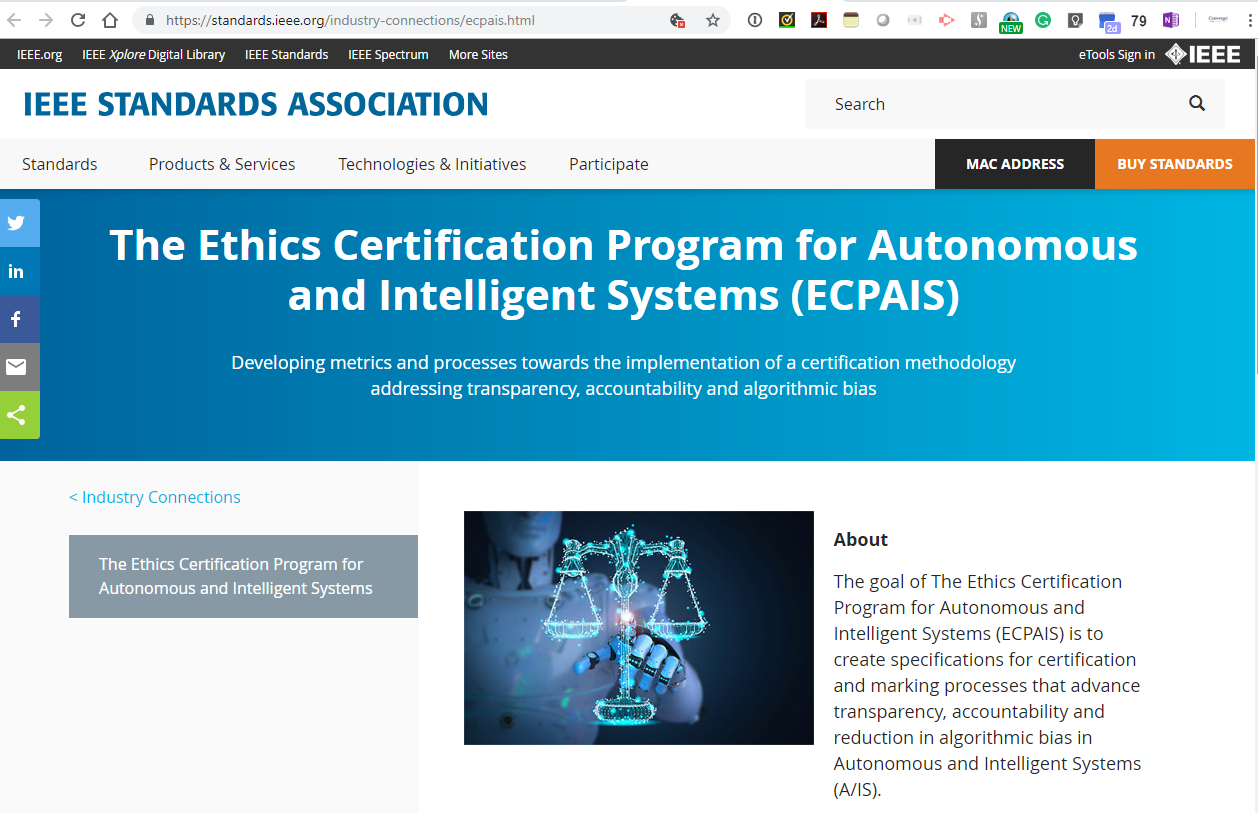
IEEE launches Ethics Certification Program for AI

IEEE and the IEEE Standards Association (IEEE-SA) are launching an the Ethics Certification Program for Autonomous and Intelligent Systems (ECPAIS).

The idea is to offer a process and define a series of marks by which organizations can seek certified A/IS products, systems and services.

“It becomes more and more evident that consumers and citizens of the world are expecting technology to conform with ethical principles beyond functionality,” said Konstantinos Karachalios, managing director of IEEE-SA. “IEEE is one of the first global organizations to recognize the importance of certified accountability, transparency and reduction of algorithmic bias as being a critical enabler for A/IS value realization. This is also why the formation of ECPAIS complements the series of our IEEE P7000™ standard projects, along with all our A/IS Ethics work.”

“Today’s technology ecosystem calls for solutions that secure fair and transparent A/IS development, and Finland is at the forefront of key global efforts to move ethical A/IS from principles to pragmatism through close public-private partnership,” noted Meeri Haataja, chair of Ethics Working Group in Finland’s AI Program, and chair of ECPAIS. “Moving forward, A/IS need certifiable processes supported by a trusted organization that establishes easily identifiable marks, in order to signal high levels of reliability and safety to the general public. As chair of this groundbreaking IEEE program, I am honored to more broadly share and further incentivize Finland’s, and Europe’s, forward-thinking push to secure certifiably ethical A/IS.”

Wednesday, September 19, 2018

IEEE 802.11aq enables wireless service delivery

The IEEE Standards Association (IEEE-SA) approved and published IEEE 802.11aq, an amendment to IEEE 802.11™, that addresses discovery of available services in Wireless Local Area Networks (WLANs).

The IEEE 802.11aq amendment specifies parameters for pre-association queries between wireless networks and devices. By facilitating a rich exchange of information between the wireless access point and the user’s device, users can swiftly and effortlessly discover what types of services are supported before making the decision to connect. Simplifying the service discovery process streamlines the network selection process, thereby elevating the end user experience.

IEEE said storing and caching available services with access points permits operators to differentiate their service offerings from those of market competitors in the same locality, opening the door to potential revenue generation opportunities.

“Connecting to a WLAN without first being able to easily discover whether a given service is supported by that network is often a source of frustration for end users. The IEEE 802.11aq amendment mitigates these situations by permitting users to quickly determine what services are available prior to actually connecting their devices,” said Stephen McCann, chair IEEE 802.11aq task group. “IEEE 802.11aq also delivers a critical competitive advantage through service differentiation in crowded market environments.”

Thursday, July 26, 2018

Standards organizations to address Ethics in Autonomous and Intelligent Systems

A new Open Community for Ethics in Autonomous and Intelligent Systems (OCEANIS) has been formed to focus on standards as a means to address ethical matters in autonomous and intelligent systems.

IEEE and the IEEE Standards Association (IEEE-SA) are founding members.

In addition to IEEE-SA, Founding Members include:

  • Austrian Electrotechnical Association (OVE)
  • Austrian Standards International (A.S.I.)
  • British Standards Institution (BSI)
  • China Electronic Standardizations Institute (CESI)
  • International Electrotechnical Commission (IEC)
  • Ecuadorian Service for Standardization (INEN)
  • National Standards Authority of Ireland (NSAI)
  • Turkish Standards Institute (TSE)
  • Verband und Deutsche Kommission Elektrotechnik Elektronik Informationstechnik (VDE/DKE)

Konstantinos Karachalios, managing director for IEEE-SA, says, “IEEE-SA’s initiative in the establishment of OCEANIS aligns with IEEE’s tagline and with the rationale behind IEEE's Global Initiative on Ethics of Autonomous and Intelligent Systems. We are convinced that the complex ethical issues emerging in the development and deployment of such systems can only be addressed through processes that correspond to the envisioned principles, not through agreements behind closed doors. IEEE has already initiated an entirely new series of standardization projects open to any interested person and carried out through our rules-based and transparent process.”


The IEEE has announced the publication of the new IEEE 802.3bv, Standard for Ethe

Tuesday, June 26, 2018

IEEE adopts OpenFog Reference Architecture

The IEEE Standards Association (IEEE-SA) has adopted The OpenFog Consortium’s OpenFog Reference Architecture for fog computing as an official standard.

The new standard, known as IEEE 1934™, relies on the reference architecture as a universal technical framework that enables the data-intensive requirements of the Internet of Things (IoT), 5G and artificial intelligence (AI) applications.

“We now have an industry-backed and -supported blueprint that will supercharge the development of new applications and business models made possible through fog computing,” said Helder Antunes, chairman of the OpenFog Consortium and senior director, Cisco. “This is a significant milestone for OpenFog and a monumental inflection point for those companies and industries that will benefit from the ensuing innovation and market growth made possible by the standard.”

The OpenFog Consortium, which was founded more than two years ago, describes fog computing as a system-level horizontal architecture that distributes resources and services of computing, storage, control and networking anywhere along the cloud-to-things continuum. It supports multiple industry verticals and application domains, enables services and applications to be distributed closer to the data-producing sources, and extends from the things, over the network edges, through the cloud and across multiple protocol layers.

“The reference architecture provided a solid, high-level foundation for the development of fog computing standards,” said John Zao, Chair, IEEE Standards Working Group on Fog Computing & Networking Architecture Framework, which was sponsored by the IEEE Communications Society's Edge, Fog, and Cloud Communications Standards Committee. “The OpenFog technical committee and the IEEE standards committee worked closely during this process and benefited from the collaboration and synergies that developed. We’re very pleased with the results of this standards effort.”

OpenFog Consortium Releases its Reference Architecture

The OpenFog Consortium, whose founding members include ARM, Cisco, Dell, Intel, Microsoft, and Princeton University, published its OpenFog Reference Architecture, a universal technical framework designed to enable the data-intensive requirements of the Internet of Things (IoT), 5G and artificial intelligence (AI) applications.

Fog computing is the system-level architecture that brings computing, storage, control, and networking functions closer to the data-producing sources along the cloud-to-thing continuum. The new reference architecture aims to enable high-performance, interoperability and security in complex digital transactions.

In brief, the OpenFog Reference Architecture contains a medium- to high-level view of system architectures for fog nodes (smart, connected devices) and networks, deployment and hierarchy models, and use cases. It is based on eight core technical principles, termed pillars, which represent the key attributes that a system needs to encompass to be defined as "OpenFog." These pillars include security, scalability, openness, autonomy, RAS (reliability, availability, and serviceability), agility, hierarchy and programmability.

Thursday, March 22, 2018

IEEE Publishes IEEE 802.3cc-2017 25 Gb/s Ethernet Standard

IEEE announced the publishing and availability of its 802.3cc-2017—Standard for Ethernet Amendment: Physical Layer and Management Parameters for Serial 25 Gb/s Ethernet Operation Over Single-Mode Fiber.

The new amendment to IEEE 802.3 addresses the growing need for increased Ethernet speeds for enterprise, campus and metro Ethernet speeds exceeding 10 Gb/s, and that can support reaches up to 10 and 40 kilometers over single-mode fiber (SMF).

IEEE 802.3cc supports efficient Ethernet operation and defines single-lane 25 Gb/s PHYs for operation over single-mode fiber with lengths up to 10 km and 40 km. IEEE 802.3cc addresses the requirement in metropolitan networks, where the core operates at 100 Gb/s, for tributary feeds at rates higher than 10 Gb/s. By enabling extended 25 Gb/s reaches, IEEE 802.3cc matches the per-lane rate of several 100 Gb/s PMDs currently used in these networks.

“IEEE 802.3cc provides network operators a cost-effective upgrade path to 25 Gb/s that minimizes network design, installation and maintenance costs by preserving current network architecture, management, and software,” said David Lewis, chair, IEEE 802.3cc 25 Gb/s Ethernet over Single-Mode Fiber Task Force. “The work of the IEEE 802.3cc 25 Gb/s Ethernet over Single-Mode Fiber Task Force has demonstrated how responding quickly to industry demand for greater energy-efficient Ethernet capabilities can be achieved in a manner that can reduce both operational costs, and the environmental footprint of network upgrades.”

Thursday, November 30, 2017

New IEEE 802.11 Light Communications Study Group gets underway

A new IEEE 802.11 Light Communications Study Group has been formed to engage with manufacturers, operators and end users to discuss a global wireless local area network light communications standard.

IEEE said solid state lighting, e.g., LED lighting, could leverage available and very large source of wireless spectrum outside of the traditional radio spectrum and that the technology has notable potential as a wireless solution that offers greater bandwidth and efficiency, security, and data density, while not being subjected to or contributing to electromagnetic interference (EMI) below 3 THz.

“In just a few short years, the interest in light communications has grown significantly and there is an enormous amount of valuable knowledge that vendors and operators can share as they work together to advance the technology globally,” said Nikola Serafimovski, chair of the IEEE 802.11 Light Communications Study Group. “It’s an exciting time for the light communications market sector, as it is poised for substantial growth over the next five years. We look forward to broad participation under the auspices of the IEEE 802.11 Wireless LAN Working Group and the IEEE-SA as we work to develop the light communications market in line with industry needs, and to ensure best practices that drive market expansion.”

Sunday, November 12, 2017

TRON Forum transfers IoT OS to IEEE

The TRON Forum, which supports a development project called TRON Project that addresses real-time architecture for embedded systems, will transfer ownership of the TRON µT-Kernel 2.0 to the IEEE Standards Association (IEEE-SA). This effectively transfers a leading real-time operating system (OS) title for 16- and 32-bit microprocessors deployed throughout the IoT ecosystem to IEEE.

The arrangement also provides a license to TRON Forum for use of the intellectual property.

“In our ongoing efforts to foster openness and the broad utilization of globally-recognized technical standards, the IEEE-SA continues to seek collaborative agreements that help advance technology for humanity,” said Konstantinos Karachalios, managing director for the IEEE-SA. “This agreement with the TRON Forum will pave the way for development of new standards in line with the goal of both our organizations to promote open innovation frameworks. We look forward to our continued work and cooperation.”

The TRON Project is a project launched in 1984 by Prof. Ken Sakamura, now dean of the Faculty of Information Networking for Innovation and Design (INIAD) at Toyo University. The Project aims to build an open architecture for embedded systems.

http://www.ieee.org
http://www.tron.org

Wednesday, October 11, 2017

5th Annual IEEE Women in Engineering conference set for 21-22 May 2018

The fifth annual IEEE Women in Engineering International Leadership Conference (IEEE WIE ILC) has been scheduled for 21-22 May 2018 at the San Jose Convention Center.

The conference will welcome speakers from around the world to share their experience and skills to inspire women to Lead Beyond through tracks focused on skills necessary for advancement in Innovation, Inspiration and Executive Leadership. Designed to advance women working in STEM disciplines, WIE ILC brings together over 1,500 professional women for two full days of education, networking, innovation, knowledge sharing, interactive sessions, discussion and much more. In addition, WIE ILC will host the #WIEWednesday virtual track series consisting of online presentations focused on Innovation, Inspiration and Executive Leadership that will run from February through May 2018, leading up to the conference.

“The IEEE Women in Engineering International Leadership Conference has been enthusiastically embraced by the global women in STEM community. Now entering its fifth year, we’re excited to gather some of the world’s most powerful and inspiring thought leaders together once again to share new concepts for driving women’s advancement in business and technology,” said Nita Patel, chair, IEEE WIE ILC. “Over half of our attendees have ten or more years of experience and offer a wealth of knowledge in their respective fields. We invite you to join us at WIE ILC, to engage, exchange and network with fellow professionals. Registration will open in November.”

Individuals and groups interested in speaking at WIE ILC, whether in person or during the virtual track series, are invited to submit presentation proposals with a theme of Lead Beyond by 20 October 2017.

http://ieee-wie-ilc.org/


Tuesday, October 3, 2017

IEEE publishes 5G and Beyond Technology Roadmap White Paper

IEEE published a white paper summarizing the challenges and opportunities in building and sustaining a 5G and beyond ecosystem.

The whitepaper, which is titled "5G and Beyond Technology Roadmap", describes key technology trends that will impact design drivers and challenges for technologies to provide simultaneous wireless communication, massive connectivity, tactile internet, quality of service and network slicing. Some topics addressed include: applications and services, hardware, MIMO, mm-wave, edge automation platform, security, standardization building blocks and testbed. The white paper is available for download at no cost on the IEEE 5G web portal’s Roadmap page. The IEEE 5G and Beyond Technology Roadmap will be periodically updated with forecasts for three-, five- and 10-year horizons.

“5G consolidates the trend in convergence of technologies and underlying standards with emerging solutions offering exciting possibilities not only to consumers but also to industries,” said Mischa Dohler, co-chair, IEEE 5G and Beyond Technology Roadmap Working Group. “Disruption will happen at many levels, most importantly through changes in the value chain, adoption of flexible systems management and orchestration, as well as emergence of innovative mobile connectivity technologies.”

The white paper can be downloaded here: https://5g.ieee.org/roadmap

Tuesday, September 19, 2017

IEEE 802.3 looks to extend Optical PHYs beyond 10km

A new IEEE 802.3 Beyond 10km Optical PHYs Study Group has been formed under the auspices of the IEEE 802.3 Ethernet Working Group.

The new study group aims to develop a Project Authorization Request (PAR) and Criteria for Standards Development (CSD) responses for optical solutions targeting physical distances beyond 10km for 50 Gb/s, 200 Gb/s, and 400 Gb/s Ethernet.

"The launch of the IEEE 802.3 Beyond 10km Optical PHYs Study Group represents a first step towards standardization that will meet the needs of network providers, such as wireless operators across the globe where bandwidth demands are projected to vary significantly from region to region,” said John D’Ambrosia, chair, IEEE 802.3 Beyond 10km Optical PHYs Study Group, and senior principal engineer, Huawei. “The Ethernet application space being addressed by this new working group will help ensure that a fully comprehensive networked Ethernet ecosystem can meet tomorrow’s demands for the speed and reach needed to support industry growth worldwide."

Wednesday, August 23, 2017

IEEE P7130 to define Quantum Computing nomenclature

A new IEEE P7130—Standard for Quantum Computing Definitions project aims to establish a general nomenclature for Quantum Computing to standardize communication with related hardware and software projects.

Specifically, IEEE P7130 will define terms related to the physics of quantum computing including quantum tunneling, super position, quantum entanglement, as well as other related terms and terminology that will be updated as technological advances are made.

"While Quantum Computing is poised for significant growth and advancement, the emergent industry is currently fragmented and lacks a common communications framework,” said Whurley (William Hurley), chair, IEEE Quantum Computing Working Group. “IEEE P7130 marks an important milestone in the development of Quantum Computing by building consensus on a nomenclature that will bring the benefits of standardization, reduce confusion, and foster a more broadly accepted understanding for all stakeholders involved in advancing technology and solutions in the space.”

"IBM is part of quantum information's history, since its foundation more than 30 years ago. And we've been championing important terms, metrics, and scientific methods ever since," said Jerry Chow, manager, Experimental Quantum Computing, IBM Research and IEEE P7130 working group participant. "This standards project will help anyone from students to seasoned quantum scientists nucleate around a common language, while keeping up with the field's rapid pace of change, and further accelerate pioneering experiments and explorations in quantum computing."

"1QBit works with a variety of classical, quantum and otherwise non-standard processors, which necessitates communication between multiple external teams, across a wide range of industries, discussing many different types of computing systems,” said Andrew Fursman, CEO 1Qbit and IEEE P7130 working group participant. “IEEE P7130 "Standard for Quantum Computing Definitions" provides a valuable service to 1QBit, our partners in quantum computing, and the many industries with which we intersect."

“Confusions exist on what quantum computing or a quantum computer means,” added Professor Hidetoshi Nishimori of the Tokyo Institute of Technology and IEEE P7130 working group participant. “This partly originates in the existence of a few different models of quantum computing. It is urgently necessary to define each key word.”

https://standards.ieee.org/develop/wg/QCWG.html

Thursday, May 25, 2017

Video: IEEE is making big strides in AI, IoT, SmartCities, and much more


IEEE President and CEO, Karen Bartleson, discusses IEEE’s Global Initiative for Ethical Considerations in Artificial Intelligence and Autonomous Systems, IoT, smart cities, and robotics and how IEEE is working to advance technologies for the benefit of humanity.

Video recorded at the IEEE Women in Engineering International Leadership Conference #WIELead

See video: https://youtu.be/FmKTTdQB9rw