Sunday, October 16, 2016

OpenCAPI Looks to Redefine Server Architecture Beyond PCIe

Major industry vendors announced their support for OpenCAPI, a new standard that provides an open, high-speed pathway for different types of technology – advanced memory, accelerators, networking and storage – to more tightly integrate their functions within servers. The idea is to re-architect servers to remove system bottlenecks, putting the compute power closer to the data -- and to do so with an open (non-Intel) design.

Backers of the newly formed OpenCAPI Consortium include AMD, Dell EMC, Google, Hewlett Packard Enterprise, IBM, Mellanox Technologies, Micron, NVIDIA and Xilinx.

OpenCAPI said its high bandwidth, low latency open interface is capable of 25 Gbps, outperforming the current PCIe specification which offers a maximum data transfer rate of 16 Gbps.

Several companies announced plans to introduce and deploy OpenCAPI enabled products, including:

  • IBM plans to introduce POWER9-based servers that leverage the OpenCAPI specification in the second half of 2017. Additionally, IBM will enable members of OpenPOWER Foundation to introduce OpenCAPI enabled products in the second half 2017.
  • Google and Rackspace’s new server under development, codenamed Zaius and announced at the OpenPOWER Summit in San Jose, will leverage POWER9 processor technology and plans to provide the OpenCAPI interface in its design.
  • Mellanox plans to enable the new specification capabilities in its future products.
  • Xilinx plans to support OpenCAPI enabled FPGAs.


The OpenCAPI consortium said it intends to make the OpenCAPI specification fully available to the public at no charge before the end of the year.

IBM first introduced CAPI technology to the industry in 2014 with our POWER8 processor and made it available to our OpenPOWER partners. Since then, the industry has embraced and validated its potential as a game-changing technology for the most important modern workloads including artificial intelligence, advanced data analytics and deep learning,” said Brad McCredie, IBM Fellow and Vice President of POWER Development. “As a result of this initial success, IBM has decided to double down on our commitment to open standards and enablement of industry innovation by opening up access to our CAPI technology to the entire industry. With the support of our OpenCAPI co-founders, we have created a new OpenCAPI specification that tremendously improves performance over our prior specification and IBM will be among the first to implement it with our POWER9 products expected in 2017.”

http://www.opencapi.org

Iron Mountain Signs with Amazon Wind Farm in Texas

Iron Mountain, which provides storage and information management services including colocation in secure data centers, signed a wind power purchase agreement that will leverage renewable energy sources to power as much as 30 percent of its North American electricity footprint. That capacity will be sufficient to power all of its Texas operations (more than 75 facilities) as well as additional states, providing long-term rate stability and with as much as $1.5 million annually in related cost avoidance.

Under the deal, Iron Mountain will purchase 10 percent of the energy produced at the Amazon Wind Farm Texas, a 253-megawatt (MW) 110+ turbine wind farm in Scurry County, Texas, developed by Lincoln Clean Energy, a developer, owner and operator of clean power projects with a particular focus on wind and solar power in the United States. When completed in 2017, Iron Mountain’s share of the wind farm could produce up to 100,000 megawatt hours (MWh) per year – the equivalent of nearly one-third its power consumption for North America.

“Power consumption is an expensive and resource-consuming part of our global operational footprint , and one of the areas we’ve targeted as an opportunity to transform our business,” said Ty Ondatje, senior vice president of Corporate Responsibility and chief diversity officer, Iron Mountain. “Renewable energy strategies, along with energy efficiency, are at the heart of our efforts to deliver both savings back to the company and look for opportunities to innovate. We’ve discovered that it’s also helping us to open meaningful dialogue and collaboration opportunity with our customers who are seeking to understand and mitigate their own environmental impact. We believe that renewable energy strategies can benefit our business, positioning Iron Mountain and our customers to meet the growing expectations for sustainable business practices.”

http://www.ironmountain.com

Amazon Plans 253 Megawatt Wind Farm in Texas

Amazon will commission a new 253-megawatt (MW) wind farm in Scurry County, Texas, that will generate 1,000,000 megawatt hours (MWh) of wind energy annually – enough energy to power almost 90,000 U.S. homes.

Amazon Wind Farm Texas, which is scheduled to open in late 2017, will include more than 100 turbines and be the company’s largest renewable energy project to date. Amazon previously announced wind and solar farms in Indiana, North Carolina, Ohio and Virginia that deliver energy to the electrical grids supplying both current and future Amazon Web Services (AWS) Cloud data centers. The five projects together will generate more than 2.6 million MWh of renewable energy each year.

http://www.amazon.com/sustainability

Aliyun Looks to AMD for Cloud-based GPUs

AMD and Alibaba Cloud (Aliyun) announced a collaboration to strengthen research and cooperation related to the use of AMD Radeon Pro GPU technology in Alibaba Cloud’s global data centers.

“The partnership between AMD and Alibaba Cloud will bring both of our customers more diversified, cloud-based graphic processing solutions. It is our vision to work together with leading technology firms like AMD to empower businesses in every industry with cutting-edge technologies and computing capabilities,” said Simon Hu, president of Alibaba Cloud.

“The collaboration between AMD and Alibaba Cloud leverages the world-class technology and software engineering capabilities of both companies to meet the growing demand for standards-based GPU computing solutions capable of enabling more immersive and intuitive cloud services,” said AMD President and CEO Dr. Lisa Su. “Working closely with industry leaders like Alibaba Cloud helps ensure the investments AMD is making in our high-performance graphics and computing datacenter products continue to align with the needs of the broader cloud market.”

At this week's Computing Conference in Hangzhou, China, AMD is conducting the following demos:


  • An Alibaba Cloud Single Root Input/Output Virtualization (SR-IOV) Solution featuring AMD Radeon Pro server technology. The demo is powered by the Radeon FirePro™ S7150 x2 GPU featuring AMD Multi-user GPU (MxGPU) hardware-based server virtualization technology. The solution features the industry’s only hardware-virtualized GPU technology, which provides guaranteed service levels and improves security for remote workstation, cloud gaming, cloud computing, and Virtual Desktop Infrastructure (VDI) implementations.
  • A virtual reality (VR) experience demo powered by AMD Radeon VR Ready Premium graphics featuring AMD’s powerful, energy efficient Polaris graphics architecture.


http://www.amd.com

NTT Com Offers Multi-Cloud MPLS to Azure, AWS

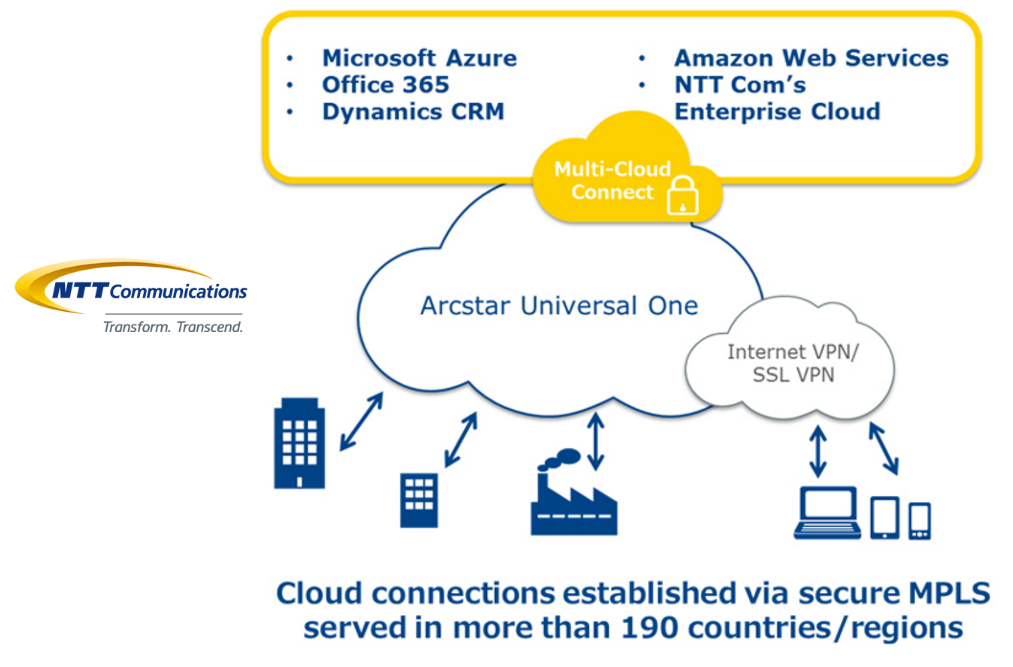
NTT Communications is extending its Multi-Cloud Connect services in the US.

The service initially offers connection to Microsoft Azure and Office 365 on the West Coast and will begin connectivity on the East Coast in October. Connection to NTT Com's Enterprise Cloud in late October and Amazon Web Services (AWS) in November will follow.

Multi-Cloud Connect enables customers of Arcstar Universal One – NTT Com's MPLS network service – to easily build a multi cloud environment. Instead of an internet connection, enterprises can connect to public cloud services as well as NTT Com's private cloud service through a highly secure MPLS VPN. Service expansion in Singapore and other Asian markets are also on the roadmap.

http://www.ntt.com/en/about-us/press-releases/news/article/2016/20161013.html

Rivada Granted Patent for Self-Triangulation Technology

Rivada Networks has been awarded US Patent 14/961,088: “Enhanced Location-Based Services using a single device with pseudo location positioning for improved 3D positioning”, which allows a mobile or iOT device to improve its position by, in effect, triangulating its location on itself.

Rivada said that unlike traditional triangulation, its method is not dependent on other devices. The patent also enables to location software to work on much lower power consumption than alternative LBS technologies, and has the potential to dramatically improve the battery life of mobile devices.

The technology has the potential to significantly change problems with battery drainage,  says:

“Location based technologies at present consume battery power at an alarming rate, which renders their use in a disaster situation difficult. At times like that, when location services are essential, and power hard to come by, a solution which is more accurate and less power-intensive will be vital," stated Rivada Networks Chief Scientist Clint Smith.

“Our patented technology will also improve the accuracy of the service. E-LBS, as patented by Rivada Networks, allows location to be identified precisely in three dimensions. By triangulating off the device’s own previous estimates of its location, we are able to triangulate the precise location of a device in all three dimensions with tremendous accuracy."

https://www.rivada.com/


Arbor Networks Updates DDoS Digital Attack Map with Jigsaw

Arbor Networks announced an enhanced version of the Digital Attack Map, a live data visualization of distributed denial-of-service (DDoS) attacks around the globe.

The Digital Attack Map uses data from Arbor Networks’ Active Threat Level Analysis System (ATLAS), a globally scoped threat monitoring network that currently collects 140Tbps of anonymous traffic data from more than 330 service provider customers. This represents approximately one-third of the world’s global internet traffic.
lability.

Updates include:

  • A change in architecture of the ATLAS system allows the Digital Attack Map to unlock 20X the data of the previous version in terms of the number and scale of the attacks presented.
  • The new system architecture moves all of this data from batch processing to real-time streaming, thereby ensuring that the data is up to date, and as accurate as possible.


Jigsaw, which is an incubator within Alphabet (Google's parent company) focused on addressing online censorship, is using the data for its mission.

“DDoS attacks are growing at an alarming rate in terms of size, frequency and complexity. They are the primary threat to the availability of networks, application and online services. The Digital Attack Map represents a just a slice of the rich data set that we have in ATLAS and it has been brought to visual life by the engineers at Jigsaw, allowing anyone to see DDoS attacks on a global scale or a country by country basis. Jigsaw is doing important work to educate the public about the DDoS threat, and we are gratified that our data is being showcased on the Digital Attack Map,” said Brian McCann, President of Arbor Networks.

http://www.DigitalAttackMap.com

Thursday, October 13, 2016

“VMware Cloud on AWS” Brings New Private/Public Model

Amazon Web Services and VMware announced a strategic alliance to drive hybrid cloud services for enterprise customers.

Under the alliance, "VMware Cloud on AWS" will be the primary public cloud solution delivered, sold, and supported by VMware; AWS will be VMware’s primary public cloud infrastructure partner; and VMware will be AWS’s primary private cloud partner in new strategic alliance. The service, which will be sold by VMware beginning in mid-2017, will run on next-generation, elastic, bare metal AWS infrastructure.

The companies said their jointly engineered "VMware Cloud on AWS" solution will enable customers to run applications across VMware vSphere-based private, public, and hybrid cloud environments. This will allow  VMware customers to use their existing VMware software and tools to leverage AWS’s global footprint and breadth of services, including storage, databases, analytics, etc.

“VMware Cloud on AWS offers our customers the best of both worlds,” said Pat Gelsinger, CEO, VMware. “This new service will make it easier for customers to preserve their investment in existing applications and processes while taking advantage of the global footprint, advanced capabilities, and scale of the AWS public cloud.”

“Our customers continue to ask us to make it easier for them to run their existing data center investments alongside AWS,” said Andy Jassy, CEO, AWS. “Most enterprises are already virtualized using VMware, and now with VMware Cloud on AWS, for the first time, it will be easy for customers to operate a consistent and seamless hybrid IT environment using their existing VMware tools on AWS, and without having to purchase custom hardware, rewrite their applications, or modify their operating model.”

http://phx.corporate-ir.net/phoenix.zhtml?c=176060&p=irol-newsArticle&ID=2211713
http://www.vmware.com/cloud-services/vmware-cloud-aws.html

Docker Signs Aliyun Cloud for Container Service

Aliyun, the cloud computing arm of Alibaba Group, and Docker announced a commercial agreement to provide a Docker image store and distribution for Docker Hub on Alibaba Cloud. In addition, Alibaba Cloud will resell Commercially Supported (CS) Docker Engine and Docker Datacenter, enabling enterprises to manage their production workloads across the entire application lifecycle.

The companies said that because Docker Hub will be hosted locally in mainland China on Aliyun, users will experience faster downloads and UI response rates, enabling them to ship applications more frequently than before. Backed by Docker, Inc., Alibaba Cloud will also provide enterprise support options for CS Docker Engine and Docker Datacenter. Through the partnership, enterprises across China will be able to innovate more rapidly, accelerating time to value when building, shipping and running distributed applications.

“As enterprises in China and throughout the world begin to modernize their application environments, there has been an increasing demand for an easy solution to deploy Docker on Alibaba Cloud,” said Sicheng Yu, Vice President of Alibaba Group and General Manager of Alibaba Cloud Global. “Our partnership with Docker will bring enterprises the full lifecycle management needed to scale existing implementations into production. We look forward to working with Docker to help organizations with their journey as they move their workloads to Alibaba Cloud.”

http://www.docker.com
https://intl.aliyun.com/

Ericsson: 3 Steps on the Road to 5G

The journey to 5G is well underway and progressing in 3 steps, says Erik Ekudden, VP & Head of Group Technology Strategy at Ericsson.

The first step in the implementation of a 5G-ready Core, where SDN and NFV are used for network slicing.  Next is the evolution of wide-area  IoT with LTE Cat-M, NB-IoT, etc.  And the third step is the rollout of 5G wireless access with the extreme capacity for AR/VR, 4k video streams, etc.

See Video: https://youtu.be/HcAnUlBf9vo


Sprint to Launch SD-WAN with Velocloud

Sprint is preparing to launch global SD-WAN services in early 2017 using VeloCloud's platform. The first customer field trials are underway.

“After a thorough vendor evaluation process, Sprint determined that the VeloCloud solution best aligned with Sprint’s focus on network agility, flexibility and cloud services enablement, said Mike Fitz, Vice President of the Sprint Global Wireline Business Unit. “We are excited to work with VeloCloud to support additional customer proof of concepts and build upon our existing relationship.”

Earlier this year Sprint announced the formation of their new Sprint Global Wireline Business Unit. The organization is focused on providing business customers with a top-tier global all-IP global network that reduces customer’s costs while providing a strong, resilient foundation for current and future business communications solutions.

“We are proud to partner with Sprint,” said Sanjay Uppal, Co-founder & Chief Executive Officer of VeloCloud. “Sprint is a leader in providing worldwide voice and data networking solutions.  Sprint’s managed services expertise and commitment to exceptional care, coupled with VeloCloud’s industry leading SD-WAN platform, delivers a powerful and advanced network solution with end-to-end security.

http://www.sprint.com
http://www.velocloud.com

AT&T Builds SD-WAN with VeloCloud


AT&T is rolling out an SD-WAN hybrid solution that combines multiple types of network access using technology from VeloCloud. The network-based solution will be available in 2017. VeloCloud is part of the AT&T Integrated Cloud ecosystem focused on the SD-WAN. In addition to VeloCloud, AT&T said it plans to collaborate with more SD-WAN technology companies as part of its evolving ecosystem to support customers’ needs. “Businesses need...

EarthLink Picks VeloCloud for SD-WAN Services


EarthLink is working with VeloCloud to deliver SD-WAN (software-defined wide area network) services. EarthLink’s full-service SD-WAN offering will launch to market in fall 2016.  This technology enables customers to realize the full potential of the cloud by supporting application growth, network agility and simplified branch implementations while delivering optimized access to cloud services, private datacenters and enterprise applications. “VeloCloud...

Telia Achieves 15 Gbps with Ericsson 5G

In a 5G outdoor trial conducted in Kista, Sweden using 800 MHz of spectrum in the 15 GHz band, Telia and Ericsson achieved peak rates of 15 Gbps per user and a latency below 3 milliseconds.

Ericsson said this marks an important milestone in our companies’ joint roadmap for 5G in Sweden and Estonia announced in January, with the goal to let Telia customers in Stockholm and Tallinn experience 5G services already in 2018.

Mats Svärdh, Head of Networks & IT Infrastructure, Global Services & Operations, Telia Company says: “This is a great achievement and stepping stone towards taking 5G to our customers in Sweden and Estonia 2018. The standardization and development of 5G has just started. Our knowledge and learnings from testing in a real outdoor environment will be crucial to understand and develop the 5G technology and networks needed to meet our customers’ future requirements on our services in a digitalized society.”

http://www.ericsson.com

Hawaiki Transpacific Cable Project is On Track

Pre-deployment work on Hawaiki, the 14,000 km transpacific cable system scheduled for completion in mid-2018, is on track. Hawaiki will link Australia and New Zealand to the mainland United States, as well as Hawaii, with options to expand to several South Pacific islands.

Hawaiki Submarine Cable LP and TE SubCom announced that system manufacturing has commenced. Some updates:

  • More than 1,000 kilometers of lightweight cable has been manufactured to date for Hawaiki at TE SubCom’s facility in Newington, N.H., USA.
  • Manufacturing of Hawaiki repeaters is underway.
  • Detailed landing surveys have been completed for sites in Pacific City, Oregon and Kapolei, Hawaii.
  • Completion of deep sea survey from Oregon to Hawaii.
  • Survey has covered all of U.S. Exclusive Economic Zone (EEZ), with the completion of the branch to American Samoa
  • In September 2016, Hawaiki Submarine Cable LP officially submitted for a submarine cable landing license from the U.S. Federal Communications Commission (FCC).
  • Demonstrating its commitment to the connectivity of Pacific Islands, Hawaiki has added three additional branching units to enable the future connection of New Caledonia, Fiji and Tonga. 

http://www.hawaikicable.co.nz
http://www.te.com

Aerohive Trims Guidance

Citing slower E-Rate funding approvals, Aerohive Networks trimmed its financial guidance, saying it now expects revenue for the third fiscal quarter to be $40 million, which is below the company's previously stated guidance of $46 million to $50 million.
On a GAAP basis, the company expects gross margin for the third fiscal quarter to be between 66.3 percent and 66.8 percent and net loss per share for the third fiscal quarter to be between $0.19 to $0.20, compared with previously stated guidance of a net loss of $0.14 to $0.20 per share.

“The pace of E-Rate funding approval letters slowed significantly in the last weeks of the third quarter. As of the end of the quarter, funding approvals for the program were running nearly 70 percent below the pace of last year,” stated David Flynn, President and Chief Executive Officer. “This significant decline in approvals was the primary driver of our weaker-than-expected order volume in the quarter, resulting in revenues below our prior guidance. Lower variable operating expenses in the quarter partially offset the revenue weakness and allowed us to be cash flow positive.”

Aerohive expects fourth quarter revenue of $43 million to $45 million.

http://www.aerohive.com

Wednesday, October 12, 2016

Google and Facebook Team Up for Pacific Light Cable Network

Facebook and Google are teaming up to build the highest capacity, trans-Pacific cable system to date.

The Pacific Light Cable Network (PLCN), which will stretch 12,800 km between Los Angeles and Hong Kong, will have an estimated cable capacity of 120 Tbps.  The cable is expected to enter service in the summer of 2018. The project is organized by Pacific Light Data Communication Co. Ltd., a new company based in Hong Kong.

TE SubCom has been appointed lead contractor. The cable will use TE SubCom’s C+L technology, a major step forward in available cable transmission capacity that effectively doubles the available bandwidth and capacity per fiber pair over a traditional C-band-only designed system.

Google noted that it has now taken an ownership stake in six submarine cables: PLCN, Unity, SJC, FASTER, MONET and Tannat.

http://www.te.com/usa-en/about-te/news-center/subcom-facebook-google-pldc-co-build-plcn-101216.html
https://cloudplatform.googleblog.com/2016/10/new-undersea-cable-expands-capacity-for-Google-APAC-customers-and-users.html

Transpacific FASTER Cable Enters Service with 60 Tbps Capacity

The world's highest capacity undersea cable system has entered commercial service -- six fiber pairs capable of delivering 60 Terabits per second (Tbps) of bandwidth across the Pacific.

FASTER is a 9,000km trans-Pacific cable connecting Oregon and two landing sites in Japan (Chiba and Mie prefectures). The system has extended connections to major hubs on the West Coast of the U.S. covering Los Angeles, the San Francisco Bay Area, Portland and Seattle. The design features extremely low-loss fiber, without a dispersion compensation section, and the latest digital signal processing technology.

Google will have sole access to a dedicated fiber pair. This enables Google to carry 10 Tbps of traffic (100 wavelengths at 100 Gbps). In addition to greater capacity, the FASTER Cable System brings much needed diversity to East Asia, writes Alan Chin-Lun Cheung, Google Submarine Networking Infrastructure.

"From the very beginning of the project, we repeatedly said to each other, 'faster, Faster and FASTER,' and at one point it became the project name, and today it becomes a reality. This is the outcome of six members' collaborative contribution and expertise together with NEC's support," said Hiromitsu Todokoro, Chairman of the FASTER Management Committee.

"This was the first trans-Pacific submarine cable built solely by NEC Corporation, employing the latest 100Gbps digital coherent optical transmission technology. We are honored that the consortium entrusted us to build FASTER. Although we faced many challenges during the construction, I am truly glad that we were able to overcome these and to welcome this day," said Kenichi Yoneyama, Project Manager for FASTER at NEC's Submarine Network Division. "This epoch-making cable will not only bring benefits to the United States and Japan, but to the entire Asia-Pacific region."

Construction of the system was announced in August 2014 by the FASTER consortium, consisting of China Mobile International, China Telecom Global, Global Transit, Google, KDDI and Singtel.

http://www.nec.com
https://cloudplatform.googleblog.com/2016/06/Google-Cloud-customers-run-at-the-speed-of-light-with-new-FASTER-undersea-pipe.html


  • Google previously invested in the 7.68 Tbps Pacific Unity cable system, which came online in 2010.

Microsoft and Facebook to Build 160 Tbps Transatlantic Cable

Microsoft and Facebook will jointly fund a new transatlantic cable system linking Virginia Beach, Virginia to Bilbao, Spain.

The MAREA cable, which will be managed by Telxius, Telefónica’s new infrastructure company, will feature eight fiber pairs and an initial estimated design capacity of 160 Tbps. The new 6,600 km submarine cable system will take a more southern route than other transatlantic cables, which mostly connect northern Europe to the New York/New Jersey region.

Construction is set to begin in August 2016 with completion targeted for October 2017.

“In order to better serve our customers and provide the type of reliable and low-latency connectivity they deserve, we are continuing to invest in new and innovative ways to continuously upgrade both the Microsoft Cloud and the global Internet infrastructure,” said Frank Rey, director, global network acquisition, Microsoft Corp. “This marks an important new step in building the next generation infrastructure of the Internet.”

https://blogs.technet.microsoft.com/server-cloud/2016/05/26/microsoft-and-facebook-to-build-subsea-cable-across-atlantic/

  • Microsoft has previously announced investments with Hibernia and Aqua Comms for fiber connectivity from North America to Ireland and on to the United Kingdom.
  • Microsoft is a consortium partner in the New Cross Pacific (NCP) Cable Network.  Other partners include China Mobile, China Telecom, China Unicom, Chunghwa Telecom, and KT. TE SubCom its the cable supplier.


Ericsson Cites Negative Industry Trends

Ericsson warned that its third quarter 2016 financial results will be below previous expectations.

The company cited "negative industry trends" from the first half of 2016, along with weaker demand for mobile broadband, especially in markets with weak macro-economic environments.

"Our result is significantly lower than we expected, with a particularly weak end of the quarter, and deviates from what we previously have communicated regarding market development. The negative industry trends have further accelerated affecting primarily Segment Networks. Continued progress in our cost reduction programs did not offset the lower sales and gross margin. More in-depth analysis remains to be done but current trends are expected to continue short-term. We will continue to drive the ongoing cost program and implement further reductions in cost of sales to meet the lower sales volumes," stated Jan Frykhammar, Ericsson President and CEO.

Key points:

  • Sales declined by -14% YoY to SEK 51.1 (59.2) b., driven by slower development in Segment Networks where sales declined by -19%.
  • Gross margin declined to 28% (34%) following lower volumes in Segment Networks, lower mobile broadband capacity sales, and higher share of services sales.
  • Operating income declined to SEK 0.3 (5.1) b., including restructuring charges of SEK 1.3 b.
  • Current trends are expected to continue short term.


https://www.ericsson.com/news/2048427

Nokia Bell Labs Achieves 65 Tbps for Transoceanic Cable Systems

Alcatel-Lucent Submarine Networks (ASN) and Nokia Bell Labs have achieved record transmission capacity over a 6,600 km single mode fiber.

The lab trial demonstrated a total 65 Tbps transmission using submarine grade dual band erbium doped fiber amplifiers, which will help extend the capability of transoceanic cable systems to meet increasing data traffic demand. The trial leveraged Bell Labs' new Probabilistic Constellation Shaping (PCS) technology, a new modulation technique that maximizes the distance and capacity of high-speed transmission in optical networks. Unlike traditional techniques whereby all constellation symbols are transmitted with the same occurrence, PCS intelligently uses non-uniform transmission of constellation symbols by reducing the occurrence of high power symbols, thus providing more resilience to noise and other impairments, and the ability to dynamically adapt to changing conditions.

"The future digital existence where everyone, everything and every system and process is connected will require a massive increase in network capacity and the ability to dynamically optimize this capacity. Probabilistic Constellation Shaping extends the limits of current optical transmission by utilizing novel modulation techniques to dramatically improve the performance and capacity needed for the new digital era that will be enabled by the Future X Network," stated Marcus Weldon, president of Nokia Bell Labs & Nokia CTO.

http://www.nokia.com

U.S. Cellular Tests 5G for Fixed Wireless with Nokia

U.S. Cellular is working with Nokia to test 5G fixed wireless in both indoor and outdoor environments.

Nokia said the 5G testing used 28GHz spectrum through an experimental license from the FCC and Nokia's commercially-available, 5G-ready AirScale radio platform to stream six simultaneous 4K ultra high-definition videos.

For the outdoor testing, which was conducted at U.S. Cellular's technology center in Schaumburg, Ill., the team set up a point-to-point, clear line of sight scenario between a base station and user equipment. To test the impact of a real world environment, impairments such as dry wall, windows and metal panels were introduced, and testing was repeated by moving the base station and user equipment behind trees and foliage. The indoor testing was done in U.S. Cellular's lab. In both environments, the tests delivered speeds of 5Gbps and ultra-low latency under 2 milliseconds (ms) over the 5G wireless link.

Ricky Corker, executive vice president and head of North America for Nokia, said: "Nokia continues to accelerate its efforts to develop and test 5G in North America, and we're pleased to expand our relationship with U.S. Cellular with this newest 5G collaboration. Our tests show how 5G technology not only will enhance U.S. Cellular's ongoing efforts to stay ahead of the needs of their data-hungry customers and businesses, but also create opportunities for new services requiring high bandwidth and low latency."

http://www.nokia.com

CoreSite Expands its Silicon Valley Data Center Campus

CoreSite Realty announced the opening of “SV7”, the fifth building on its Santa Clara campus, and its seventh building in the Silicon Valley market.  The company 62% of the 230,000 net rentable square feet of the new facility has already been leased. CoreSite commenced and completed construction on the entire build out of SV7 in order to continue to meet strong demand for multi-tenant data center space in the Silicon Valley market.

"We are pleased to announce the opening of SV7, which underlines our commitment to our continued growth in the important Silicon Valley market,” said Paul Szurek, CEO of CoreSite. “Santa Clara remains one of the top markets in the U.S., with strong data center demand driven by growth in the deployment of leading technology products and services, and we believe that our SV7 development provides a differentiated colocation solution to this robust market. Further, SV7 offers our customers seamless access to the network, cloud and enterprise communities of interest across CoreSite’s Santa Clara campus and the rest of CoreSite’s Silicon Valley data center market.”

http://www.coresite.com

Laser Light Looks to Bring Space-based Optical Links to Equinix Data Centers

Laser Light Communications, which is planning to deploy an All Optical Global Communications Network (HALO) using a constellation of 8-12 Medium Earth Orbit satellites with sat-ground 100 Gbps optical up/down links, will establish its inaugural global Point of Presence (PoP) at Equinix’s DC11 International Business Exchange (IBX®) data center in the Washington, D.C. area.

Laser Light will commence installation, testing and demonstration of its leading-edge laser communications and SD-WAN equipment using the DC11 facility. Once operational, the HALO satellite constellation will offer its Optical Satellite as a Service (OSaaS) - SpaceCable services –  to carriers, enterprises and government customers at Equinix facilities around the globe, providing a seamless all-optical communications system, through its hybrid satellite-terrestrial network, capable of quickly and cost-effectively connecting any two points on the globe with 100Gbps service links.  

Laser Light said space-based laser communication technology – known as Free Space Optics – stems from 20+ years of civil science and federal investments and deployments by government entities such as Department of Defense (DOD), National Aeronautics and Space Administration (NASA), European Space Agency (ESA) and Japanese Space Agency (JSA).

http://www.equinix.com
http://www.laserlightcomms.com/

Mist Raises $28 Million for Cloud-enabled Wi-Fi + Bluetooth

Mist, a start-up based in Cupertino, California, raised $28 million in Series B funding for its smart wireless networking that integrates Wi-Fi and Bluetooth location services.

Mist said its platform lets you think centrally and act locally through a combination of cloud-based intelligence and on premises enterprise-grade Access Points. Machine learning automates key tasks like event correlation, location, and clustering to dramatically simplify wireless operations. The platform collects ongoing real-time state information from every mobile device on the network. It leverages virtual BLE (vBLE) beacons to eliminate the setup and management hassles of physical beacons.

Additional features:

  • Real-time visibility into user Radio Frequency (RF) environment - “RF glasses” give administrators a real-time view of the RF environment from the mobile device’s perspective. If a wireless user complains about a Wi-Fi or BLE problem, the Mist platform can be used to easily visualize in real-time exactly what their wireless environment looks like for accurate troubleshooting.
  • BLE Asset tracking – Mist is the first vendor to deliver deep analytics on both Wi-Fi and BLE using a single converged platform (Access Points and cloud). Administrators can easily track the average and maximum number of wireless users or BLE-enabled devices in a given location, the number of visits per zone, who is visiting each zone, and what the wireless experience was during each visit.
  • BT11 Access Point – The Mist BT11 is an industry-first enterprise-grade Access Point for Bluetooth Low Energy (version 4.2). It has a 16 antenna element steerable directional antenna and one omni-directional element array for the highest location accuracy of any BLE AP on the market. In addition, the BT11 has a dedicated radio for collecting data and sharing it with the Mist cloud for detailed location analytics and high accuracy indoor location services (down to one-meter accuracy with sub-second latency).


The funding was led by GV (formerly Google Ventures), with additional funding from Lightspeed Venture Partners, Norwest Venture Partners, and Cisco Investments. With the latest round of financing, Karim Faris, General Partner at GV, has joined Mist’s Board of Directors.

“The latest round of financing will help us further our goal of delivering amazing Wi-Fi and Bluetooth experiences to the billions of people using smartphones, tablets and laptops,” said Sujai Hajela, CEO and co-founder of Mist. “At the same time, we are committed to simplifying wireless operations and lowering IT costs by being the first vendor to bring big data and machine learning at web scale to wireless networking.”

“Mist is addressing two of the biggest issues in mobility today: reliable Wi-Fi that is easy to operate at web scale, and accurate Bluetooth location services that are seamless to deploy in any environment,” said GV General Partner Karim Faris. “Mist’s cloud-based platform uses advanced machine learning to deliver unprecedented automation and insight. This means that organizations like corporations, hotels, stores, hospitals, and universities can interact with their mobile users in exciting new ways.”

http://www.mist.com