Showing posts with label Mobile. Show all posts

Wednesday, December 7, 2022

New download peak speed benchmark: 7.3Gbps

Telstra, Ericsson claimed a new 5G download peak speed benchmark of 7.3Gbps for a single user.

The result was achieved at a Telstra live mobile site located at the Gold Coast, Queensland Australia. 

This new global 5G benchmark of 7.3Gbps for a single user was demonstrated using a smartphone form factor mobile test device, powered by Snapdragon X70 5G Modem-RF System. The mobile device connected to a live commercial Telstra mobile site equipped with an Ericsson Radio System base-station supporting New Radio Dual Connectivity (NR-DC) between 800MHz of n258 (26GHz) mmWave spectrum and 100MHz of mid-band n78 (3.6GHz) Time Division Duplex (TDD) spectrum.

The Ericsson base station used in this milestone has two Ericsson’s Baseband 6648, AIR5322 n258 26GHz mmWave radios, AIR6488 n78 3.6GHz radios and commercial Ericsson RAN software running 5G NR DC (new radio dual connectivity) capability. The high peak speed is achieved by aggregating eight 100MHz mmWave carriers (800MHz total bandwidth) running peak modulation of 256QAM and combining with 100MHz of mid-band TDD using NR dual connectivity.

The peak speed to 7.3Gbps surpassed  the previous 5G downlink benchmark also set by Telstra in February 2022 of 5.9Gbps (peak modulation of 64QAM on mmWave).

https://www.ericsson.com/en/press-releases/7/2022/telstra-ericsson-and-qualcomm-achieve-new-download-speed-benchmark

Tuesday, December 6, 2022

Qualcomm debuts Compact Macro 5G RAN Platform

Qualcomm Technologies introduced a Compact Macro 5G RAN Platform to address macro cell infrastructure for mobility and Fixed Wireless Access (FWA). Sampling is expected to start in Q1 2023.

The new platform leverages the Qualcomm FSM 5G RAN Platform for Small Cells, while featuring macro-grade antenna module support with 256 antenna elements, delivering up to 60dBm of peak EIRP and up to 1 GHz of spectrum. 

The new Qualcomm Compact Macro 5G RAN Platform offers long-range performance enhancements for compact macro products that more than double the range capabilities compared to small cells designed with the Qualcomm FSM 5G RAN Platform, significantly reducing the number of cell sites needed for wide area coverage. 


Qualcomm said its new platform will accelerate deployment of mmWave infrastructure by facilitating up to 50% base station equipment cost reduction for a given coverage area, compared to similar high-power mmWave macro solutions.

“Building on our 5G infrastructure and mmWave leadership, we are pleased to announce a new long-range outdoor platform for compact macro cells that present our customers and operators with a cost-to-performance paradigm highly differentiated from traditional macro solutions,” said Durga Malladi, senior vice president and general manager, cellular modems and infrastructure, Qualcomm Technologies, Inc. “This innovative solution will streamline deployments and accelerate mmWave adoption by providing the range, performance, energy efficiency, and form factor our partners need at an attractive price point. We’re thrilled to extend our technology leadership and expertise to help the ecosystem fully realize the benefits of mmWave for outdoor 5G networks.”

https://www.qualcomm.com/news/releases/2022/12/qualcomm-announces-long-range-compact-macro-platform

Thursday, October 13, 2022

Verizon moves commercial traffic onto its 5G core

Verizon has begun moving customer traffic onto its new cloud-native, containerized 5G core.

The Verizon Cloud Platform (VCP), on which the 5G core is built, is based on a Webscale software architecture with advanced technologies designed specifically for telco workloads. VCP is a distributed platform that supports edge services, private cloud services, Network Function Virtualization tools, Cloud Native Functions, Web applications, mapping and spatial analysis tools, orchestration tools, service assurance tools, auto-remediation, and compute offerings. 

In addition to network slicing and dynamic resource allocation, Verizon cites the following benefits for its new 5G core:

  • Real-time resource management of Radio Access Network and core virtual container-based network functions
  • Advanced analytics of network data to improve network performance
  • Optimized services between Verizon's fixed and mobile networks
  • Scalable, more cost-efficient architecture
  • Ability to move workloads to fit use case requirements

Veizon said this architecture will enable it to achieve new levels of operational automation and adaptability to create differentiated customer experiences. This directional technology platform that enables MEC will support stand alone, non-stand alone, and VoNR services.

“Our mission has always been to build and operate the best, most reliable, highest performing, and secure networks in the world,” said Adam Koeppe, Senior Vice President of Network Technology, Strategy, and Planning at Verizon. “The 5G Core is a critical step in achieving our goal. From the densification and virtualization work in the Radio Access Network, to the architectural design changes in the core of the network developed specifically for telco workloads, we are working to ensure customers not only have access to 5G, but have the most advanced, secure, and robust network to support the remarkable new solutions being developed on 5G technology.”

“Bringing traffic onto the newly designed core coincides with the ecosystem development around us. With a critical number of customers now having devices that can access the advanced features of the 5G core and the solutions and applications development – especially for enterprise customers – really taking off, now is the ideal time to move traffic onto the new core,” said Koeppe.

https://www.verizon.com/about/news/verizon-moves-commercial-traffic-5g-core

Verizon has deployed 8,000 virtualized cell sites 

Verizon has now deployed over 8,000 virtualized cell sites with a goal of deploying over 20,000 by the end of 2025. “We are building the network with the most advanced technology available, because we know people rely on our network and we are committed to delivering the variety and quality of services our customers need,” said Adam Koeppe, Senior Vice President of Planning and Technology at Verizon. “Even while driving the most aggressive network...

Verizon upgrades its core network for 400G with Juniper's PTX series

Verizon is refreshing its core network with Juniper Networks' PTX series routers supporting 400G interfaces. Verizon said the new equipment is half the size of the existing equipment, reducing space requirements in core facilities and driving down both power usage per GB and cost per GB to operate. In addition, the new equipment offers an advanced level of automation, allowing for automated interfaces with other network systems.Verizon also...


Thursday, August 25, 2022

Nokia and Google test 5G network slicing on Android

Nokia and Google completed a round of testing of slice selection functionality on 4G/5G networks using UE Route Selection Policy (URSP) technology and Google Pixel 6 (Pro) phones running Android 13. 

The goal is to enable 5G network slicing services and enhance the customer application experience of devices with Android 13.

Specifically, URSP capabilities enable a smartphone to connect to multiple network slices simultaneously via different enterprise and consumer applications depending on a subscriber’s specific requirements.

The trial, which took place at Nokia’s network slicing development center in Tampere, Finland, also included LTE-5G New Radio slice interworking functionality. This will enable operators to maximally utilize existing network assets such as spectrum and coverage. The trial was conducted using Nokia’s end-to-end 4G/5G network slicing product portfolio across RAN-transport-core as well as related control and management systems. The trial included 5G network slice selection and connectivity based on enterprise and consumer application categories as well as 5G NR-LTE slice interworking functionalities.

Ari Kynäslahti, Head of Strategy and Technology at Nokia Mobile Networks, said: “New application-based URSP slicing solutions widen operator’s 5G network business opportunities. We are excited to develop and test new standards-based URSP technologies with Android that will ensure that our customers can provide leading-edge enterprise and consumer services using Android devices and Nokia’s 4G/5G networks.”

https://www.nokia.com/about-us/news/releases/2022/08/25/nokia-and-google-trial-innovative-slicing-solution-for-android-devices-and-4g5g-networks/

Friday, August 19, 2022

Dell'Oro: RAN Disappoints in 2Q 2022

The positive momentum that has characterized the Radio Access Network (RAN) market over the past four years is losing some steam, according to a new report from Dell'Oro Group. The overall 2G-5G RAN infrastructure equipment market – including hardware and software – declined in the second quarter, recording the first year-over-year contraction in more than two years and the third consecutive quarter of RAN coming in below expectations. Although the RAN market is not immune to external risks, initial readings suggest that the RAN impact from deteriorating macro conditions, high levels of inflation, and supply chain disruptions were limited in the quarter.

"The shift in the pendulum is not a surprise, but admittedly it has swung a bit faster toward the negative than initially expected", said Stefan Pongratz, Vice President at Dell'Oro Group. "Slower momentum is not a sign that the 5G deployment phase is over. The message we have communicated for some time now, namely that the 5G cycle will be longer than previous technology cycles, still holds. At the same time, market conditions in the quarter were impacted by APAC, excluding China, Russia, and foreign exchange," continued Pongratz.

Additional highlights from the 2Q 2022 RAN report:

  • Top 5 global suppliers in the quarter include Huawei, Ericsson, Nokia, ZTE, and Samsung.
  • Top 4 suppliers outside of China in the quarter include Ericsson, Nokia, Huawei, and Samsung.
  • Huawei and ZTE continued to dominate in China, together accounting for 90 to 95 percent of 1H 2022 revenues.
  • Ericsson maintained its grip on the RAN market outside of China, accounting for 39 percent of the revenues for the 1H 2022.
  • Nokia's RAN position outside of China improved between 1Q and 2Q 2022.
  • Samsung's 1H 2022 RAN share improved both in North America and globally.
  • Even though RAN results disappointed in the quarter and first half revenues are tracking below expectations, RAN is still projected to record a fifth consecutive year of growth in 2022.

https://www.delloro.com


Tuesday, August 2, 2022

Reliance Jio becomes India's biggest spectrum holder

Reliance Jio was the largest purchaser in the auction of 5G spectrum conducted by the Department of Telecommunications, Government of India, over the past week.

Jio confirmed that it acquired spectrum in the 700MHz, 800MHz, 1800MHz, 3300MHz and 26GHz bands. The company said it will use equipment made in India for its 5G rollout.

Jio's total cost of acquiring the technology agnostic spectrum for a period of 20 years is Rs. 88,078 crore. As per terms of the spectrum auction, the spectrum payments have to be made over 20 equated annual instalments, with interest computed at 7.2% per annum. 

Through this acquisition, Jio’s total owned spectrum footprint has increased significantly to 26,772 MHz (uplink + downlink), which is the highest in India:

  • Sub-GHz: Jio has the highest amount of sub-GHz spectrum with at least 2X10 MHz contiguous spectrum in both 700 MHz and 800 MHz bands across each of the 22 circles.
  • Mid-band: Jio is the only operator which has at least 2X10 MHz in 1800 MHz band (with 2X20 MHz in six key circles), 40 MHz in 2300 MHz band and 100 MHz in 3300 MHz band across all the 22 circles.
  • mmWave: In addition, Jio also has right to use 1,000 MHz in the millimetre wave band (26 GHz) in each of the 22 circles which will be crucial to enable enterprise use cases as well as provide high-quality streaming services.

Shri Akash M Ambani, Chairman, Reliance Jio Infocomm issued the following statement:

“We have always believed that India will become a leading economic power in the world by adopting the power of breakthrough technologies. This was the vision and conviction that gave birth to Jio. The speed, scale and societal impact of Jio’s 4G rollout is unmatched anywhere in the world. Now, with a bigger ambition and stronger resolve, Jio is set to lead India’s march into the 5G era. We will celebrate ‘Azadi ka Amrit Mahotsav’ with a pan India 5G rollout. Jio is committed to offering world-class, affordable 5G and 5G-enabled services. We will provide services, platforms and solutions that will accelerate India’s digital revolution, especially in crucial sectors like Education, Healthcare, Agriculture, Manufacturing and e-Governance and make another proud contribution to Honourable Prime Minister’s DIGITAL INDIA MISSION.”


Sunday, July 24, 2022

Gogo Business Aviation hits midpoint on 5G air-to-ground rollout

Gogo Business Aviation activated the 75th site on its nationwide 5G network, marking the halfway point in the construction of its air-to-ground infrastructure.  The company said it remains on budget and on schedule to launch in the second half of 2022.

Gogo 5G is expected to deliver ~25 Mbps on average with peak speeds in the 75-80 Mbps range with coverage over the entire continental United States. The service is designed to deliver high throughput with very low latency. It will use both licensed and unlicensed spectrum. The base station communicates with aircraft passing overhead using 16-antenna digital port beamforming antennas using massive MIMO technology.

Gogo says its AVANCE platform, with its multi-bearer capability and software-centric design, allows customers to future-proof their inflight connectivity investments, with  upgrade paths to both Gogo 5G and to Gogo's global Low-Earth Orbit (LEO) satellite-based product in the future.

Gogo is working with Duncan Aviation to complete the first-article Supplemental Type Certification (STC) for the onboard 5G system hardware along with STCs that will cover more than 30 aircraft models. Additional STCs are being developed by several other Gogo authorized dealers, and at the factory by business aviation aircraft manufacturers.

"Getting to the 50% mark for our 150-tower 5G nationwide network in a matter of months is an incredible accomplishment by our team," said Mike Rupert, vice president of network operations for Gogo Business Aviation. "We have a team of network experts that has been working hard to bring the 5G network to life, building sites across the country, and that work will continue into the fall."

"We've been testing our network and we're pleased with the results we're seeing," said Dave Glenn, senior vice president of customer operations. "Gogo 5G is going to deliver on everything we've promised to the market."

https://business.gogoair.com/gogo-5g/


Monday, July 11, 2022

Testing planned for 5G Non-Terrestrial Networks

Ericsson, Thales, and Qualcomm Technologies will conduct smartphone-use-case-focused testing and validation of 5G non-terrestrial networks (5G NTN). The goal of the testing will be to validate various technology components needed to enable 5G non-terrestrial networks, including a 5G smartphone, satellite payload and 5G network pieces on the ground.

The benefits of 5G connectivity via low Earth Orbit (LEO) satellites are expected to include coverage in extreme geographies or remote areas across seas, oceans and other locations where terrestrial coverage is absent.

Ericsson plans to verify a 5G virtual RAN (vRAN) stack, modified to handle radio signals propagating (what happens to 5G radio waves travelling through the vacuum of space and the Earth’s atmosphere) via the fast-moving LEO satellites.

The testing follows the March 2022 go-ahead by 3GPP to support non-terrestrial networks for the first time.

Erik Ekudden, Senior Vice President and Chief Technology Officer, Ericsson, says: “This testing and validation cooperation between Ericsson, Thales and Qualcomm Technologies will be a major milestone in the history of communications as the ultimate result could effectively mean that no matter where you are on Earth – in the middle of an ocean or the remotest forest – high-end, secure and cost-effective connectivity will be available through collaborative 5G satellite and terrestrial connectivity.”

https://www.ericsson.com/en/press-releases/2022/7/ericsson-qualcomm-and-thales-to-take-5g-into-space

AT&T Mexico looks to Nokia for 5G

AT&T Mexico is collaborating with Nokia on 5G and has selected the company as a strategic partner for AT&T Mexico’s 5G Innovation Lab. 

Under the deal, Nokia will provide equipment from its 5G AirScale RAN portfolio, powered by its latest ReefShark System-on-Chip chipset.

Nicole Rodriguez, CTO at AT&T Mexico, said: “We are committed to providing our customers with the best experience possible. As we move forward with the deployment of our 5G network, we need the latest technology and the most reliable support services."

Tommi Uitto, President of Mobile Networks at Nokia, said: “We are excited to be part of this important milestone as a strategic partner for AT&T Mexico. Our latest AirScale portfolio creates a strong foundation for the operator's 5G evolution, enabling super-fast mobile connectivity and innovative use cases for its customers.”

Friday, July 8, 2022

India probes Chinese smartphone manufacturers

On July 6th, Indian authorities raided the local offices of Vivo accusing the Chinese smartphone manufacturer of money laundering and the forgery of identity papers. Vivo accounts for an estimated 15% of the smartphone market in India.

In December 2021, similar probes were launched into Xiaomi and Oppo for alleged tax evaion.  As a result, India seized Xiaomi assets valued at US$700 million.

In February 2022, the Indian offices of Huawei were raided by tax authorities.

India has also banned or restricted more than 200 smartphone owned or developed by Chinese entities, including banning TikTok.


Thursday, July 7, 2022

FCC begins Mandatory Disaster Response Initiative for mobile operators

The FCC launched a Mandatory Disaster Response Initiative (MDRI) aimed at ensuring that the nation’s communications networks are more available in the midst of disasters and other emergencies. 

MDRI will leverage the industry-developed Wireless Network Resiliency Cooperative Framework, which is a voluntary agreement among a limited group of facilities-based mobile wireless service providers.   This agreement, which the Commission endorsed in lieu of a mandatory regulatory regime at the time,  commits its participants to a five-pronged approach to enhance coordination during an emergency by 

  1. providing for reasonable roaming under disaster arrangements (RuDs) when technically feasible; 
  2. fostering mutual aid among wireless providers during emergencies; 
  3. enhancing municipal preparedness and restoration by convening with local government public safety representatives to develop best practices, and establishing a provider/PSAP contact database; 
  4. increasing consumer readiness and preparation through development and dissemination with consumer groups of a Consumer Readiness Checklist; and 
  5. improving public awareness and stakeholder communications on service and restoration status, through Commission posting of data on cell site outages on an aggregated, county-by-county basis in the relevant area through its Disaster Information Reporting System (DIRS).   

Beyond the terms of the Framework itself, the FCC sought input on whether wireless providers should be required to perform testing of their roaming capabilities and related coordination processes, submit reports to the Commission regarding how the Framework had been implemented during a disaster and on whether despite the merits of its history during disasters now, the Framework would be more effective if some or all of its obligations were codified as mandatory. 

The FCC has now issued a Report and Order requiring that all facilities-based mobile wireless providers, including each such signatory to the Framework, comply with the MDRI. 

The FCC believes the incremental costs imposed on facilities-based mobile wireless providers by these new requirements will be minimal in many cases and, even when significant, will be far outweighed by the nationwide benefits.

Jessica Rosenrorcel, Chairwoman of the FCC, states: "Today’s action takes several important first steps to improve the resiliency of our wireless networks.  First, it expands the times and places where carriers will be able to roam on each other’s networks during an emergency, improving the likelihood that people will be able to stay connected when the unthinkable happens.  Second, it takes what has to this point has been a voluntary Wireless Network Resiliency Cooperative Framework, which promotes service continuity through coordination, assistance, and information sharing during and after emergencies and disasters, and makes it mandatory for all mobile network operators.  We’ve seen that the mutual aid and other provisions of this Framework can be effective at speeding recovery and ensuring responders have all the information they need, and it’s time that these practices be implemented on an industry-wide basis.  Third, it changes the circumstances that can trigger the initiation of the Framework, meaning that the Framework’s activation will be more predictable, consistent, and responsive to needs on the ground."

https://www.fcc.gov


Tuesday, June 28, 2022

Open RF Association streamlines its technical work

 The Open RF Association, which is dedicated to creating an open 5G ecosystem of interoperable hardware and software across member multi-mode RF (radio frequency) front-end and chipset platforms, is consolidating its existing five working groups into three – Software Interoperability, Hardware Interoperability and Compliance.

When the Open RF Association was formed, it identified five key areas essential for specification development: the RF register map, software APIs, the hardware RF Front End and RFIC, RF power management, and compliance. With the completion of the first phase of its plan to establish a standard for the RF Front-end and RFIC ecosystem, the Open RF working groups have consolidated efforts along natural lines, merging the software-focused register map and software API working groups into the Software Interoperability Working Group, and combining the hardware and power management working groups into the Hardware Interoperability Working Group.

  • The new Software Interoperability Working Group, comprised of the Register Map and SW_API working groups, will increase its efforts to develop a register map framework and common hardware abstraction layer (HAL) creating an agnostic RFIC and RFFE interface model.
  • The new Hardware Interoperability Working Group, comprised of the RF PMIC and Hardware RFFE working groups, will continue to maximize common frontend features and capabilities, and evolve the 5G user curve model.
  • The Compliance Workgroup remains unchanged, working to deliver the consortium's initial Level 1 compliance requirement end of this year.

“The next stage of the OpenRF working groups will focus on standardizing various RF front-end applications – the hardware features, capabilities, and interface requirements associated with each, while still allowing for the flexibility needed for members to differentiate their products,” said OpenRF Hardware Working Group Chair Peter Bacon of MuRata.

https://openrf.com

Monday, June 6, 2022

Latvia's LMT picks Nokia 5G Standalone Core

LMT, a communication service provider based in Latvia, has selected Nokia's 5G Standalone (SA) Core to deliver new advanced 5G services, like network slicing, enhance its network experience and reliability, and more quickly monetize its network assets. The deal widens Nokia’s footprint in LMT, which already uses Nokia Cloud Packet Core, Subscriber Data Management, and software solutions for 5G signaling and cloud management. Financial terms were not disclosed.

The deployment will also include the Nokia 7220 Interconnect Router for data center fabric.

Nokia notes that is now has 60 customers for its 5G SA Core, including around 30 CSPs in Europe. In addition, 25 of the top 40 communication service providers globally by revenue rely on Nokia Core network products.

Fran Heeran, SVP & Head of Core Networks, Cloud and Network Services, at Nokia, said: “We are proud to build on our solid partnership with LMT by providing it with Nokia’s market leading Core Network technology to enable the rollout of advanced 5G services. LMT already provides its customers with a strong experience and we look forward to furthering that work.”   

https://www.nokia.com/about-us/news/releases/2022/06/06/nokia-5g-standalone-core-selected-by-lmt-to-deliver-advanced-5g-services-in-latvia/

Sunday, June 5, 2022

T-Mobile activates first Voice Over 5G areas

Marking a milestone for its Standalone (SA) 5G network, T-Mobile activated commercial Voice Over 5G (VoNR) service in limited areas of Portland, Ore. and Salt Lake City for customers with the Samsung Galaxy S21 5G. T-Mobile plans to continue its VoNR rollout to many additional areas and 5G smartphones this year.

Customers connected to VoNR will notice slightly faster call set-up times, meaning less delay between the time they dial a number and when the phone starts ringing. 

More importantly, T-Mobile says VoNR brings it one step closer to truly unleashing its standalone 5G network because it enables advanced capabilities like network slicing that rely on a continuous connection to a 5G core.

“The commercial launch of the VoNR service is another important step in T-Mobile’s successful 5G deployment,” said Fredrik Jejdling, Executive Vice President and Head of Business Area Networks at Ericsson. “It demonstrates how we as partners can introduce 5G voice based on the Ericsson solution.”

“We are proud of our partnership with T-Mobile to bring the full capabilities of 5G to customers in the United States,” said Tommi Uitto, President, Nokia Mobile Networks. “Nokia’s radio and core solutions power T-Mobile’s 5G standalone network – and this VoNR deployment is a critical step forward for the new 5G voice ecosystem.”

https://www.T-Mobile.com/coverage

O2 completes Germany's first 5G Voice over New Radio call

O2 has become the first German mobile network operator to make a Voice over New Radio (VoNR) call purely over its live 5G network. Currently, voice calls in all German mobile networks are completed using 3G and 4G technologies.VoNR is currently possible in the live network at O2's first 5G mobile stations in Potsdam and Munich."Voice over New Radio will enable our customers to make optimum use of the network in the future. We are introducing...

China Mobile, Huawei, establish 5G VoNR+ working group

China Mobile, Huawei and over 10 other partners have established a 5G VoNR+ (New Calling) Working Group for the 5G Deterministic Networking Alliance (5GDNA). The Working Group aims to facilitate 5G new calling industry collaboration and aims to promote VoNR+ new calling standards and technologies, boost its industry, and build an industry ecosystem.Huawei says that as 5G integrates with AR and VR technologies, new services such as visual menus,...

DT tests multivendor 5G voice over new radio (VoNR) call 

Deutsche Telekom and partners completed the first 5G Voice over New Radio (VoNR) call in an end to end multi-vendor environment. The partners were able to verify the capability over a 5G Standalone (SA) network with voice and 5G data sessions in parallel. This network setup integrated a 5G Core from Ericsson and IP Multimedia Subsystem (IMS) from Nokia. The calls were completed on commercial terminals from Samsung and Xiaomi and a Mobile Test...

T-Mobile US inks multi-billion-dollar deals with Ericsson and Nokia 

T-Mobile US has signed new five-year, multi-billion-dollar agreements with both Ericsson and Nokia for the continued expansion of its 5G network.  Financial terms were not disclosed. Both vendors have been long-term suppliers to T-Mobile.“T-Mobile already has the largest 5G network in the country,” said Neville Ray, T-Mobile President of Technology. “These agreements with our longstanding 5G partners Nokia and Ericsson will help us take our...

Thursday, June 2, 2022

AT&T transmits 5G from Flying COW

AT&T recently demonstrated a 5G "Flying COW" (Cell on Wings) over a quiet, non-descript field in rural Missouri.

“We had intermittent, weak LTE signal at the flight location before we launched the 5G Flying COW,” said Ethan Hunt, Unmanned Aircraft Systems (UAS) Principal Program Manager, AT&T. “We flew the drone up to about 300 feet, turned on the signal and it began transmitting strong 5G coverage to approximately 10 square miles.”

AT&T says the drone could be used to quickly set-up 5G service for first responders in a search and rescue mission.

“Our focus within the drone world is connectivity. All of our drone solutions have that focus,” said Art Pregler, Unmanned Aircraft Systems (UAS) Program Director, AT&T. “5G brings a lot of new capability to the table. We can connect a lot larger number of devices with 5G. When we put that up, we can share with a larger population.”

AT&T also highlighted two other drone projects:

  • Beyond Visual Line of Sight (BVLOS) flight operations, GEOCAST air operations -- this would allow the pilot to operate a drone from a completely different location. An AT&T-patented flight control system  allows  operators and  tethered Flying COWs to be separated by thousands of miles.  In the next phase, AT&T will launch untethered Flying COWs.
  • 5G RoboDogs -- which could be used for a number of situations, such as search and rescue or bomb disablement. 

https://about.att.com/story/2022/5G-drone-program.html

NTU Singapore taps Keysight for 6G R&D in terahertz frequencies

The Centre for Disruptive Photonic Technologies in Singapore has selected Keysight's software-centric test and measurement solutions to advance 6G technology based on terahertz frequencies.

Keysight’s solutions will be used to validate on-chip terahertz electronic-photonic devices such as transceivers. Located at Nanyang Technological University, Singapore (NTU Singapore), a leading research university, the centre leverages terahertz frequencies to develop a unique electronic-photonic hybrid approach. It can be used to design mobile devices capable of efficiently operating at data rates of up to several terabits per second (Tbps). Many emerging applications and future 6G use cases, including augmented reality, holographic communication and mobile edge computing rely on such high data rate speeds.

“Keysight is pleased to contribute to breakthroughs in 6G technology by providing NTU with a 6G testbed that accurately analyzes unchartered terrain spanning electronics and photonics technologies for their TeraX Lab,” said Boon Juan Tan, vice president and general manager of Keysight’s general electronics measurements solutions (GEMS) group. “Together with pacesetters such as NTU, Keysight is enabling high-speed data transfer links critical to realizing a wide range of consumer, enterprise and government 6G applications.”

Keysight’s integrated software and hardware tools, with advanced performance in measurement science applicable to 6G technologies, enable NTU to accurately characterize complex transceiver modules. Keysight combines the company’s high-speed arbitrary waveform generator (AWG), optical modulation analyzer with highly detectable symbol rates, network analyzer (PNA), PSG analog signal generator with compact upconverters and downconverters from Virginia Diodes Inc. (VDI) and PathWave Vector Signal Analysis software to create a turnkey solution for comprehensive testing and validation of on-chip terahertz electronic-photonic devices.

https://www.keysight.com/zz/en/about/newsroom/news-releases/2022/0602-nr22065-keysight-test-solutions-selected-by-ntu-singapore-t.html

Keysight and Samsung Research sign 6G MoU

Keysight Technologies and Samsung Research signed a memorandum of understanding (MoU) to advance research and development of 6G. The two companies will work together to develop test and verification technologies for 6G wireless systems.The collaboration will accelerate the development of AI-enabled air interfaces that leverage massive multiple input multiple output (MIMO) antenna technology. Such air interfaces support deployment of energy-efficient...

Keysight and LG Electronics collaborate on 6G

Keysight Technologies collaborated with LG Electronics to demonstrate a 6G radio frequency (RF) front-end (RFFE) module at the recent 2021 Korea Science and Technology Exhibition in December.The demonstration leveraged Keysight’s 6G Sub-Terahertz (THz) R&D Testbed and LG’s 6G radio front-end transceiver to generate terabit data wireless transmissions. Keysight’s 6G testbed supports a scalable number of frequency bands and ultra-wide bandwidths....


Monday, May 30, 2022

Taiwan Mobile awards 5G coverage expansion deal to Nokia

Taiwan Mobile (TWM) awarded a 5G expansion deal to Nokia for its latest energy-efficient AirScale portfolio.

Nokia will provide equipment from its AirScale portfolio, including base stations and massive MIMO antennas to boost network performance and capacity. The deal also covers the introduction of 4G/5G dynamic spectrum sharing to maximize the advantages of TWM’s spectrum assets, which include 700MHz and 2100MHz bands. Nokia will help the operator modernize its LTE infrastructure, as well as consolidate the network management and optimization under a centralized tool for a superior 4G/5G RAN network performance. 

Nokia has partnered with TWM for more than 20 years and has previously provided 2G, 3G, and 4G.

TWM currently has over one million 5G subscribers.

Tommi Uitto, President of Mobile Networks at Nokia, said: “This new extended coverage deal is a testament to the great progress we’ve made in the deployment of 5G services in Taiwan with our long-term partner, Taiwan Mobile as its sole supplier. I am also encouraged to see how our AirScale portfolio is helping to reduce energy consumption and pave the way for a sustainable future.”

https://www.nokia.com

Taiwan Mobile deploys 5G standalone core with Nokia

Taiwan Mobile Co. has deployed Nokia's 5G standalone core. The installation includes Nokia’s voice core, cloud packet core, subscriber data management, signaling, network exposure, policy controller, cloud infrastructure, and security management for radio transport. The 5G standalone core network enables Taiwan Mobile to provide advanced 5G services such as network slicing and smart city solutions that require ultra-low latency and reliability.Nokia...

Taiwan's Chunghwa Telecom extends 5G deal with Nokia

Chunghwa Telecom (CHT) awarded a two-year deal to Nokia to enhance its 5G network across Taiwan’s central and southern regions. Under the deal, Nokia will provide equipment from its latest energy-efficient AirScale portfolio across 4,000 new sites to boost performance and capacity.Nokia will supply CHT with solutions from its AirScale Single RAN equipment portfolio including macro base stations, small cells, 5G Massive MIMO antennas (64TRX and...


Tuesday, May 17, 2022

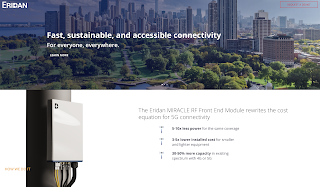
Eridan lands $46 million for direct polar transmitter in gallium nitride and silicon

Eridan, a start-up based in Mountain View, California, raised $46 million in financing for its MIRACLE RF Front End Module. 

Eridan has built a direct polar transmitter in gallium nitride and silicon, which promises:

  • 10x less input power to provide the same coverage
  • 60-100x reduction in power consumption in sparsely-populated areas, due to improved spatial efficiency
  • Equipment that’s smaller, lighter, and less expensive to install, and doesn’t require specialized power sources or heavy heat sinks

The funding was led by Capricorn’s Technology Impact Fund and Monta Vista Capital with additional participation from Social Capital, Diamond Edge Ventures and Pilot Grove Management.

The company anticipates initial stages of deployment in late 2023 in small cells and Massive MIMO systems for urban and suburban locations.

"Accessible, efficient and reliable wireless connectivity is critical to our future economic, environment and social well being. Achieving that reality, however, is impossible without a major technology breakthrough to reduce the spectrum and power needed. That’s how Eridan will provide improved and expanded connectivity for everyone, everywhere, using a fraction of the power," stated Doug Kirkpatrick, Eridan CEO and Co-founder.

https://eridan.io

Thursday, May 12, 2022

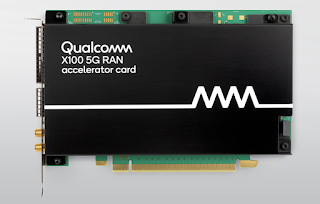
Vietnam's Viettel builds with Qualcomm 5G RAN Accelerator Card

Viettel High Technology, which is the R&D arm of Viettel and in charge of design, development, manufacturing, and commercialization of telecommunications solutions, is using the Qualcomm X100 5G RAN Accelerator Card and Massive MIMO Qualcomm QRU100 5G RAN Platform to accelerate the development and commercialization of high-performance Open RAN massive MIMO solutions.

Viettel's 4G infrastructure coverd 97% of Vietnam population and the operator's 5G services are available in 16 cities and provinces in Vietnam to date. 

Viettel develops full network elements including Devices, Radio Access Network (RAN), Transmission Network, and Core Network which are forming a strong foundation for digital society.

“Viettel has been a pioneer in adopting new telecommunications technologies including 5G. We are delighted to have Qualcomm Technologies as a key technology provider in our 5G gNodeB project,” said Nguyen Vu Ha, general director, Viettel High Technology. “This collaboration between Qualcomm Technologies and Viettel Group will be the cornerstone of Vietnam’s national strategy for Made in Vietnam 5G infrastructure.”

“As the need for reliable, robust, and powerful mobile experiences increases across Vietnam, we anticipate a new wave of demand for 5G services from both end users and enterprises. Joining forces with Viettel will allow us to innovate through and launch technology that will advance the cellular ecosystem and accelerate the enablement and deployment of modern networks at scale,” said ST Liew, vice president, QUALCOMM CDMA Technologies Asia-Pacific Pte. Ltd. and president, Qualcomm Taiwan and South East Asia. “We look forward to working closely with Viettel for the rollout of advanced 5G infrastructure and services for Vietnam and globally.”

https://www.qualcomm.com/news/media-center

HPE offers 5G RAN virtualized DU powered by Qualcomm accelerator

Hewlett Packard Enterprise (HPE) will deliver 5G distributed units powered by Qualcomm Technologies X100 5G RAN inline accelerator card and its HPE ProLiant DL110 Gen10 Plus Telco Server.The Qualcomm X100 5G RAN accelerator card, which leverages a combination of DSPs and ARM CPUs, offloads Layer 1 and Layer 2 MAC functionality, including compute-intensive 5G baseband processing. HPE's 5G RAN virtualized distributed unit (vDU) solution is designed...

Rakuten Symphony and Qualcomm target Massive MIMO RU and DU

Rakuten Mobile and Qualcomm Technologies agreed to collaborate to develop a next-generation 5G Radio Unit (RU) with Massive MIMO capabilities and distributed units (DUs).The new products, which will leverage the Qualcomm X100 5G RAN Accelerator Card and high-performance Massive MIMO Qualcomm QRU100 5G RAN Platform, are designed to enhance Rakuten Symphony’s Symware product portfolio of Open RAN solutions.Rakuten Mobile, Rakuten Symphony and Qualcomm...

Qualcomm intros 5G DU accelerator card

Qualcomm introduced its 5G DU X100 PCIe inline accelerator card with concurrent Sub-6 GHz and mmWave baseband support.The accelerator card is designed to ease of deployment with O-RAN fronthaul and 5G NR layer 1 High (L1 High) processing. It plugs into standard Commercial-Off-The-Shelf (COTS) servers to offload CPUs from latency-sensitive and compute-intensive 5G baseband functions such as demodulation, beamforming, channel coding, and Massive MIMO...