Monday, April 25, 2016

Juniper Advances its Software-Defined Secure Networks Framework

Juniper Networks announced several cloud and virtualized service offerings as part of its Software-Defined Secure Networks (SDSN) framework, including a new compact and containerized virtual firewall called Juniper Networks cSRX. This  next-generation firewall is designed for advanced security services for Software Defined Networks. The cSRX, which Juniper describes as the industry's first virtual firewall in a containerized form factor, provides a way to wrap advanced security services around every workload and the ability to scale up to high multi-tenancy. Advanced security services in the cSRX include Content Security, AppSecure, and unified threat management (UTM).

The rollout also includes a multi-core version of the Juniper Networks vSRX virtual firewall that is expected to be capable of reaching 100 Gbps - 10 times greater than the nearest competitor and creates new possibilities for using agile and flexible virtual firewalls. The multi-core vSRX offers full routing, firewall and L4-L7 security features. The vSRX delivers high availability, granular security with segmentation capabilities between zones, organizations, lines of business and applications, as well as rich connectivity features like Network Address Translation (NAT), routing and VPN.
Working closely with Intel, vSRX leverages the Open Source Data Plane Development Kit (DPDK) software architecture

Both products are anticipated to enable the network to better detect and combat threats through increased performance, intelligence, and a higher density of services on the Intel Xeon processor family (x86 platform).

"As the security landscape continues to evolve, it is more important than ever to work together to combat cyber threats. These key additions to our security portfolio will further our Software-Defined Secure Networks vision and greatly benefit our customers. Our products provide the best opportunity to create secure networks through policy, detection and enforcement. We are excited to be releasing the most flexible firewall solutions in the market and continue to showcase our commitment to bringing SDSN to organizations across the globe," Kevin Walker, security CTO, Juniper Networks

http://www.juniper.net

Netronome Brings Hardware-Acceleration to OpenStack Networking

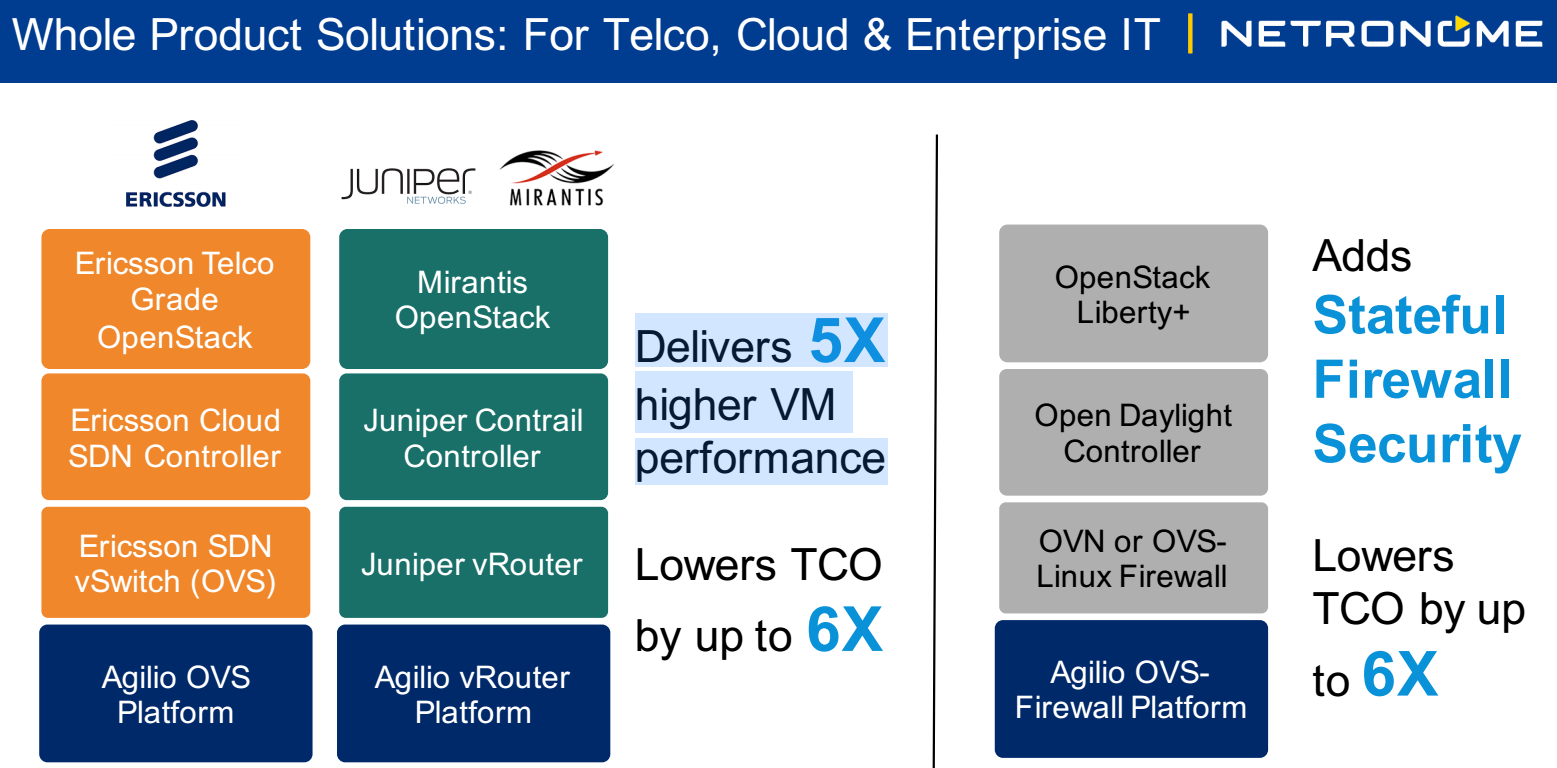
Netronome has tuned its Agilio Server Networking Platform for delivering hardware-acceleration for OpenStack networking, allowing data centers to accelerate applications such as network virtualization, security, load balancing and telemetry using different data plane options suitable for use cases spanning traditional IT to IaaS and Telco NFV workloads. Netronome's own testing has found a 5X boost in VM performance when network functions are offloaded to its Agilio interface cards.

At this week's OpenStack Summit in Austin, Netronome, in collaboration with Ericsson and Mirantis, is showcasing acceleration of open source datapath implementations, specifically, Open vSwitch (OVS), Stateful Firewall (Connection Tracking) and OpenContrail vRouter using Agilio CX intelligent server adapters. The company said this approach will be incorporated as an enhanced OpenStack networking plug-in architecture specification. As a result, critical networking functions that would otherwise hamper performance of the OpenStack implementation are offloaded to the Agilio platform, accommodating significantly more virtual machines per server leading to up to 6X lower TCO and higher services revenue per server compared to traditional NICs.

“The OpenStack platform has become the de facto cloud and SDN orchestration tool and server-based networking has become the cornerstone of pervasive SDN and cloud-based networks,” said Sujal Das, senior vice president and general manager, strategy and marketing at Netronome. “Our flagship Agilio product-based demonstrations and proposed open specification bring much needed hardware-based efficiency to that mix.”

“Mirantis OpenStack delivers comprehensive cloud orchestration tools that are optimized for Enterprise IT and NFV deployments,” said Kamesh Pemmaraju, vice president of product marketing at Mirantis. “Utilizing Netronome’s expertise in server-based networking and its Agilio intelligent server adapters, our joint pioneering work promises to provide the industry with new OpenStack networking capabilities that will enable rapid SDN deployments, delivering significantly higher networking performance and increases in server efficiency.”

Netronome plans to release beta releases of products that integrate OpenStack with Agilio Software for OVS, Stateful Firewall and OpenContrail vRouter, and an open enhanced OpenStack networking plug-in architecture specification in Q3 2016.The specification enhancements will propose extension of the current SR-IOV OpenStack plug-in mechanism for efficient packet delivery to virtual machines and add the OVS, Stateful Firewall and vRouter data paths implemented in intelligent server adapters such as Netronome’s Agilio CX products. Through support of innovative VirtIO extensions, hardware-based performance and efficiency benefits are delivered without compromising operational agility, while virtual machine migration capabilities needed for efficient server resource utilization are preserved.

http://www.netronome.com


Netronome's Agilio Server Networking Accelerates Cloud Data Centers

Netronome introduced its Agilio Server Networking Platform for transparently offloading server-based networking data paths, such as open virtual switch (OVS), Juniper Networks Contrail vRouter, and Linux firewall.

The company said its hardware and software-based Agilio platform delivers up to 5X higher throughput while reducing CPU requirements by up to 80 percent compared to traditional NICs and server-based networking implemented in software.

Server-based networking is being widely deployed in cloud data centers to handle virtualization, firewalls, load balancing, telemetry, zero-trust security using micro-segmentation, virtual network functions (VNFs) and application-based analytics. The big cloud providers (AWS, Microsoft Azure, Google) are using server-based networking in their mega data centers. Netronome's Agilio solution accelerates such server-based networking functions by offloading compute-intensive flow and tunnel processing from the CPUs.

The Agilio CX intelligent server adapters (ISAs) are based on Netronome's own flow processing silicon (NFP-4000) and software architecture (Agilio Software). The Agilio ISAs use onboard memory to support up to two million security policies, and deliver 28Mpps of throughput using hardware-based acceleration.

Nexenta Adds OpenStack & Docker Support for Scale-Out Storage

Nexenta announced significant updates to its block and object storage platform, including seamless integration with OpenStack and Docker environments.

The NexentaEdge is a software-only, scale-out, multi-service storage solution to deliver cluster-wide inline deduplication and compression, offering high-performance, simplified management of petabyte-scale repositories. With the latest updates, the block and object software-defined platform includes additional performance optimizations for all-flash and hybrid configurations, tightly integrates with the OpenStack ecosystem to simplify deployments in OpenStack clouds, and adds support for container-based deployments and Docker environments.

In addition to full iSCSI, NexentaEdge now supports native block device services, allowing hyperconverged OpenStack deployments to run Nova nodes directly on the NexentaEdge cluster. To fully automate deployment and configuration of NexentaEdge nodes in Canonical OpenStack environments, Juju Charms are available from the Canonical Juju Charms Store. All NexentaEdge Cinder drivers are also fully integrated in the OpenStack Mitaka release.

http://nexenta.com/NexentaEdge


QTS Signs Big Cloud Customer for DFW Mega Data Center

QTS Realty Trust confirmed that one of the world's largest cloud provider companies has doubled its custom data center agreement to support its rapid growth.

The hyperscale cloud provider selected QTS in early 2016 to provide more than 20,000 square feet and four megawatts of power. The new agreement dramatically increases the company's usage to a total of 40,000 square feet and eight megawatts of power at the LEED Gold certified QTS Dallas-Fort Worth mega data center.

The QTS Dallas-Fort Worth data center is 700,000 square feet with the capacity to increase by 600,000 square feet for a total of 1.3 million square feet. The purpose-built facility is structurally reinforced and built with 90' subterranean concrete piers that isolate the building from movement.

http://www.qtsdatacenters.com/


  • QTS will open its newest mega data center in downtown Chicago in the former Chicago Sun-Times printing plant later this summer.


Mirantis and QCT Partner on OpenStack Appliance

Mirantis and QCT (Quanta Cloud Technology) are partnering to offer Mirantis Unlocked Appliances, turnkey, rack-based appliances featuring Mirantis OpenStack. The appliance is targeted at Cloud Native Applications featuring hardware and software from QCT and Cumulus Networks.

“Mirantis Unlocked Appliances gives enterprises a fast, easy way to exploit the flexibility and cost-savings of OpenStack. They are off-the-shelf, optimized solutions that reduce time-to-value while also reducing risk in OpenStack deployments,” said Mirantis co-founder and CMO, Boris Renski. “The addition of the QCT Mirantis Unlocked Appliance brings hyperscale platforms as an alternative in Unlocked Appliances.”

https://www.mirantis.com/appliances

EBSCO Load Balances OpenStack Cloud with Avi Networks

EBSCO Information Services (EBSCO) has deployed Avi Networks on OpenStack to create a highly-automated private cloud and cutting-edge software-defined data center.

Avi Networks delivers public-cloud-like agility for application services beyond load balancing including deep application analytics, predictive autoscaling, and security in the data center or public cloud.

http://www.avinetworks.com

Sequans LTE for IoT Module Certified by AT&T

Sequans Communications' newest EZLinkLTE module, the US60L, has been certified to operate on AT&T’s 4G LTE network.

At the heart of the module is Sequans’ IoT-optimized, LTE Cat 4-capable chipset, Colibri, along with memory, power management and a complete RF front-end.

http://www.sequans.com

Sunday, April 24, 2016

Blueprint: Top 10 Use Cases for OpenStack SDN

by Wendy Cartee, VP of Product Management and Marketing at PLUMgrid

Years ago, Linux opened up the data center and made it programmable, uncorking a Genie’s bottle of previously unimagined use cases, wealth and possibilities that became known as the cloud. For years after the data center became a software-programmable cloud, networking remained the bottleneck in an otherwise programmable environment. Today, we’re seeing a similar transformation with the advent of SDN and NFV. Launching in 2010, a free and open-source software infrastructure-as-a-service (IaaS) platform for cloud computing, OpenStack, made it easier to configure cloud infrastructure by linking compute, storage, and networking resources to support a range of use cases. Now, SDN is not just supporting but driving some of the biggest innovations in cloud services. Enabling users to easily deploy and manage resources from a single pane of glass, production services that used to take months to provision are now live in mere minutes.

To illustrate this evolution, here are 10 top use cases that have emerged for OpenStack SDN including both as-a-services and vertical examples:

XaaS Use Cases

Infrastructure as a Service – OpenStack’s compute, storage, and networking services were built to provide IaaS and through its 13 releases OpenStack has evolved to enable much more than IaaS.

IaaS enables achievement of strategic business objectives including faster time to revenue for customers, Opex and CapEx efficiency, and scale while overcoming the challenges of traditional provisioning with rapid time to revenue and the ability to address complex change management.

Platform as a Service – PaaS offers a ready-to-consume development environment, with databases, tools and libraries. Delivering similar business benefits to IaaS, PaaS enables application developers to immediately start writing code, significantly reducing time to production and speeding time to market for new applications.

Communications as a Service – Service providers who offer voice, video, and data services are now delivering more than just connectively and bandwidth. With Communications as a Service, OpenStack enables cloud-based delivery of unified communications, multi-site collaboration, and video conferencing without truck rolls.  

Streaming content and media services – Content providers are leveraging OpenStack to deliver streaming content and media such as movies, live television, videos, music, photographs, and more. The technology delivers on key business objectives such as increased service velocity to reduce churn and attract new subscribers with high application performance and the ability to control infrastructure costs while achieving scale.

Hadoop as a Service – Big data analysis requires the elasticity and resources provided by cloud infrastructures. With OpenStack, Hadoop as a Service offers easy to access big data services to scientists, and businesses alike to accelerate research and data analysis.

Container as a Service – As microservices drive application development for mobile and IoT, containers are providing rapid, lightweight resources for developers. Through several container projects, OpenStack is enabling container deployment and orchestration models including Docker, Mesos, and Kubernetes.

Vertical Use Cases

Financial cloud solution – Financial services require data center resources in highly secure, reliable, and compliant cloud environments. Through OpenStack’s Neutron project, the community is building firewalls with vendor plug-ins that add micro-segmentation, encryption, analytics, and enhanced high availability for resiliency.

Retail/ecommerce solution – Micro-segmentation, policy-based security, flexible workloads, and simplified installers are driving adoption for retailers. Retailers are increasingly leveraging OpenStack to build private clouds for ecommerce that reduce costs while increasing online revenues by enabling the agility required to accommodate rapidly changing consumer and client tastes.

Pharmaceutical/life sciences solution – Pharmaceuticals and life sciences are deploying OpenStack clouds for telemedicine, mobile applications, and research to enhance care and deliver private data center resources for security and compliance. Through micro-segmentation, OpenStack enables strict isolation of clients, data and applications that must be implemented at every level of the service architecture to comply with strict security and privacy rules and guidelines.

Government – Public sector groups including government, research, and education are deploying OpenStack clouds for enhanced research, collaboration, and online services. Private virtual domains that provide policy-based security and traffic isolation are key to enabling multi-tenancy that meet regulatory compliance.

According to the most recent OpenStack User Survey, the number one business driver for choosing OpenStack is the ability to accelerate innovation and better compete by deploying applications faster. Avoiding vendor lock-in and increasing operational efficiency were a close second. Of the seven drivers presented in this study, from the 67 percent of users surveyed who listed “Save money over alternative infrastructure choices” as a motivating factor—all of them listed it as their number one reason.

Top business drivers of OpenStack


Which industries use OpenStack and how?
The IT industry continues to dominate OpenStack users who took their survey, making up nearly two-thirds of all response. The top industry segments after IT were telecommunications (12 percent), academic/research (10 percent), and 2 percent each for film/media, finance, and manufacturing/industrial. However, IT supports a variety of uses with the cloud. As part of the top 10 use cases listed above, the IT services and uses provided by OpenStack include:  big data, call center, cable TV and ISP, data center/co-location, government identity and security, high-performance computing, online video games, professional services/IT consulting, public/private/hosting cloud services, software development/DevOps/delivery, storage solutions, system integrators, telco and networking and Web hosting and email hosting.


In just a few years, SDN has evolved networking to significantly impact the cloud, enabling it to continue apace with its accelerating rate of innovation. As illustrated above, the combination of SDN and OpenStack delivers agility and simplicity across a diverse range of use cases, from several instances of XaaS to a number of vertical industry-specific examples. As open source adoption has taken hold, the cloud and a large global community of open source contributors have made building out new use cases almost instantaneous. Although it took a decade for the cloud to find mainstream appeal, OpenStack was founded in 2010 and there are already 20+ million lines of code, 38,000 contributors from 178 countries and 583 companies supporting the community. Who knows what use cases and profitable new services have yet to be imagined?

Stay tuned and follow the OpenStack community or come to an OpenStack Summit near you to find out. The pace of innovative disruption is much faster now, so you won’t have to wait long.

About the Author


Wendy Cartee is VP of Product Management and Marketing at PLUMgrid, Inc., the leading innovator of secure cloud infrastructure for enterprises building private and public clouds.  With over 15 years of product management and marketing experience at prior companies such as Cisco Systems, Juniper Networks, and HP Cloud, Wendy has defined solutions for data centers, WAN, Internet, and mobile infrastructure that generated billions in revenue. An avid technology and customer advocate, Wendy has 8 U.S. patents in networking technologies, all of which are deployed in some of the largest networks.  Wendy is listed in the CCIE Hall of Fame as the first 100 CCIEs in the world.  She has a BSEE from Cal Poly, MBA from Santa Clara University, and is a graduate of the Stanford Executive Program from the Graduate School of Business.

About PLUMgrid

PLUMgrid is the leader of secure and scalable virtual network infrastructure solutions for OpenStack clouds. PLUMgrid delivers industry leading software-defined networking (SDN) and network functions virtualization (NFV) solutions that enable modern data centers to connect tenants, applications and workloads efficiently across hypervisors, virtualized, container and bare metal architectures. PLUMgrid is headquartered in Santa Clara, Calif. and is funded by venture capital and strategic investors. Visit www.plumgrid.com


Got an idea for a Blueprint column?  We welcome your ideas on next gen network architecture.
See our guidelines.

Akanda Updates its OpenStack Astara

Akanda announced its new Mitaka release for open source network orchestration and virtualization.

Akanda is the major contributor to OpenStack Astara, which is a vendor-agnostic solution for open source network orchestration and virtualization. Astara does not require an SDN controller.

DreamHost, which is a web and cloud hosting provider based in Los Angeles, is using Astara to support more than 2,000 customers with thousands of virtual machines (VMs).

New features in OpenStack Astara include:


  • Over-the-Top Network Functions - OpenStack operators can bring their own network function to any Layer 2 network. 
  • Advanced Features for High Network Availability - higher levels of reliability and scalability for Layer 3 services, such as routing, load-balancing, and application performance management.
  • Lightweight IPV6 VPNaaS - Astara can now support up to 16 million IPV6 VPNs over VXLAN. IPV6 VPNs are a lightweight alternative to more expensive MPLS-based VPNs, which can't be decoupled from network hardware without significant vendor support. Many network experts consider IPV6 VPNs to be foundational for hybrid cloud and IOT use cases.


"The Mitaka release of OpenStack Astara introduces web-scale to virtualized network services," said Henrik Rosendahl, CEO of Akanda. "It's all about software defined hardware choices; new features that allows cloud operators to scale up and out, and radically simple OpenStack Neutron deployment. We're also excited about new services such as IPV6 VPNs, which are elemental for hybrid cloud and IOT applications."

http://akanda.io/

University of Cambridge Builds OpenStack with Mellanox

The University of Cambridge has selected Mellanox End-to-End Ethernet interconnect solution including Spectrum SN2700 Ethernet switches, ConnectX-4 Lx NICs and LinkX cables for its OpenStack-based scientific research cloud.

“The new generation of analytics-based research, with access to unprecedented volumes of data, coupled with the need to provide quick and secure access to computing and storage resources to the research community in and beyond UoC, have fueled the momentum behind an OpenStack cloud tailor-made for scientific research,” said Chole Jian Ma, Senior Director of Cloud Market Development, Mellanox. “Mellanox Ethernet interconnect solution enables UoC to deploy a high-throughput, low-latency cloud network fabric and leverage advanced offload and acceleration capabilities such as SR-IOV, RDMA, and VXLAN Offload that mitigate virtualization penalties.”

http://www.mellanox.com

AT&T Teams with Globecomm for IoT Satellite Connectivity

AT&T is teaming up with Globecomm to launch a new service that allows satellite connectivity to work seamlessly with its cellular network.

The Globecomm satellite connectivity will help businesses connect their IoT assets all over the world.

“We’re offering a one-stop shop for IoT connectivity,” said Mike Troiano, vice president, AT&T IoT Solutions. “Our customers now have a flexible, reliable and highly secure service to monitor their assets nearly anywhere. They don’t have to choose one connectivity solution over the other – they can have the full package.”

“Businesses want more real-time visibility into their assets on a global scale,” said Jon Kirchner, senior vice president, Products and Corporate Strategy, Globecomm.  “We’re working with AT&T to offer seamless connectivity over a single platform. We’re helping businesses collect and analyze critical information wherever their assets are – to generate operational improvements and hard ROI – on land or at sea.”

http://www.att.com/iot
http://www.globecommsystems.com/iot/

Friday, April 22, 2016

PrecisionHawk Gains Investments from DOCOMO, Verizon, Intel

PrecisionHawk, a start-up that specializes in data collection via drones, closed $18 million Series C funding round with strategic investments from NTT DOCOMO, Verizon Ventures, Intel Capital, USAA, Yamaha Motors and others. This investment brings PrecisionHawk’s total funding to more than $30 million.

PrecisionHawk said the new funding will be used to expand its terrestrial data analysis platform, DataMapper, which currently ingests data from all drone systems but, in the future, will combine aerial data from satellites and manned aviation so users can manage, analyze and compare all incoming data sources on a single platform.

http://media.precisionhawk.com/topic/series-c/

NTT Tackles Artificial Spin for Photonic Computation

Researchers at NTT and and Osaka University announced an important step toward photonic computation by developing a large-scale artificial spin network based on photonics technologies. The development targets a fundamental component for the coherent Ising machine (CIM), which utilizes interacting artificial spins realized with optical parametric oscillators (OPO) for computation of combinatorial optimization problems.

The researchers generated more than 10,000 time-multiplexed OPOs using an optical fiber cavity as long as 1 km.

The OPOs can be used as artificial spins for a large-scale CIM to solve combinatorial optimization problems in the real world. The research was published in the UK science journal “Nature Photonics” on April 18, 2006.

http://www.ntt.co.jp/news2016/1604e/160418a.html

Peraso Raises $20 Million for WiGig Silicon

Peraso Technologies, a start-up based in Toronto, raised a $20 million funding round, to support its development of 60 GHz chip sets and solutions compliant with the IEEE 802.11ad specification.

Peraso said its WiGig IC solutions, which are now in production, address both next generation WiFi opportunities in the consumer electronics (CE) space, as well as outdoor devices in the 60 GHz wireless infrastructure space.

The round was co-led by IDT and included existing investor Roadmap Capital (Roadmap), with additional financing from iNovia Capital.

“The interest we’re seeing in WiGig is tremendous,” said Ron Glibbery, President and CEO of Peraso. “Multi-Gigabit wireless connectivity is something that more and more CE and wireless infrastructure manufacturers are seeking to incorporate in their products.  Raising this capital allows Peraso to take our sales to the next level. Participation by IDT provides further validation of the market opportunity, and continued participation from Roadmap, as well as iNovia, speaks to the tremendous success the company has demonstrated in getting our first ICs to market.”

http://www.perasotech.com

Thursday, April 21, 2016

Google Expects its Cloud vEPC to Scale for Billions of Users

Google is now delivering Wi-Fi access in Indian railway stations using a virtual Evolved Packet Core (vEPC) running in its cloud infrastructure, said Geng Lin, Head of Global Engineering, Global Markets, at Google, in a keynote address at Layer123 NFV World Congress in San Jose, California.

The Google Access project is striving to bring reliable Internet options to the estimated 4 billion unconnected users in developing markets. Wi-Fi is one of the access technologies it will use, but there will be others. Google is looking to partner with other carriers, governments and organizations to bring down the cost of serving large populations.

This project, which was undertaken last year with India's RailTel, aims to offer reliable, super-fast Wi-Fi to as many as 10 million daily users when it is fully rolled out in hundreds of railway stations across the country.

Lin said Google chose to implement a cloud-based, EPC control plane and service operations center to offer an extensible service across the country that can scale to millions of users. RailTel provides a fiber backhaul to each station. Google integrates the Wi-Fi RAN with the vEPC running on its Google Compute Engine infrastructure. Google's cloud-based service operations is also delivering advanced analytics and service level monitoring to improve the customer experience.

The service went live in January in the first railway stations. So far, the network is delivering 99.94% weekly, end-to-end availability for users, proving the vEPC running on the Google cloud is stable and scaling well. The number of active users is now on a sharp uptick as more stations are added to the network. Currently, the vEPC is serving nearly 200,000 active, registered users. Average usage per user per day is over 50 minutes, equating to 366MB of data per user per day.

Lin said Google's vEPC will scale to tens of millions of users for this Railtel project, but the architecture is extensible to reach hundreds of millions and ultimately billions of users by leveraging the global Google Compute Engine. The vEPC could also be offered as a wholesale service on the Google Compute Engine to partner carriers.

http://www.layer123.com/nfv-agenda-day2/
https://googleblog.blogspot.com/2015/09/bringing-the-internet-to-more-indians.html

Video: Source Photonics Demos PAM4 - 2x50G QSFP28

Pulse Amplitude Modulation encodes information in the amplitude of a series of signal pulses.

In this video, Dr. Manish Mehta, EVP of Product Line Management at Source Photonics, introduces the fundamentals of PAM4 encoding, which is expected to play a major role in enabling lower cost, 100Gbps data center connections.

Source Photonics conducted a live demonstration of PAM4 2x50Gbps QSFP28 transceivers at #OFC2016. These will add to the company's portfolio of small form factor 100G optical transceivers.

The PAM4 demonstration comes on the heels of Source Photonics’ industry leading release of the 100G QSFP28 LR4 platform of products. Source Photonics announced first in industry sampling of the LR4 and LR4 Lite in March 2014 and mass production in March 2015. In January 2016, Source Photonics announced the shipment of its 10,000th QSFP28 module to customers.

The 2x50G-PAM4 QSFP28 will operate at a worst case power consumption of 3.5W at 70C case temperature and support KR4 FEC in the host IC. The company is also in development to support a KP4 FEC implementation similar to the FR8 requirements for 8-channel 400G standards.

“Cloud scale and Web 2.0 datacenters are demanding increased volume and lower cost 100G small form factor products and reducing component count is a critical long term solution”, says Sheng Zhang, Chief Scientist at Source Photonics. “We are demonstrating a major step towards the productization of PAM4 technology that will be instrumental in the cost reduction of 100G QSFP28 products and the release of initial 400G products.”

Anomali Raises $30 Million for Early Threat Detection

Anomali, a start-up based in Redwood City, California, raised $30 million in series C funding for its ThreatStream threat intelligence and Anomali Enterprise platforms.

The company, which was previously known as ThreatStream, delivers early detection and identification of adversaries in a network. The company says this makes it possible to correlate tens of millions of threat indicators against real time network activity logs and up to a year or more of forensic log data.

The new funding, led by Institutional Venture Partners (IVP), includes significant investments from General Catalyst Partners, GV (formerly Google Ventures) and Paladin Capital Group. The round raises Anomali’s total funding to more than $56 million since launching in 2013.

"Anomali is entering a very exciting era of cybersecurity, and we couldn’t be happier to have the support and backing of our customers and partners. Our rebrand, new product suite and this latest round of funding validates our vision for reducing business risk for large enterprises and small to medium sized businesses," said Hugh Njemanze, CEO of Anomali. "We are truly in a unique position as the only security vendor who can scale to meet the challenge of making ever increasing amounts of threat intelligence useful for the entire security team while detecting and preventing attacks enabled by long adversary network dwell times.”

http://www.anomali.com

Verizon Posts Q1 Revenue of $32.2 billion

Verizon reported Q1 sales of $32.2 billion, a 0.6 percent increase compared with first-quarter 2015, and $1.06 in earnings per share (EPS), compared with $1.02 per share in 1Q 2015.

“Verizon’s strong first-quarter results demonstrate our capacity to compete effectively, while executing on our plan of continued network leadership and seeding new growth markets in mobile video and the Internet of Things,” said Chairman and CEO Lowell McAdam.

New IoT revenue streams reached approximately $195 million in first-quarter 2016, a year-over-year increase of about 25 percent.

Some highlights:

Wireless

  • 640,000 retail postpaid net additions in first-quarter 2016
  • At the end of first-quarter 2016, Verizon had 112.6 million retail connections, a 3.7 percent year-over-year increase, and 107.2 million retail postpaid connections, a 4.4 percent year-over-year increase.
  • Total revenues were $22.0 billion in first-quarter 2016, a decline of 1.5 percent compared with first-quarter 2015 as more customers continued to choose unsubsidized device payment plans. Service revenues plus installment billings increased 1.6 percent, comparing first-quarter 2016 with first-quarter 2015.
  • Verizon ended first-quarter 2016 with a total of 73.8 million smartphones. This is 85 percent of the total phone base, with 4G devices more than 81 percent of the retail postpaid connections base.
  • Approximately 92 percent of Verizon’s total data traffic is on the LTE network. Overall data traffic on LTE has increased by approximately 50 percent year over year.
  • Wireless capital expenditures totaled $2.2 billion in first-quarter 2016 and are expected to ramp up throughout the year.
  • Fios remains the growth driver in wireline segment


Wireline highlights

  • Verizon added 98,000 net new Fios internet connections and 36,000 net new Fios video connections in first-quarter 2016. 
  • Total Fios revenues grew 5.0 percent, to $3.5 billion, comparing first-quarter 2016 with first-quarter 2015, including consumer Fios revenue growth of 4.7 percent.
  • In first-quarter 2016, consumer revenues were $4.0 billion, an increase of 0.8 percent compared with first-quarter 2015.


http://www.verizon.com

Ericsson Q1 Sales Drop 2% YoY, Profitability Rises

Ericsson reported Q1 sales of SEK 52.2 billion (US$6.42 billion), down 2% compared to the same period last year. Net income amounted to SEK 2.1 billion, up 45% from SEK 1.5 billion in Q1 2015. Gross margin declined despite higher IPR licensing revenues. The main reasons were lower margins in Global Services, a higher share of mobile broadband coverage projects in parts of Asia and lower software sales in IP and core networks.

Some highlights:

  • Segment Networks sales declined slightly YoY. A continued weak macro-economic environment impacted sales negatively in some emerging markets in the Middle East and Latin America. In addition, sales in Europe were down primarily driven by completion of mobile broadband projects in 2015. Mobile broadband sales in North America and South East Asia grew and the fast pace of 4G deployments in Mainland China continued. IPR licensing revenues grew YoY, mainly driven by recently signed contracts which included certain one-time items. Software sales in IP and core networks declined.
  • Sales in segment Global Services declined YoY. This was mainly due to lower Network Rollout activities in Europe and Latin America. Professional Services sales were stable with growth in Consulting and Systems Integration driven by transformation projects and stable Managed Services sales with 21 contracts signed in the quarter.
  • Sales in Support Solutions increased YoY due to higher IPR licensing revenues. The underlying demand remains strong in OSS and BSS as data growth and increased focus on customer experience drives operators to transform their OSS and BSS solutions.
"We are not satisfied with our overall growth and profitability development over the past years and I am convinced this will make us more competitive and enable us to grow both our company and our earnings," stated Hans Vestberg, President and CEO of Ericsson.

http://www.ericsson.com

ADVA Hits Sales of EUR 122.0 Million in Q1 2016

ADVA Optical Networking reported Q1 2016 revenues of EUR 122.0 million, up 27.6% year-on-year (YoY) and in line with the company's guidance.

Pro forma operating income in Q1 2016 stood at EUR 2.0 million or 1.6% of revenues, which represents a EUR 1.7 million YoY decrease (Q1 2015: EUR 3.7 million) and is in line with the previously announced guidance. The operating income came to EUR 1.0 million (Q1 2015: EUR 3.3 million).

“We were absolutely right with the assessments we communicated in 2015,” commented Brian Protiva, CEO, ADVA Optical Networking. “The demand for data center interconnect (DCI) technology continues to grow, and 100G solutions in metro networks are gaining momentum.”

http://www.advaoptical.com/