Wednesday, October 14, 2015

Layer123: Verizon Expands Secure Cloud Interconnect Internationally

Verizon Enterprise Solutions announced a significant expansion of its Secure Cloud Interconnect service to Latin America and to additional sites in Europe and the U.S.

Verizon’s Secure Cloud Interconnect service, a software-defined networking offering, helps enterprises seamlessly connect, manage and secure their cloud environments that often extend across multiple clouds and data centers around the globe.

In total, Secure Cloud Interconnect service now offers secure, private connections to six cloud providers (Amazon Web Services, Google, HP, Microsoft Azure Express Route for Microsoft Office 365/Skype for Business/Government Cloud, Salesforce; Verizon ) and three data center providers (Equinix, CoreSite, and Verizon) at more than 30 global locations in the Americas, Latin America, Europe and the Asia-Pacific region.

“Verizon’s Secure Cloud Interconnect allows users to connect to applications simply, securely and reliably,” said Shawn Hakl, vice president of enterprise networking and innovation for Verizon. “SCI customers will find our solution delivers an unbeatable combination of performance, security and efficiency to help enable their digital transformation while reducing the complexity often associated with cloud computing.”

Verizon’s Secure Cloud Interconnect global footprint:

  • Amazon Web Services: Sao Paulo; Silicon Valley, Los Angeles and New York; Singapore, Sydney, and Tokyo; London and Frankfurt, Germany 
  • Google: Chicago and Denver; and Hong Kong and Singapore 
  • HP: Atlanta (2); and Frankfurt and Russelsheim, Germany
  • Microsoft Azure ExpressRoute and Microsoft ExpressRoute for Office 365: Silicon Valley, Washington, D.C.; London; Hong Kong and Sydney
  • Salesforce.com: Chicago and San Jose, Calif. 
  • Verizon Cloud: Sao Paulo; Culpeper, Va., Denver, Miami; and Santa Clara, Calif.; and London and Amsterdam.
  • Future expansion plans include a significant build out in the Asia-Pacific region slated to be completed this fall. 

Verizon Enterprise Solutions also announced the expansion of the Secure Cloud Interconnect in the public sector. The service – now available at more than 30 locations across the Americas, Latin America, Europe and the Asia-Pacific region –  supports cloud (public, private and hybrid) and colocation solutions from a growing roster of connected cloud providers.

http://www.verizon.com/about/news/verizon-secure-cloud-interconnect-service-expands-latin-america-deepens-european-us-footprint

Layer123: Softbank Deploys Cisco Evolved Services Platform

Softbank is deploying Cisco's Evolved Services Platform (ESP) Orchestration, software defined networking (SDN) and network function virtualization (NFV) technologies to support its White Cloud SmartVPN.

The Softbank service offers enterprise customers a differentiated network service with a selection of multi-vendor networking equipment offerings. The White Cloud SDN creates software-controlled service chains in which traffic is steered through the appropriate security functions for a given flow, based on customer profile, service type or other parameter. A self-service online portal gives customers a simple way to select security policies and scalable network services associated with changes of business requirements.

Softbank is using Cisco's Network Services Orchestrator (NSO) enabled by Tail-f for the provisioning of both its physical and virtual elements.  Cisco said its enhanced architecture reduces the time to deployment for new enterprise services from weeks to minutes, while allowing for greater elasticity of customer demand by utilizing service chaining of new virtual network functions. Using strict, standardized YANG models for both services and devices, NSO automates all of the multi-vendor devices, making it easy to change and reconfigure services on-demand, without time-consuming and error-prone manual effort.

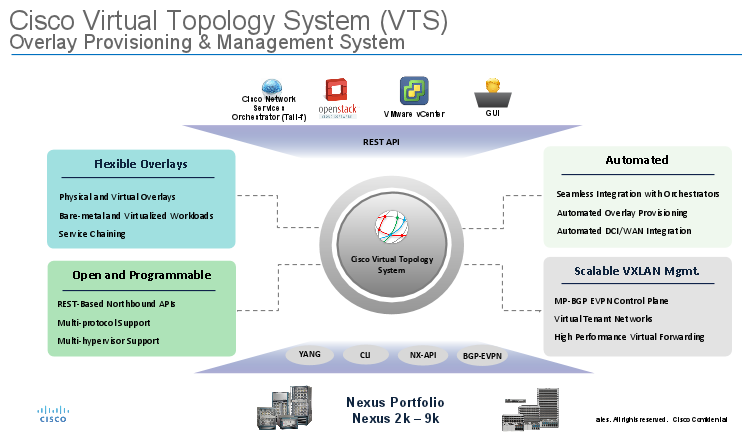
Softbank has also deployed Cisco’s Virtual Topology System to stitch the dynamic service chains within the data center.  The Cisco Virtual Topology System is a standards-based, open software-overlay management and provisioning system. It automates data center network fabric provisioning for virtual and physical infrastructure.

"Our new Cisco architecture has enabled us to dramatically increase our ability to provide highly responsive customer experience,” said Sadahiro Sato senior vice president of ICT innovation, Softbank. “The flexibility and open nature of the Cisco Evolved Services Platform will equip us with the tools to innovate new services at a rapid pace and keep ahead of our competition. Automation and elasticity on demand will also help us dramatically reduce both our operating and capital costs as we grow the offering.”

“We are delighted to partner with Softbank to unlock network innovation and accelerate service creation and deployment,” said Gee Rittenhouse senior vice president of cloud and virtualization, Cisco. “Softbank was able to leverage an open, modular multi-vendor architecture that suites its specific needs by utilizing Orchestration, NFV and SDN products from Cisco’s Evolved Services Platform. This new business solution is an exciting opportunity for Cisco to work with such an innovative and customer-centric service provider.”

http://www.softbank.jp
http://www.cisco.com

Layer123: Telstra, HP, F5 Networks and Nuage Demo ETSI NFV

Telstra, HP, F5 Networks and Nuage Networks demonstrated a Networks Functions Virtualization (NFV) proof of concept (PoC) solution that has been certified by the European Telecommunications Standards Institute (ETSI) at this week's SDN & OpenFlow World Congress in Düsseldorf, Germany.

The ETSI PoC #38 showcases:

  • Full ISO 7-layer stack fulfillment, activation and orchestration of virtual network functions in carrier networks.
  • How NFV and SDN technologies can be complimentary in providing compelling value proposition to the carriers to be able to deploy services faster and also to be able scale capacity elastically on demand.
  • 18 specific use cases highlighting the advantages of deploying F5 virtualized network functions in a multi-vendor environment.
  • Integration of F5 BIG-IP technologies with HP NFV Director and HP Helion CloudSystem for the comprehensive end-to-end lifecycle management of virtualized network functions, including VNF instantiation, provisioning, orchestration and service assurance.
  • Integration of F5 virtualized network functions with Nuage Networks Virtual Services Platform (VSP) to enable service insertion and traffic toward the appropriate services independent of their location. VSP ensures data paths between VNFs have consistent communications and security policy enforcement throughout the infrastructure.


“Telstra has a strong working relationship with HP and other organizations, with the goal of furthering our NFV strategies and programs through proof of concepts and field trials. Partnering with multiple vendors helps us to deliver impactful virtualization and orchestration capabilities within a flexible architectural framework. As service providers look to build seamless Application Delivery Networks, vendors that have qualified their technologies with the industry’s standardization groups are seen as more attractive to customers.” – David Robertson, Director, Transport & Routing Engineering, Networks, Telstra Operations

http://www.hp.com

Layer123: BTI Debuts Virtual Network Edge for its Packet/Optical

BTI Systems introduced a virtual network edge solution for its metro packet/optical portfolio.

The BTI 7800 Virtual Network Edge, which enables next-generation broadband services delivery, leverages the high density and massively scalable, SDN-enabled BTI 7800 Series metro packet-optical platform. BTI said it is pursuing a unique architectural approach by integrating virtualization software in an open and converged network infrastructure platform that has been purpose-built for the metro cloud. BTI integrates optical transport and wire-speed routing with applications software in an open system that supports rapid development using third-party commercial off-the-shelf (COTS) compute blades and open carrier-grade Linux OS.

Key features of the BTI 7800 Virtual Network Edge solution:

  • A high-performance packet-optical transport platform integrated with a NFV applications plane, and sharing a common non-blocking switch fabric, power, cooling and management for efficiencies and cost savings;
  • Scalable performance and economics by leveraging best-of-breed merchant silicon and horizontally-scalable COTS compute in a multi-slot chassis design;
  • Increased service velocity and innovation with open management interfaces (NETCONF/YANG, RESTful APIs and OpenFlow), an open NFV plane (COTS compute, X.86 processor, carrier-grade Linux OS) and open standard SDN control (OpenDaylight today);
  • Flexible hosting of BTI or third-party Virtual Network Functions for services innovation and differentiation; 
  • Central-Office ready architecture with full redundancy, NEBS3, DC (and AC) power and minimal cabling;
  • Fast service deployment backed by an agile, responsive and experienced professional services organization.


BTI is showcasing the Virtual Network Edge solution at this week's Layer123 SDN & OpenFlow World Congress in a Proof-of-Concept demo with Active Broadband Network’s Virtual Broadband Network Gateway (vBNG).  The companies will feature the hosting of Active Broadband Network’s Software-Defined Virtual Network Gateway (SDN-vNG) software on the BTI 7800 Series.  Additionally, the demonstration will show the Network Functions Virtualization (NFV) capabilities integrated in the BTI 7800 Series platform, being controlled and managed from an OpenDaylight SDN controller.

“Service providers are transforming their rigid, proprietary and fixed-function networks to open, virtualized and web-scalable infrastructures that enable much faster response to the historic pace of change in today’s competitive environments,” said BTI Systems Chief Technology Officer Robert Keys. “This transformation to a new architecture is happening at the network edge, and requires the use of virtualized network functionality to aggregate subscriber access traffic, including DSL, PON and Ethernet services, in a more efficient, on-demand and cost effective manner.

http://www.btisystems.com

ONOS Project Joins Linux Foundation

The initiative to develop the Open source SDN Network Operating System (ONOS) will now be managed as a collaborative project under The Linux Foundation.

The partnership will focus on creating disruptive SDN solutions featuring open source software platforms, white boxes, a range of network control and management applications and the ability to rapidly create and deploy innovative services. By becoming a Linux Foundation Collaborative Project, ONOS will leverage the Foundation’s depth of expertise in open source software project governance and community participation, significantly enhancing the project’s capabilities in the crucial strategic area of open source processes and practices.

The ONOS project and platform includes several compelling SDN/NFV solutions for service providers, a global footprint in Research and Education (R&E) networks and a growing community around the globe.


“Service providers are increasingly adopting open source software to build their networks and today are making open source and collaboration a strategic part of their business and an investment in the future,” said Jim Zemlin, Executive Director of the Linux Foundation. “The Linux Foundation recognizes the impact the ONOS project can have on service provider networks and will help advance ONOS to achieve its potential. The partnership combines the best of the two organizations’ capabilities in support of a strategic vision to transform service provider infrastructure with open source SDN and NFV.”

“Now is the perfect time to partner with the Linux Foundation,” said Guru Parulkar, Executive Director and Board Member at ON.Lab/ONOS project. “They bring a number of resources and also provide a measure of trust and sustainability through a well-built brand that delivers extended reach to our collaborative community and accelerates innovation on an even larger scale. ONOS’ services provider, vendor, and research partners welcome the partnership and look forward to the benefits of scale, awareness and sustainability that it will provide.”

The ONOS project has issued four open source releases of ONOS since December 2014 and demonstrated its architecture’s features including scalability, high performance, high availability, modularity and the ability to support OpenFlow as well as NETCONF and other southbound protocols. The project has also demonstrated a number of service provider solutions enabled by ONOS such as CORD (Central Office Re-architected as Data Center), packet-optical convergence, SDN-IP peering, and others.

http://www.onosproject.org
http://www.linuxfoundation.org

DOCOMO PACIFIC Deploys Ciena's 6500 Packet/Optical

DOCOMO PACIFIC will deploy Ciena's 6500 Packet-Optical Platform to build Guam’s first 200G network to deliver high-speed services for enterprise, government and carrier customers. The network will link all major communications hubs on the island, including three cable landing stations, via a ring-protected, underground fiber optic backbone.

With a new all-fiber optical core, powered by Ciena’s WaveLogic3 Extreme chipset, DOCOMO PACIFIC can now transport high-bandwidth traffic across a protected network with buried fiber and offer a flexible mix of 10G and 100GE services over a single 200G wavelength.

DOCOMO PACIFIC was formed through the merger of Guamcell Communications and HafaTel prior to acquisition in December 2006 by NTT DOCOMO.  DOCOMO PACIFIC officially merged with MCV Broadband and is now Guam and the CNMI's leading provider of telecommunications and entertainment services.

http://www.ciena.com


Tuesday, October 13, 2015

Layer123: ONF Predicts 2016 Will Be the Year of the Northbound Interface

The Open Networking Foundation (ONF) released its annual set of networking industry predictions for 2016:

2016 is the year of the northbound interface -- ONF predicts that we will see industry agreement on, investment in, and deployment of a small number of popular NBIs. They will apply to specific use cases (such as real-time media) or operating environments (particularly relative to OpenStack). As a result, we will see the emergence of applications using these NBIs to their advantage.

Open source will be put to good use -- 2015 was a big year for open source in the SDN community. In 2016, we’ll see SDN-based enterprise production applications using the developments that began this year, including open source controllers such as the Open Network Operating System (ONOS), OpenDaylight, and Ryu; Linux networking projects like IO Visor; and the above-mentioned NBIs. ONF embarked on our own open source initiatives this past year with the development of OpenSourceSDN.org, an open source software community and code repository. In the past eight months, the community has completed and released three projects including Atrium 2015/A, a software distribution; Aspen, a real-time NBI for multimedia traffic; and Boulder, an open source intent-based NBI. All told, there are over a dozen projects in the repository, generated by the community (including but not limited to our working groups). We expect to see these frameworks emerge in commercially available products.

Service provider adoption of SDN to expand worldwide -- Service provider adoption of SDN begin in 2015, especially in Asia (China, Hong Kong, Korea, and Japan). 2016 will bring about continued and expanded adoption globally because of competitive pressures and now-demonstrated advantages, with OpenFlow enabling carrier SDN beginning with optical transport and packet-optical integration, then extending up to NFV (given its high traction) and into management (as the OSS is finally disaggregated).

The intersection of SDN and Network Functions Virtualization (NFV) rises to the spotlight -- It’s great to virtualize a computing function and house it in a commodity server in a data center. But to have it effect behavioral changes in the network itself requires SDN, which is based on exactly this model of separated forwarding and control; consider load balancing, ACLs, and even WAN optimization. SDN supports these virtual network functions now. Moreover, using SDN for service function chaining in the control plane – perhaps the hottest demand among NFV users – extends virtualization into the hypervisor and server itself. Thus the full benefits of aligning networking control and forwarding are best achieved with a foundation of SDN, and that requires more than just trading proprietary servers for commodity ones. In 2016, the combination of SDN and NFV will become commonplace in both carrier networks and enterprise clouds.

SDN and NFV lend a hand to 5G progress -- the role of SDN in 5G will become clear and may well be a thread that ties the multiplicity of meanings of 5G together.

“Last year we predicted that open source software would be recognized as a desirable route to network standards with vendors looking to open source communities as a way to reduce development expenses,” said Dan Pitt, executive director of the Open Networking Foundation. “Over the past 12 months we’ve seen an increase in participation from vendors and operators alike in open source organizations helping to propel their development and ensure their deployment into networks. The industry as a whole has seen great advancements in the past year that are delivering on the initial promise of SDN. We are no longer talking about its potential; we are seeing SDN in action. ONF is proud of the progress that has been made this year, and we expect that it will lay the foundation for global advancements in 2016 and beyond.”

http://www.opennetworking.org


Layer123: Ciena Updates its Blueplanet Orchestration

Ciena unveiled key enhancements to its Blue Planet network orchestration software.

Ciena’s Blue Planet software helps service providers automate services – from creation to orchestration to delivery – across both physical and virtual domains. Key advancements include:


  • Rapid Customization and Agile Development: New container-based, micro-services architecture allows rapid customization and accelerated development of new applications, including those from third-parties and based on open-source. Blue Planet loosely couples software functions within these containers to create and enable SDN Management and Control, NFV Orchestration, and Multi-Domain Service Orchestration. The new architecture also enables disaggregation of the software stack, enabling providers to add their own services.
  • Self-Service Programmability: New TOSCA-based service templates equip providers with ‘DevOps’ style self-service programmability of resources (physical, virtual, or cross-domain) for creating, deploying, or enhancing services. This reduces professional services fees typically required by OSS or integration vendors.
  • Simplified Integration with Legacy Systems: Support for business process model and notation (BPMN) standard simplifies integration with legacy OSS/BSS systems and simplifies providers’ ability to create, integrate and operate new services. BPMN reduces network complexity and improves the ability to offer programmable, self-service tools to end-users.
  • Freedom to Choose: Blue Planet supports non-Ciena domains (e.g. access, metro, core, cloud) to deliver end-to-end service orchestration. This enables providers to select and deploy best-of-breed options at each domain without losing operational simplicity and abstraction. It also reduces vendor lock-in and ensures simple, low-cost operations across multi-vendor physical or virtual functions and domains.
  • Open and Standards-based: Blue Planet incorporates more than 15 standards or open source code bases (including Docker, LINUX, TOSCA, BPMN, Netconf/YANG, etc). Additionally, open APIs expose critical data to northbound platforms.

“More than a year ago, Ciena’s Blue Planet division (formerly Cyan), embarked on a journey to break down the software silos that are prevalent in the vendor community. Now, we’re poised to bring together SDN, NFV and service orchestration into a unified, open platform that enables service providers to leverage these cutting-edge technologies for building virtualized on-demand networks and cloud-based service offerings,” stated Mike Hatfield, Senior Vice President & General Manager, Blue Planet, Ciena.

Layer123: BT and ADVA Demo Backhaul Intensive CCTV Surveillance with NFV

At this week's SDN & OpenFlow World Congress in Düsseldorf, Germany, ADVA Optical Networking and At this week's SDN & OpenFlow World Congress in Düsseldorf, Germany, ADVA Optical Networking and BT are conducting a demonstration of managed services built upon network functions virtualization (NFV). 
The demo focusses on CCTV-based video surveillance and shows how backhaul-intensive applications such as this are currently limited by the need to centrally process enormous amounts of data. ADVA Optical Networking’s new FSP 150 ProVM, with its built-in server, underlines how these applications can use NFV at the network’s edge to decentralize processes and drastically improve application performance. The video surveillance application is supplied by ADVA Optical Networking’s partner – Alchera Technologies.

“NFV is radically altering the technology landscape. It’s presenting significant opportunities to develop new services and help enterprises take the next step in simplifying their IT operations,” said Peter Willis, chief researcher, data networks, BT. “With ADVA Optical Networking, we’re showing how simple and effective it is to decentralize services and push functionality to the edge of the network. Our video-surveillance demonstration clearly highlights the many efficiencies and enhancements that can be gained. The key to achieving this is the ADVA FSP 150 ProVM. This new technology enables us to add applications directly at the edge of the network in the demarcation device. The potential here is enormous.”

http://www.advaoptical.com/

Layer123: ADVA Intros FSP 150 ProVM NFV Box

ADVA Optical Networking introduced its FSP 150 ProVM product family, a new generation of edge network functions virtualization (NFV) technology that combines Carrier Ethernet 2.0 and IP demarcation with an internal server that can host virtual network applications.

The ADVA FSP 150 ProVM is a completely open solution that includes standardized interfaces based on OpenFlow, OpenStack and Netconf/YANG.

ADVA said the close integration of control and management systems with the underlying hardware creates strong synergies between physical and virtual network functions, resulting in optimum performance. The company's ConnectGuard features add robust encryption, tamper resistance and network isolation with access control lists.

“Service providers are standing on the edge of a new era of revenue opportunity. NFV presents them with a real chance to dramatically increase the managed services they sell,” said Christoph Glingener, CTO, ADVA Optical Networking. “The key to success here is in the implementation. Our new FSP 150 ProVM is the only carrier-grade VNF solution in the industry that combines extensive, hardware-assisted service assurance with virtual application hosting. And this is critical. Service providers need the same level of operations, administration and maintenance as they have with their existing demarcation technology. Without this, they’ll lack critical functionality. NFV at the edge of the network needs assurance, openness and security – three vital ingredients and our FSP 150 ProVM has them all. There can be no question that this technology will be an important component of NFV-centric networks.”

http://www.advaoptical.com/

VMware Releases vCloud NFV platform

VMware announced the general availability of its vCloud NFV platform, which brings together the core virtualization and management components required for NFV deployment in multi-vendor, multi-function environments. The vCloud NFV platform supports more than 40 virtual network functions from 30 different VNF vendors. VMware vCloud NFV includes the following components:

  • Production-Proven NFVI Solutions: VMware vSphere delivers high performance, scale and availability for mobility and fixed line services in the cloud. VMware Virtual SAN is fully integrated into the VMware stack to support the most demanding mobile core and IMS functions, delivering better performance than a virtual appliance or external device for supporting the storage requirements of network functions and services. VMware NSX provides critical L2/L3 networking features in software to help CSPs realize the benefits of server virtualization for the entire data center / central office construct.
  • Openness and Choice in Cloud Management: VMware provides flexible options for virtual infrastructure management (VIM) through VMware vCloud Director-SP and VMware Integrated OpenStack. VMware vCloud Director addresses NFV needs through new self-service provisioning capabilities, vApp enhancements and tenant throttling. VMware Integrated OpenStack is Kilo-based, and includes load-balancing as a service (LBaaS), Ceilometer and Heat Auto Scaling to make VMware-based OpenStack clouds more scalable, performant and resilient.
  • Service Assurance with Day 2 and Ongoing Operations: VMware offers CSPs fully integrated and unified operations tools to deliver ongoing service assurance for multi-tenant network functions. 

VMware also announced a new NFV accreditation program and new carrier-grade services delivered by VMware and VMware partners.

The VMware Ready program designates VMware’s highest level of endorsement for products and solutions created by the company's established partners, and accreditation builds customer confidence and accelerates partner opportunity. Initial partners committing to the VMware Ready NFV Program include Affirmed Networks, Brocade, Metaswitch, Mitel, NEC, VeloCloud and Versa Networks.

“VMware’s technology is enabling leading global service providers such as Vodafone, Ooredoo, IIJ, and Vip Mobile deliver mission critical network functions spanning mobile core and cloud,” said Shekar Ayyar, corporate senior vice president and general manager, Telco NFV Group at VMware. “We are continuing to double down on our efforts to help CSPs create one consistent infrastructure environment to rapidly and securely build, run and deliver any traditional or cloud-native virtual network function.”

These solutions and partnerships will be featured this week at VMworld 2015 Europe in Barcelona.

http://www.vmware.com/

Monday, October 12, 2015

Layer123: Radisys and Sanctum Deliver SDN-enabled Network Services Platform

Radisys announced a partnership with Sanctum Networks to deliver a carrier-class SDN-enabled network services platform that provides communication service providers (CSPs) the ability to rapidly identify, provision and create network service offerings with real-time network visibility.

The joint solution integrates Sanctum’ Jupiter SDN Controller with Radisys’ FlowEngine Intelligent Traffic Distribution System, delivering flexible programmability on control and data plane systems with seamless orchestration.  

“FlowEngine is our flagship technology for CSPs seeking to enable carrier-class SDN and NFV in their networks. Our solutions focus on delivering highly scalable and programmable data plane processing capabilities with flexible SDN control interfaces,” said Joseph Sulistyo, director of product management and strategy, Radisys. “Sanctum Networks has developed an innovative and nimble SDN controller with a well-designed user interface and dynamic network programming model. The combination of Sanctum’s intelligent SDN orchestrator and FlowEngine’s powerful data plane processing capabilities allows CSPs to provision the network and optimize service delivery in real-time as demands change, with unified integration across data, control and cloud management systems.”

Radisys and Sanctum Networks will demonstrate the integrated solution at this week's SDN and OpenFlow World Congress in Dusseldorf.

http://www.radisys.com
http://www.sanctumnetworks.com

Dell/EMC Merger - Servers, Storage, Virtualization, PCs

Michael S. Dell, MSD Partners and Silver Lake announced a bid to acquire EMC Corporation for $24.05 per share in cash in addition to tracking stock linked to a portion of EMC’s economic interest in the VMware business -- a deal valued at approximately $67 billion.

The EMC Board of Directors approved the merger agreement and intends to recommend that stockholders of EMC approve the agreement.

The combination of Dell and EMC will create the world’s largest privately-controlled, integrated technology company, with leadership positions in servers, storage, virtualization and PCs. The combined company will have more than $80 billion in combined revenues.

“The combination of Dell and EMC creates an enterprise solutions powerhouse bringing our customers industry leading innovation across their entire technology environment. Our new company will be exceptionally well-positioned for growth in the most strategic areas of next generation IT including digital transformation, software-defined data center, converged infrastructure, hybrid cloud, mobile and security,” said Mr. Dell. “Our investments in R&D and innovation along with our privately-controlled structure will give us unmatched scale, strength and flexibility, deepening our relationships with customers of all sizes. I am incredibly excited to partner with the EMC, VMware, Pivotal, VCE, RSA and Virtustream teams and am personally committed to the success of our new company, our customers and partners.”

EMC and Dell said the plan is for VMware to remain a publicly traded company, with the merger accelerating VMware’s growth across all of its businesses through significant synergies with Dell’s solutions and go-to-market channels.

http://www.dell.com/learn/us/en/uscorp1/secure/dell-emc-transaction?dgc=IR&cid=dellemctransaction&lid=3-2&ref=bnn

Sunday, October 11, 2015

Advantech Unveils 2nd Generation Ultra-High End Appliance

Advantech introduced its next-generation, ultra-high end network appliance tailored for network and security platform manufacturers looking to scale application throughput to hundreds of gigabits per second.

Advantech's FWA-6522C optimizes packet delivery from high-speed network interfaces into CPU sockets and into the virtual machines by adding an extra layer of intelligence in front of the Intel Xeon processors. The FWA-6522C increases throughput and reduces latency by integrating a Netronome Flow Processor (NFP) to route high-speed traffic to the destination Intel Xeon physical or virtualized cores. The NFP is a fully programmable flow processor which is connected to the Intel Xeon processors using four PCIe x8 Gen3 interfaces. To eliminate architectural bottlenecks, stateful packet processing and application-aware load balancing can be easily offloaded to the NFP via user space APIs, or using industry standard SDN interfaces such as OVSDB and Openflow. The FWA-6522C also provides acceleration for the Open vSwitch datapath.

The new FWA-6522C upgrades Advantech’s previous generation ultra-high end appliance with the Intel Xeon Processor E5-4600 v3 product family, which provides 50% more cores, threads and cache than previous generation for faster application response.

The quad socket FWA-6522C also increases memory density supporting up to 1TB of RAM which is essential in highly complex applications. The FWA-6522C provides up to 400 Gbps of flexible network I/O through four PHY Mezzanine Modules with various network interface choices up to 100 GbE and optional advanced LAN bypass. Its unique system design improves PCIe connectivity and thermal performance in a compact 2U rackmount footprint. Carrier-grade IPMI and BIOS features include hardware-redundant BIOS and fail safe HPM.1 firmware updates of all components for advanced reliability.

Advantech said its FWA-6522C enables demanding packet processing applications such as network/cybersecurity and network analytics to offload compute intensive functions like packet classification, load balancing, flow state tracking and virtual switching to cost-effectively meet 100 GbE networking needs.

“With the arrival of 100 GbE interfaces, whitebox server platforms struggle to run data plane intensive applications dealing with over 100 million flows. Complex packet classification and flow load balancing tasks cannot be handled efficiently by commodity hardware. To efficiently scale network applications while avoiding complexity of bladed system architectures a new breed of system is required”, said Peter Marek, Senior Director x86 Solutions, Advantech. “The FWA-6522C’s innovative design overcomes limitations of whitebox architectures in high-end networking. The integrated workload-specific processor offloads flow and packet processing tasks so that customers can fully exploit the increased CPU horsepower of the FWA-6522C to boost performance of next-generation high-end network applications.”

“Advantech’s FWA-6522C ultra-high-end appliance sets a new benchmark for application performance for those looking to scale x86-based systems for throughput and port density, including 100 gigabit Ethernet,” said Jarrod Siket, senior vice president of marketing and general manager of the networking and communications business unit at Netronome. “Netronome’s smart flow processing platforms offload and secure virtualized servers and appliances at cloud scale, and are purpose-built for SDN and NFV designs.”

http://www.advantech.com/nc

SanDisk and HP Target Breakthrough Memristor Memories

SanDisk and HP announced a long-term partnership to collaborate on a new technology within the Storage Class Memory (SCM) category. The partnership will leverage HP’s Memristor technology and expertise and SanDisk’s non-volatile ReRAM memory technology and manufacturing and design expertise.

The companies said Memristor technology could be up to 1,000 times faster than flash storage and offer up to 1,000 times more endurance than flash storage. It also is expected to offer significant cost, power, density and persistence improvements over DRAM technologies. The SCM technology and its characteristics are intended to allow systems to employ tens of terabytes (TB) of SCM per server node for applications such as in-memory databases, real-time data analytics, transactional and high-performance computing.

The two companies also will partner in enhancing data center solutions with Solid State Drives (SSDs).

“We are very excited to deepen our relationship with HP and enhance its leadership offerings by using our complete portfolio of enterprise SAS, SATA and PCIe products, and leading-edge enterprise system solutions,” said Siva Sivaram, Executive Vice President, Memory Technology, SanDisk. “Our partnership to collaborate on new SCM technology solutions is expected to revolutionize computing in the years ahead.”

http://www.hp.com
http://www.sandisk.com

Saturday, October 10, 2015

Australian Researchers Build Quantum Logic Gate in Silicon

Researchers at the University of New South Wales in Australia have built a quantum logic gate in silicon for the first time -- a major step toward quantum computers.

“We’ve demonstrated a two-qubit logic gate – the central building block of a quantum computer – and, significantly, done it in silicon. Because we use essentially the same device technology as existing computer chips, we believe it will be much easier to manufacture a full-scale processor chip than for any of the leading designs, which rely on more exotic technologies," stated Andrew Dzurak, Scientia Professor and Director of the Australian National Fabrication Facility at UNSW.

“This makes the building of a quantum computer much more feasible, since it is based on the same manufacturing technology as today’s computer industry,” he added.

Professor Kohei M. Itoh from Keio University in Japan provided specialised silicon wafers for the project.

http://newsroom.unsw.edu.au/news/science-tech/crucial-hurdle-overcome-quantum-computing

NIST Researchers Teleport Quantum State over 100km of Fiber


Researchers from the National Institute of Standards and Technology (NIST) and NTT have transferred quantum information carried in light particles over 100 km of optical fiber, four times farther than the previous record. The breakthrough could lead to quantum repeaters, opening the door to quantum communications over long distances of fiber. Previously, quantum state has been teleported over free space, but transfers over optical have been limited...

NTT and University of Tokyo Cite Progress in Quantum Cryptography


Nippon Telegraph and Telephone(NTT) and The University of Tokyo reported progress in developing a quantum cryptography scheme that can assure security without monitoring the error rate of photon transmission. In an article in the UK science journal “Nature Photonics”, the researchers describe a quantum key distribution (QKD) experiment based on a novel QKD scheme called the round-robin differential phase shift (RRDPS) protocol. NTT said the experiment...

Intel Invests in QuTech for Quantum Computing


Intel will invest US$50 million and provide significant engineering resources to Delft University of Technology and TNO, the Dutch Organisation for Applied Research, to accelerate advancements in quantum computing. Intel said its goal is to extend the university's physics expertise and diverse quantum computing research efforts by contributing advanced manufacturing, electronics and architectural expertise. "A fully functioning quantum computer...


Altera Demos FPGAs for CCAP Architecture

Altera demonstrated its new, flexible and upgradeable silicon solution for  multi-service operators (MSOs) adopting distributed CCAP (converged cable access platform) architecture.

The Altera DOCSIS Remote (MAC) PHY design, which is being demonstrated with partners Analog Devices, and Capacicom, enables cable operators to more efficiently and cost-effectively meet the ever-increasing need to segment cable networks, driven by the demand of high-speed Internet, unicast 4K video and other multimedia content.

The solution uses Altera Arria 10 FPGAs and Analog Devices' class-leading digital-to-analog converters (DACs) and analog-to-digital converters (ADCs), combined with Capacicom's MAC and PHY implementation, resulting in state-of-the-art radio frequency (RF) performance.

"With today's Altera FPGA portfolio and onward technology roadmap coupled with Capacicom's substantial experience in DOCSIS PHY and MAC layers, ADI has now found the perfect combination of partners to extend its leadership in high-performance analog into cable infrastructure solutions," said Carlton Lane, Analog Devices cable solutions manager. "ADI, Altera and Capacicom have set up a long-term collaboration to create the semiconductor industry reference platform for R - (MAC) PHY, with a continuing roadmap commitment to the lowest power consumption and cost per port."

Arria 10 FPGAs and SoCs deliver the highest performance at 20 nm.  The company said its Arria 10 FPGAs and SoCs are up to 40 percent lower power than previous generation FPGAs and SoCs and feature the industry's only hard floating-point digital signal processing (DSP) blocks with speeds up to 1,500 giga floating-point operations per second (GFLOPS).

http://www.altera.com/arria10

Friday, October 9, 2015

Big Switch, Facebook and NTT Demo Open Network Linux

Big Switch Networks, Facebook and NTT have jointly demonstrated Open Network Linux, integrating key components of the Open Compute Project.

The demonstration and code repository showed pluggable forwarding agents including:

  • FBOSS (used by Facebook) built on Broadcom's OpenNSL Library
  • L3 Routing (used by NTT)
  • OpenFlow (used by Big Switch Networks)

Pluggable forwarding agents are seen as a key innovation in Open Network Linux.

Open Network Linux was originally contributed to OCP by Big Switch Networks, a Gold level member, in March 2014. Hardware compatibility has grown to include 15+ open switch hardware platforms used in hyperscale data centers, including Facebook's Wedge switch and Accton's Edgecore AS5712-54X and AS6712-32X switches, and Dell's 4048 and S6000 open networking switches.

"There is a rich set of switch software components now available as open source via the Open Compute Project's networking track, but the integration was such a challenge that they were really out of reach for most organizations. With Open Network Linux, this is no longer the case," said Rob Sherwood, Big Switch CTO and co-creator of Open Network Linux. "At the same time, I'm proud that this architecture strikes the right balance of shared code and pluggable agents. We are unifying disparate efforts in the hyperscale networking development community without locking anyone into any specific architecture."

"We're glad to see Big Switch Networks providing Open Network Linux on top of Wedge, as well as making it easier for companies to plug in OCP and open source packages like FBOSS," said Omar Baldonado, Manager of Networking at Facebook. "This development will encourage more organizations to try out the benefits of open source networking and disaggregated networking models."

http://www.bigswitch.com
http://opennetlinux.org

Facebook Shows its Yosemite Open Source Modular


At the Open Compute Summit in San Jose, Facebook introduced its "Yosemite" open source, modular chassis for high-powered microservers. Key design elements to the system: A server-class SoC with multiple memory channels, which provides high-performance computing in 65W TDP for SoC and 90W for the whole server card. A standard SoC card interface to provide a CPU-agnostic system interface. A platform-agnostic system management solution to manage...

Facebook Releases FBOSS Open Switching System


Facebook released its open switching system (code-named “FBOSS”) on GitHub. The initial release consists primarily of the FBOSS agent, a daemon that runs on each switch and manages the hardware forwarding ASIC. It receives information via configuration files and thrift APIs and then programs the correct forwarding and routing entries into the chip. It also processes packets from the ASIC that are destined to the switch itself, such as control plane...

UNH-IOL Publishes Open Compute List

The University of New Hampshire InterOperability Laboratory (UNH-IOL) has released an Open Networking Integrator’s List public directory of independently validated, interoperable combinations of networking products that are based on Open Compute Specifications.

The list is based on successful completion of interoperability and conformance tests performed at the laboratory’s most recent Open Networking Plugfest, held September 21-25, 2015 at the UNH-IOL. Devices tested during the Open Networking Plugfest included network operating system (NOS) software, 10G and 40G switches, optical modules, active optical cables, and direct attached copper cables.

Participants included 3M, Accton Technology Corporation, Amphenol, Avago, Big Switch Networks, Cumulus Networks, FCI, Finisar, FlexOptix, HP, Lumentum and Mellanox Technologies. The UNH-IOL collaborated on this event and two previous Open Compute Plugfests with the OCP Networking Project, creating tests for disaggregated and open technologies in data center networking. The outcomes of testing performed by the UNH-IOL will build confidence in open networking components, drive expanded choices, reduce costs and enable rapid innovation in the networking arena.

“There is a large community of vendors that believe in open networking and are willing to prove their interoperability in an open fashion,” said Carlos Cardenas, co-chair of the OCP Networking Project. “The results of everything happening here will alter the networking industry by improving customer confidence and increase adoption of open networking.”

https://www.iol.unh.edu/

Thursday, October 8, 2015

AWS Builds a Global IoT Platform for Billions of Devices

Amazon Web Services announced a new managed cloud service provides the infrastructure for Internet of Things (IoT) applications and the ability to securely interact with cloud services and with other devices at "world-scale."

AWS said its platform lets billions of things keep responsive connections to the cloud, and lets cloud applications interact with things (works in device shadows, rules engine, and the real-time functionality). The service is currently in beta.

Key components listed on the AWS IoT developer site:

  • Things are devices of all types, shapes, and sizes including applications, connected devices, and physical objects. Things measure and/or control something of interest in their local environment. The AWS IoT model is driven by state and state changes. This allows things to work properly even when connectivity is intermittent; applications interact with things by way of cloud-based Thing Shadows. Things have names, attributes, and shadows.
  • Thing Shadows are virtual, cloud-based representations of things. They track the state of each connected device, and allow that state to be tracked even if the thing loses connectivity for an extended period of time.
  • The real-time Rules Engine transforms messages based on expressions that you define, and routes them to AWS endpoints (Amazon DynamoDB, Amazon Simple Storage Service (S3),  AWS Lambda, Amazon Simple Notification Service (SNS), Amazon Simple Queue Service (SQS), Amazon Kinesis, and Amazon Kinesis Firehose) all expressed using a SQL-like syntax. Routing is driven by the contents of individual messages and by context. For example, routine readings from a temperature sensor could be tracked in a DynamoDB table; an aberrant reading that exceeds a value stored in the thing shadow can trigger a Lambda function .
  • The Message Broker speaks MQTT (and also HTTP 1.1) so your devices can take advantage of alternative protocols even if your cloud backend does not speak them. The Message Broker can scale to accommodate billions of responsive long-lived connections between things and your cloud applications. Things use a topic-based pub/sub model to communicate with the broker, and can also publish via HTTP request/response. They can publish their state and can also subscribe to incoming messages. The pub/sub model allows a single device to easily and efficiently share its status with any number of other devices (thousands or even millions).
  • Device SDKs are client libraries that are specific to individual types of devices. The functions in the SDK allow code running on the device to communicate with the AWS IoT Message Broker over encrypted connections. The devices identify themselves using X.509 certificates or Amazon Cognito identities. The SDK also supports direct interaction with Thing Shadows.
  • The Thing Registry assigns a unique identity to each thing. It also tracks descriptive metadata such as the attributes and capabilities for each thing.
  • All of these components can be created, configured, and inspected using the AWS Management Console, the AWS Command Line Interface (CLI), or through the IoT API.

https://aws.amazon.com/iot/