Wednesday, September 9, 2015

Google Cloud Builds Global Content Delivery Network Partnerships

Google announced collaborations with four of the industry’s leading content delivery network (CDN) providers: CloudFlare, Fastly, Highwinds, and Level 3 Communications.

The new CDN Interconnect program enables the customers of these CDN providers and the Google Cloud Platform to pay reduced prices for in-region Cloud Platform egress traffic (to approved CDN locations).

Google said this CDN Interconnect program will encourage the best practice of regularly distributing content originating from Cloud Platform out to the edge close to end-users. Google provides a private, high-performance link between Cloud Platform and the CDN providers, allowing content to travel a low-latency, reliable route from the Google data centers out to the end users. Google is recommending that publishers on the Google Cloud Platform to also use a CDN provider especially for heavy, frequently accessed content.

Google's network footprint currently extends to 70 PoPs in 33 countries.

Level 3 Content Delivery Network is in 90+ major metro cities globally.

CloudFlare posted the following explanation: 30 CloudFlare points of presence (PoPs) are directly connected to Google Cloud Platform’s infrastructure. When one of these CloudFlare PoPs requests content from a Google Cloud Platform origin, it’s routed through a high-performance interconnect instead of the public Internet. This dramatically reduces latency for origin requests, and it also enables discounted Google Cloud Platform egress pricing in the US, Europe and Asia regions.

As of May 1st, Fastly has nine points of presence (POPs) interconnected with Google: San Jose, Los Angeles, Dallas-Fort Worth, Chicago, New York, Ashburn, Frankfurt, London, and Tokyo.

http://googlecloudplatform.blogspot.com/2015/09/push-google-cloud-origin-content-out-to-users.html
http://your.level3.com/GoogleCloudPlatformCDN

Console Unveils its Cloud Direct Connect Platform

Console, a start-up based in Santa Clara, California, introduced its platform for directly connecting enterprise networks to other networks or cloud services while bypassing the public Internet.

The Console software and interconnection platform provides a one-click, Layer 2 & 3 provisioning process to networks in its directory using Autonomous System Numbers (ASNs).  Enterprise customers would not need to know the ASN because Console's provisioning process takes care of that as well as the BGP routing between domains. Users simply click on the service or network they wish to connect to, Console auto-provisions the ASN and sets up the connection.

The company announced a number of strategic partners and customers, including Microsoft Azure, Zayo Group, SummitIG, Hurricane Electric, velocloud, and numerous data center operators. The company says its approach results in improved security, faster speeds, and lower latency compared with connecting over the public Internet.

“Historically, security, performance and complexity concerns have always been barriers to enterprise cloud deployment. By enabling direct interconnection with Azure, the Console platform expels this notion, allowing our users to securely and directly connect to Azure with a click of a button,” says Al Burgio, CEO of Console Inc. “Our revolutionary Console platform, combined with Microsoft’s powerful cloud offerings, enable enterprises to realize the tangible business benefits of the cloud faster and easier than ever before.”

“Our collaboration with Console will expand the number of enterprises able to directly access Microsoft Azure through Azure ExpressRoute,” says Ross Ortega, Principal Product Manager, Networking, Microsoft Azure. “With Console’s direct connections customers can quickly provision and access Microsoft cloud services with better predictability, privacy, and performance.”

“Hurricane Electric is excited to join both the Console platform and Data Center Partner Program. The Console platform provides customers the opportunity to simplify the way they directly connect to SaaS and cloud providers, including our leading global IPv6 backbone,” states Mike Leber, President of Hurricane Electric.

http://console.to/

Paul Gampe: Console Uses ASN to Simplify Cloud Connect

Much like zip codes for the U.S. postal system, the Internet uses Autonomous System Numbers (ASNs).  Paul Gampe, CTO of Console Inc., explains the idea of automating of Layer 2 and Layer 3 connections so that enterprises no longer need to know about ASNs or BGP complexities when establishing a direct link to another enterprise or cloud service provider.

See 1-minute video:  https://youtu.be/aQbaSsOUfHM


Al Burgio: Console Aims for Enterprise Cloud Enablement

Console is a new start-up that is really about cloud enablement, says Al Burgio.  It's focus is on eliminating the complexity of establishing direct connections from enterprise networks to cloud services. The company's newly launched service is positioned as Interconnect 2.0

See 1 minute video: https://youtu.be/Z2kOPDb-UTw


Chef Raises $40 Million for DevOps Automation, Now Available via Azure

Chef, which offers DevOps automation tools, raised $40 million in Series E funding.

The funding round was led by DFJ Growth and included Millennium Technology Value Partners, as well as all existing investors: Battery Ventures, Citi Ventures, DFJ, Ignition Partners, and ScaleVP. Hewlett Packard Ventures also joined the round with a strategic investment. This new round will allow Chef to extend its leadership in the DevOps market by expanding Chef’s operations globally and accelerating product development amidst surging customer demand.

Chef cited strong growth in its annual recurring revenue.  The company says more than half of the Fortune 50 use its products and 80 percent of Chef’s revenue comes from enterprise businesses.

“This is an inflection point for Chef as a company. Our innovation is becoming the primary bridge between traditional IT and New IT in the enterprise,” said Barry Crist, CEO, Chef. “Today we enter a new era as the automation control plane for digital-first organizations everywhere, and this new capital will help us take DevOps mainstream.”

Separately, Chef announced availability of its tools in the Microsoft Azure Marketplace. Chef is already available in AWS and via HP.

https://www.chef.io

Chef was founded in 2008 and is based in Seattle.

Jim McNiel on the New NetScout

Big advances in information technology are changing the game, says James P. McNiel, Chief Marketing Officer for NetScout. Everybody is talking about SDN, NFV and software-defined data centers.  The new NetScout combines the old NetScout Systems, Tektronix Communications, Arbor Networks, Fluke Networks and VSS -- the result is a pure-play company dedicated to network-based traffic.

See 2 minute video:  https://youtu.be/7OyNz7uRR1A


  • In July 2015, NetScout Systems completed its acquisition of Danaher Corporation’s Communications Business. The deal was valued at $2.3 billion and involved the issuance of 62.5 million shares of NetScout common stock at $36.89 per share to Danaher’s shareholders. 


  • The acquisition includes Tektronix Communications, Arbor Networks and parts of the Fluke Networks businesses, all of which were owned by Danaher Corp.  The deal was first announced in October 2014.
  • Danaher’s Communications business generated revenue (unaudited) of approximately $836 million for the year ended December 31, 2013.  Danaher’s Communications business, which has over 2,000 employees worldwide, includes: 

    Tektronix Communications
    , based in Plano, Texas, which provides a comprehensive set of assurance, intelligence and test solutions and services support for a range of architectures and applications such as LTE, HSPA, 3G, IMS, mobile broadband, VoIP, video and triple play. Also included are VSS Monitoring and Newfield Wireless.

    Arbor Networks
    , based in Burlington, Massachusetts, which provides solutions that help secure the world’s largest enterprise and service provider networks from DDoS attacks and advanced threats.
    Fluke Networks
    , based in Everett, Washington, which delivers network monitoring solutions that speed the deployment and improve the performance of networks and applications. The data cabling tools business and carrier service provider (CSP) tools business within Fluke Networks are not included this transaction.
    NetScout also announced that it has secured a new five-year, $800 million senior secured revolving credit facility that replaces its previous revolving credit facility of $250 million.

    http://www.netscout.com
  • Danaher acquired Tektronix in 2007 for $1.1 billion.
  • Danaher acquired Arbor Networks in 2010


Quantenna Announces 802.11ac 10G Wave 3

Quantenna Communications introduced the first 10G Wave 3 Wi-Fi products supporting up to 12 streams for rates up to 10 Gbps. The products are built on Quantenna’s True 8x8 QSR10G Wi-Fi platform with multi-user MIMO (MU-MIMO) technology for home wireless access points and residential gateways.

Quantenna said its 10G Wave 3 platform delivers the maximum capacity within the minimum spectrum so that more streams can be simultaneously transmitted with improved range and reliability. Even single-user MIMO (SU-MIMO), 1x1 and 2x2 client performance is vastly improved, ensuring that the millions of currently shipping mainstream smart phones, tablets and notebook PCs will also benefit from an improved Wi-Fi experience. The QSR10G Wave 3 product family also supports a unique adaptive MIMO architecture. This enables 10G Wave 3 access points to maximize overall network performance, delivering the best possible capacity across all client devices.

“In Wi-Fi access points more antennas are always better, but 10G Wave 3 is not just about 8x8 MU-MIMO and faster speeds. It’s about making better use of network and airtime efficiency to support the growing number of connected devices, services and applications,” said Dr. Sam Heidari, Quantenna CEO. “After pioneering the Wi-Fi industry with 4x4 MIMO, we’ve gained a deep understanding of real-world channel behavior in crowded environments. These insights have led to the creation of 10G Wave 3 and the world’s first 8x8 MIMO, which are poised to revolutionize the Wi-Fi experience.”

Key Wave 3 features:

  • Integrated AP chipset for dual-band (5GHz and 2.4GHz), dual concurrent operation and management
  • 160MHz channel support for 5GHz networks. When combined with 8x8 MIMO configuration, this offers 4x the capacity of 80MHz 4x4 MIMO networks
  • Unique adaptive MIMO configuration
  • Up to 1024 QAM modulation for 2.4GHz and 5GHz transmissions
  • Supports rich set of interfaces to external hosts such as PCIe Gen3/Gen2, RXAUI, RGMII, and others

Sampling is underway.

http://www.quantenna.com

Skyport Names Art Gilliland as CEO

Skyport Systems, a start-up offering "hyper-secured" servers, announced the appointment of Art Gilliland to the position of CEO.

Gilliland most recently served as senior vice president and general manager of enterprise security at Hewlett-Packard. Prior to that, he held a number of top management positions at Symantec, including senior vice president and general manager of the Information Security Group. He earlier served as vice president of products and marketing and director of business development at IMlogic, which was acquired by Symantec in 2006. Gilliland holds a BA in economics from Carleton College and an MBA from Harvard Business School.

“Art’s extensive operating experience in the security industry, combined with his creative vision for Skyport and Skyport’s unique and powerful security offering make him a perfect fit as we move into this next phase of revenue growth and product development,” said Stefan Dyckerhoff, managing director at Sutter Hill Ventures, who served as interim CEO from the company’s inception until Gilliland’s appointment. “We are extremely pleased that he decided to join us, and we look forward to solving our customers’ most challenging infrastructure security problems.”

Skyport’s SkySecure solution is a cloud-managed secure server appliance for protecting an organization’s sensitive applications and infrastructure. It combines a hardened server platform with integrated security capabilities – a server that securely boots, detects and prevents malware and rootkits, wraps each application in a dedicated firewall, logs and records every transaction and is centrally managed to simplify operational complexity.

Skyport is based in Mountain View, California.
http://www.skyportsystems.com


Tuesday, September 8, 2015

Verizon Rolls Out Managed Software Defined WAN with Cisco

Verizon is rolling out a new, managed software-defined WAN service using Cisco’s Intelligent WAN (IWAN) technology.  The idea with a software-defined WAN is for enterprises to harnesses the ubiquity of broadband Internet connections with the performance and reliability of a private IP network.

The solution uses software-defined networking technology for intelligent path control over both MPLS and Internet connections depending on application needs and network performance.  It incorporates integrated application optimization for improved and faster application performance.

“With Verizon’s new service, we are taking our IWAN solution to the next level,” said Jeff Reed, vice president of the Cisco Enterprise Infrastructure Solutions Group. “Cisco IWAN’s open architecture enables Verizon to offer a flexible, highly secure and reliable service to its enterprise customers. With IWAN as the foundation and Verizon’s expertise in network management, the solution will enable enterprises to improve the application experience for their employees and customers.”

“Verizon and Cisco have joined forces to enable a whole new generation of networking solutions that help companies operate more efficiently and with greater agility,” said Shawn Hakl, vice president of enterprise networking and innovation, Verizon. “Our focus is to help enterprises improve the performance and security of their networks by using the most effective means of connecting mobile users to cloud applications. More than ever, today’s networks require rigorous oversight and expert management to meet the constant demands of the digital age.”

Verizon and Cisco will both market and sell the managed solution to their respective enterprise customer bases in the U.S. beginning in September. The companies plan to roll out the solution in EMEA by the end of the year. The new solution will be supported by Verizon’s IT consulting group which help enterprises manage their transition to SD-based networking.

http://news.verizonenterprise.com/2015/09/verizon-iwan-enterprise-managed-network/
http://newsroom.cisco.com/press-release-content?type=webcontent&articleId=1716521


Verizon Aims for 5G Field Trials in 2016

Verizon announced plans to begin 5G field trials in 2016. The benefits of 5G are expected to include 50x throughput performance over 4G, latency in the single milliseconds, and the ability to handle exponentially more Internet-connected devices to accommodate the expected explosion of the Internet of Everything.

Alcatel-Lucent, Cisco, Ericsson, Nokia, Qualcomm and Samsung participated in an inaugural Verizon 5G Technology Forum last month. The carrier is building "5G Sandboxes" at its Innovation Centers in Waltham, Mass. and San Francisco for collaborating with ecosystem partners and developers.

“5G is no longer a dream of the distant future,” said Roger Gurnani, executive vice president and chief information and technology architect for Verizon. “We feel a tremendous sense of urgency to push forward on 5G and mobilize the ecosystem by collaborating with industry leaders and developers to usher in a new generation of innovation.”

http://www.verizon.com/about/news/verizon-sets-roadmap-5g-technology-us-field-trials-start-2016

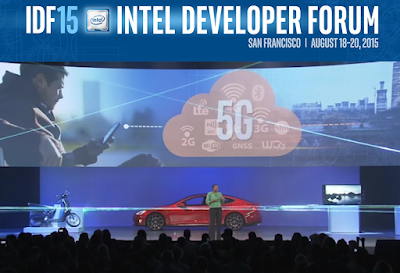
Intel Network Builders Fast Track Targets 5G


Intel intends to leverage its unique combination of computing, networking and wireless communications assets "to develop 5G solutions that integrate intelligence across the entire network, end-to-end, from the data center to device and throughout systems in between." Intel has launched a Network Builders Fast Track to guide its efforts with the networking industry in accelerating innovation in the 5G ecosystem. Under the program, Intel is collaborating...


EC Project SESAME Targets 5G with RAN Virtualization + Edge Computing


The European Commission has awarded EUR 8 million grant to a consortium of telecom industry vendors to develop the infrastructure required to support the future 5G network and communication systems. Project SESAME, which is led by Hellenic Telecommunications Organization (OTE) and funded under the EC Horizon 2020 programme (H2020), will design and demonstrate virtualised, cloud-enabled, multi-operator, frequency agile, 5G-oriented radio access and...


Ericsson and SK Telecom Collaborate on 5G Network Core Slicing


Ericsson and SK Telecom have signed agreed to collaborate on the development of a 5G core network that deploys network slicing technology.  The idea behind slicing is to use logical instead of physical resources to provide networks on an as-a-service basis. The instantiation of the network slicing will use the Ericsson Virtual Evolved Packet Core solution. The companies are building a test bed using Ericsson’s HDS 8000 Hyperscale Datacenter...


DOCOMO Expands 5G Collaboration Program


NTT DOCOMO is expanding its industry collaboration program for 5G.  The company announced individual collaborations with five additional vendors: Intel, Keysight Technologies, Panasonic Corporation, Qualcomm Technologies, and Rohde & Schwarz GmbH & Co. DOCOMO and its vendor-partners expect to begin technical discussions and various indoor trials at the DOCOMO R&D Center in Yokosuka, Kanagawa Prefecture within the current fiscal...


ZTE and KT Collaborate on 5G Research


ZTE has signed a strategic cooperation agreement with KT Corporation on research and commercialization of 5G technology. Specifically, ZTE and KT will launch 5G Test Bed construction in Seoul, and jointly develop, present, and design the future 5G network architecture based on the Test Bed. The partnership between ZTE and KT will help advance 5G standardization and the development of the industry ecosystem globally. The agreement was announced at...


FANTASTIC-5G Targets sub-6 Ghz Air Interface


A group of 16 leading players in the field of telecommunications kicked off the “FANTASTIC-5G Project” (Flexible Air iNTerfAce for Scalable service delivery wiThin wIreless Communication networks of the 5th Generation) with the aim of developing a new air interface below 6 GHz for 5G networks. Specifically, the 2-year FANTASTIC-5G project will develop a new multi-service air interface that is: Highly flexible, to support different types of data...


Ericsson Heads METIS-II 5G Radio Project


Ericsson will serve as coordinator of anew METIS-II EU project to develop the overall 5G radio system design and roadmap recommendation for 5G standardization. The METIS-II project brings together 23 partners from all regions with strong 5G R&D initiatives (China, the EU, Japan, South Korea and the US) and involving most of the major international vendors, major operators, and key researchers. On a strategic level, METIS-II will provide the...


Xilinx Collaborates with China Mobile on 5G Fronthaul Interface


Xilinx is working with China Mobile Research Institute (CMRI) for the development of the next generation fronthaul interface (NGFI) for 5G. Fronthaul is the link between the baseband and radio units, which are expected to be distributed in 5G architectures. Specifically, Xilinx is contributing to the NGFI eco-system with a validated NGFI reference design on its Zynq SoC platform. The reference design, which can easily be migrated to other Zynq and...


5G Novel Radio Multiservice Adaptive Network Project Gets Underway


to develop a novel, adaptive and future-proof mobile network architecture for the 5G era. As part of the 5GPPP initiative, vendors, operators, IT companies, enterprises and academia in Europe are joining forces to launch the 5G NORMA (5G Novel Radio Multiservice adaptive network Architecture) project. The 5G NORMA project, which is expected to run for 30 months, will propose an end-to-end architecture that takes into consideration both Radio Access...

Interoute to Acquire Easynet for £402 million

Interoute agreed to acquire European managed services provider Easynet for an enterprise value of £402 million.

Interoute said the acquisition will enable enterprise, government and service provider customers of the merged group to access a full suite of the combined companies products and services. In addition to increased products and services, the acquisition will bring an enhanced and expanded set of skills and capability to serve both companies’ existing customers and new prospects across the world. On a pro forma basis, after giving effect to the acquisition, Interoute would have had total revenue of over €700 million in the twelve months ended 30 June 2015.

Gareth Williams, Interoute's CEO commented, "These are exciting times for Interoute and our customers as we create a leading, independent European ICT provider. It's the next step in our acquisition strategy and moves us much closer to our goal of being the provider of choice to Europe’s digital economy."

Mark Thompson, CEO of Easynet, commented, "I believe this acquisition will bring great benefits to both Interoute's and Easynet’s customers. The combined companies can offer broader and deeper connectivity options, as well as an expanded portfolio of products and services, and the acquisition will further expand an already market-leading cloud hosting capability in Europe."

http://www.interoute.com
http://www.easynet.com/us/en/

Equinix Bids for Japan's Bit-isle Data Centers

Equinix announced a cash tender offer for all issued and outstanding shares of Tokyo-based Bit-isle Inc. The offer price is JPY 922 per share, in an all cash transaction totaling 33.3 billion Japanese Yen or approximately US$280 million.

Bit-isle operates five data centers in Tokyo and one in Osaka.  These facilities are in close proximity to the existing Equinix International Business Exchange (IBX) data centers in Japan creating campuses for customers’ future expansion needs. Bit-isle has a strong Japanese enterprise and system integrator customer base, including some of Japan’s largest businesses.

Equinix said the acquisition of Bit-isle will make it the fourth largest data center operator in Japan. After the completion of TY5 in Q1 2016, Equinix will have 10 IBX data centers in Tokyo and two in Osaka.

The Bank of Tokyo-Mitsubishi has committed to provide a one-year senior bridge term loan facility to fund the acquisition.

http://www.equinix.com/company/news-and-events/press-releases/equinix-plans-to-expand-data-center-footprint-in-japan-through-acquisition-of-bit-isle/

Fortinet Outlines Software-Defined Network Security Framework

Fortinet introduced its new Software-Defined Network Security (SDNS) framework for providing advanced threat protection in the modern, agile data center.

Fortinet said its goal is to provide actionable steps in delivering a comprehensive approach to securing the data center, while providing the most extensible platform for infrastructure integration with technology partners including HP, Ixia, PLUMgrid, Pluribus Networks, Extreme Networks and NTT.

Highlights of Fortinet's SDN Security framework:


  • Data Plane - the encapsulation of security engines from fixed hardware boxes into logical instances that can be more scalably distributed and embedded deep into virtualized switching fabric and abstracted network flows.
  • Control Plane - the orchestration and automation of security policy with provisioning of elastic workloads to eliminate security and compliance gaps in highly agile, dynamic environments.
  • Management Plane - a 'single pane-of-glass' for security policy and events across physical and virtual appliances, private and public clouds, and throughout converged infrastructure to ensure a consistent and compliant security posture.

"There is likely no single SDN platform that all enterprise and service provider customers are going to standardize on," said John Maddison, vice president of marketing for Fortinet. "Hence the reason we are developing an eco-system to support different SDN platforms through proprietary and open Application Programming Interfaces (API's). The key is providing scalable security modules that can be called on-demand, at the orchestration level."

Fortinet noted that it is working closely with a large number of partners to tightly integrate security within their key infrastructure platforms. These platforms include SDN controllers, orchestration frameworks, hypervisors, cloud management, security management and analytics. Fortinet is currently working with more than two-dozen technology providers to ensure protection from cyber threats through Fortinet's advanced SDN Security.

http://www.fortinet.com

Azimuth Intros HetNet Emulation Testing

Azimuth Systems introduced a HetNet-environment emulation capability, called Virtual Network Environment (VNE), for its ACE RNX platform.

The company said its solution unlocks repeatable, scalable HetNet testing by (1) defining interfering cells; (2) creating a HetNet environment that uses those cells; and (3) developing test scenarios specifically for that environment. Early customer trials have shown a significant reduction in the time to recreate field issues using VNE.

“As experts in wireless performance test solutions, we anticipated how the proliferation of HetNet environments would be a disruptive challenge in the industry. HetNet makes most of existing lab-based technology inadequate for testing,” says Peter Paglia, president and CEO of Azimuth Systems. “So, as we led the industry from SISO to MIMO, and from RvR & RvN to field playback, we are leading the industry from link testing to true environment testing. ‘Re-creating the wireless environment’ is something we saw as necessary for realistic lab-based testing. We are pleased that Azimuth Systems is the only test equipment vendor to have the vision to introduce this capability into the industry. We are looking forward to partnering with our customers to tap the power provided by VNE.”

Controlling the ACE RNX and VNE is Azimuth’s Director 3, a powerful and forward-looking test executive known for its advanced automation, cloud-based architecture, and intuitive test creation capabilities. Included within Director 3 is a graphical, easy-to-use interface called Scenario Builder, a first-in-the-industry wizard that helps users easily define complex environments and create numerous test and mobility scenarios. Once an environment is created in Scenario Builder, the software automatically programs the RNX, greatly facilitating and accelerating the testing process.

http://www.azimuthsystems.com

ONF Releases OpenFlow v1.3 Testing Specification

The Open Networking Foundation (ONF) released a new OpenFlow v1.3 testing specification.

The ONF also announced the addition of its seventh authorized testing facility, the Electronics and Telecommunications Research Institute (ETRI) in South Korea. This brings to seven the number of accredited international testing laboratories, including: Beijing Internet Institute (BII) in Beijing; China Telecommunication Technology Labs (CTTL) in Beijing; Criterion Network Labs (CNLabs) in Bangalore; Indiana Center for Network Translational Research and Education (InCNTRE) at Indiana University; Network Benchmarking Lab (NBL) of National Chiao Tung University (NCTU) in Hsinchu, Taiwan; and the University of New Hampshire InterOperability Lab (UNH-IOL) at the University of New Hampshire.

“OpenFlow is a component vital to SDN’s acceleration and deployment worldwide and is increasingly being demanded by network operators,” said Dan Pitt, executive director of the Open Networking Foundation. “OpenFlow plays a key role in SDN as an architecture, a model, and an interface. Operators are also demanding interoperability and conformance to the standard, and this specification helps achieve exactly that.”

https://www.opennetworking.org/certification/product

Monday, September 7, 2015

Blueprint: Shining Light in New Directions with CDC-F

Remarkable improvements for optical networks on the horizon with CDC-F technology

by Scott Larrigan

Optical networks support everything we do online — from email and video conferencing at work to social media and streaming video at home. This demand for more and faster data communication is putting extreme pressure on the capacity of our optical networks.  However, the arrival of a new technology is set to dramatically ease this pressure and make optical networks much more efficient.

Known technically as Colorless, Connectionless, Contentionless with FlexGrid support — but referred to more simply as CDC-F wavelength routing — this technology allows the limited number of photonic light paths, or wavelengths, to be dynamically routed throughout an optical network almost as easily as a person shining a flashlight in a new direction. While it is a truly remarkable technology from a physics perspective, it is also remarkable from a business perspective, significantly reducing network cost of ownership and providing the foundation for high capacity Cloud access and SDN-based agility.

Traditional Use of Wavelengths in Optical Networks

Currently, most optical networks deploy multiple static wavelengths between devices to connect our data communications traffic electrically.  In the past these devices included SONET/SDH add/drop multiplexers, but today are mainly comprised of Optical Transport Network (OTN) switches, Ethernet switches and IP/MPLS routers.

The main reasons for this type of static wavelength deployment architecture were the lack of sophisticated software and economical photonic components. In the past, advanced optical components operating on the photonic level could not be packaged into devices and deployed in large numbers across a network economically. The software needed to route wavelengths more dynamically throughout the optical network didn’t have the required Operations, Administrative and Management (OAM) capabilities to monitor, troubleshoot and assure end-to-end wavelength performance.

Initially, these barriers were not a significant issue for the creation of efficient optical networks because service connectivity capacities were a smaller percentage of the capacity of the transporting wavelength. Hence, electronic switching was required to fill wavelengths to efficient carriage capacities.

In addition, service connectivity demands involved inter-connecting distributed compute and storage for enterprise sites. This resulted in many service connections with different source and destination endpoints spread out throughout the network and the need for electrical devices to efficiently fill transport wavelengths between these endpoints. Finally, the benchmark for service creation time intervals was in the timeframe of days, if not weeks. So if a new wavelength was required, or needed to be re-routed, there was no competitive pressure to accelerate these time intervals.

New network demands on optical networks

Today, new capacity, architectural and agility demands are being placed on optical networks:

  • Service connectivity capacities match, or even exceed, the capacities of the foundational transport wavelength capacities.  For example, routers with 100GE interface capacities match the speeds of foundational 100G optical transport wavelengths.
  • Service traffic demands are moving from inter-connecting sites with distributed compute and storage to connecting sites to more centralized Cloud compute and storage services.  Hence, higher service capacities will be required to interconnect enterprise sites to large Cloud compute and storage data centers. 
  • Cloud data centers may utilize NFV (network function virtualization) architectures to interconnect sites with high levels of distributed storage and compute, resulting in the need for higher capacity services to interconnect them. 
  • With the advent of SDN, service creation times are expected to be in seconds. This new service creation agility is expected to use network resources more intelligently and support new types of revenue generating services that can have short, or time-of-day based lifetimes.

All of these factors are changing the way optical networks have to be designed and operated going forward. One reason is that there are now ways to efficiently fill transport wavelengths closer to service endpoints, which means fewer electrical touch points are needed to efficiently fill them. In fact, as soon was a wavelength is efficiently filled to 100G capacity levels the most economical way to route this wavelength light path is by keeping it in its native light form rather than convert it to and from electrical signals using electrical switching devices.

In addition,connectivity services can have much shorter lifetimes than before because of the rapid service creation capabilities of SDN.  This new dynamism makes the optimal deployment of the limited number of wavelengths more difficult, resulting in sub-optimal fragmented wavelength deployments that limit network capacity growth and increase network TCO.

CDC-F Technology Turns on a New Light

CDC-F — or Colorless, Connectionless, Contentionless with FlexGrid support — offers unprecedented agility for optical networks. However, like a number of technology acronyms it only conveys its true meaning to people working in a specific technology field. Here is what CDC-F technology is and what it can do inside the transport network.

  • “Colorless” means that it can dynamically change a wavelength frequency, or color of light.  Without colorless technology our data communications wavelengths are mapped to a fixed color of light, with no way the change it unless a card supporting a different color of light was used.  New “colorless” cards/modules support multiple colors of light with only software control required to change between colors.
  • “Directionless” means we can route wavelength light paths throughout a maze of intersecting fiber optical cables supporting traffic from different geographic directions without any manual reconfiguration of the network.
  • “Contentionless” allows us to make better use of the limited number of wavelengths that we have to support optical networks.  We can more easily deploy wavelengths that use the same frequency/color of light throughout an optical network provided that wavelengths of the same frequency don’t merge, or contend, for the same fiber optic cable.
  • Having “Flex-grid support” permits the creation of ultra-high capacity super channels comprised of several wavelength frequencies rather than just one frequency.  This is achieved by supporting a more flexible wavelength spectrum allocation grid together with the support of logical super channels comprised of several wavelength frequencies. 

When combined with the right wavelength routing control and OAM software, all the capabilities above provide the foundational agility to route wavelengths throughout optical networks almost as easily as a person shining a flashlight in a new direction.  This happens under software control, with no operational truck rolls required.

Wavelength routing technology allows optical networks to be more dynamic, enabling new tools that can optimize wavelength utilization in a network.  This type of optimization can lead to 35% network TCO improvements including greener networks that require less power.

However, the true value of CDC-F wavelength routing technology is that it provides the foundation of SDN- and NFV-based architectures that many optical network operators around the world are moving toward for the future.

Wavelength routing can facilitate the creation of these architectures because it addresses the SDN agility demands for a more dynamic and flexible network. For example, high capacity wavelengths can be more easily created and routed throughout the optical network to support the interconnection of Cloud datacenter virtualized compute and storage, and high capacity end user access to these datacenters. Wavelength capacities can also be increased by wavelength routing without having to change the wavelength routing hardware.  This trait has never been seen before in networks.

About the Author

Scott Larrigan is Senior Marketing Manager, IPR&T Product and Solution Marketing, Alcatel-Lucent, where he is responsible for marketing the company's IPRT portfolio including optics, microwave, and mobile backhaul. For years, Scott has been supporting an IP packet over optics network evolution and the optimization of mobile networks to support 2G, 3G, and 4G/LTE over a common packet network. Scott has over 20 years experience in the telecom industry with roles ranging from marketing, business development, product management, and R&D. He holds a Bachelor of Science (BSc) degree, specializing in computer science, from the University of Manitoba in Canada. He also is a co-author of 4 patents related to IP networking technologies.


Got an idea for a Blueprint column?  We welcome your ideas on next gen network architecture.
See our guidelines.

Global LTE Subscriptions Pass 750 Million

The number of LTE endpoints worldwide passed 755 million as of 30-June-2015, according to figures from Ovum cited by the Global mobile Suppliers Association (GSA).

Some other mid-year 2015 milestones noted by GSA:

  • 441 million LTE subscriptions were added in the past year, equivalent to 140% annual growth. 
  • For the first time LTE exceeded ten percent share (10.44%) of the worldwide subs total for all mobile technologies. GSA forecasts over 1 billion LTE subscriptions worldwide by the end of 2015.
  • LTE subscriptions increased by 113.5 million in Q2 2015, which is over 52% higher than for 3G/WCDMA-HSPA which gained 74.4 million. GSM subscriptions fell by over 98 million in the quarter.
  • APAC increased its share of global LTE subscriptions to 51.2%. North America has almost 200 million LTE subscriptions (198 million) and remains the second largest LTE market, though its share reduced to 26.2% of the global total compared with 42.4% a year earlier. 
  • European share remained at around 16% and the total number of LTE subscriptions across Western Europe markets has just passed 100 million.
  • Strong growth was seen in the Latin America and Caribbean region which now has over 22.5 million 4G/LTE subscriptions and over 17.2 million higher than a year ago, equivalent to 324% annual growth. A strong performance for LTE was also achieved in the Middle East where more than 1 million LTE subscriptions were added monthly. The region has 23.7 million LTE subscriptions and an annual growth of 194%. Russia has almost 3x the number of LTE subscriptions compared to one year earlier.
  • By June 2015, China had passed 225 million LTE subscriptions, 63.5 million in Q2 alone.
  • 422 operators have commercially launched LTE systems in 143 countries, according to GSA data announced in July 2015. GSA forecasts there will be 460 commercially launched LTE networks by end 2015. 
  • LTE-Advanced deployments have taken hold in all markets around the world. Now over 30% of operators are investing in LTE-Advanced system deployments, with the commercialisation of carrier aggregation the first feature to be exploited. 88 operators, i.e. over 20% of all LTE operators, have commercially launched LTE-Advanced service in 45 countries. 
  • 15 LTE-Advanced networks support Category 4 devices (above 100 Mbps up to 150 Mbps peak downlink speed) while 73 networks support Category 6 devices (above 150 Mbps up to 300 Mbps). 
  • The number of LTE and LTE-Advanced subscriptions is expected to pass the 3G/WCDMA-HSPA global total in 2020.

http://www.gsacom.com/


Nokia Unveils 5G "System-of-Systems" Architecture

Nokia Networks unveiled its programmable 5G architecture with the ability to reshape radio and core networks in real time to adapt to changing demands.  The goal is to enable Network-as-a-Service for operators to offer network functions to other industries. The announcement outlines key principles of this architecture and its suitability to address a variety of 5G use cases.


In a nutshell, Nokia will leverage the concept of network slicing in a fully self-aware software defined transport infrastructure that automatically adapts itself to changing service requirements.  This is achieved by Self-Organizing Networks (SON) for transport solution in combination with a multivendor Software-Defined Networking (SDN) fabric control that acts across SDN domains. The network control does not need to talk to every SDN controller since a single Rest Application Programming Interface (API) is used. Similarly, Nokia Networks is also introducing programmable APIs to the virtual core network elements to be able to adapt core network behavior in run time.

Nokia said its enables the core network to adapt to dynamically changing needs, such as the creation of new network slices or mobility profiles, either immediately or on demand.

“Nokia Networks is leading industry-wide 5G architecture work through various vehicles such as the 5G-Public Private Partnership (5G-PPP) project 5G NORMA (5G Novel Radio Multiservice adaptive network Architecture). With our cognitive and cloud-optimized architecture for the 5G era, we have outlined an end-to-end architecture that will allow unprecedented and cognitive customizability to meet stringent performance, security, cost, and energy requirements," stated Volker Ziegler, Chief Architect at Nokia Networks.

Key architecture functionalities:

  • Network Slicing: Multiple independent and dedicated virtual sub-networks (network instances) are created within the same infrastructure to run services that have completely different requirements on latency, reliability, throughput and mobility. 
  • Dynamic Experience Management (DEM): Automatic Quality of Experience (QoE) optimization of each application session provides superior customer experience even under high network load using up to 30 percent fewer resources. DEM can already be deployed in today’s networks. 
  • Service-determined connectivity: Conventionally, the network’s available connectivity determines what services are possible. In 5G, devices and services are no longer tied to a single point to point IP connection. In fact, the connectivity path can be freely chosen according to actual service demand. By enabling a service to determine the connectivity, the required latency and reliability can be assured by the network. 
  • Fast traffic forwarding: A distributed telco cloud structure, enabled by the Nokia AirFrame Data Center Solution, will support a new generation of critical services in such sectors as automotive and industrial. 
  • Mobility on demand: A wide range of mobility needs can be met, from stationary utility meters to high-speed trains. Typically, only 30 percent of users are mobile and do not need mobility support, providing an opportunity to use network resources more efficiently. 

http://networks.nokia.com/news-events/press-room/press-releases/nokia-networks-unveils-its-programmable-5g-multi-service-architecture-networksperform

Nokia Expands its Telco Cloud Portfolio

Nokia Networks announced a number of improvements and enhancements in its telco cloud portfolio, including the new Nokia OSS Office for Telco Cloud, the Nokia AirFrame Data Center Solution (now also available in a container), the intelligent Nokia Service Chaining and Nokia cloud wise Care Services.

Some highlights:

  • The Nokia OSS Office for Telco Cloud solution is a service to help operators plan their best path for transforming their network and service operation centers for the telco cloud.  This includes planning from high level strategy to processes, tools and use cases. 
  • The Nokia AirFrame Data Center Solution is now available as a containerized solution with an efficient power and cooling system built-in. It can simply be dropped into place to cater for peak demand or to provide localized telco and IT services. A software-defined storage (SDS) module has also been introduced to provide flexible data storage pools within the data center environment.
  • Nokia Service Chaining provides greater efficiency and management through a virtualized service environment for the delivery of network services. Dynamic service functions, such as firewalls and media optimizers, can easily address peak loads and intelligently steer traffic. These scalable and best-of-breed functions can be implemented within the telco cloud at a fraction of the cost required for conventional networks. Nokia also launched third party appliance certification as well as implementation and integration services for service chaining.
  • Nokia cloud wise Care Services: two new service packages to help operators run and maintain their deployed telco cloud networks. Nokia Resolution Prime Services provides operators with a single point of contact and service management for resolving VNF faults within a complex multivendor telco cloud network. Nokia TotalCare for VMWare, a newly launched care package, supports operators’ VMWare deployments with an extended SLA covered by the company.

http://networks.nokia.com/news-events/press-room/press-releases/nokia-networks-launches-help-operators-execute-strategic-decisions-in-cloud-transformation