Wednesday, December 18, 2019

Internet2 to move onto CenturyLink’s new low-loss optical fiber

by Benedict Chua, Assistant Editor

Internet2 will migrate the majority of its footprint onto CenturyLink's new low-loss optical fiber.

CenturyLink recently pulled new, low-loss optical fiber over a large portion of its national network. The installation uses an ITU-T G.652.D compliant single-mode optical fiber that is optimized for high bit rate coherent systems using advanced modulation schemes supporting 100G and above. CenturyLink also realigned amplifier spacing to create more efficient resources for optimized optical networks.

Internet2 said the move will support its new all-coherent open-line system. CenturyLink has also been selected to provide the professional services to migrate Internet2 to its new platform, which will be equipped with a flex-grid open-line system being provided by Ciena. The new contractual fiber-use agreements will extend through at least 2042. Internet2 will have the ability to reach anywhere on its domestic footprint with an unregenerated wavelength of up to 200G. Many high-use spans on Internet2’s Network will also support 400G and 800G wavelengths with existing technologies and higher bitrates are expected in the coming years as new DSP technology comes into production. Internet2 has been able to achieve unregenerated spans without employing Raman amplification, a reduction in complexity and improved efficiency both at installation and for ongoing operations.

“We believe the combination of the most advanced fiber from CenturyLink with the latest coherent transmission technologies from Ciena provides enormous opportunities to enable research and academic pursuits in the United States,” said Rob Vietzke, vice president of network services for Internet2. “Whether it is tracking the origins of Neutrinos in the Antarctic, comparing gene sequences or studying the climate, this new optical network, with its ability to span very long distances at very high bandwidths and improved efficiency, is essential to providing the best research infrastructure for data-intensive science on the globe.”

“One of America’s leading research and education organizations placed its trust in CenturyLink to upgrade its network to a high-speed, high-capacity, fiber-optic network that will support today’s leading-edge research projects,” said Sonia Ramsey, CenturyLink’s vice president for the state and local government and education market. “Internet2’s selection of CenturyLink recognizes the company’s long-standing relationship with the research and education community and our commitment to meet the community’s ever-increasing advanced technology needs.”     

https://www.internet2.edu/news/detail/17474/

Internet2 to deploy open line system (OLS) from Ciena

by Benedict Chua, Assistant Editor

Internet2 will deploy a flexible grid open line system (OLS) from Ciena to transform its network to a more scalable, programmable and adaptive architecture.

The upgraded network, which connects several hundred universities, government agencies, and community anchor institutions across the U.S., strengthens Internet2 and the wider R&E community’s ability to conduct scientific research, enhance collaboration, and improve operations.

The OLS element will provide access to a highly reliable, contiguous coherent optical network that can facilitate wavelength delivery and efficient data transfer throughout the continental United States. The OLS also includes Ciena’s commitment to support wavelengths launched directly from Internet2’s member networks for transport to strategic endpoints beyond their regional footprints.

Specifically Internet2 will deploy Ciena’s latest-generation Waveserver – powered by WaveLogic 5 Extreme – programmable 200G-800G coherent optics to enable Internet2 to deploy 800G wavelengths in metro locations and support efficient 400GE interconnect over native 400G wavelengths between Internet2 points-of-presence system-wide.

Ciena said Internet2’s deployment will reduce the overall space and power footprint of the current optical add-drop locations by as much as two-thirds, contributing to a lower cost and greener network that supports substantially more capacity. Internet2 will be able to tune, control and dynamically adjust optical capacity across any path using Ciena’s Liquid Spectrum ™ analytics software. Additionally, Ciena’s Manage, Control and Plan domain controller will help improve network management and operations.
Executive Comments:

“Ciena put forth a great proposal that met Internet2’s objectives to efficiently increase capacity, increase optical reach, and support open line system use cases. Together with superior coherent modems and a proven support system, the openness, flexibility and greener profile of this network will play a key role in our ability to accelerate discoveries in the research and education community. We are delighted to have Ciena as a partner in tackling the great research and education challenges of the next decade,” stated Howard Pfeffer, President and CEO, Internet2.

“Internet2 is a trailblazer in the R&E community. They are also leaders in developing collaborative environments that are shaping how future high performance, high capacity networks will be created to fuel the digital society. Ciena worked with Internet2 to establish America’s first nationwide 100G R&E network and this latest initiative will significantly enhance Internet2’s services,” said Rod Wilson, Chief Technologist for Research Networks, Ciena.

Next-Gen-SD-WAN: 2020 Predictions with Nuage's Sunil Khandekar


Nuage Networks saw a lot of traction for SD-WAN in 2019 with their engagement with service providers in all three tiers across the globe. Sunil Khandekar, CEO of Nuage Networks, shares three predictions for SD-WAN and what we can expect to see in 2020.

https://nginfrastructure.com/sd-wan/


CENIC deploys first 400G circuit in Los Angeles

CENIC, the organization that provides global connectivity for education and research institutions in California, has deployed a 400 Gbps single-carrier optical circuit between Los Angeles and Riverside. This marks one of the first-ever 400G superchannels to be deployed by a US regional research and education network. Construction included upgrading nodes in Los Angeles, Tustin, Oceanside, San Diego (home to the San Diego Supercomputer Center), Escondido, Sun City, and Riverside to 400G capabilities.

CENIC upgraded network infrastructure to flex spectrum Reconfigurable Optical Add-Drop Multiplexers (ROADMs) and the NCS 1004 transponder platform. CENIC used Cisco-loaned equipment for the validation in production and is now implementing the permanent infrastructure.

“This is an important networking milestone for CENIC,” said President and CEO Louis Fox. “With increasing demands for 100G services among our community, from research scientists working with big data sets to educators leveraging technology to transform the classroom, network capacity should not limit the work or ambitions of our researchers, teachers, or students.”

CENIC plans to expand its 400G provisioning capabilities along its coastal fiber path from Los Angeles to Sunnyvale by mid-2020.

CENIC’s network traffic continues to grow by roughly 60% each year. Between May 2018 and May 2019, the network moved an exabyte of data.

http://www.cenic.org


Telstra deploys Ericsson's container-based EPC core

Ericsson and Telstra successfully deployed a live cloud-native container-based Evolved Packet Core for 4G and 5G services -- an industry first and a significant milestone in network orchestration and automation, according to the companies..

Ericsson's cloud-native container-based Evolved Packet Core was deployed in Telstra’s production Network Functions Virtualization Infrastructure (NFVi). It is fully integrated into Telstra’s mobile core network and is carrying live 4G and 5G Non-Standalone (NSA) traffic.

Highlights of Telstra’s cloud-native Evolved Packet Core :

  • Ericsson Packet Core Controller and Ericsson Packet Core Gateway support 4G and 5G Non-standalone (NSA) control and user plane functions in both a centralized configuration and edge-breakout configurations.
  • Ericsson’s Packet Core Controller is deployed as a cloud-native container-based Mobility Management Entity (MME) in an existing MME pool.
  • Both the Ericsson Packet Core Controller and Packet Core gateway are designed from the ground up to be fully cloud-native container-based solutions. They run on Ericsson’s Cloud Container Distribution (CCD) that is part of Ericsson’s NFVI solution or on other Cloud Native Computing Foundation (CNCF) aligned distributions.
  • Ericsson CCD provides container management and orchestration for the latest Ericsson cloud native applications. CCD can be run on bare metal or within a Virtual Machine in an OpenStack deployment.

Emilio Romeo, Head of Ericsson Australia and New Zealand, says: “Telstra and Ericsson are leading the mobile industry with this first container-based cloud-native Evolved Packet Core in Telstra’s production environment and carrying live traffic. This is an important step towards fundamentally changing the way both companies deploy and operate mobile core networks. Core networks will become much more flexible and agile, allowing operators such as Telstra to quickly create and deploy compelling new services for their customers. This in turn helps operators build new revenues.”


Silver Peak and Ciena expand NFV partnership

Silver Peak announced expanded collaboration with Ciena to integrate Silver Peak network functions virtualization (NFV) and Ciena universal customer premise equipment (uCPE) to create new service delivery models for communications service providers (CSPs) that bring new levels of flexibility to global enterprise customers.

The companies said Silver Peak EdgeConnect NFV supported by Ciena’s ability to host multiple virtual network functions (VNFs) and Ethernet connectivity services frees CSPs to offer a virtually limitless portfolio of connectivity and enhanced managed SD-WAN services to medium and large enterprises, accelerating new revenue streams.

“As enterprises advance digital transformation and cloud initiatives to gain business agility and competitive edge, many understand the foundational requirement for a modern WAN edge,” said Fraser Street, vice president of technical alliances at Silver Peak. “Cloud-first enterprises are increasingly turning to service providers for turnkey managed SD-WAN services that unite advanced network functions like the EdgeConnect NFV, enabling them to retire legacy WAN infrastructure and fully leverage the power of software that delivers a multiplier effect on cloud investments.”

“With an ongoing surge in demand for network connectivity and services, driven by high-bandwidth content and business-critical applications, the industry is witnessing firsthand how digital transformation impacts the network,” said Brian Lavallée, senior director of portfolio marketing at Ciena. “CSPs and enterprises are actively modernizing their network assets to be increasingly intelligent, agile, and adaptive. Together with Silver Peak, we make this journey possible.”

EE activates 5G in six more UK cities

EE switched on its first 5G sites in six new cities across the UK, bringing its 5G rollout to a total of 50 cities and large towns in 2019.

EE launched with 5G coverage in London, Edinburgh, Belfast, Cardiff, Birmingham and Manchester in May. The new activation includes Hull, Leeds, Newcastle, Nottingham, Sheffield and Sunderland, surpassing its target of introducing 5G to 16 UK cities in 2019. EE has also switched on its first 5G sites in Northampton, Stevenage and Wakefield.

Marc Allera, CEO of BT’s consumer division, said: “We switched on the UK’s first 5G network in May, and this is another milestone towards keeping our customers connected 100% of the time. We’re leading the way in the UK, with 4G and 5G coverage in more places than any other operator. Adding 5G to more cities and towns – and expanding our 5G coverage in each place – is helping us to always deliver the best mobile experience to our customers.”

Telefónica tests flexiWAN SD-WAN on whitebox CPE.

by Benedict Chua

flexiWAN, which offers a modular and opensource SD-WAN, confirmed that with Telefónica os testing its solution.

“Telecom operators should position themselves as Value Added Services (VAS) creators by leveraging their vast commercial and technology ecosystems,” said Juan Campillo, Connectivity Innovation Director at Telefónica. “flexiWAN’s product vision is aligned with Telefónica’s current open networks strategy. Thanks to the openness of solutions like flexiWAN, Telefónica can better control the value chain fostering innovation, reducing complexity as well as adapting the product to companies with less networking knowledge and to a larger variety of enterprise networking needs.”

“Our work with Telefónica allows us to benefit from their vast experience and market reach to enterprises of all sizes and segments as well as to technology companies,” commented Amir Zmora, CEO and Co-founder of flexiWAN. “With this, we enjoy access to leading technology companies for integration and cooperation for enhancing flexiWAN as well as better understanding of the enterprise market needs.”

Tuesday, December 17, 2019

Orange teams with American Tower on new mobile sites in France

Orange, the leading mobile network operator in France, and ATC France, a subsidiary of American Tower Corporation, signed an agreement concerning the deployment of between 900 and 2,000 new mobile network sites located mainly in rural areas and along transport routes over the period 2020-2024.

Orange and ATC France have been working together since 2012 for the deployment and operation of mobile network infrastructure and have thus further reinforced that existing partnership. This agreement makes it possible for ATC France and Orange to pool their expertise for the benefit of their customers and to improve network coverage in France.

The contract with ATC France will enable Orange to support the accelerated deployment of its mobile network and increase the density of its coverage. It will achieve this while allowing Orange to maintain its expertise in the design and construction of network infrastructure and ensuring that the Group retains the necessary mid-term investment capacity to consolidate its leadership across the entire network.

A 20-year hosting service agreement between the two partners means that Orange will benefit from the excellence of ATC France's management and marketing services for mobile network infrastructure and will therefore ensure that the quality of its services across the country will be maintained.

ATC France hosts nearly 5,500 operator contracts across the totality of its sites in operation. Strengthening its partnership with Orange is fully in line with its infrastructure development strategy for its customers and will support the deployment of digital services across the country.

Fabienne Dulac, Deputy CEO of the Orange Group and CEO of Orange France, said: "The nationwide deployment of the network, particularly in rural areas, is a priority for Orange.  We are delighted to be able to enter into this agreement with ATC France, which has proven expertise in terms of infrastructure management. This partnership will enable us to accelerate deployment in these key areas while retaining our capacity for differentiation and our ability to invest in the networks, whether they are fixed or mobile."

Fortinet tops 21,000 SD-WAN customers

Fortinet announced a company milestone: 21,000 organizations across different industries and verticals have adopted its Fortinet Secure SD-WAN solution.

Fortinet delivers full-featured SD-WAN via the FortiGate next-generation firewall.

Fortinet said its security-driven networking approach to SD-WAN seamlessly integrates enterprise-grade SD-WAN, advanced security, and advanced routing in a unified offering to modernize customers’ WAN edge and help achieve their digital innovation goals with FortiManager Orchestration that can scale to support up to 100,000 SD-WAN sites.


https://nginfrastructure.com/sd-wan/

Ericsson and Mediatek test 5G Voice over New Radio (VoNR)

Ericsson has collaborated with MediaTek on performing interoperability tests spanning Stand Alone New Radio (SA NR), 5G Core and IP Multimedia Subsystem (IMS) to ensure that voice support is enabled as service providers evolve their 4G networks to 5G. The two partners have also successfully tested Evolved Packet System (EPS) Fallback for situations where SA is not available.

The interoperability test, which was conducted at the Ericsson Lab in Kista in early December, involved the use of an end-to-end solution from Ericsson and Dimensity 1000 commercial chipset from MediaTek deployed on a 3.5GHz TDD band.

With Standalone New Radio (SA NR), a 5G-enabled device does not need to rely on 4G technology to make 5G voice (VoNR) calls. With the arrival of standalone NR access, voice and other communication services will need to be provided, requiring the 5G network to support native voice calling services for 5G smartphones. Using VoNR on SA architecture, service providers will be able to offer voice services on 5G-voice-capable devices as well as enhanced mobile broadband (eMBB) services to consumers and business users.

Hannes Ekström, Head of Product Line 5G RAN, Ericsson, says: “Although 5G is closely associated with superior data-transfer capabilities, voice services remain essential for mobile users. So 5G phones are expected to provide all the capabilities of 4G phones in addition to new 5G features and services. Ensuring continued voice services on 5G devices must therefore be addressed properly.

CommScope adds sub-6 GHz and mmWave 5G to its FWA gateway

CommScope added support for sub-6 GHz and mmWave 5G New Radio (NR) wireless connectivity on its NVG558 fixed wireless access (FWA) gateway platform, which already supports 4G LTE and 3.5 GHz CBRS connectivity.

CommScope’s NVG558 offers:

  • Dual-band or tri-band 802.11ac (Wi-Fi 5) and 802.11ax Wi-Fi (Wi-Fi 6) options
  • CommScope HomeAssure™ for smart, whole-home Wi-Fi
  • Optional IoT service capability
  • Docker container support for simplified application deployment
  • Deep Packet Inspection support for advanced Wi-Fi management, Quality of Service,and Parental Controls
  • IPTV video optimization

The platform also offers subscriber self-install capabilities to help operators reduce truck-rolls and customer installation wait times, lowering costs and improving the overall customer experience. In addition, all NVG500 Series gateways support Docker® containers. This enables operators to rapidly prototype and deliver new broadband applications and services without having to take the time to integrate them into the platform’s firmware and complete lengthy lab approvals and field trials.

“As operators build out their 5G networks, many want to maximize the value of these networks by using them to offer fixed wireless broadband services to customers,” said Joe Chow, senior vice president and segment leader, Customer Premises Equipment at CommScope. “The new version of the NVG558 offers these operators a flexible platform for delivering customers smart-home devices, video streaming, gaming, virtual reality, augmented reality, and other next-generation services using high-speed 5G NR wireless networks.”

Samsung readies production of Baidu's KUNLUN AI silicon

Baidu’s first cloud-to-edge AI accelerator chip has completed development and will be mass-produced early next year by Samsung Electronics.

Baidu KUNLUN chip is built on the company’s advanced XPU, a home-grown neural processor architecture for cloud, edge, and AI, as well as Samsung’s 14-nanometer (nm) process technology with its I-Cube (Interposer-Cube) package solution.

The chip offers 512 gigabytes per seconds (GBps) memory bandwidth and supplies up to 260 Tera operations per second (TOPS) at 150 watts. In addition, the new chip allows Ernie, a pre-training model for natural language processing, to inference at three times faster than that of conventional GPU/FPGA-accelerating model.

“Baidu KUNLUN is an important milestone for Samsung Foundry as we’re expanding our business area beyond mobile to datacenter applications by developing and mass-producing AI chips. Samsung will provide comprehensive foundry solutions from design support to cutting-edge manufacturing technologies, such as 5LPE, 4LPE, as well as 2.5D packaging.”

“We are excited to lead the HPC industry together with Samsung Foundry,” said OuYang Jian, Distinguished Architect of Baidu. “Baidu KUNLUN is a very challenging project since it requires not only high level of reliability and performance at the same time, but is also a compilation of the most advanced technologies in the semiconductor industry. Thanks to Samsung's state of the art process technologies and competent foundry services, we were able to meet and surpass our goal to offer superior AI user experience.”

“We are excited to start a new foundry service for Baidu using our 14nm process technology,” said Ryan Lee, vice president of Foundry Marketing at Samsung Electronics. “Baidu KUNLUN is an important milestone for Samsung Foundry as we’re expanding our business area beyond mobile to datacenter applications by developing and mass-producing AI chips. Samsung will provide comprehensive foundry solutions from design support to cutting-edge manufacturing technologies, such as 5LPE, 4LPE, as well as 2.5D packaging.”

Cisco amplifies legal case against former employees now at Poly

Cisco is extending its legal case agaist three former employees, James He, Wilson Chung, and Jedd Williams, who are accussed of trade secret misappropriation. Cisco filed the complaint in federal court a few weeks ago and is now amending the case to include their new employer, Poly.

In a blog post, Mark Chandler, Executive Vice President, Legal Services, and General Counsel for Cisco, says the action was taken because of Poly's "repeated efforts to receive and use Cisco trade secrets and confidential information in their business."

https://blogs.cisco.com/news/why-does-poly-protect-employees-who-took-cisco-info

IEEE P802.11ax meets 5G Indoor Hotspot requirements

The IEEE P802.11ax draft standard meets or exceeds requirements specified by the International Telecommunications Union for the 5G Indoor Hotspot and Dense Urban test environments of the enhanced Mobile Broadband (eMBB) usage scenario.

IEEE said this establishes P802.11ax as a foundation for an advanced Wi-Fi technology capable of supporting 5G network performance.

“Achieving 5G performance at the cost points associated with Wi-Fi supports the continued advancement of wireless technology, as well as the exponential growth of mobile wireless device utilization,” said Dorothy Stanley, IEEE 802.11 Working Group chair. “The successful evaluation of IEEE P802.11ax meets the ever-increasing needs of wireless communication, providing higher data rates, increased reliability, and lower latency to better serve the entire industry.”

The methodology specified in the IMT-2020 requirements provides network descriptions, channel models, traffic patterns and other parameters necessary to benchmark performance. The benchmark for compliance to the IMT-2020 requirements for the specific scenario and environments consists of:

  • Minimum acceptable downlink/uplink peak performance,
  • Average user experience,
  • Cell-edge user experience,
  • Mobility performance and latency performance.
  • IEEE P802.11ax was shown to satisfy all the Medium Access Control and Physical Layer (MAC/PHY) requirements for Indoor Hotspot and Dense Urban test environments of the eMBB usage scenario.

Kaloom appoints McGinn as Chairman of Board

Kaloom, a start-up offering a programmable and automated data center fabric,  recently appointed Richard A. McGinn as Board Chairman.

McGinn previously served as CEO of VeriFone Systems, one of the world's largest point of sale terminal vendors and a leading provider of payment and commerce solutions, and CEO of Lucent, a multinational telecommunications equipment company. While at Lucent, McGinn oversaw and directed engineering, research and investments of more than $4 billion annually, and was involved in the acquisition of, or investment in, more than 30 technology companies. McGinn was also a founder and Investor of Sky Capital from 2014 to 2016. Additionally, he was a General Partner of M.R. Investment Partners from 2010 to 2014 and of RRE Ventures from 2001 to 2010.

In addition, Kaloom appointed Hitendra Sonny Soni as Senior Vice President of Worldwide Sales and Marketing.  Soni has previously held executive positions at Snaproute/Infoblox, HPE, CliQr/Cisco, ServiceMesh/DXC, VCE, Accelerated Networks/Calix and Xylan/Alcatel-Lucent.


https://www.kaloom.com/

Monday, December 16, 2019

Intel acquires Habana Labs for $2 billion - AI chipset

Intel has acquired Habana Labs, an Israel-based developer of programmable deep learning accelerators for the data center, for approximately $2 billion.

Habana’s Gaudi AI Training Processor is currently sampling with select hyperscale customers. Large-node training systems based on Gaudi are expected to deliver up to a 4x increase in throughput versus systems built with the equivalent number of GPUs. Gaudi is designed for efficient and flexible system scale-up and scale-out.

Additionally, Habana’s Goya AI Inference Processor, which is commercially available, has demonstrated excellent inference performance including throughput and real-time latency in a highly competitive power envelope. Gaudi for training and Goya for inference offer a rich, easy-to-program development environment to help customers deploy and differentiate their solutions as AI workloads continue to evolve with growing demands on compute, memory and connectivity.

Habana will remain an independent business unit and will continue to be led by its current management team. Habana will report to Intel’s Data Platforms Group, home to Intel’s broad portfolio of data center class AI technologies.

“This acquisition advances our AI strategy, which is to provide customers with solutions to fit every performance need – from the intelligent edge to the data center,” said Navin Shenoy, executive vice president and general manager of the Data Platforms Group at Intel. “More specifically, Habana turbo-charges our AI offerings for the data center with a high-performance training processor family and a standards-based programming environment to address evolving AI workloads.”

Habana Labs chairman Avigdor Willenz will serve as a senior adviser to the business unit as well as to Intel Corporation after Intel’s purchase of Habana.

“We have been fortunate to get to know and collaborate with Intel given its investment in Habana, and we’re thrilled to be officially joining the team,” said David Dahan, CEO of Habana. “Intel has created a world-class AI team and capability. We are excited to partner with Intel to accelerate and scale our business. Together, we will deliver our customers more AI innovation, faster.”


Interview: Habana Labs targets AI processors


Habana Labs, a start-up based in Israel with offices in Silicon Valley, emerged from stealth to unveil its first AI processor. Habana's deep learning inference processor, named Goya, is >2 orders of magnitude better in throughput & power than commonly deployed CPUs, according to the company. The company will offer a PCIe 4.0 card that incorporates a single Goya HL-1000 processor and designed to accelerate various AI inferencing workloads,...

Habana Labs, a start-up based in Tel-Aviv, Israel, raised $75 million in an oversubscribed series B funding for its development of AI processors.

Habana Labs is currently in production with its first product, a deep learning inference processor, named Goya, that is >2 orders of magnitude better in throughput & power than commonly deployed CPUs, according to the company. Habana is now offering a PCIe 4.0 card that incorporates a single Goya HL-1000 processor and designed to accelerate various AI inferencing workloads, such as image recognition, neural machine translation, sentiment analysis, recommender systems, etc.  A PCIe card based on its Goya HL-1000 processor delivers 15,000 images/second throughput on the ResNet-50 inference benchmark, with 1.3 milliseconds latency, while consuming only 100 watts of power. The Goya solution consists of a complete hardware and software stack, including a high-performance graph compiler, hundreds of kernel libraries, and tools.

Habana Labs expects to launch an training processor - codenamed Gaudi - in the second quarter of 2019.

The funding round was led by Intel Capital and joined by WRV Capital, Bessemer Venture Partners, Battery Ventures and others, including existing investors. This brings total funding to $120 million. The company was founded in 2016.

“We are fortunate to have attracted some of the world’s most professional investors, including the world’s leading semiconductor company, Intel,” said David Dahan, Chief Executive Officer of Habana Labs. “The funding will be used to execute on our product roadmap for inference and training solutions, including our next generation 7nm AI processors, to scale our sales and customer support teams, and it only increases our resolve to become the undisputed leader of the nascent AI processor market.”

“Among all AI semiconductor startups, Habana Labs is the first, and still the only one, which introduced a production-ready AI processor,” said Lip-Bu Tan, Founding Partner of WRV Capital, a leading international venture firm focusing on semiconductors and related hardware, systems, and software. “We are delighted to partner with Intel in backing Habana Labs’ products and its extraordinary team.”

https://habana.ai/

Intel ships its Nervana Neural Network Processors

Intel announced the commercial production of its Nervana Neural Network Processors (NNP) for training (NNP-T1000) and inference (NNP-I1000).

The new devices are Intel’s first purpose-built ASICs for complex deep learning for cloud and data center customers. Intel said its Nervana NNP-T strikes the right balance between computing, communication and memory, allowing near-linear, energy-efficient scaling from small clusters up to the largest pod supercomputers. Both products were developed for the AI processing needs of leading-edge AI customers like Baidu and Facebook.

Intel also revealed its next-generation Movidius Myriad Vision Processing Unit (VPU) for edge media, computer vision and inference applications. Additionally, Intel’s next-generation Intel Movidius VPU, scheduled to be available in the first half of 2020, incorporates unique, highly efficient architectural advances that are expected to deliver leading performance — more than 10 times the inference performance as the previous generation — with up to six times the power efficiency of competitor processors.

“With this next phase of AI, we’re reaching a breaking point in terms of computational hardware and memory. Purpose-built hardware like Intel Nervana NNPs and Movidius Myriad VPUs are necessary to continue the incredible progress in AI. Using more advanced forms of system-level AI will help us move from the conversion of data into information toward the transformation of information into knowledge,” stated Naveen Rao, Intel corporate vice president and general manager of the Intel Artificial Intelligence Products Group.

“We are excited to be working with Intel to deploy faster and more efficient inference compute with the Intel Nervana Neural Network Processor for inference and to extend support for our state-of-the-art deep learning compiler, Glow, to the NNP-I,” said Misha Smelyanskiy, director, AI System Co-Design at Facebook.


Cisco to acquire Exablaze for FPGA-based solutions

Cisco agreed to acquire Exablaze, a privately-held designer and manufacturer of FPGA-based devices aimed at reducing latency and improving network performance. Financial terms were not disclosed.


Exablaze, which is based in Sydney, Australia, is focused on low-latency networking, layer 1 switching, timing and time synchronization technologies, and low-latency FPGA solutions. The company was founded in 2013. Exablaze targets applications such as high-frequency trading (HFT), financial services, high-performance computing, and emerging AI/ML clusters.

https://blogs.cisco.com/news/cisco-corporate-news-december-2019
https://exablaze.com/

Brookfield acquires 130,000 towers from Reliance Jio for $3.7 billion

by James E. Carroll

Brookfield Infrastructure Partners will acquire a 100% stake in a telecom tower company in India from Reliance Industrial Investments and Holdings Limited for US$3.7 billion, of which Brookfield Infrastructure will invest approximately $375 million, with the balance being funded by its institutional partners.

The deal includes approximately 130,000 communication towers that forms the infrastructure backbone of Reliance Jio’s mobile network.

Brookfield says the majority of the towers are connected by fiber backhaul, which provides a unique platform to capitalize on the rollout of 5G and future technologies. Jio is an anchor tenant of the tower portfolio under a 30-year Master Services Agreement, providing a secure source of revenues for the tower company.

“This is a unique opportunity to invest in a large-scale, high-quality telecom business and participate in India’s high-growth data industry,” said Sam Pollock, Chief Executive Officer of Brookfield Infrastructure. “This is an attractive business that offers downside protection with meaningful upside by co-locating equipment from other Mobile Network Operators on the towers, which to-date, have only carried Jio equipment. Further growth is anticipated through a tower build-out program, which is expected to bring the portfolio to approximately 175,000 towers.”


AT&T sells 31 data centers to Brookfield Infrastructure for $1.1 billion


AT&T completed the sale of its data center colocation operations and assets to Brookfield Infrastructure and its institutional partners for $1.1 billion. This includes 18 Internet Data Centers (IDC) in the United States and 13 outside the United States. The colocation data center operations serve a diversified customer base of more than 1,000 companies. Brookfield has established a wholly owned company, Evoque Data Center Solutions ("Evoque"),.

Google Cloud announces security partnerships

Google Cloud Platform announced more than a dozen new solutions with security partners, including:

  • GCP is working with McAfee, Palo Alto Networks, and Qualys to help customers manage the deployment of agent-based endpoint security and vulnerability management solutions automatically and at scale.
  • Palo Alto Networks is expanding its usage of services on Google Cloud to jointly develop new solutions for Anthos and threat detection.
  • McAfee will integrate its MVISION Cloud solution for data security, threat prevention, governance, and compliance capabilities for container workloads with Google Cloud, as well as its endpoint security solution for Linux and Windows-based workloads.
  • Citrix Workspace is now available on Google Cloud. This includes integration with G Suite that provides a single sign-on experience, multi-factor authentication, enhanced security policies for G Suite, web filtering policies for G Suite, and end-to-end visibility and analytics. Also, users will be able to seamlessly authenticate using G Suite credentials early next year to provide simple, secure access to the apps and information they need to do their jobs anywhere, on any device.
  • Exabeam, a leading SIEM vendor, will expand its SaaS Cloud security management platform on Google Cloud, helping customers bring the scale and speed of the cloud to their existing, trusted SIEM platform.
  • ForgeRock will deliver its Digital Identity Platform on Google Cloud. ForgeRock’s platform helps customers build and maintain cloud-ready architecture to automate multi-cloud deployments. ForgeRock joins Google Cloud as a Premier Partner in the identity space and has named Google Cloud as its primary cloud provider for its cloud-native suite of identity products.
  • Fortinet will provide a new reference architecture for customers to connect facilities to Google Cloud with secure SD-WAN solutions, to make its FortiWeb Cloud WAF-as-a-Service available on Google Cloud, and to integrate its FortiCWP service with Google Cloud Security Command Center.
  • Semperis and STEALTHbits are working with GCP to enable customers to manage, audit, and protect their Microsoft Active Directory-dependent apps and workloads running on Google Cloud from service outages, data breaches, and cyberattacks.
  • Tanium will integrate its endpoint security telemetry and Chronicle’s Backstory platform with GCP to provide full visibility into endpoint events across an enterprise.

In addition, Google Cloud Platform is expanding its work with leading systems integrators and managed services providers, including: Deloitte, IBM Security, Wipro, Arctic Wolf, Comm-IT, Cyderes, and Optiv.

https://cloud.google.com/blog/products/identity-security/making-your-cloud-more-secure-through-google-cloud-partners

DE-CIX tops 8 Tbps at Frankfurt Internet Exchange

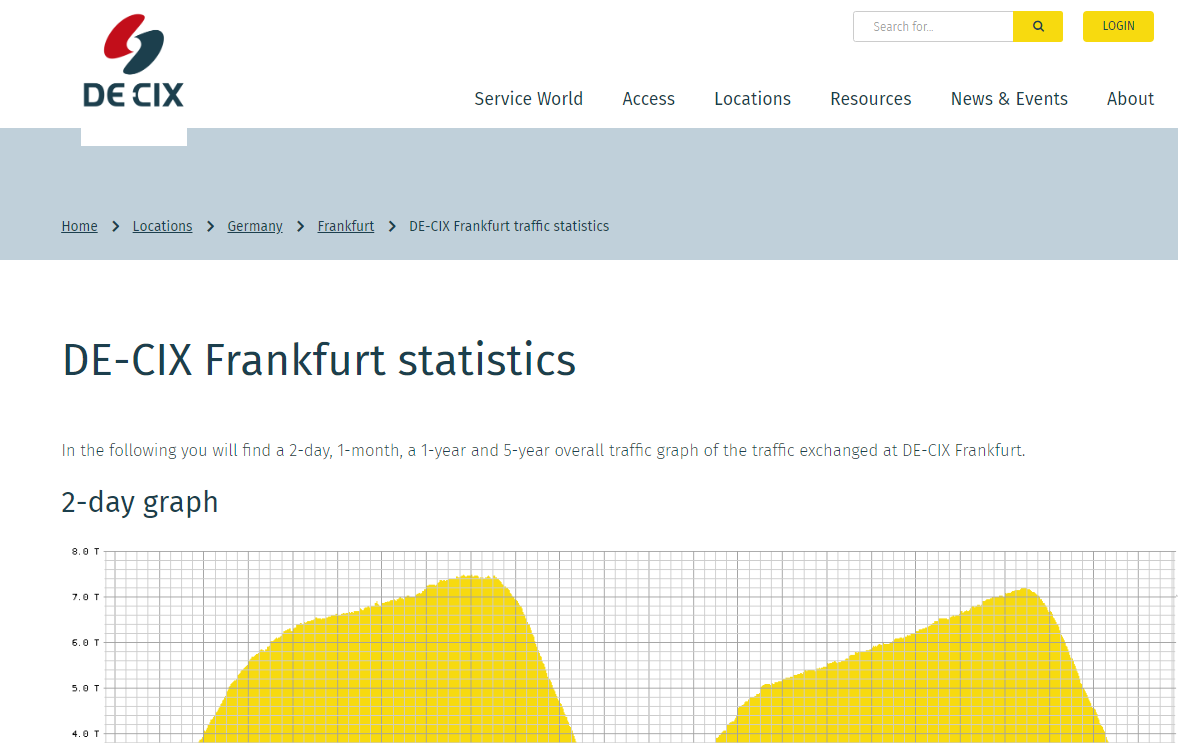
DE-CIX Frankfurt hit a new world record: more than 8.1 Terabits per second across its Internet Exchange. In September, the Frankfurt Internet Exchange handled peak rate of 7.1 Tbps for the first time.

In a timeframe of just a few weeks, data traffic at DE-CIX Frankfurt increased by almost 14 percent at peak times.

“This record figure not only underscores our position in the global market, but also that of the FrankfurtRhineMain metropolitan region as one of the most important data hubs in the world.  We are very happy with the development that we have been able to observe for many years now with regard to data throughput and the customer response to it at DE-CIX in Frankfurt. This data record can be explained purely on the basis of the increase in the number of connected networks since the beginning of the year. Here we were able to record an increase of more than 10 percent, which brings us to just under 950 connected networks. An additional factor coming into play is being in the season when Internet users particularly like to stream films or play online. All of these components contribute to such a record,” says Thomas King, Chief Technology Officer (CTO) at DE-CIX.

Generally, the data traffic at Internet Exchanges moves in waves and reflects the daily rhythm of Internet usage, beginning at 6 am and reaching its peak at around 9 in the evening. Seasonal changes – in summer people tend to be online less than in the fall and winter months – can also be registered.

https://www.de-cix.net/en/locations/germany/frankfurt/statistics