Tuesday, January 17, 2017

HPE to Acquire SimpliVity for Hyperconverged Infrastructure Products

Hewlett Packard Enterprise agreed to acquire SimpliVity, a start-up offering software-defined, hyperconverged infrastructure, for $650 million in cash.

SimpliVity, which is privately held, was founded in 2009 and is headquartered in Westborough, MA. The company’s software-defined, hyperconverged infrastructure is designed from the ground up to meet the needs of enterprise customers who require on-premises technology infrastructure with enterprise-class performance, data protection, and resiliency, at cloud economics.

HPE said the SimpliVity portfolio enables it offer a rich set of enterprise data services across hyperconverged, 3PAR storage, composable infrastructure and multi-cloud offerings.

“This transaction expands HPE’s software-defined capability and fits squarely within our strategy to make Hybrid IT simple for customers,” said Meg Whitman, President and CEO, Hewlett Packard Enterprise.  “More and more customers are looking for solutions that bring them secure, highly resilient, on-premises infrastructure at cloud economics.  That’s exactly where we’re focused.”

http://www.hpe.com
https://www.simplivity.com/

Megaport Teams with Seaborn Cable for South America Coverage

Megaport announced a strategic agreement with Seaborn Networks, which is developing the Seabras-1 cable system, to enable elastic, subsea connectivity services via an online portal to South America.

Seaborn will have its own portal and provisioning platform in line with the existing services that Megaport currently offers. This will enable Seaborn customers to access any of Megaport's 140+ enabled data centres, and also to order from a portal that leverages three years of Megaport's technology and will have continued management and support from Megaport.

Under the alliance, Seaborn will also have exclusive rights to deploy Megaport-enabled broadband on demand solutions inside of South America and for international connectivity to and from South America. This will be the first third party operated Megaport PoP in Sao Paulo, Brazil.

"A strategic alliance such as this with Seaborn Networks, enables us to leverage our unique SDN to provide cloud connections between North and South American enterprises in a flexible, cloud agnostic manner," said Denver Maddux, Megaport CEO. "Seaborn was an easy choice for a strategic alliance and exclusive South American partnership with a long list of mutual benefits, like minded executive teams and a shared desired to disrupt the natural markets using leading technology and software. As Megaport continues to expand our global reach and diversification of services, partners like Seaborn will be a key focus in creating a truly neutral, global platform."

"We share Megaport's vision regarding the opportunity to roll out these broadband-on-demand capabilities on the US-Brazil route as well as throughout other South American markets," said Larry Schwartz, Chairman & CEO of  Seaborn Networks. "We are excited to be able to have the exclusive rights to deploy Megaport's Elastic Interconnection services throughout South America and look forward to working with the Megaport team."

http://www.megaport.com
http://www.seabornnetworks.com

Infinera Upgrades and Expands DTN-X Platform for Cloud-Scale Subsea Networks

Infinera is expanding its DTN-X family with new platforms to power cloud scale subsea networks, where bandwidth demand is rapidly rising due to Internet content providers who are moving content around the globe between data centers. This traffic is dominated by N x 100 Gbps elephant flows. Infinera said subsea operators need to maximize the fiber capacity of their cable plants and simultaneously optimize their networks to efficiently handle these 100 Gbps flows and support smooth scale-out of capacity.

Infinera introduced the XTS-3300 and XTS-3600 meshponders for subsea networks, and upgraded its DTN-X XTC Series to 12 Tbps of non-blocking Optical Transport Network (OTN) switching with a new 1.2 Tbs subsea line card. The solution features dynamic spectral sharing and access to real-time subsea link performance. Some highlights:


  • DTN-X XTS-3300 and XTS-3600 meshponders. The compact 1 rack unit (1RU) and 4RU plug-and-play subsea platforms integrate Infinera's new Infinite Capacity Engine with the Advanced Coherent Toolkit (ACT) for enhanced capacity and reach. The industry’s first meshponders combine 2.4 Tbps super-channels with sliceable photonics and in-flight line-rate Layer 1 encryption in a compact and lower-power form factor. They support Infinera’s unique Instant Bandwidth capability, providing rapid bandwidth management and service provisioning for success-based growth. The XTS Series features long-reach subsea-optimized modulation formats providing best-in-class capacity, as well as the industry’s first commercially available Nyquist subcarriers to improve transmission performance and soft-decision forward error correction (SD-FEC) gain sharing to maximize capacity. The new platforms seamlessly interoperate with Infinera’s DTN-X XTC and XT Series, providing a unified end-to-end Intelligent Transport Network portfolio that enables end-to-end services covering subsea, long-haul, metro and data center interconnect applications.
  • DTN-X XTC Series upgrade. The Infinera DTN-X XTC-4 and XTC-10 have been upgraded with subsea-optimized and Instant Bandwidth-enabled 1.2 Tbps line modules. The XTC-4 and XTC-10 platforms now have more than twice the switching and transmission capacity, enabling up to 12 Tbps of OTN switching via non-disruptive in-service upgrades. The new line modules coexist with previously deployed modules, thereby protecting prior investments in DTN-X platforms. The DTN-X XTC Series now offers up to 12 Tb/s of non-blocking switching capacity with ODU0-level switching granularity in a single unit, and unlike competitive systems, has no tradeoffs between client-side tributary capacity and line-side capacity.
  • New subsea software tools for open systems. Dynamic spectral sharing enhances Infinera’s open architecture, allowing subsea operators to partition and monetize valuable fiber spectrum so that it can be securely shared with multiple tenants, independent of both cable and submarine line terminal equipment suppliers. Mission-critical subsea link performance data is available in real time, on-demand, via open software-defined network application programming interfaces. This enables subsea operators to monitor transmission health as well as identify opportunities for capacity adjustments. In addition to these new tools, Infinera’s Time-based Instant Bandwidth enables operators to instantly change network capacity as well as duration, facilitating a dynamic Intelligent Transport Network. Now operators can closely match traffic patterns to address bursty service demands from customers, match bandwidth to revenue, and instantly reroute bandwidth in the case of network disruptions.
Infinera is also expanding the capabilities of its  Advanced Coherent Toolkit, which increases capacity and reach on submarine cables to include Nyquist subcarriers and SD-FEC gain sharing, 3QAM (quadrature amplitude modulation), matrix-enhanced phase-shift keying (ME-PSK) that surpasses binary phase-shift keying (BPSK) reach performance, and a new, high-gain SD-FEC algorithm.

Infinera has validated the benefit of Nyquist subcarriers in customer trials demonstrating approximately 20 percent increase in reach compared to single carrier transmission, facilitating increased capacity via higher spectral efficiency. The trials also validated SD-FEC gain sharing in which high-margin carriers share excess margin with carriers at lower optical signal-to-noise ratio (OSNR) to improve performance, increasing capacity. These new capabilities are controlled by Infinera’s Xceed Software Suite and managed by Infinera’s Digital Network Administrator (DNA).

The XTS-3300 platform is planned for availability in the second quarter of 2017, with the XTS-3600 platform and the 1.2 Tb/s subsea line module for the XTC-4 and XTC-10 platforms to follow shortly thereafter.

“Infinera is committed to bringing advanced features to the subsea market. The XTS Series offers unprecedented ease of installation and scale-out, advanced transmission performance, and the power of Instant Bandwidth to deliver real value to cable system operators,” said Scott Jackson, Vice President of Subsea Business Group at Infinera. “The new capabilities announced today deliver leading capacity and reach, and provide the tools essential for cloud scale subsea networks. We are pleased to show Infinera’s investment in the subsea market, with solutions enabling operators to rapidly and cost-effectively deliver scalable services across open networks.”

https://www.infinera.com/subsea-networks-to-cloud-scale-with-new-dtn-x-platforms/

Transpacific Hawaiki Cable Completes Route Survey

Hawaiki, a new 14,000 km transpacific cable system, has finished route survey work and is on schedule for completion in mid-2018. Hawaiki will link Australia and New Zealand to the mainland United States, as well as Hawaii and American Samoa, with options to expand to several other South Pacific islands.

Additionally, cable and repeater manufacturing for the system continues unabated at SubCom’s Newington, N.H. USA facility, while the permitting process for implementation of Hawaiki is progressing as planned.


Highlights:

  • SubCom has completed the route survey for the entire Hawaiki system, including the small boat, shallow water work for all landings.
  • Manufacturing continues at SubCom’s facility, with more than 4,500 km of completed cable and more than 25 completed repeaters.
  • Production of Hawaiki branching units, which will enable the connection of American Samoa, New Caledonia, Fiji and Tonga, has commenced.
  • The permitting process for Hawaiki is well under way, with Australian installation permits already issued and additional landing permits filed in Oregon, Hawaii and New Zealand.
  • Hawaiki will be the highest cross-sectional capacity link between the U.S. and Australia and New Zealand.
  • The system was co-developed by New Zealand-based entrepreneurs Sir Eion Edgar, Malcolm Dick and Remi Galasso.

“The start of 2017 finds the Hawaiki cable system closer and closer to ready for service,” said Remi Galasso, CEO of Hawaiki. “The information garnered from the recently completed deep water route survey will be instrumental in ensuring the long-term viability of the cable system and we are thrilled with the progress on the cable and repeater manufacturing efforts. Installation will begin later in 2017 and a fully lit system that should positively impact the entire region is soon to follow.”

http://www.hawaikicable.co.nz

NJFX Completes Tier 3 Colocation Campus by the Shore

NJFX has completed the third and final phase of its Tier 3, carrier neutral facility linking the United States, Europe, South America and the Caribbean. The third phase of construction includes a brand new 64,800-square-foot colocation facility, which could accommodate compute-heavy and content-rich applications that not only require a diverse carrier ecosystem, but also robust power density. In North America, NJFX has seven United States backhaul providers preparing to serve private fiber backhaul to cities across country, all while bypassing New York City and other legacy infrastructure.

The completion of Phase III coincides with NJFX’s powering of its first customer cage that uses the company’s 432 tie cable to provide ubiquitous connectivity across the NJFX campus and its Cable Landing Station (CLS) Meet Me Room. Moving forward, carriers across the United States will begin the process of interconnecting the NJFX campus with their self-managed fiber cables, using the NJFX 8 POE’s designed to support well over 300 varying terrestrial and subsea fiber cables, thereby allowing on and off ramps between South America, Europe and the Caribbean via its Atlantic Ocean gateway.

NJFX said its fully-built colocation campus now offers capacity for 1,000 cabinet equivalents with power densities up to 20kW/cabinet load.

“2016 was an outstanding year for NJFX,” states Gil Santaliz, Founder and Chief Executive Officer of NJFX. “We launched the facility in September and since then have developed key strategic partnerships with a multitude of networks and successfully completed our data center commissioning. As we head into 2017, we look forward to further developing our campus’ ecosystem, one of the most robust and diverse in the market.”

http://www.njfx.net

Dell'Oro: WDM Market Projected to Reach $15B by 2021

WDM revenue is projected to drive Optical Transport Equipment market over the next five years as the overall market is projected to reach $15 B by 2021, according to a newly released report by Dell'Oro Group.

Highlights from the Optical Transport 5-Year Forecast Report:

  • All of the Optical Transport market growth will be from WDM equipment demand, of which metro applications is forecast to drive the highest amount of growth for the next five years.
  • Demand for WDM wavelength speeds greater than 100 Gbps reached an inflection point in 2016, and we project it to grow at an average annual rate above 80 percent.
  • Enterprise direct purchasing for data center interconnect will deeply influence the WDM market. We expect these direct purchases to comprise nearly 20 percent of WDM revenue by 2021.

"We are anticipating multiple years of Optical Transport Equipment market growth in the next five years," said Jimmy Yu, Vice President at Dell'Oro Group. "We do not see any significant change in the future demand for network capacity. We believe that, on average, WDM shipments and revenue will be much higher across the next five years. However, we do believe the Optical Transport market is inherently cyclical, and, following seven strong years of growth, foresee some market bumps to occur along the way," added Yu.

http://www.delloro.com

Italy's Retelit Powers Ultra-high Capacity Transport Network with Coriant

Retelit, a leading Italian provider of data and infrastructure services to the telecommunications market, has selected Coriant’s 100G technology to support end-to-end delivery of high-capacity, low latency services on its recently expanded fiber optic infrastructure.

The Coriant coherent optical transmission solution will power a resilient, 100G terrestrial transit network for end-user traffic traversing Europe and Asia via Retelit’s AAE-1 (Asia Africa Europe 1) subsea landing station in Bari, Italy. Retelit’s network project will serve as the backbone for AAE-1 transit traffic.

The deployment uses the Coriant hiT 7300 Multi-Haul Transport Platform and Coriant CloudWave Optics coherent interface technology. Coriant said its advanced transmission technologies and sophisticated optical layer planning tools enable Retelit to maximize the reach, capacity, and flexibility of its high-speed transport infrastructure, while reducing operational costs and complexity. Retelit will also use the Coriant Transport Network Management System (TNMS) to simplify and accelerate end-to-end service provisioning.

“The launch of AAE-1 will unleash new demand for high-capacity, low latency terrestrial transit across Italy,” said Richard Fellner, Regional Vice President, EMEA, Coriant. "We are pleased to be a strategic technology partner with Retelit and help them capitalize on emerging market opportunities with a best-in-class solution and unmatched service excellence.”

http://www.coriant.com

Telia Carrier Upgrades Submarine Cables in the Baltic Sea

Telia Carrier has established a new route stretching from Stockholm to St. Petersburg via Tallinn, and has upgraded multiple submarine cables to future proof its network, bringing lower latency and additional capacity. The company said this new route, which is the most direct route possible from Stockholm to St. Petersburg at just under 900 km, further diversifies its network and enables 100G+ services to carriers, content and cloud providers in the Baltics, Russia and beyond.

The new route also allows Telia Carrier to service the increase in traffic coming into Europe from Asia via terrestrial cable routes from the East as well as directly from Russia.

"As our network becomes more meshed throughout Eastern Europe and the Baltics, we are continuing to build out eastward to stay ahead of content demand and the resulting backbone traffic in the region," said Johan Godal, global product manager, wavelength and network outsourcing services at Telia Carrier. "By extending the route from Sweden to Russia and upgrading the submarine cables in the Baltic Sea, we can now offer high capacity and low latency services via a highly-meshed network throughout the region."

http://www.teliacarrier.com

Zayo with Inter Data Center Wavelength Contract with E-commerce Company

Zayo has been selected by a global e-commerce company to provide wavelength connectivity between two of the company’s data centers in Nevada and a data center in Utah. The solution includes four 100G diverse routes between the Nevada data centers and two 100G routes to Salt Lake City. The routes leverage Zayo’s existing fiber, including its recently completed Salt Lake to Sacramento network.

“In this case, the customer is looking for a competitive advantage, which our low-latency wavelength solution provides,” said Matthew Brouker, vice president of Wavelength at Zayo. “It’s an excellent illustration of leveraging our embedded network to provide the customer with a solution to execute their latency-sensitive e-commerce strategies.”

http://www.zayo.com

Monday, January 16, 2017

IDC: Growth in Cloud IT Infrastructure Spending to Rise by 18% in 2017

Total spending on IT infrastructure products (server, enterprise storage, and Ethernet switches) for deployment in cloud environments will increase by 18.2% in 2017 to reach $44.2 billion, according to IDC's latest Worldwide Quarterly Cloud IT Infrastructure Tracker.

IDC expects the majority (61.2%) of spending will be done by public cloud datacenters, while off-premises private cloud environments will contribute 14.6% of spending.

Spending on IT infrastructure for on-premises private cloud deployments will growth at 16.6%. In comparison, spending on traditional, non-cloud, IT infrastructure will decline by 3.3% in 2017 but will still account for the largest share (57.1%) of end user spending. (Note: All figures above exclude double counting between server and storage.

Some forecasts for 2017:

  • Spending on IT infrastructure for off-premises cloud deployments will experience double-digit growth across all regions.
  • The majority of 2017 end user spending (57.9%) will still be done on on-premises IT infrastructure which combines on-premises private cloud and on-premises traditional IT. 
  • Ethernet switches will be fastest growing segment of cloud IT infrastructure spending, increasing 23.9% in 2017, while spending on servers and enterprise storage will grow 13.6% and 23.7%, respectively. In all three technology segments, spending on private cloud deployments will grow faster than public cloud while investments on non-cloud infrastructure will decline.
  • Spending on off-premises cloud IT infrastructure will experience a five-year compound annual growth rate (CAGR) of 14.2%, reaching $48.1 billion in 2020. Public cloud datacenters will account for 80.8% of this amount. Combined with on-premises private cloud, overall spending on cloud IT infrastructure will grow at a 13.9% CAGR and will surpass spending on non-cloud IT infrastructure by 2020. Spending on on-premises private cloud IT infrastructure will grow at a 12.9% CAGR, while spending on non-cloud IT (on-premises and off-premises combined) will decline at a CAGR of 1.9% during the same period.

"In the coming quarters, growth in spending on cloud IT infrastructure will be driven by investments done by new hyperscale datacenters opening across the globe and increasing activity of tier-two and regional service providers," said Natalya Yezhkova, research director, Storage. "Another significant boost to overall spending on cloud IT infrastructure will be coming from on-premises private cloud deployments as end users continue gaining knowledge and experience in setting up and managing cloud IT within their own datacenters."

http://www.idc.com

Börje Ekholm Takes Command at Ericsson

Börje Ekholm officially assumed the position as President and CEO of Ericsson.

Jan Frykhammar remains a member of the Executive Leadership Team and is, effective today, appointed Executive Vice President and Advisor to the CEO. Magnus Mandersson remains Executive Vice President, Advisor to the CEO and a member of the Executive Leadership Team. Carl Mellander remains acting Chief Financial Officer and a member of the Executive Leadership Team.

"I am very excited to assume the role as President and CEO of Ericsson, a company that I have admired for as long as I can remember. Ericsson has shaped an entire industry and led technology developments that have benefitted so many. Yet, we are only at the beginning of the mobility journey as we in coming years will see massive transformation across industries as 5G is introduced," stated Börje Ekholm, President and CEO, Ericsson.

http://www.ericsson.com
  • Prior to his appointment as CEO of Ericsson, Börje served as CEO of Patricia Industries, a division within Investor. Prior to assuming this position in 2015, Börje Ekholm held the position as President and CEO of Investor AB between 2005 and 2015. Previous positions also include President of Investor Growth Capital Inc., as well as positions with Novare Kapital AB and McKinsey & Co Inc.

Hans Vestberg is Out as CEO of Ericsson

Hans Vestberg has stepped down as President and CEO and member of Ericsson's Board of Directors.

Jan Frykhammar, Executive Vice President and CFO, will assume the CEO position until a new CEO is in office.

The resignation comes under pressure from the company's Board of Directors, which issued a statement saying that new leadership is required to address changing market conditions and "drive the next phase of Ericsson's development."  As stated during the disappointing financial report last week, the company must further cut expenses.

In a press statement, Chairman of the Board Leif Johansson says: "Hans Vestberg has led the company for seven years through significant industry and company transformation. Hans has been instrumental in building strong relationships with key customers around the world and his leadership and energy have been an inspiration to employees and leaders across Ericsson. However, in the current environment and as the company accelerates its strategy execution, the Board of Directors has decided that the time is right for a new leader to drive the next phase in Ericsson's development."

https://www.ericsson.com/news/2030327


  • In June 2009, Hans Vestberg took over as CEO of Ericsson, replacing Carl-Henric Svanberg who had taken over as CEO of BP.

Megaport Enables Singapore - Hong Kong - Los Angeles Route

Megaport announced a new route connecting Hong Kong to Los Angeles and a secondary path from Singapore to Hong Kong to meet high customer demand. As with all Megaport enabled infrastructure, consumption will be based on cloud computing models, including month-to-month services.

The connectivity provides enterprise customers with access trans-pacific capacity via Megaport’s global Software Defined Network, enabling customers to link services including cloud connections, Point to Points, and remote peering between Hong Kong, Singapore, and the U.S., without requiring a physical presence in all locations. Customers can directly connect to Amazon Web Services, Google, Microsoft Azure, and more cloud service providers through Megaport
partnerships.

“This link represents a great step forward for Megaport from a growth standpoint as we not only are enabling a secondary path between Singapore to Hong Kong to keep up with demand, but are also linking two of our key markets,” said Denver Maddux, CEO, Megaport. “Through this new route, we are able to bring together Megaport’s backbone in Asia and our terrestrial network in North America, therein providing a more immersive network and a richer fabric through the increased number of customers, partners, and providers on the combined footprint.”

In January, Megaport enabled transatlantic capacity for customers through a partnership with Aqua Comms Limited, the owner/operator of AE Connect, a
13TB undersea cable connecting New York, Dublin, and London.

http://www.megaport.com


What does the future of Internet Exchange points look like? Software will bring new capabilities.

SEA-US Trans-Pacific Cable Access in CoreSite’s L.A. Data Centers

CoreSite will be the access point for the SEA-US Trans-Pacific Cable System in its Los Angeles data center campus.

Specifically, SEA-US’s Submarine Line Terminating Equipment (SLTE) will be hosted by CoreSite and directly connect the West Coast of the U.S. with Indonesia and the Philippines, including Manado in Indonesia, Davao in Southern Philippines; Piti in the territory of Guam; as well as Honolulu (on the island of Oahu), Hawaii.

The SEA-US system, which spans approximately 15,000 kilometers, is configured with 2-fiber-pairs for an initial capacity of 20 Tbps. The SEA-US system bypasses the is expected to begin operating during the second quarter of 2017.

The CoreSite Los Angeles campus includes two data center facilities – LA1, also known as One Wilshire, and LA2 with over 424,000 square feet of scalable space in downtown Los Angeles, connected by robust dark-fiber assets. With over 500 current customers, 240 of which are networks.

“CoreSite drives high-performance solutions to business requirements by connecting strategic communities of interest supported by best-in-class network and computing services,” said Paul Szurek, CEO of CoreSite. “The SEA-US submarine cable system will be the sixth subsea cable to offer direct access from our Los Angeles campus, augmenting the importance of CoreSite’s data center platform in the trans-Pacific route to key Indonesian and Asian markets.”

he SEA-US trans-Pacific cable system is backed by a consortium of seven investing companies, including PT. Telekomunikasi Indonesia International, Globe Telecom, Hawaiian Telecom, Teleguam Holdings, GTI Corporation, RAM Telecom International (RTI), and Telkom USA.

http://www.CoreSite.com

NEC to Build Southeast Asia to U.S. Cable System


NEC was selected by a consortium of seven global telecommunications companies to build a new submarine cable system that directly connects Southeast Asia and the United States. The Southeast Asia -- United States (SEA-US) cable will span 15,000 km and connect the five areas and territories of Manado (Indonesia), Davao (Philippines), Piti (Guam), Oahu (Hawaii) and Los Angeles. When completed in the Q4 2016, the cable system will support 100G wavelengths...


Ericsson and Cisco Land Vodafone Hutchison as Key Customer

Ericsson and Cisco Systems have been selected to transform and virtualize Vodafone Hutchison Australia (VHA)'s networks. The deal represents the first major collaboration between Ericsson and Cisco on Telecom Cloud infrastructure.

The joint architecture solution comprises of Ericsson Hyperscale Datacenter System and software components such as Ericsson Cloud Execution Environment, Ericsson Cloud Manager, Cloud SDN controller; together with Cisco WAN Automation Engine, Cisco Network Services Orchestrator (NSO), Cisco IP Network VNFs including IOS XR 9000v and Cloud Services Router 1000v, and both virtualized and physical security technologies such as the Adaptive Security Appliance and Cisco Firepower security gateway, along with services and support. This builds on VHA's selection, in 2014, of Ericsson to replace and upgrade VHA's complete core network, including virtual EPC and virtual IMS/ Voice over LTE.

The companies said this upgrade will enable VHA to better prepare for new emerging services and to evolve its core network to increase the level of agility and programmability from network slicing. Ericsson will lead the transformation program, having responsibility for not only building the infrastructure but ensuring the delivery of an end-to-end operational system.

Rima Qureshi, Head of Region North America and responsible for the strategic partnership with Cisco at Ericsson says: "This major transformation deal clearly demonstrates Ericsson's global end-to-end transformation and operations capabilities as a trusted transformation partner. As the first collaboration between Ericsson and Cisco on .Telecom Cloud infrastructure, it also shows how our global partnership is speeding digital transformation for customers across industries.

Yvette Kanouff senior vice president, general manager, service provider business, Cisco, says: "Cisco and Ericsson have been working with key strategic accounts around the globe to validate a telecom cloud infrastructure.  This broad and significant engagement with VHA demonstrates how our two companies are utilizing our complementary assets to deliver technical and commercial innovation and systems integration leadership to the benefit of our customers."

http://www.ericsson.com
http://www.cisco.com

SEA-US Cable Secures FCC License

Hawaiian Telcom confirmed that the Federal Communication Commission has approved the landing license for the new Southeast Asia – U.S. (SEA-US) fiber cable system. The company noted that the SEA-US undersea fiber cable has been successfully connected at the shore-end in Hermosa Beach, California where construction of the cable landing station is expected to be completed later this month. The ship laying the submarine fiber is en route to Honolulu, scheduled to arrive in February.

The $250 million SEA-US cable system is designed to bypass congested, earthquake-prone regions (Luzon Straight) and optimize stable connectivity. It will deliver an initial 20 terabit per second (Tb/s) capacity.

SEA-US consortium members include Globe Telecom (Manila, Philippines), GTA (Tamuning, Guam), GTI (Los Angeles, California), RTI (San Francisco, California), Telin (Jakarta, Indonesia), and Telkom USA (Los Angeles, California).

“Hawaiian Telcom invested $25 million to become an owner and operator of SEA-US, the most technologically advanced trans-Pacific cable system providing the fastest direct access between the U.S. and Indonesia,” said CEO Scott Barber. “With this investment, we have added needed broadband capacity, which will serve the state of Hawai?i for many years to come. SEA-US will connect Hawai?i to more than two billion people in the Philippines, Indonesia and Southeast Asia, as well as the mainland U.S., providing the infrastructure to launch new economic opportunities.”

http://www.hawaiiantel.com

Comcast Business Brings 10 Gbps Private Links to Microsoft's Cloud

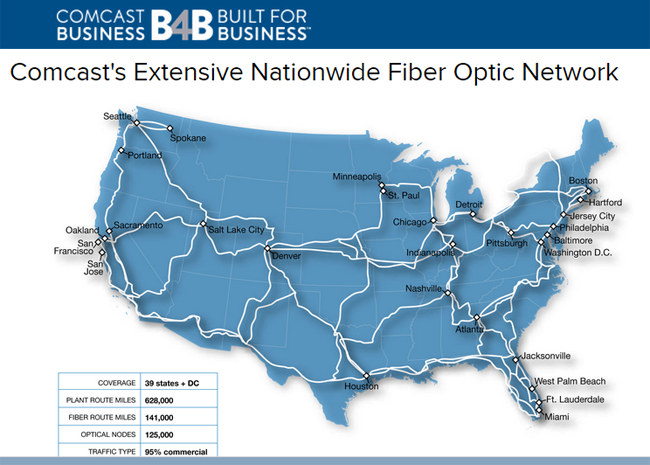
Comcast Business is now supporting 10 Gbps private connectivity for enterprise customers to the Microsoft Cloud, including Microsoft Azure, Microsoft Office 365, and Microsoft Dynamics 365. The Azure ExpressRoute service is available to its more than one million Comcast Business Ethernet-enabled buildings nationwide.

The private cloud connectivity service provides businesses with predictable and often better performance, security and availability compared to connecting over the open internet, and is backed by a service level agreement (SLA).  Comcast Business is now a member of the Microsoft ExpressRoute partner program.

"As businesses increasingly rely on cloud services to virtualize more of their IT applications, they require connectivity with measurable performance, reliability and security," said Rosemary Cochran, principal at Vertical Systems Group. "The addition of Comcast Business to the Microsoft ExpressRoute partner network offers companies the cloud connectivity they need, backed by the reach and flexibility of Comcast’s expansive Ethernet service footprint."

http://www.comcast.com


Ericsson and Telstra Demo Encryption over 10Gbps Transpacific Link

Ericsson and Telstra demonstrated the ability to encrypt data securely while in transit between Los Angeles and Melbourne at 10Gbps. The tests used Ciena's ultra-low latency 10G wire-speed encryption solution.

The companies said the trial demonstrates the advanced security that can be delivered while data is "in transit".

Darrin Webb, Executive Director of International Operations and Services, Telstra, says: "Our market-leading subsea cable network is the largest in the Asia-Pacific region and this innovation continues our commitment to providing customers with a world-class network experience. The outcome of this test shows that data can now be encrypted while in transit across a long distance, while maintaining the speed and reliability our customers have come to expect from our international network. We will continue to work with Ericsson and Ciena to take this trial to the next level with a 100Gbps encryption test."

http://www.telstra.com
http://www.ericsson.com

O3b Networks Sees Growth Across Asia Pacifiv

O3b Networks ended 2016 contracting upwards of 7.5 Gbps throughout the Asia Pacific region, and generating an increase of approximately 30% year-on-year growth for the total used bandwidth.

The company said its fast growth in APAC was a direct result of the successful performance of its high throughput, low latency satellite-enabled network and growing demand for high-quality connectivity.

During 2016, all existing O3b APAC customers upgraded their contracted capacity and, most notably, two Tier-1 Telco providers were added to the company’s customer roster. In 2016 a number of the O3b APAC customers implemented ultra-high availability solutions, to further improve service up-time. In partnership with its customers, O3b has implemented both Site Diversity with additional O3b Terminals, and Hybrid Band diversity through SES C-Band satellite capacity, enabling mission critical services to be maintained through network restoration techniques. O3b is delivering these solutions through its O3b Network Services capabilities, combining unrivalled satellite performance with always-on networking.

“As we reflect on growth in 2016 and move forward into the new year, we are massively proud of the strides we have made in the Asia Pacific Region,” said Steve Collar, CEO of Asia Pacific, O3b Networks. “Today our MNO customers are capable of providing 3G/4G LTE mobile data services to their subscribers, with a quality of experience that was previously out of reach. The surge in data use has been incredible; leading customers in the region have increased capacity to more than 1Gbps. We look forward to expanding our customer base, and providing fiber-equivalent connectivity for more of the region.”

http://www.o3bnetworks.com

Friday, January 13, 2017

Commentary: No one quite knows what to do with T-Mobile

Preamble - Malone suggests a new role for T-Mobile USA 

On January 10th, speaking at a Lions Gate Entertainment investor event, John Malone, who owns majorities in Liberty Media, Liberty Global and Liberty Interactive, plus 49% of Starz (since June 2016 a major subsidiary of the Lionsgate Group), 29% of Discovery Communications, and via Liberty Broadband is the largest share holder in Charter Communications, suggested that under a more liberalminded Trump presidency the three top U.S. cable cos - Comcast, Charter Communications and Cox Communications - could combine to acquire Deutsche Telekom's high-performing U.S. mobile subsidiary T-Mobile USA (TMUS) to create a substantial cable and wireless corporation. 

The Malone idea has some merit given the rapid increases in scale and convergence, particularly by AT&T, which in late July 2015 became a major TV player in the Americas via its $49 billion acquisition of DirecTV, and is also hoping to become a major content provider via a possible $85.4 billion acquisition of Time Warner (although that initiative yet to be approved by the company's shareholders, the FCC and DoJ, and has been publicly criticised by Donald Trump, which implies the proposal in its present form may not have a high chance of acceptance).

However, the Malone suggestion also has a slightly bizarre quality about it given that according to a recent analysis by 24/7 Wall Street, Comcast is the No. 1 most hated company in the U.S., while Charter is at No. 12, whereas judging by the steady flow of mobile customers eager to sign up with T-Mobile each quarter, it must be one of the most popular consumer-oriented institutions in the country. 

While allowing for a degree of media hyperbole in the characterisation of Comcast and Charter and the attractions of building a strong third communications pole with a full services capability able to take on AT&T and Verizon at any level, the operational chemistry for such a deal does not seem good, particularly when taking into account the unusual character of John Legere, CEO of TMUS and the obvious architect of its current success. 


T-Mobile Q3 2016 results very strong 

To get some idea as to why Malone's suggestion seems a little far fetched one needs to look at the remarkable TMUS results for Q3 2016, announced October 24th, when it reported: 

• 2.0 million net mobile additions, the company's 14th consecutive quarter it had signed up at least a million new subscriptions, implying significant gains in market share against two of the world's largest and most successful communications operators, AT&T and Verizon. 
• It ended the quarter with 69.4 million customers. 
• 1.32% branded post paid churn. • Service revenue of $7.1 billion, up 13.2% year on year, making it the industry leader in growth for the 10th consecutive quarter. 
• Total revenue of $9.2 billion, up 17.8% year on year, making it the industry leader in growth for the 13th time in the past 14 quarters. 
• Adjusted EBITDA of $2.6 billion, up 37.8% year on year. • Net income of $366 million, up 165% year on year. 
• 4G LTE coverage of 312 million pops, almost identical to that of Verizon. 

During the Q3 teleconference on the results, Legere said: - 'Don't forget, our network is still the fastest in America, It has been the fastest in both download and upload for 11 quarters in a row, upload speeds are becoming increasingly important with the rise of social sharing, and upload speeds are almost 50% faster than Verizon, the closest competitor'. 

(NB: as of the close January 12th T-Mobile US was valued at $57.15 per share, or $47.1 billion, and over the last 52 weeks the company's stock price has moved between a low of $33.23 and a recent high of $59.46.) 

Deutsche Telekom's position 

A few years ago Deutsche Telekom seemed quite keen to dispose of TMUS, and in May 2014 an offer from Sprint's new owner Softbank of Japan was accepted in principle, but collapsed in August 2014 following opposition from U.S. regulators, who were insistent on keeping four wireless competitors in the market. Softbank owner Masayoshi Son in late 2016 made it clear he still hoped to cut a deal.

As T-Mobile has got larger and more profitable the attitude of Deutsche Telekom, which owns 65% of the company, has subtly changed and the parent has become more helpful in providing lines of credit to help its expansion. Notably, in mid November 2016 Deutsche Telekom CEO Tim Hoettges, speaking at the Morgan Stanley annual TMT Conference, was quoted as saying that it was not 'in the mood' for selling the business and was in the mood of 'where is the partner we need'. With TMUS approaching the size of its German parent and still growing fast, it is beginning to look like Deutsche Telekom's greatest opportunity for growth. 

John Legere's position 

The TMUS CEO, who frequently dresses like a yester year pop star in leather and jeans, is obviously on a high and in such circumstances may be excused some of his more outlandish statements, including liberal non family-friendly cursing and the baiting of his two main rivals (for example 'either those bastards change or we take over the industry'), who often rise ponderously to the bait. Nevertheless, whatever his personal peculiarities there seems little doubt that he is a genuinely effective and transformative manager rather than the lucky inheritor of a favourable business trend. 

In late 2012, Legere took over a company that was bleeding subscribers and whose revenue growth was declining. Since then, he has dramatically reversed those trends through a number of well designed sales packages and through re-motivation of the company's staff and his company now has genuine momentum. Since he took over T-Mobile the customer base has doubled and in early August 2015 T-Mobile announced that it had moved past Sprint to become the country's third largest operator in terms of subscriptions. 

In January 2014, TMUS announced that it was moving into mobile banking via a deal with Bancorp and Blackhawk Network Holdings. Whilst not particularly advanced the solution offered basic banking services: a prepaid Visa card; a mobile app customers could use to deposit checks, pay bills, transfer funds and reload cards; and access to AllPoint’s partner network of 42,000 ATMs to withdraw cash. Moreover, though behind Sprint, Legere appeared to be well ahead of the two larger rivals. The opportunity was not negligible and at the time it was said that the unbanked in the U.S. numbered about 68 million, or around 20% of the population. 

On August 18, 2016, Legere announced his boldest move yet, with a genuinely unlimited data plan called TMobile ONE priced at $70 a month for the first subscription in a family, $50 a month for the second subscription, with additional lines only $20 a month and up to 8 lines with auto pay. The only qualification was that the very heaviest users might find their applications given lower priority at times of congestion. 

Summary 

Brilliant as its performance is in the short and even medium term, there is a core problem for T-Mobile, highlighted by the Malone suggestion, which is convergence. Legere seems to think that given enough capacity and intelligence the mobile can fulfil all of a user's digital needs and given his energy and creativity he can probably grow the company for another five years. Fibre, at least in the U.S., is on average much further behind wireless in than in many other developed countries, so that position may be plausible. However, that still leaves the question of content and large operators across the world seem to feel the need to increasingly control directly a good proportion of the content they transmit. Maybe, given his drive and creativity, Legere can come up with a solution to that problem as well. 

Thursday, January 12, 2017

IDC: Worldwide Cloud IT Infrastructure Market Revenue Grows 8.1%

Vendor revenue from sales of infrastructure products (server, storage, and Ethernet switch) for cloud IT, including public and private cloud, grew by 8.1% year over year to $8.4 billion in the third quarter of 2016 (3Q16), according to IDC's Worldwide Quarterly Cloud IT Infrastructure Tracker.

"New cloud data centers have begun to launch, but in the third quarter the effect on the cloud IT infrastructure market was minimal," said Kuba Stolarski, research director for Computing Platforms at IDC. "As network upgrades continue to prop up cloud growth overall, the hyperscale cloud datacenters are coming and they will drive new server and storage deployments over the next few quarters. Recently, there has been renewed strength in emerging markets and among smaller cloud service providers. As OpenStack has become easier to implement and maintain by a growing population of capable system administrators, private cloud options are becoming more viable in an increasing set of use cases and with a wider set of deployment parameters."

Some highlights:

  • The overall share of cloud IT infrastructure sales climbed to 39.2% of all IT infrastructure spending in 3Q16, up from 34.7% a year ago. Revenue from infrastructure sales to private cloud grew by 8.2% to $3.3 billion, and to public cloud by 8.0% to $5.1 billion. 
  • Revenue in the traditional (non-cloud) IT infrastructure segment decreased 10.8% year over year in the third quarter. 
  • Private cloud infrastructure growth was led by Ethernet switch at 60.8% year-over-year growth, followed by storage at 9.0%, and server at 3.2%. 
  • Public cloud growth was also led by Ethernet switch at 46.2% year-over-year growth, followed by server at 6.8% storage at 3.0% year over year. 
  • In traditional IT deployments, server declined the most (12.9% year over year) with Ethernet switch and storage declining 1.6% and 8.6%, respectively.
  • From a regional perspective, vendor revenue from cloud IT infrastructure sales grew fastest in Middle East & Africa at 36.7% year over year in 3Q16, followed by Japan at 29.9%, Latin America at 21.7%, Western Europe at 16.8%, Asia/Pacific (excluding Japan) at 11.9%, Canada at 5.3%, Central & Eastern Europe at 4.3%, and the United States at 2.9%. 


http://www.idc.com/getdoc.jsp?containerId=prUS42056316