Wednesday, November 16, 2016

Ericsson: North America to Lead in 5G Rollouts

Mobile broadband to account for 90 percent of all subscriptions by 2022, according to the newly-released Ericsson Mobility Report. North America is set to lead in 5G rollouts and Ericsson is predicting that 25 percent of all subscriptions will be 5G in North America in 2022, representing the highest market penetration in the world.

"Almost 90 percent of smartphone subscriptions are on 3G and 4G networks today and standardized 5G networks are expected to be available in 2020. We are already seeing a great interest among operators in launching pre-standard 5G networks. 5G will accelerate the digital transformation in many industries, enabling new use cases in areas such as IoT, automation, transport and big data," stated Ulf Ewaldsson, Chief Strategy and Technology Officer, Ericsson.

Some highlights of the Ericsson Mobility Report:

  • Asia Pacific will be the second fastest growing region for 5G subscriptions, with 10 percent of all subscriptions being 5G in 2022. From 2016 to 2022, Middle East and Africa will dramatically shift from a region with a majority of GSM/EDGE-only subscriptions, to 80 percent of all subscriptions on WCDMA/HSPA and LTE.
  • By the end of 2016, there will be 3.9 billion smartphone subscriptions. Almost 90 percent of these subscriptions will be registered on WCDMA/HSPA and LTE networks. 
  • By 2022, the number of smartphone subscriptions is forecast to reach 6.8 billion, with more than 95 percent of the subscriptions registered on WCDMA/HSPA, LTE and 5G networks.
  • As of Q3 2016, 84 million new mobile subscriptions were added during the quarter to reach a total of 7.5 billion, growing at around 3 percent year-on-year. 
  • India grew the most in terms of net additions during the quarter (+15 million), followed by China (+14 million), Indonesia (+6 million), Myanmar (+4 million) and the Philippines (+4 million). 
  • Mobile broadband subscriptions are growing by around 25 percent year-on-year, increasing by approximately 190 million in Q3 2016 alone. 
  • The total number of mobile broadband subscriptions is now around 4.1 billion.
  • In Q3 2016, data traffic grew around 10 percent quarter-on-quarter and 50 percent year-on-year.
  • Mobile video traffic is forecast to grow by around 50 percent annually through 2022 to account for nearly 75 percent of all mobile data traffic.

https://www.ericsson.com/news/2056743?categoryFilter=press-releases_1270673222_c

Cisco Posts Revenue of $12.4 Billion, up 1% YoY

Cisco reported revenue of $12.4 billion for its first quarter of FY 2017. Net income (GAAP) came in at $2.3 billion or $0.46 per share, and non-GAAP net income was $3.1 billion or $0.61 per share.

"We had a good quarter despite a challenging global business environment and we performed well in our priority areas," said Chuck Robbins, CEO, Cisco. "We are leading our customers in their digital transition by providing them with highly secure, automated, and intelligent solutions in the ways they want to consume them. Our innovation pipeline is robust and we are well positioned for the future."

Some highlights:

  • Total revenue was $12.4 billion, up 1%, with product revenue down 1% and service revenue up 7%. 
  • Revenue by geographic segment was: Americas down 1%, EMEA flat, and APJC up 6%. 
  • Product revenue performance was led by Security and NGN Routing which increased 11% and 6%, respectively. Switching decreased 7%, Collaboration and Data Center each decreased 3%, and Wireless and Service Provider Video each decreased 2%.
  • Total gross margin (GAAP) and product gross margin were 63.8% and 63.4%, respectively. 
  • Headcount decreased by 1,326 to 72,385, compared to the prior quarter.

http://investor.cisco.com/investor-relations/overview/default.aspx

Microsoft Makes Open Source Commitments

Microsoft announced a number of big moves to bolster its standing with the open source community, including:

  • joining the Linux Foundation as a Platinum Member
  • welcoming Google to the independent .NET Foundation
  • working with Samsung Electronics Co. Ltd. to enable .NET developers to build apps for more than 50 million Samsung devices worldwide
  • demonstrating a preview of Visual Studio for Mac, which enables developers to write cloud, mobile and macOS apps on Apple’s Mac operating system using the popular development environment
  • previewing the next version of the company’s flagship SQL Server database with support for Linux, Linux-based Docker containers and Windows-based environments
  • and previewing Azure App Service on Linux with support for containers.


“We want to help developers achieve more and capitalize on the industry’s shift toward cloud-first and mobile-first experiences using the tools and platforms of their choice,” stated Scott Guthrie, Microsoft Cloud and Enterprise Executive Vice President. “By collaborating with the community to provide open, flexible and intelligent tools and cloud services, we’re helping every developer deliver unprecedented levels of innovation.”

https://news.microsoft.com/2016/11/16/microsoft-contributes-to-open-ecosystem-by-joining-linux-foundation-and-welcoming-google-to-the-net-community/

Microsoft Contracts 237 Megawatts of Wind Energy

Microsoft announced two wind power purchasing agreements totaling 237 megawatts -- its biggest purchase of wind energy to date.


“Microsoft is committed to building a responsible cloud, and these agreements represent progress toward our goal of improving the energy mix at our datacenters,” said Brad Smith, president and chief legal officer at Microsoft. “Our commitment extends beyond greening our own operations because these projects help create a greener, more reliable grid in the communities in which we operate.”

Specifically, Microsoft has contracted with Allianz Risk Transfer (ART) to fix its long-term energy costs and purchase the environmental attributes connected with the new, 178-megawatt Bloom Wind project in Kansas. The project is the first to use a novel structure developed by ART and designed to offset high upfront costs associated with the creation of large-scale wind projects. Microsoft is the first buyer to participate in this structure, which has the potential to bring clean energy projects online at a faster pace.

The second contract involves a long-term agreement with Black Hills Energy to purchase 59 megawatts of renewable energy certificates from the Happy Jack and Silver Sage wind projects, which are adjacent to Microsoft’s Cheyenne, Wyoming, data center. The combined output of the Bloom and Happy Jack/Silver Sage projects will produce enough energy on an annual basis to cover the annual energy used at the datacenter.

“We are constantly looking for new ways to approach energy challenges and avenues of engagement with our utility partners,” said Christian Belady, general manager of cloud infrastructure strategy and architecture at Microsoft. “The team worked closely with ART to come up with a completely new model to enable faster adoption of renewables. Likewise, the tight engagement with Black Hills created the opportunity for Microsoft’s datacenter to become an asset for the local grid, maintaining reliability and reducing costs for ratepayers. This kind of deep collaboration with utilities has great potential to accelerate the pace of clean energy, benefitting all customers — not just Microsoft.”

These are Microsoft’s third and fourth wind energy agreements, joining the 175-megawatt Pilot Hill wind project in Illinois and 110-megawatt Keechi wind project in Texas. In March, Microsoft also signed an agreement with the Commonwealth of Virginia and Dominion Energy Inc. to bring 20 megawatts of solar energy onto the grid in Virginia. These projects are in addition to the renewable and carbon-free energy Microsoft purchases from the grid mix in the markets in which it operates.

http://www.blackhillscorp.com
http://www.microsoft.com

MEF16 - Software-defined Access for User-driven Services


Software-defined Access will play a key role in future network architecture, says ADTRAN's Kurt Raaflaub, speaking at #MEF16.

 It is very important that the connection from the data center to the end-user's device be open, programmable, and scalable. This allows for a user-driven service model to thrive.

See video: https://youtu.be/3EwHgxi5ZgY

MEF16 - Distributed NFV with Whitebox CPE is Hot


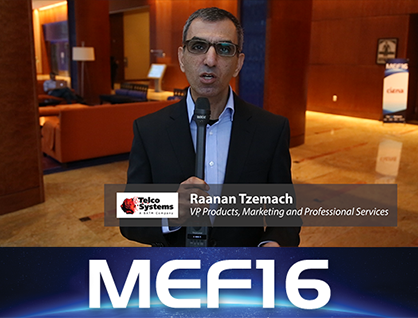
Distributed NFV with universal CPE (the whitebox solution) is one of the hot trends at this year's MEF16, says Telco Systems' Raanan Tzemach.

One of the top drivers for this is that OPEX can be reduced in rolling out new services by avoiding the need to stack new boxes at the customer site.

See video: https://youtu.be/6Rmx2ZjUuFU


Coriant Adds Open Line System Capabilities to DCI Portfolio

Coriant introduced Open Line System (OLS) capabilities for its Groove G30 DCI Platform.

The open, plug-and-play optical layer solution provides 3X the density over comparable offerings, and gives network operators the ultimate in configuration flexibility to cost-efficiently address diverse Data Center Interconnect (DCI) and metro applications, including coherent and direct detect (PAM4) interconnect.

The Coriant Groove OLS solution offers open Northbound Interfaces (NBI) using YANG model-based NETCONF and RESTCONF, as well as an easy-to-use Command Line Interface (CLI), web-based Graphical User Interface (GUI), and support for SNMP.  The platform is designed to support up to 96 channels (wavelengths) in a 1RU form factor with full DWDM terminal capabilities, including all passive and active functions.

Coriant said its Groove OLS solution sets new benchmarks in flexibility and efficiency. Key benefits include:

  • Open line system – prevents vendor lock-in by disaggregating the optical layer from the transmission layer and enables the Coriant Groove OLS solution to be paired with Groove or third-party transmission/transponder layer solutions
  • Optical layer density – supports up to 96 channels in 1RU with full WDM terminal functionality, including passive and active optical layer functions, delivering 3X the density over comparable solutions and enabling significant OpEx savings via footprint and power efficiencies
  • Configuration flexibility – enables "build your own optical layer" based on plug-and-play configurable technology for coherent and direct detect (PAM4) applications; supports a diverse range of optical layer functions in compact modular pluggable formats, including multiplexing/demultiplexing, pre-amplifier, booster amplifier, local add/drop amplifier, optical channel monitoring, optical protection, optical supervisory channel, OTDR, and tunable DCM functions
  • Open management – shares common YANG model-based NETCONF and RESTCONF, and other northbound management and control interfaces with the Coriant Groove G30 DCI Platform for fast deployment and ease of integration into any OS environment
"Growth in interconnect traffic is driving the need for much more open and flexible optical layer solutions," said Yajun Wang, Chief Architect, Open Line System, Coriant. "The Coriant Groove™ OLS solution is architected to meet the requirements of ongoing open optical layer initiatives, enabling operators to cost-effectively deploy a future-proof optical layer."

The Open Line System solution for the Coriant Groove G30 DCI Platform will be available in Q1 2017.

http://www.coriant.com

MEF16 - LSO Hackathon - Putting it to Code


The LSO Hackathon takes the MEF's specification work and puts it to code. The exercise carries out implementations of the specs to validate that they work.

Charles Eckel provides an overview of this year's LSO Hackathon.

More info on the event is posted here: https://wiki.mef.net/display/LH/MEF+LSO+Hackathon

See video:  https://youtu.be/ldqLJwHHp-0

Tuesday, November 15, 2016

Nokia Outlines its Priorities for Growth, Standalone Software Business

At the company's Capital Markets Day event in Barcelona, Nokia outlined its vision and strategic priorities for ensuring sustainable growth.

The company cited four key priority areas:

  • Lead in high-performance, end-to-end networks with communication service providers: Use our unparalleled, end-to-end portfolio to sustain our market and profitability leadership.
  • Expand network sales to select vertical markets needing high-performing, secure networks: Broaden our footprint in five select verticals: energy, transportation, public sector, technological extra-large enterprises and webscale.
  • Build a strong, standalone software business: Move beyond our current product-attached software model and create a software business with the margin profile of large software companies, focused on areas including enterprise software and IoT platforms.
  • Create new business and licensing opportunities in the consumer ecosystem: Expand successful patent licensing efforts into areas like automotive, consumer electronics and IoT. Create new revenue streams from technology and brand licensing, and establish new businesses in digital media and digital health.

"Nokia is extremely well-positioned to win in its primary market with communication service providers, and we aim to target superior returns through focused growth into more attractive adjacent markets where high-performance, end-to-end networks are increasingly in demand," stated President and CEO Rajeev Suri. "We also see opportunities to renew current patent licensing agreements at favorable terms, add new licensees in the mobile phone area and expand licensing further into new areas such as consumer electronics and the automotive sector. Given the appeal to others of our innovations in Networks, virtual reality and digital health, we are confident that we can continue to build our patent and technology licensing business further in the coming years," he continued.

Some highlights from the release:

  • Nokia's Networks business aims to grow net sales faster over the long-term than its primary addressable market.
  • Nokia's primary addressable market size is approximately EUR 113 billion in 2016, and is expected to have a 5-year compound annual growth rate of approximately 1%.
  • Nokia's adjacent addressable market size is approximately EUR 18 billion in 2016, and is expected to have a 5-year compound annual growth rate of approximately 13%.
  • Nokia targets the long-term operating margin range for Nokia's Networks business to be 10% to 15%, with all Networks business groups expected to contribute double-digit long-term operating margin. If the market environment and Nokia's execution are both in-line with Nokia's expectations, Nokia expects operating margin to be around the midpoint of this range.
  • For 2017, net sales for Nokia's Networks business to decline in line with its primary addressable market in full year 2017.
  • Nokia expects operating margin for Nokia's Networks business in full year 2017 to be in the range of 8% to 10%.
  • Nokia targets approximately EUR 1.2 billion of total annual cost savings in full year 2018 compared to the combined non-IFRS operating costs of Nokia and Alcatel-Lucent for full year 2015, excluding Nokia Technologies.


See Rajeev Suri’s review at the Annual General Meeting in June 2016:  https://youtu.be/YheSCoZMY6k

Microsoft Azure Announces Cloud Bot-as-a-Service

Microsoft announced a new Azure Bot service powered by the Microsoft Bot Framework and serverless compute in Microsoft Azure.

The new Azure Bot Service helps developers to build, connect, deploy and manage intelligent bots that interact naturally via app or website to text/sms, Slack, Facebook Messenger, Skype, Teams, Kik, Office 365 mail and other popular services. Bots run on Azure Functions, a serverless environment. The service scales based on demand and the developer pays only for the resources the bots consume.

Microsoft is providing out-of-the-box templates such as the basic bot, Language Understanding Intelligent Service bot, form bot, and proactive bot. Developers can build bots in C# or Node.js directly in the browser and try it out with the companion Web Chat control.

The Azure Bot Service includes built-in configurable channels to improve your customer interactions and increase your reach to more customers. You can easily build bots that work from your apps or websites and across popular channels such as Slack, Facebook Messenger, Skype, Teams, Web chat, Email, GroupMe, Kik, Telegram and Twilio. Through the Direct Line support you can interact with Microsoft Bot Framework features through a REST API, so you can bring the conversation experience to your app or website, provide control over your branded experience and reach  the many channels Bot Framework supports.

https://azure.microsoft.com/en-us/services/bot-service/

NYT: Secret Backdoor in Some U.S. Phones Sent Data to China, Analysts Say

Certain low-cost Android phones in the U.S. equipped with a certain Firmware Over The Air (FOTA) update software system were found to be sending data to a server in China without the owners' consent, according to The New York Times.

The case involves firmware developed by Shanghai Adups Technology Company, which claims its code runs on more than 700 million devices worldwide. The phones in question were sold under the BLU brand name in the U.S., although the article also cites other prominent Chinese mobile phone vendors as customers of Adups.

The discovery of the backdoor is credited to Kryptowire, a start-up based in Virginia that provides mobile application security analysis tools, anti-piracy technologies, mobile app marketplace security analytics, and Enterprise Mobility Management (EMM) solutions.

Kryptowire said the firmware that shipped with the mobile devices and subsequent updates "allowed for the remote installation of applications without the users' consent and, in some versions of the software, the transmission of fine-grained device location information."

http://www.nytimes.com/2016/11/16/us/politics/china-phones-software-security.html?smid=tw-share&_r=0

http://www.kryptowire.com/adups_security_analysis.html

Intel Cites Gains with its Omni-Path Architecture Systems

Intel cited growing momentum in the nine months since Intel Omni-Path Architecture (Intel OPA) began shipping, The company said OPA is becoming the standard fabric for 100 gigabit (Gb) systems, as it is now featured in 28 of the top 500 most powerfulsupercomputers in the world announced at Supercomputing 2016.  Intel believes OPA now has 66 percent of the 100Gb market. This acceptance is twice the number of InfiniBand EDR systems.

Top500 designs include Oakforest-PACS, MIT Lincoln Lab and CINECA. The Intel OPA systems on the list add up to total floating-point operations per second (FLOPS) of 43.7 petaflops (Rmax), or 2.5 times the FLOPS of all InfiniBand* EDR systems.

Intel OPA is an end-to-end fabric solution that improves HPC workloads for clusters of all sizes, achieving up to 9 percent higher application performance and up to 37 percent lower fabric costs on average compared to InfiniBand EDR.

https://newsroom.intel.com/newsroom/wp-content/uploads/sites/11/2016/11/supercomputing-2016-fact-sheet.pdf

CenturyLink Delivers 2.5 Tbps Super-channel Capacity at SC16 with Infinera

CenturyLink is delivering 2.5 terabits per second (Tbps) of super-channel transmission capacity to support SCinet at this week's International Conference for High Performance Computing, Networking, Storage and Analysis (SC16) in Salt Lake City, Utah.

The 2.5 Tbps of line-side capacity will connect the Salt Lake City Convention Center to CenturyLink’s global fiber optic network, utilizing the Infinera DTN-X Family. The multi-terabit deployment demonstrates CenturyLink’s rapid provisioning of 100 Gigabit Ethernet (GbE) services from the conference to CenturyLink’s point of presence in Salt Lake City and across its national backbone.

“Since 2014, CenturyLink has provided increasing amounts of super-channel transmission capacity to support real-time high-performance computing at this conference,” said Pieter Poll, Senior Vice President of Network Planning at CenturyLink. “Providing SCinet with 2.5 terabits of transmission capacity demonstrates the scalability and efficiency of CenturyLink’s network and complements the work we are doing with Infinera as we increase capacity on our core network to accommodate all customers. This includes providing the connectivity businesses need to operate efficiently as well as satisfying the communication and entertainment needs of families.”

http://www.infinera.com
http://www.centurylink.com

MEF16 - Highlights from this Year's Event with Pascal Menezes


Pascal Menezes, MEF's CTO, provides some highlights of MEF16 in Baltimore.

One of the big themes was machine-driven, inter-provider communications based on APIs, which could be used to improve services across network boundaries in an automated. Another theme is automated analytics and machine learning for self-healing networks.

MEF has just published a white paper on the idea of the Third Network that was written in coordination with other standards bodies.

Looking ahead to 2017, the MEF plans to build more resources for the developer community.

See video: https://youtu.be/L8IoQje0kAo

MEF16 - Fujitsu's Jeff Babbitt on Open Architecture


Openness and Disaggregated are big themes at #MEF 16, says Fujitsu's Jeff Babbitt.

But when you ask what openness really means, different vendors and different service providers will offer different interpretations.  To a large extend, it is a question of degree for both open software and open hardware.

See video: https://youtu.be/L3S7rkKh8dM

MEF16 - Fujitsu's Ralph Santitoro on LSO Becoming Real


Lifecycle Service Orchestration (LSO), SDN and NFV are becoming real, says Fujitsu's Ralph Santitoro, speaking at #MEF16 in Baltimore.

 There is a lot of complexity with SDN and LSO. This requires the integration of many types of products and VNFs. The need for open environments adds to this integration challenge.

At this year's MEF16, Fujitsu's SDN/NFV Solutions Practice won the award for "Best Consulting Practice".

 See video: https://youtu.be/8X1jkWLbHjQ

MEF16 - Netcracker's Ari Banerjee on How Virtualization Requires Strategic Partnership


Enterprise services are the most profitable segment for operators, says Netcracker's Ari Banerjee.

NFV offers great market potential for value-added services.  Implementing this technology is not just about orchestration. The relationship between the network operator and the vendor needs to change to a strategic partnership.

See video: https://youtu.be/lqkA19moy58

AT&T Fiber Launches in 20 More Metros This Month

AT&T is launching fiber Internet service in nearly 85 cities across 20 major metros in November, offering connection speed of up to 1 Gbps.

The first four major metros launching this week are Baton Rouge, Birmingham, Charleston and Reno. AT&T is also expanding its 100% fiber network in 16 metros where it has already launched:

Atlanta
Charlotte
Chicago
Cleveland
Dallas
Fresno
Houston
Jacksonville
Los Angeles (Los Angeles County and Orange County)
Miami
Orlando
Raleigh
San Antonio
San Francisco
St. Louis
West Palm Beach

http://att.com/getfiber

MACOM's 25Gbps Laser Enters Mass Production

MACOM Technology Solutions announced volume production of its family of 25Gbps lasers for data center, mobile infrastructure and Fiber to the home (FTTH) applications.

MACOM leverages Etched Facet Technology (EFT), which, when combined with its in-house wafer scale Indium Phosphide manufacturing, are expected to provide a cost and capacity advantage previously unachievable by incumbent laser suppliers.

The 127/129/131/133D-25G-LCT11 and 1295/1300/1304/1309-25B-LCT11-S families of 25Gbps lasers serve the CWDM and LAN-WDM Data Center applications respectively.
The 131D-25I-LT5TC family of TO packaged 25Gbps laser products service the 5G-LTE and 100G PON applications. MACOM’s TO package is a robust, high-speed package design that enables the full utilization of laser bandwidth with efficient heat dissipation.

“With this industry leading family of lasers, MACOM continues to expand its leadership footprint beyond just RF & microwave and into photonics, and we believe key OEMs have taken notice, viewing us a key strategic supplier providing them all the critical technology and products at the necessary cost and capacity to enable their Cloud Data Center, Mobile and FTTH applications,” said Dr. Alex Behfar, Senior Vice President and Chief Scientist, Photonic Solutions at MACOM. “In markets where EFT can bring disruptive economics to bear, we believe it will play a pivotal role in achieving the cost thresholds to enable mainstream deployment. We have already proven our ability to service high volume cost competitive markets such as PON, and with our 25Gbps laser family we believe we are well positioned to become a preeminent supplier of lasers into these high volume markets.”

http://www.macom.com/25GLasers

Monday, November 14, 2016

Facebook Expands Fort Worth Data Center to Five Buildings

Facebook revealed plans to expand its data center in Fort Worth, Texas from one building to five buildings on the same campus.

Construction on the first building is nearing completion. Facebook is now rolling racks of servers into the new building.

The facility will be powered by 100% renewable energy, thanks to the more than 200 MW of new wind power that we worked with Citigroup Energy, Alterra Power Corporation, and Starwood Energy Group to bring to the Texas grid.

https://www.facebook.com/notes/fort-worth-data-center/expanding-our-fort-worth-data-center-to-five-buildings/1187767507983650