Sunday, October 25, 2015

Blueprint: NFV - the New and Improved Network…with Some of the Same Old Baggage

by Douglas Tait, Director, Product Marketing, Oracle Communications

Network function virtualization (NFV) is in motiion Software functions are separating from hardware infrastructure and virtualizing, then becoming capable of running on a wide array of suitable hardware. In fact, NFV adoption is so strong that according to a statement made by Heavy Reading analyst Jim Hodges at the recent NFV Everywhere event in Dallas, the global NFV market will grow from $485.3 million in 2014 to $2.2 billion by the end of this year. The promise here, of course, is that communications service providers (CSPs) can reduce operational and expenditure costs related to updating, maintaining, or enhancing network functions by decoupling the software from the hardware.  This provides CSPs with more options to buy and deploy best-of-breed software components that run on best-of-breed hardware components.

If only it were that simple.

This article will cover why the path to NFV isn’t so clear cut, and some ideas for overcoming the complexity.  

The New and Improved Network

The NFV “divide and conquer” approach makes sense—the software lifecycle is completely different from the hardware lifecycle, and IT has made huge strides in developing and testing software virtualization technology. NFV provides the blueprint to virtualize software and deploy agile services when needed, or when upgrades are required, all without major expensive network re-deployments.  

This separation of software from hardware is a significant first step forward for the communications industry that creates new ways to manage the network elements. Now, an open market for best-of-breed hardware is possible, which could drive down costs. Also possible is the encapsulation of software elements as “virtualized network functions” (VNFs), which allows CSPs to manage software lifecycle management separately so that upgrades and enhancements do not affect the hardware environment (except in the event of rare scaling and performance dependencies).

NFV is moving network technology in the right direction, and in many ways, it’s similar to the revolution of cloud computing in IT. And also like cloud computing, now that the deployment model has been revolutionized, the next step in NFV is to free up the hold on software functions. Specifically, NFV has matured to the point where CSPs can deploy on any suitable best of breed hardware. Now it’s time for CSPs to have more choices to deploy best of breed software on that hardware to build the best possible network.
   
But here is the fly in the ointment, or, the “same old baggage.” While hardware components are interoperable, the network software components were never designed to be interoperable.

Same Old Baggage

For NFV software, interoperability is required on two levels: 1) between VNFs and 2) between Management and Network Orchestrators (MANOs) and the VNFs. Regardless of NFV, the same old baggage comes from taking existing network functions that do not interoperate and virtualizing them into VNFs—you still have network functions that do not interoperate. In many ways, NFV is compounding the problem, because currently there aren’t agreed-upon standards between the MANO and VNF. As a result, the various suppliers are creating the best interface for just the NFV products they own.

If this situation sounds familiar, it probably is: the problem of NFV interoperability is not new. And there have already been several attempts to create hard standards for network functions to fix it—TINA-C, JAIN, PARLAY, OneAPI. Each made a valiant effort at standardization, yet did not fully achieve software interoperability in the communications network. Now, the NFV community is pursuing interoperability with an open sourced approach—that is, creating an open source reference implementation model for NFV and hoping that the network equipment providers will follow. This open source model has had some success in the IT industry—think Apache Foundation, Linux, and GNU. And for the communications industry, projects like OPNFV, Open Daylight, ONF, Open Stack, and Open vSwitch offer an approach that would move the industry to a common software model, but without requiring NFV vendors to comply with a standard.

The original NFV whitepaper makes it clear that many of the largest and most influential CSPs want to allow VNFs to proliferate in an open market where network providers may mix, match, buy, and deploy best of breed VNFs that would automatically connect and run their networks. But to make this objective a reality, full interoperability between VNFs and MANOs is required. So what is the best way for the industry to move forward from this stalemate?

NFV: Path to Software Interoperability 

To overcome these obstacles and achieve the full potential of NFV, the industry should consider not just one solution, but rather an integrated and multi-step path to jumpstart the VNF market from a premise to a promise with a real plan. Here are a few things that the industry should consider:

  • Assemble a policing agency or an interoperability group that tests or runs the software and generates compliance reports.  As discussed, one of the major roadblocks to reaching NFV’s potential is that there is very little standardization enforcement across the communications industry. A standards body or policing agency could help by validating that vendors’ products and solutions meet defined specifications required to call themselves “certified NFV suppliers”—and therefore deemed trustworthy by customers.
  • Continue with the open source community offerings.  Although the open source communities do not have a charter to enforce interoperability, CSPs may use the reference implementation the communities produce as a model or means to test the VNFs. 
  • Define a standard API for VNFs.  While this approach does not completely solve the interoperability issues and does not enforce the standard between the VNFs into the MANO, it would provide a universal programming interface for all VNFs. VNF providers could produce their products despite not having their own MANO product.
  • Define a standard protocol that the industry could adopt as a universal standard, or that at least would be enforceable via something like the Java Community Process. This would enable   CSPs to compare vendors, supporting a fair and free market—CSPs could buy the best product for their company without fear that the vendor is violating standards.
  • Provide an interface framework in the VNF manager.  In the absence of hard protocol standards, another way to accelerate the adoption of NFV is a VNF plugin framework. This would allow VNF suppliers to build and test executable plugins that interface with their products, yet run within the VNF manager—promoting technical interoperability between the VNF manager and the VNF, while opening the market for suppliers to work together. While a plugin framework does not solve the problem of interoperability between VNFs, VNF managers and various VNF suppliers would be able to rapidly integrate their products. And, when the industry finally advances and produces a standard, the only update required is the plugin; the VNF manager and the VNFs would require little change.  

If the industry can develop standards against which vendors can build NFV solutions, and employ a policing body to enforce these standards, VNF interoperability will move forward—driving unprecedented innovation to bring new services and new revenue streams to market quickly, with much lower risk. But the industry must continue to move forward in the meantime. So it must take action now to enable industry players to work together, promoting a culture of openness and innovation.

About the Author

Doug Tait is director of product marketing, Oracle Communications.

Got an idea for a Blueprint column?  We welcome your ideas on next gen network architecture.
See our guidelines.

Oracle Partners with Intel to Take on IBM as it Pivots to Cloud

Oracle and Intel announced a special partnership aimed at migrating customers running Oracle databases on Intel Power Systems to new platform based on Intel Xeon silicon. The companies said they are able to deliver database-aware software enhancements optimized for Intel Xeon.


At this week's Oracle OpenWorld, the company is rolling out enhancements to its partner network as it makes a strategic "pivot to the cloud.: “Cloud is our top priority and we are aligning our resources to that strategic initiative,” said Shawn Price, senior vice president, Cloud, Oracle. “We will work with our partner ecosystem to pivot to the cloud and fully capitalize on the historic opportunity before us. We remain committed to expanding our partner community and providing all of its valued members the tools, technology and expertise they need to deliver excellence to our joint customers and succeed in the market.”

  https://www.oracle.com/engineered-systems/exadata/exayourpower.html

Oracle OpenWorld 2015 Expects 60,000 Attendees

This week's Oracle OpenWorld 2015 in San Francisco is expected to attract 60,000 in person attendees. The conference, which runs October 25-29, takes place at 18 locations throughout downtown San Francisco. It features 2,500 sessions, 3,000 speakers, and more than 400 Oracle demos, as well as partner and customer exhibitions.

Elton John will highlight the customer party at Treasure Island.

https://www.oracle.com/


Friday, October 23, 2015

Australia's nbn Tests Alcatel-Lucent's G.fast

Australia’s nbn national broadband network completed a trial of Alcatel-Lucent's G.fast technology, which uses copper infrastructure that extends the last few hundred meters into the premises to achieve speeds of close to 1 Gbps.

nbn's stated goal is to provide affordable ultra-broadband download speeds of at least 25 Mbps to eight million premises and at least 50 Mbps to 90 percent of premises with fixed-line access by 2020. nbn is using a mix of technologies to meet specific deployment needs, including a significant fiber-to-the-node (FTTN) and fiber-to-the-building (FTTB) component using VDSL Vectoring, as well as fiber-to-the-premises (FTTP), hybrid fiber coaxial (HFC), fixed, wireless and satellite technologies.

The trial – conducted over the past month – demonstrated how G.fast can complement nbn’s existing multi-technology deployment toolkit, offering a range of opportunities to evolve its capabilities. Alcatel-Lucent’s G.fast technology uses the 7368 Intelligent Service Access Manager (ISAM) Optical Network Terminals (ONTs), 7368 Intelligent Services Access Manager (ISAM) CPE with integrated reverse power and 5520 Access Management System  to accelerate last mile fiber-to-the-home ultra-broadband connectivity.

https://www.alcatel-lucent.com/

Ericsson Cites Slowdown in 4G Rollouts in China

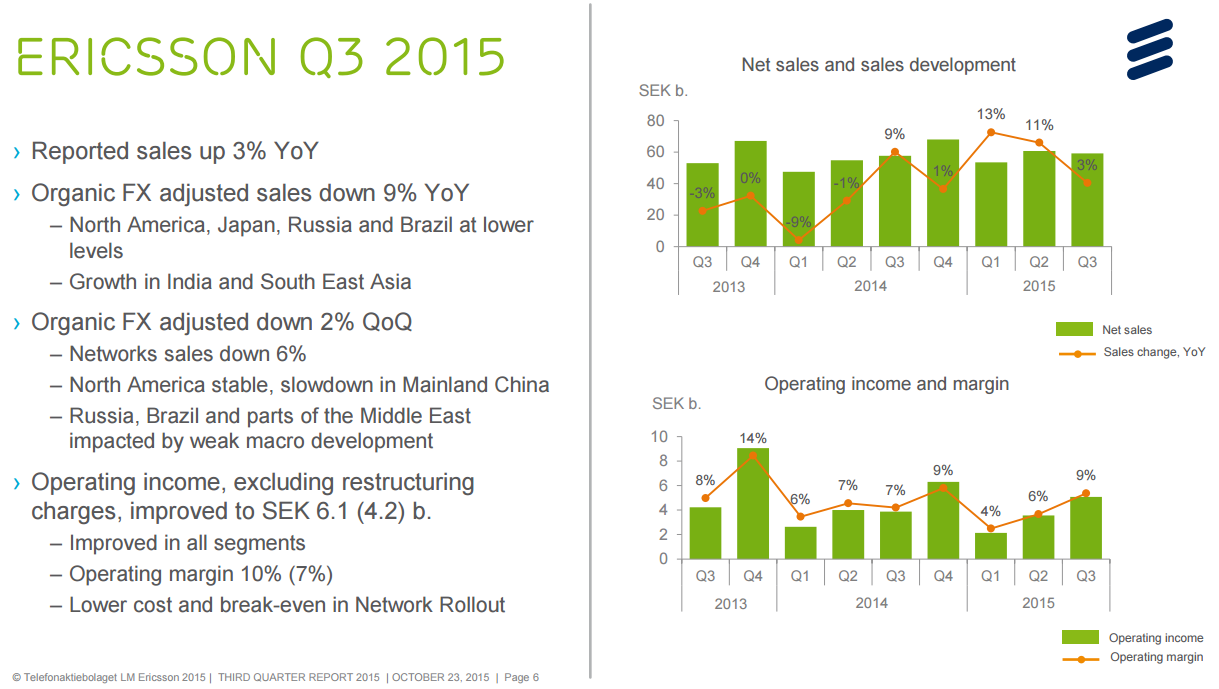
Ericsson's overall sales for Q3 2015 increased by 3% YoY to reach SEK 59.2 billion (approximately US$6.98 billion).  Sales, adjusted for comparable units and currency, decreased by -9% due to lower sales in Networks, where the company cited a slowdown of the 4G deployments in mainland China. Network sales in North American have stabilized. This was partly offset by sales growth in Professional Services, where sales increased by 15% YoY.

Gross margin came in at 33.9%, down from 35.2% a year earlier. Operating expenses, excluding restructuring, decreased YoY to SEK 14.3 billion.

Ericsson said its global cost and efficiency program is on target to achieve annual net savings of SEK 9 b. during 2017.

http://www.ericsson.com/thecompany/investors

Huawei Marine to Build Brazil-to-Cameroon Cable

Huawei Marine has been commissioned to construct the Cameroon-Brazil Cable System (CBCS), a 6,000-km undersea network linking Fortaleza (Brazil) and Kribi (Cameroon).


The cable system, which is sponsored by CamTel and China Unicom, will have an initial system capacity of 32 Tbps over 4 fiber pairs. Huawei Marine will deploy its 6fp submarine Repeater 1660, the industry’s first titanium repeater, which boasts a slim-line profile to allow direct lay and plough burial. The cable system is expected to come online in 2017.

http://www.huaweimarine.com/

Thursday, October 22, 2015

PMC Unveils 3rd Gen OTN/Ethernet Framer with Encryption for Routers

PMC introduced its META-240G, its third generation, multi-rate OTN/Ethernet framer for routers. This next gen converged OTN/Ethernet 10G/40G/100G router PHY enables 2X scaling of router line cards.

New capabilities in this META-240G generation include an integrated 100G gearbox for interfacing directly with optical modules, including the new high-density QSFP28 transceivers.  PMC also added ultra-low latency OTN encryption, which is targeted at point-to-point, secure data center interconnects or multipoint, secure cloud connectivity. The new silicon also consumes 50 percent less power per port than the previous generation.

Key features include:
  • Support for OTN wrapping of 10GE/40GE/100GE to OTU2/OTU3/OTU4;
  • Industry compatible ITU-T 10G, 40G, and 100G FECs;
  • Integrated, protocol agnostic AES-256 datapath encryption engine with flexible key management for SDN control;
  • Support for IEEE 1588v2 PTP and Synchronous Ethernet timing protocols, enabling packet-based mobile backhaul and packet transport networks;
  • Integrated 100G Gearbox to connect directly to a wide range of 10G, 40G and 100G optical module types, including CFP2, CFP4 and QSFP28; and
  • Leverages common Software Development Kit across META and DIGI family code base.
“The convergence of packet and optical transport layers with OTN allows service providers to deploy more robust and manageable networks,” said Babak Samimi, vice president of marketing and applications for PMC’s Communications Business Unit. “With our DIGI products driving the migration to OTN in the optical transport network and the META family extending OTN to the router network, the industry is realizing this network vision built on PMC’s technology.”

Sampling is underway.

http://investor.pmcs.com/phoenix.zhtml?c=74533&p=irol-newsArticle_Print&ID=2100437

PMC's DIGI-G4 Processor Scales OTN Line Card Capacity by 4X

PMC-Sierra has commenced sampling of its new DIGI-G4 chip -- the industry's highest density 4x100G OTN processor and featuring 50 percent less power per port than the previous generation.

The DIGI-G4 OTN processor, which builds on the success of PMC’s DIGI-120G, enabling the transition to 400G line cards in packet optical transport platforms (P-OTP), ROADM/WDM and optimized data center interconnect platforms for OTN switched metro networks. It increases 10G, 40G and 100G line card port density by 4X with flexible client mapping of Ethernet, storage, IP/MPLS and SONET/SDH, while reducing power by 50 percent per port. DIGI-G4 builds on the IP from DIGI-120G, enabling customers to maintain their rich feature set and software investment, which reduces time to market by up to six months and lowers development costs.

Significantly, DIGI-G4 delivers multi-rate, sub-180ns latency OTN encryption, allowing cloud and communications service providers to ensure security without compromising performance. DIGI-G4 supports sub-wavelength OTN encryption and is compatible with OTN switched networks. PMC said these these capabilities, combined with the densest 10G/40G/100G Ethernet ports, enables a new class of low-power, high-capacity transport platforms optimized specifically for the hyperscale data center WAN interconnect market (see whitepaper).

“Without DIGI-G4 the industry would be challenged to transition to 400G OTN switched metro networks,” said Babak Samimi, vice president of marketing and applications for PMC’s Communications Business Unit. “The world’s leading OEMs are designing around DIGI-G4 because our solution allows them to scale their product portfolios to the highest capacities at half the power per port, while leveraging their existing DIGI software investment. Coupled with new capabilities like OTN encryption, we’re solidifying PMC’s position as the industry leader in OTN processors.”

DIGI-G4 Highlights

  • Industry’s first single-chip 4x100G solution for OTN switched line cards
  • Integrated 100G Gearbox for direct connect to CFP2, CFP4 and QSFP28 transceivers
  • Industry’s highest density 10G, 40G and 100G multi-service support, including Ethernet, storage, IP/MPLS and SONET/SDH
  • Industry’s first sub-wavelength OTN encryption solution to secure the cloud
  • Industry’s first 25G granularity flexible framer to DSP interface providing scalable line-rates to match the programmable modulation capabilities found in next-generation Coherent DSPs
  • Multi-chip Interlaken interconnect solutions for scalable compact chassis data center interconnect applications
  • High performance OTN-SDK with adapter layer software accelerates customer time to market

The PM5990 DIGI-G4 is sampling now.

http://www.pmcs.com/OTN

Affirmed Networks Collaborates with HP on OpenStack Service Platform

Affirmed Networks is working with HP to deliver a carrier-grade OpenStack NFV service platform for mobile networks.

The platform combines Affirmed Networks' NFV-based mobile packet core solution with HP's OpenStack solution.

"Carriers worldwide are strongly motivated to move to virtualized networks running on OpenStack environments due to the many capital and operational savings this architecture provides," said Amit Tiwari, VP Strategic Alliances and Systems Engineering, Affirmed Networks.

"We continue to see strong interest in NFV from CSPs who want to gain greater agility against non-traditional competitors from a content delivery perspective," Werner Schaefer, vice president, Network Functions Virtualization, HP. "We are committed to working strategically with industry leaders like Affirmed Networks who can help us provide open, carrier-grade solutions that allow our customers to drive top-line growth."

http://www.affirmednetworks.com

Pacific Wave Activates 100G Link to Asia

Pacific Wave activated the first 100G research and education (R&E) network link between Asia and the U.S., with related transit, peering, and exchange fabric.

Pacific Wave will provide this 100Gbps capability to the National Science Foundation (NSF) funded International Research Network Connections (IRNC) TransPAC4 project, led by Indiana University.

This integrated 100Gbps trans-pacific layer 1, 2 and 3 TransPAC – Pacific Wave network fabric incorporates:

  • A dedicated 100Gbps wavelength between the Pacific Wave national Research & Education (R&E) node in Seattle, U.S.A. and Tokyo, Japan
  • 100Gbps peering and routing fabrics – using Brocade MLX routers - in Tokyo and Seattle
  • Access and peering in Tokyo for Asian R&E networks at both the long-standing WIDE/T-REX/T-LEX Open Exchange Point, and at the newly-established Pacific Wave node at 3-8-21 Higashi-Shinagawa, Shinagawa-Ku.
  • The 100Gbps connection in the U.S. using Pacific Wave’s existing 100Gbps open, distributed, wide-area peering and exchange fabric, which is based on a distributed mesh of Brocade MLX routers, across the Pacific Wave backbone, and has primary points of presence in Seattle, Sunnyvale, and Los Angeles, as well as additional 100Gbps access and peering at StarLight in Chicago
  • On the U.S. side, the Pacific Wave fabric provides direct 100Gbps connectivity with multiple 100Gbps interfaces to Internet2’s Advanced Layer 2 and 3 Services (AL3S and AL2S), as well as 100Gbps connectivity to ESnet, and 100Gbps and/or 10Gbps connections to nearly all the major Asia Pacific R&E networks, U.S. Department of Energy’s ESnet, U.S. National Oceanic and Atmospheric Administration N-wave, and commercial cloud providers regularly used by national and international R&E communities.
  • Interconnection of the U.S.-based Pacific Wave and the Japan-based WIDE/T-REX peering, exchange, interconnection and Science-DMZ facilities, creating the first intercontinental R&E open, distributed exchange and peering fabric
  • Extension of the new Pacific Wave experimental SDN and SDX fabrics across the Pacific Ocean to Asia, enabling direct interconnection with Asian R&E SDN and SDX projects, including those supported by WIDE and others. GENI, OpenFlow, and related projects will also be supported
  • Connectivity to Pacific Wave’s 100Gbps wide-area Inter-institutional Science DMZ network, which has primary points of presence within Los Angeles, Seattle, Sunnyvale, and which serves as the backplane for the new NSF-sponsored Pacific Research Platform


http://www.pacificwave.net

California's CENIC Wins Grant to Expand Pacific Wave Research Net

The Corporation for Education Network Initiatives in California (CENIC), along with the Pacific Northwest Gigapop (PNWGP), was awarded a grant of nearly $3.5 million from the National Science Foundation’s International Research Network Connections (IRNC) program to expand the Pacific Wave Software Defined Exchange (SDX) over a five-year period.

The grant enables the expansion of U.S.-Asia scientific research network collaboration.

The Pacific Wave SDX, which will be deployed in Seattle, Los Angeles, and the Bay Area, is an integral component of the international effort to interconnect research and education networks using Software Defined Networking (SDN). The Pacific Wave SDX joins several other IRNC awardees to support research, development and experimental deployment of multi-domain SDXs and will serve as an innovation platform for next generation networking, including enhancing connectivity to campus and wide-area “Science DMZ” infrastructures like the Pacific Research Platform (PRP), which enables researchers to move data between labs and scientific instruments to collaborators’ sites, supercomputer centers, and data-repositories without performance degradation.

Napatech: 100G Rollouts Will Drive Market for Network Appliances

By 2018, a steep rise in the penetration of 100G networks will drive the need for a new generation of accelerated, virtual network appliances.

A custom study conducted by Heavy Reading on behalf of Napatech has found that the traditional hardware appliance market has reached maturity and will be extended with 100G solutions and then, over time, replaced with virtualized appliances.  The study surveyed over 135 qualified service providers and vendors.  Here are some key findings:

Network appliances are undergoing a fundamental transition: Two drivers are responsible for this transition -- increased transport network throughput and the impact of virtualization.

100G transport networks to increase dramatically:
Increases in data network throughput are happening at all levels due to the deployment of 100G. The survey forecasts that the 100G transport network penetration will grow significantly by the end of 2018:

  • From 22 to 75 percent increase in core transport networks 
  • From 14 percent to 71 percent penetration in metro networks 
  • Nine percent penetration to 58 percent growth in access networks 

Profound impact of SDN/NFV expected: The impact of SDN and NFV on network appliances will be profound but positive overall. With virtualized network appliance growth on the rise, both NEPs and CSPs see a continued need for network appliances in a 100G virtualized world.

“As data growth continues to accelerate, increases in data network throughput are occurring at all levels due to the deployment of 100G. We are committed to delivering solutions that assist our customers in analyzing data at maximum throughput without compromise. This report is a strong indicator that our best-of-breed accelerators are poised to provide our customers with the tools they need to meet the demands of today’s high-speed, physical and virtual network environments,” stated Henrik Brill Jensen, CEO, Napatech.

http://www.napatech.com

AWS Hits Q3 Sales of $2.1 Billion, up 78% YoY

In its quarterly financial report, Amazon.com noted net sales of $2.085 billion for AWS, up from $1.169 billion for the same period last year -- a rise of 78.4%.


At its recent, re:Invent customer and partner conference, AWS attracted more than 19,000 attendees and 38,000 streaming participants. Some of the highlights of the event included a partnership with Accenture, a new Amazon QuickSight cloud-powered business intelligence (BI) service, the launch of AWS Snowball (a petabyte-scale data transport appliance for securely transfering 50 TB of data into the AWS cloud), new database tools and services that make it easier for enterprises to bring databases to AWS, and the launch of a managed cloud platform for IoT.

http://phx.corporate-ir.net/phoenix.zhtml?c=97664&p=irol-newsArticle&ID=2100418

Juniper Posts Q3 Revenue of $1.249 Billion, up 11% YoY

Juniper Networks posted preliminary net revenues for the third quarter of 2015 of $1,248.6 million, an increase of 11% year-over-year and 2% sequentially. Operating margin for the third quarter of 2015 increased to 20.7% on a GAAP basis, a year-over-year increase of 5.4 points and an increase of 0.8 points sequentially.

Net income (GAAP) amounted to $197.7 million, an increase of 91% year-over-year and 25% sequentially.

“We delivered another solid quarter of growth, demonstrating our continued momentum across the business and ability to execute our clear and deliberate strategy,” said Rami Rahim, chief executive officer of Juniper Networks. “We continue to challenge the status quo and bring new product innovations to market that bolster our position as a leader in network innovation. I'm proud of the results our team has yielded and have confidence in our prospects for the future.”

http://investor.juniper.net

ADVA Posts Record Quarter - Up 40% YoY

ADVA Optical Networking reported record revenues of EUR 122.3 million for its Q3 2015, up by 40.4%  over the same period last year.  Net profit nearly doubled to EUR 8.6 million (Q3 2014: EUR 4.4 million).

The company cited several factors for its strong financial results: the demand for data center interconnect (DCI) technology, the continued push for 100G metro solutions and the rebound in European carrier and enterprise spend.

“Q3 was an outstanding quarter. We delivered revenues of EUR 122.3 million – a quarterly record for our company,” said Brian Protiva, CEO, ADVA Optical Networking. “This shouldn’t come as any surprise. We’ve built a lot of momentum and seen strong growth throughout the year."

Gigamon Posts Revenue of $56.7 million, up 44% YoY

Gigamon reported Q3 revenue of $56.7 million, up 44% year-over-year. GAAP gross margin was 80%, compared to 77% in the third quarter of fiscal 2014. Non-GAAP gross margin was 81%, compared to 78% in the third quarter of fiscal 2014. GAAP net income was $4.3 million, or $0.12 per diluted share, compared to GAAP net loss of $3.0 million, or $0.09 per basic and diluted share, in the third quarter of fiscal 2014.

"We continue to differentiate ourselves in this disruptive and high growth market through the delivery of innovative technology and outstanding financial performance," said Paul Hooper, chief executive officer of Gigamon.  "The demand for our Security Delivery Platform portfolio continues to accelerate following 20 of the world's leading security instrumentation vendors supporting our platform. Our leadership position in the visibility market and our rapidly expanding presence in the security market establishes a healthy momentum entering what is typically our strongest quarter of the fiscal year."

http://www.gigamon.com

Avago Demos First Multi-Reader Storage Read Channel in Silicon

Avago Technologies demonstrated the first multi-reader HDD read channel in silicon -- a key technology for next-generation HDD controllers with high-performance data rates up to 4.0GHz.  The development will enable Array Reader Magnetic Recording (ARMR), which targeted at providing areal densities greater than 1.3Tb/in2.

Avago said its multi-reader HDD read channel creates the next inflection point in areal density capability.  Capacity gains enabled by multi-reader channels are 10 times greater than prior generation channel technologies.

“The Avago multi-reader HDD read channel is a significant engineering accomplishment that will provide HDD makers with the ability to deliver the increasing storage capacities needed to satisfy all storage markets,” said Dan Fisher, vice president of marketing, Data Controller Division at Avago. “We are excited to provide a technology that will enable a single 2U server to increase system capacity by an additional 16TB. This added capacity can provide storage for an additional 3 million photos or 30,000 user email accounts, all without increasing the power or physical footprint of prior generation platforms.”

http://www.avagotech.com

IHS: 15% Growth Forecast for Deep Packet Inspection

The global deep packet inspection (DPI) market is forecast to grow to $972 million in 2015, up 15 percent year-over-year, as communications service providers continue to use DPI as a key tool for bandwidth management and the creation of new services and features, according to a new report from IHS.

Some highlights:


  • There is renewed opportunity for DPI suppliers to address operators’ security concerns, leveraging their solutions to tackle network infrastructure threats such as distributed denial of service (DDoS) attacks, worms and viruses on a real-time basis
  • More than half the world’s internet traffic is likely to be encrypted by the end of 2015, driving interest in DPI systems that leverage heuristic classification to identify encrypted packets
  • The majority of the traditional DPI appliance suppliers had a challenging first half of 2015, but smaller players, particularly the embedded DPI suppliers such as Qosmos, saw healthy year-over-year growth


“While the major DPI suppliers are tackling the virtualization trend head-on, moving aggressively to introduce virtualized versions of their products and forge relationships within the NFV ecosystem, their customers are slower to jump on the bandwagon. Performance concerns remain an issue, and operators continue to be conservative with deployments of virtualized DPI technology,” said Shira Levine, research director for service enablement and subscriber intelligence at IHS.

http://www.infonetics.com/pr/2015/1H15-Service-Provider-DPI-Highlights.asp

Rapid Increase in LTE and Next Gen Broadband Coverage in EU Countries

Between 2013 and 2014, next-generation broadband and LTE coverage made big jumps in coverage availability in EU countries, according to a new study by IHS and commissioned by the European Commission.

Some key findings:

  • Three million new households gained access to broadband (both mobile and fixed broadband) in the past year, bringing the total to more than 216 million across the EU. 
  • About 15.5 million new households gained access to high-speed next-generation broadband and LTE coverage rose from 59 percent in 2013 to 79 percent in 2014.
  • LTE coverage recorded the highest growth of all access technologies in rural areas as well, increasing from about 15 percent in 2013 to 27 percent in 2014. 
  • Out of the 31 study countries, 19 countries had fixed broadband coverage levels at or above the EU average of 97 percent at the end of 2014, 27 countries had fixed broadband covering at least 90 percent of their households. 
  • Fixed broadband coverage was highest in Cyprus, Luxembourg, Malta, the Netherlands and the United Kingdom and lowest in Poland, Slovakia, Estonia and Romania, where it reached between 85 percent and 89 percent of households.
  • Malta was the only country to report complete coverage for Next Generation Access (NGA) technologies, followed by Belgium, Switzerland, the Netherlands, Lithuania, Luxembourg and Denmark, all above 90 percent. 
  • In total, 24 countries performed above the European average (68 percent) with regards to NGA availability, and only three countries reported NGA coverage below 50 percent (France, Greece and Italy).

http://www.ihs.com
https://ec.europa.eu/digital-agenda/en/news/study-broadband-coverage-europe-2014

Ruckus Acquires Cloudpath for Wi-Fi Onboarding Software

Ruckus Wireless, has acquired Cloudpath Networks, a privately held provider of secure Wi-Fi onboarding software. Financial terms were not disclosed.

Cloudpath, which is headquartered in Westminster, Colorado, introduced its secure Wi-Fi onboarding software in 2006 and has since become a leader in certificate-based Wi-Fi security with its automated, self-service software. The software provides a common entry point to securely onboard all new devices. The one-time enrollment process verifies the user and the device and automatically configures the device with the appropriate wireless network and certificate for the desired policy. Returning users connect automatically to the secure network with the appropriate policies, including virtual LANs and access control lists (ACLs) – all of which are applied dynamically. Cloudpath’s proprietary technology makes it easy for IT to manage ongoing Wi-Fi access in large and ever-changing environments.

Ruckus said its will include Cloudpath software with its Smart Wi-Fi portfolio for education, enterprise, retail and hospitality markets.

“This is a significant leap forward in simplifying Wi-Fi security for both BYOD and IT devices,” said Selina Lo, Ruckus’ chief executive officer. “We believe that Cloudpath has the easiest-to-use and most secure onboarding solution on the market, and we’re excited to embrace their technology and talented team as part of the Ruckus family.”

http://www.ruckuswireless.com/

ZeroStack Raises $16 Million for Private Cloud SaaS

ZeroStack, a start-up based in Mountain View, California announced $16 million in new funding for its scale-out private cloud that converges compute, storage, networking and management services.

The ZeroStack Cloud Platform couples on-premises, hyper-converged infrastructure with a web portal handling management and operations, which includes complete health monitoring and predictive analytics. ZeroStack was founded on the premise that building and operating a private cloud should be fast, simple and cost-effective without sacrificing functionality.

The ZeroStack Cloud Platform provides:

  • The ability to build a cloud in minutes with no prior experience necessary
  • Universal view and governance of cloud services across sites, business units and projects
  • Full control of sensitive data with a self-healing architecture hosted on-site
  • Curated updates through automated patching and upgrades


The Series B round was led by Formation 8 with contributions from existing investor Foundation Capital and current member of the company’s board of directors, Mark Leslie.

“This round of financing will help us meet the overwhelming demand for an end-to-end solution that provides the agility and ease-of-use of the public cloud combined with the control and performance of the private cloud,” said Ajay Gulati, co-founder and CEO of ZeroStack.

http://www.zerostack.com

ZeroStack Targets All-in-One Scale-Out Private Cloud

ZeroStack, a start-up based in Mountain View, California, emerged from stealth and introduced a private cloud solution that combines on-premises deployment and a SaaS platform -- allowing customers to consume a self-service cloud without significant in-house expertise or time.

The company said its design offers a complete, scale-out private cloud that converges compute, storage, networking and management software with self-healing capabilities. The SaaS platform provides monitoring, troubleshooting, capacity planning and chargeback using a powerful analytics engine. The analytics engine enables predictive failure detection with proactive resolution.

ZeroStack co-founder and CEO Ajay Gulati was senior architect and R&D lead at VMware, where he designed products including Storage I/O control and Storage DRS. Co-founder and CTO Kiran Bondalapati was founding engineer at Bromium, where he architected the company's security solution based on new techniques with hardware virtualization, and was a technical leader at AMD, where he developed the underpinnings of several virtualization technologies.

"Private clouds are an essential element of many organizations' IT strategies, but they have been frustrated by the complexity, slow time to value and cost of deploying and running them," said Ajay Gulati, co-founder and CEO of ZeroStack. "ZeroStack was founded on the belief that every enterprise should be able to stand up a private cloud without having to stitch together complex software and hardware or rely on expensive technical teams to run it. A private cloud should be as easy to consume as a public cloud."


http://www.zerostack.com

Wednesday, October 21, 2015

Dell Intros Hybrid Cloud Gear Tuned for Microsoft Azure

Dell announced a new hybrid cloud solution featuring technology jointly developed with Microsoft.

The Dell Hybrid Cloud System for Microsoft, which is built around the new Microsoft Cloud Platform System Standard, is an integrated, modular hybrid cloud solution that targets simplified, automated deployment and maintenance capabilities; a unique payment solution to reduce customer investment risk; and hybrid cloud governance, control, and policy-based automation for Microsoft Azure and other cloud environments.

The system was highlighted in a Dell World keynote discussion between Michael Dell and Microsoft CEO Satya Nadella.

Some highlights:

  • On-premises private cloud, with consistent Azure public cloud access in less than three hours, and minimized downtime with unified system updates that are non-disruptive, fully automated, dependency-aware and smart-sequenced.
  • The ability to build and provision workload templates and flexibly deploy business services and governance models of multiple cloud environments from one management construct, via out-of-the-box integration with Dell Cloud Manager (DCM).
  • Unified, simplified private-with-public cloud management and consumption control across Windows Azure Pack (WAP), Azure and other cloud services.
  • The Dell Hybrid Cloud System for Microsoft is built around CPS Standard, which combines optimized Dell modular infrastructure with pre-configured Microsoft CPS software, including Microsoft’s proven software stack and Azure Services for back-up, site recovery and operational insights. Additional services from Dell include ProSupport and Managed Cloud Services.

“The challenges most customers face on their cloud journey are clear. They tell us it’s too complex, the cost-risk is too high, and control isn’t transparent,” said Jim Ganthier, vice president and general manager of engineered solutions and cloud at Dell.

“Customers want to simplify and accelerate their journey to the cloud, and today Microsoft and Dell are extending their collaboration to remove many of the traditional barriers to hybrid cloud,” said Scott Guthrie, Executive Vice President, Cloud and Enterprise, Microsoft. “With CPS Standard, which is at the heart of the Dell Hybrid Cloud System for Microsoft, we’ve worked together to deliver a solution that goes beyond other integrated systems on the market today, by providing Azure-consistent hybrid cloud services and a fast time to value to help customers enable their hybrid cloud strategy.”

http://www.dell.com