Monday, June 9, 2014

Docker 1.0 Positioned as Standardized Container for Movable Apps

Docker 1.0 was officially released, marking an important milestone for this open platform which can be used to build, ship, and run distributed applications on various clouds. The use of a container allows the same app to run unchanged on laptops, servers, data center VMs or the cloud -- similar to the concept of shipping container for the transportation industry.

Docker enables applications to be quickly assembled from components and eliminates the friction between environments.  It consists of the Docker Engine, the de facto container standard, and Docker Hub, a new cloud-based service from Docker Inc., the start-up company behind the open source Docker project and chief sponsor of the Docker ecosystem.

Docker Inc. is now providing Long Term Support assurances for commercial users of Docker 1.0.  The company is based in San Francisco.

“We would like to thank the over 460 contributors to the project – as well as the countless partners, promoters, application publishers and meetup organizers – for helping Docker reach this important milestone,” said Solomon Hykes, CTO and founder of Docker.  “We’d also like to salute the many enterprises that ignored our statements about ‘production readiness’ and deployed Docker in prior releases. Your bravery (and unvarnished feedback) has been critical as well.”

Features of Docker Engine 1.0 include:

●       Quality: Docker is hardened and tested for enterprise production deployments;
●       Compatibility: Docker Engine now runs on all major Linux distributions, including Red Hat, Debian, Ubuntu, Fedora, Gentoo, Suse and Arch;
●       Interfaces: Docker now comes with plug-in interfaces for execution and file system drivers;
●       Extensibility: With boot2docker, support for non-Linux operating systems Mac OS X and Windows;
●       Complete documentation: Quality documentation, updated to reflect the latest capabilities and interfaces;
●       Complete training materials (previewed today at DockerCon as the Docker University Track);
●       Availability of commercial support, including Long Term Support and Proof of Concept Support packages; and
●       Integration with Docker Hub, the other half of the Docker Platform.

Since its inception 15 months ago, the open source Docker project has seen unprecedented community growth and adoption:

●       2.75+ million downloads;
●       12,000+ stars on GitHub;
●       450+ contributors – 95 percent of whom do not work for Docker, Inc.;
●       8,500+ commits;
●       14,000+ “Dockerized” applications published on Docker Hub;
●       90+ community-established user groups in more than 30 countries;
●       6,500+ Docker related projects found on GitHub; and
●       Integration in a huge number of the key deployment, DevOps, and cloud platforms.

http://dockercon.com/
http://www.docker.com/


  • Cloud services supporting Docker include Google Cloud Platform and AWS Elastic Beanstalk. 

HP Unveils SDN App and New Data Center Switch

At its HP Discovery corporate conference this week in Las Vegas, HP is introducing its Virtual Cloud Networking SDN Application based on open-source standards, along with a new HP FlexFabric datacenter 7900 switch series.  The HP Virtual Cloud Networking SDN Application will be available in August as part of the HP Helion OpenStack. The SDN app aims to automate network service, allowing applications to be rapidly deployed to thousands of users or tenants. It support private and hybrid clouds.

HP said its new FlexFabric 7900 Modular Core Switch provides a high-performance SDN fabric that delivers a high-quality application user experience, simplified operations and lower total cost of ownership to virtualized data centers.  The HP FlexFabric data center switches integrate the virtual overlay with the physical underlay to create a unified resilient fabric that ensures network visibility, availability and rapid response time for end-users.

The new switch supports full Layer 2 and 3 features, including advanced features such as TRILL and HP Intelligent Resilient Fabric (IRF), which enable scale-out, two-tier leaf-spine architectures. It supports VXLAN, NVGRE and OpenFlow 1.3.  HP is offering a number of high-density 10GbE, 40GbE and 100GbE interfaces in a smaller footprint than a traditional modular chassis.

The company claims this implementation can accelerate workload mobility for VMware vSphere vMotion by up to 80 percent. HP FlexFabric 7900 switch series starts at $55,500 and is available now.

http://www.hp.com

Optical Internetworking Forum Begins Work on Virtual Network Services

The Optical Internetworking Forum will begin work on a specification for Virtual Network Services (VNS) that could become a main driver for deployment of SDN in Transport Networks. The aim of VNS is to slice the network and present the underlying network to the customer or application as a Virtual Network (VN).

“This work on VNS is timely as the network struggles to define SDN services for Transport Networks,” said Vishnu Shukla, of Verizon and the OIF president.  “The OIF has a history of recognizing gaps in technology through its member interaction between carriers and vendors.”

The OIF also announced approval of two implementation agreements addressing OTNv3 and ENNI (External Network-Network Interface), and completed a 100G Carrier Requirements document.

The OIF OTNv3 Amendment adds support for the latest ITU-T G.709 recommendation. The amendment’s signaling extensions to the OIF UNI and E-NNI and routingextensions to the E-NNI interfaces add support for the OTU and ODU containers, including flexible and re-sizeable ODUflex containers, 2.5G and 1.25G tributary slot granularities, single-stage and multi-stage multiplexing and hitless ODUflex resizing. This enables support for dynamically adjustable client services, e.g. Ethernet, over OTN networks.

The OIF E-NNI Recovery amendments add support for signaling protection and restoration recovery mechanisms to the OIF E-NNI. The amendment’s signaling and routing extensions enable the establishment of multiple associated connections to provide a recovery mechanism to achieve a requested service level. Supported recovery mechanisms include 1+1 protection, soft and hard rerouting and shared-mesh restoration which may be combined to provide even higher service levels.

In addition, the Forum also announced that work on specifications for the CEI-56G project is proceeding rapidly with an interim meeting called to discuss details and advance the effort. CEI-56G will define the next generation of serial electrical interfaces that will enable 400 Gbps roadmaps.

Carrier Working Group members completed a requirements document for “Intermediate Reach 100G DWDM for Metro Type Applications”. The document was created to support ongoing work in the OIF’s Physical Link Layer Working Group to produce requirements and application scenarios related to low cost, reduced power and high-density approach for next-gen 100G transmission.

http://www.oiforum.com

AT&T Adds HP Helion to Cloud Ecosystem

AT&T has added HP to its network-enabled cloud ecosystem. This enables AT&T customers to use their Virtual Private Networks (VPN) to connect to HP Helion.


AT&T NetBond is a highly secure private path between a customer's AT&T Virtual Private Network (VPN) and a cloud service provider, like HP. The service is automated through APIs. AT&T said key advantages of NetBond included network elasticity, savings of up to 60% compared to fixed connections, and 50 percent lower latency and 3x the availability when compared with the public Internet.

"Business customers want high-speed connectivity and rock-solid security protecting vital data and applications in the cloud," said Andy Geisse, CEO, AT&T Business Solutions. "With HP and other major cloud providers joining our growing NetBond ecosystem, we are leading the movement to make cloud computing more attractive for the many enterprise buyers who demand security, performance, flexibility and quality of service."

"To be successful in today's digital world, organizations must overcome the security challenges of increasingly complex IT environments," said Martin Fink, executive vice president and chief technology officer, HP. "By integrating HP Helion with AT&T NetBond, we're giving enterprises new choices to take advantage of our cloud with added confidence."

AT&T and HP expect these capabilities to be available to customers in the first quarter of 2015.

http://www.att.com/cloud
http://www.hp.com

Brazilian Operators Turn to Aptilo for Wi-Fi Offload

Aptilo is working with three operators in Brazil to enable mobile data Wi-Fi offloading and carrier Wi-Fi throughout the country.

Specifically, TIM Brasil and Oi SA, two of the largest mobile operators in Brazil, are using the Aptilo Service Management Platform (SMP) to provide a carrier Wi-Fi service with mobile data offloading. Aptilo is also enabling carrier Wi-Fi services for Linktel, which operates the largest independent network of hotspots in Brazil.

“Large-scale sporting events represent a significant opportunity for carriers to generate revenue and increase branding with Wi-Fi offloading,” said Jonas Jacobsson, VP Sales Americas, Aptilo Networks. “Brazil will be host to some of the most exciting, highly anticipated sporting events, and Aptilo will be working with operators to leverage these opportunities, manage data traffic and ensure a great Wi-Fi user experience.”

http://www.aptilo.com/mobile-data-offloading

ViaSat Acquires NetNearU for Wi-Fi Management

ViaSat has acquired NetNearU, a privately-held company that developed a technology-agnostic system for managing public Wi-Fi and other wireless Internet access networks including hotspots, enterprise, campus, and metro installations. Financial terms were not disclosed.

NetNearU TRACKOS software provides automated and real-time provisioning, authentication, billing, roaming, quality of service, advertising, network monitoring, and support. The cloud-based, white-labeled Wi-Fi software could be used by wireless carriers, cable operators, the U.S. military, and other customers.

ViaSat said this acquisition expands its ability to deliver high-speed satellite services and Internet access. The systems will be used to extend ViaSat Exede services to a growing base of subscribers for multiple markets, including commercial airlines, live events, hospitality, enterprise networking and government broadband projects.

Operating as a wholly-owned subsidiary, NetNearU will retain its Bryan/College Station, Texas location—also establishing a ViaSat presence in Texas. The transaction is expected to be accretive to ViaSat non-GAAP (pro forma) earnings for fiscal year 2015. However, ViaSat has not completed its valuation analysis and, accordingly, has not determined the impact to GAAP earnings.

"Wi-Fi is an increasingly important way to access broadband networks and cloud services," said Mark Dankberg, ViaSat chairman and CEO. "NetNearU's breadth and depth in Wi-Fi expertise gives us important new ways to deliver more value and convenience from our networks."

http://www.viasat.com

In July 2013, ViaSat was granted a Blanket License Radio Station Authorization by the FCC for Ka-band aeronautical earth stations, enabling it to deliver airborne Ka-band services over all 50 U.S. states.

The 15-year, renewable license permits operation of the ViaSat Mantarray, low-profile airborne antenna on the ViaSat Ka-band satellite fleet of ViaSat-1, WildBlue-1, and Anik-F2.

"This is the first license of its kind in the world," said Mark Dankberg, ViaSat chairman and CEO. "We're gratified to see the FCC recognizing that the advanced technical design of this equipment is compatible with the operating environment in which our other Exede services successfully operate. Now airlines, and their passengers, will have access to an unprecedented amount of bandwidth. We want to let everyone on board be connected at high speed."

ViaSat is preparing to launch its "Exede In The Air" in-flight broadband service this fall with initial availability on the U.S. fleets of JetBlue Airways and one other major airline. Approximately 400 aircraft are already under contract to receive the service.

Sunday, June 8, 2014

NTT Readies its "Lagopus" SDN SoftSwitch

NTT will be showing  "Lagopus" Open Source Software (OSS) SDN switch at this week's Interop Tokyo 2014 conference ahead of a formal unveiling next month.

Development of the Lagopus SDN software switch originates with NTT Network Innovation Laboratories, which is one of the participants in Japan's O3 Project commissioned by the Ministry of Internal Affairs and Communications. A prototype SDN software switch “Lagopus” that enabled 10 Gbps forwarding was successfully developed in December 2013. NTT Software Innovation Center has contributed its "Ryu SDN Framework” controller, which supports OpenFlow 1.3 as well as other networking protocols.

NTT has also established an SDN Switch Test Center and is building an ecosystem of compatible SDN solutions.

http://www.ntt.co.jp/news2014/1406e/140606a.html

More on Lagopus:  http://lagopus.github.io/

In March 2014, Japan's "Open Innovation over Network Platforms" research and development (R&D) project, also known as the "O3 Project", announced the first milestones in its development of multi-carrier, multi-layer SDN, including the development of a database of expressions for integrating the optical layer of the network with packet layer.

The O3 project is supported by Japan's Ministry of Internal Affairs and Communications and includes the participation of Fujitsu, Hitachi, NEC, NTT Communications and NTT.

NTT provided the following highlights of these first deliverables:

1) Unified network information database and resource allocation technology
  • To permit management of each network comprising multiple wide area networks under unified rules, an expression system for common handling of necessary information (including network configuration and communications status information) was defined, and a network information database for handling it was built. This enables easy connection between the optical network as the lower layer and an upper layer (packet transport network), as well as coordination among related devices, which enables path-setting in multiple layers.
  • Fast provision of network services was also enabled by automatic allocation of resources, including band frequency needed in the optical and packet layers, based on the network information database.

2) Technologies for common control and management of networks

  • A software technology that permits operation management and control of multiple networks was developed using the above network information database.
  • Specifically, the rapid building of a new virtual network compatible with an existing large-scale network was made possible. This was enabled by leveling the control load through virtualization of functions needed for the mutual connection between a new network and existing network. A network transfer technology, which supports gradual transfer from an existing network to a new network for their mutual connection, was also developed. Provision of optical core network resources optimal for band frequencies requested by end users was also enabled.
3) Technology for developing virtualization-compatible network devices

  • Basic technologies for SDN network devices, which can be controlled by points 1 and 2 above, were also examined.
  • SDN-compatible software transfer node: Targeted transfer performance at 100,000 flows was achieved.
  • SDN-compatible optical core node: A prototype of a function for directing packet signals to line signals transferred on optical networks and housing the signals there was produced to fulfill quality requirements, such as reduced delay of packet signals.
  • SDN-compatible packet transport node: PTN  control and driver technologies were developed. These shorten the time needed to provide more than 10 types of service quality requested from a virtual network, from the previous several months to only a few minutes.
  • SDN-compatible overlay switch: Setting of the optimal transfer path for each of the flows with different characteristics was enabled.

Andorra Telecom Builds Public Wi-Fi with Cisco

Andorra Telecom has deployed a Wi-Fi network that offers two levels of service for visitors and residents in Andorra: a free basic connection (local, commercial and tourist information about the country) and high-quality Premium Internet access .

The network uses the Cisco Service Provider (SP) Wi-Fi platform, which consists of the Cisco ASR 1000 access router, the Cisco Wireless LAN Controller and the Cisco Mobility Services Engine for capturing contextual information provided by  Cisco Aironet Access Points. Andorra Wi-Fi also includes the Cisco Connected Mobile Experience (CMX) platform with ThinkSmart which provides greater intelligence and analytical capacity (Big Data) to offer customized services based on location. Andorra Telecom is using  Cisco Prime as network management platform and with Cisco Quantum Policy Suite for session and data traffic control and for managing the micro-pages of the Premium service.

The network is currently operational in the central area of Andorra La Vella and Escaldes-Engordany, which has the highest density of visitors. In the second phase, Andorra Telecom intends to extend the Wi-Fi network service to ski resorts, shops and hotels

Andorra Telecom is the exclusive public operator on Andorran territory.

http://www.cisco.com

Huawei Tests 10Gbps Wi-Fi in 5 GHz

Huawei is testing 10Gbps version of Wi-Fi at its campus in Shenzhen. The prototype has achieved a transmission data rate of 10.53Gbps on 5GHz frequency bands by using innovative technologies such as MIMO-OFDA, intelligence spectrum allocation, interference coordination and hybrid access.. Huawei said the success of this prototype development shows a ten folds increase in spectrum efficiency is possible.  The company believes that ultrafast Wi-Fi could become commercially available from 2018.

At the Institute of Electrical and Electronics Engineers (IEEE) 802.11 WLAN standard plenary meeting held from May 12-15, 2014 in Hawaii, Dr. Osama Aboul Magd from Huawei was elected as the 802.11ax WLAN standard task group chair to focus on the development of the next generation 10Gbps WiFi standard planned for commercial launch in 2018.

http://pr.huawei.com/en/news/hw-341651-ict.htm#.U5RuA_mWWSo

Friday, June 6, 2014

Infonetics: Growing Market for Femtocell and Enterprise Small Cells

Worldwide femtocell and enterprise small cell equipment revenue reached $144 million in 1Q14, up 6% from 4Q13, according to a new report from Infonetics Research.

Overall, the femtocell and enterprise small cell equipment market has seen robust unit and revenue growth over the previous half-year period, and we remain optimistic that these small cell segments have sufficient market drivers and support among operators to sustain continuous year-over-year unit and revenue growth through 2018,” notes Richard Webb, directing analyst for mobile backhaul and small cells at Infonetics Research.

“4G macro network deployments are underway in many places, and operators are starting to launch 4G-based femtocells to augment mobile broadband services,” adds Webb. “Boosted by enterprise small cell adoption kicking in to help mobile operators support enterprise-specific voice and data offerings, we believe 4G femtocell and enterprise small cell revenue will climb to $2.3 billion in 2018, a compound annual growth rate (CAGR) of 77 percent from 2013 to 2018.”

Some highlights:

  • LTE femtocells, the highest ARPU products in the market, are a driving force behind revenue growth, though W-CDMA femtocells still make up the dominant proportion of unit shipments
  • The residential segment led with 59% of femtocell revenue in 1Q14, ahead of the enterprise small cell segment
  • These are distinct markets in their own right, and Infonetics expects to see increasing specialization from vendors and operators alike
  • Integrated femtocells grew to 8% of total units in 1Q14 and are anticipated to account for about a third of unit shipments by 2018, predominantly into the residential segment
  • Femtocell/enterprise small cell equipment revenue market share leaders in 1Q14 are, in alphabetical order, Airvana, Alcatel-Lucent, Cisco, and ip.access

http://www.infonetics.com

Arista Rockets in IPO -- NYSE: ANET

Shares in Arista Networks rocketed upwards on their first day of trading on the New York Stock Exchange under the symbol "ANET".

Arista's IPO consisted of 5,250,000 shares of its common stock at a price to the public of $43.00 per share, raising $225.8 million for the firm. The stock closed on Friday at $55, up nearly 28% for the day.  This gives Arista a market cap of $3.56 billion.

Arista supplies 1/10/40 and 100GbE switching systems for next generation enterprise and cloud data centers. The company combines a merchant silicon approach with a highly programmable Extensible Operating System (EOS) in a leaf/spine data center architecture to enable scalability to hundreds of thousands of nodes.

The company is based in Santa Clara, California.
http://www.aristanetworks.com

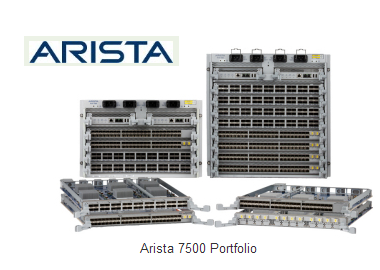
In March, Arista Networks announced two new 100GbE modules for its 7500 Series switches:

  • 7500E Series 6 port 100GbE card with support for CFP2 optics up to 40km over single mode fiber is orderable in Q2 2014 with pricing starting at $6600 per 100GbE port. 
  • 7500E Series 12 port 100GbE card is planned for availability in 2H 2014 along with a full range of QSFP-100 optics and cables.
Arista said that with 100GbE in the spine layer, customers can now achieve network virtualization using VXLAN support in the modular platforms to deploy their cloud multi-tenant networks at large scale with high bandwidth. Additionally, those deploying the Arista DANZ features within Arista EOS can now get intelligent traffic visibility on 100GbE networks by leveraging Tap Aggregation on Arista 7500E modular platforms. Arista’s Data Analysis DANZ solution is now expanded to modular chassis platforms and enables customers to connect to 100GbE spline or spine networks and to deliver tap aggregated 10GbE connections into a single 100GbE uplink to network monitoring, management and analytic tools.

“We selected the Arista 7500E platform for our data center to provide customers with true 100 Gigabit Ethernet services,” said Ihab Tarazi, Chief Technology Officer at Equinix. “Because of the open architecture and cloud interconnect protocols, including VXLAN, the programmability of Arista EOS and multi-speed mode, we are able to allocate data center resources at 10/40 or 100 gigabits in a reliable and cost-effective manner.”

Arista also noted that its 7300X Series with 10GBASE-T modules are gaining adoption among customers deploying cost-effective single tier and two tier networks.

Ciena Posts Revenue of $560 Million, up 10.3% YoY

Ciena reported revenue of $560.0 million for its fiscal second quarter ended April 30, 2014, up 10.3% from the same period in 2013.  Ciena's net loss (GAAP) was $(10.2) million, or $(0.10) per common share, which compares to a GAAP net loss of $(27.1) million, or $(0.27) per common share, for the fiscal second quarter 2013.

“As a direct result of our expanding role and reach in the industry, we delivered strong financial results in both our second quarter and first half of fiscal 2014, including continued revenue growth and increased operating leverage,” said Gary B. Smith, president and CEO, Ciena. “As the shift continues toward on-demand networking models and as we continue to diversify our business, we expect to deliver steadily improving financial performance, including performance in the second half of the year that is stronger than the first half.”

Revenue breakdown for Q2 2014 was as follows:  Converged Packet Optical 63.7%, Packet Networking 11.9%, Optical Transport 5.3%, Software/Services 19.1%.

Regionally, the U.S. market represented 57.8% of Ciena's sales in Q2.

http://www.ciena.com

Fusion-io Launches Next Gen Flash Platform

Fusion-io introduced a new flash memory platform for appliance and server applications.  The Atomic Series boasts double the capacity on the smallest available NAND footprint.  The company claims the highest transaction rate per gigabyte and up to 6.4 TB per product.

“Patience is no longer a virtue in a world where we expect information at our fingertips with ever increasing velocity,” said Fusion-io CEO and Chairman of the Board Shane Robison. “Latency is the new dial up. Our newest advancements in flash memory with the release of Atomic Series ensure that data flows seamlessly and with greater speed, efficiency and reliability by accelerating data-driven applications.”

http://www.fusionio.com/atomicseries/
http://www.fusionio.com

Thursday, June 5, 2014

Telefónica's Alcalá Data Center Achieves TIER IV Gold

Telefónica's state-of-the-art Alcalá Data Center located outside of Madrid has been named Europe's largest data center and the third largest in the world.  The facility has achieved TIER IV Gold certification from the Uptime Institute, which certifies the center's operational sustainability and attests to its high level of infrastructure availability.

The Alcalá Data Center, which recently completed its first year anniversary of launching commercial services, is the cornerstone of Telefónica's Data Center consolidation strategy, as well as one of the company's four new generation strategic data centers globally, which will act as hubs for a small number of satellite data centers that will support local services. All of Telefónica's data centers will be inter-connected via a corporate global network, all supervised and operated under one roof. This will allow Telefónica to optimize infrastructure use, enhance virtualization levels, phase out obsolete equipment and standardize the infrastructure's operating model in step with the company's global objectives.

UK, Spanish and German services are being established at the Alcalá Data Center in addition to global processes, thereby making inroads into improving the levels of quality, simplification and standardisation, which are key to Grupo Telefónica's transformation.

Telefónica has also established a new Innovation Center demonstration area at the Alcalá facility to showcase cloud services.  The company is developing Hybrid Cloud and Corporate Cloud concepts that could be enabled in a Virtual Data Center 2.0 service.

http://pressoffice.telefonica.com/jsp/base.jsp?contenido=/jsp/notasdeprensa/notadetalle.jsp&id=0&idm=eng&pais=1&elem=20866


  • In April 2013, Telefónica inaugurated the first phase of its massive Alcalá Data Centre project outside of Madrid, which aims to be one of the largest Tier IV data centers in Europe and the world. The first phase, which became operational in April 2013, is a new building measuring 24,700 m2, with seven IT rooms covering an area of 682 m2 each. The complete project, which will progress gradually, will cover a total area of 65,700 m2 (over 700,000 square feet) and include a further 16 IT rooms, on a 78,400 m2 plot of land (the size of 8 football pitches). The Alcalá Data Centre uses a modular architecture with redundant energy supplies and communications for each hall. Telefónica expects an annual reliability of 99.995%.   Each module will be independent, allowing new rooms to be activated without affecting the operation of the rest. Similarly, the 1,200 kW of IT power for each room can be multiplied up to fourfold without impacting the housed systems.  A redundant fiber optic ring connects to the company's Julián Camarillo Data Centre (Madrid), providing mutual back-up in case of faults. The facility was built by Ferrovial and Master Ingeniería, with technological advice provided by Digital Realty.


Microsoft Turns on Azure in Southern Brazil

Microsoft's Azure cloud service is now generally available in its Brazil South region, located in the state of Sao Paulo.

Early customers at the new data center include Brazil-based credit rating company Boa Vista Servicos, business management software provider Totvs, computing systems provider SiplanControl-M and e-commerce website platform Shop Delivery.

Microsoft noted ongoing demand for its global enterprise public cloud offering:  globally, more than 1,000 new customers join Azure every day, and revenue grew more than 150 percent in the last quarter. With Microsoft's recent general availability announcements in China and Japan, Azure compute capacity is doubling every six months.

http://blogs.technet.com/b/microsoft_blog/archive/2014/06/05/microsoft-azure-now-generally-available-in-brazil-south-region.aspx


Taiwan's FarEasTone Launches LTE on APT700 Band with Ericsson

Taiwan's FarEasTone Telecommunications (FET) is the first mobile operator to launch a commercial LTE service on the APT700 band.  Ericsson was the key supplier for the deployment.

APT700 band is a globally standardized band for LTE which is gaining momentum across Asia and Latin America and has the potential to serve over 2.1 billion people.

Yvonne Li, President of FarEasTone, says: "We are proud to roll out the first commercial LTE network in the world on the APT700 band. Through our long and successful relationship with Ericsson, we achieved another significant advancement in the telecom industry."

Jan Signell, Head of Ericsson Region North East Asia, says: "This is a ground-breaking step both for Ericsson and for FarEasTone in Taiwan, and by deploying the APT700 LTE network, FarEasTone's
subscribers can benefit from a fast, enhanced service."

http://www.ericsson.com


  • In October 2013 the Taiwanese government completed its LTE spectrum auction and six licenses were awarded on three frequencies: APT700, 900, and 1800 MHz. FET was awarded licenses on the APT700 and 1800 MHz frequencies.

Zain Tests NSN's Liquid Applications on Live Network

Zain KSA has successfully demonstrated Nokia's Liquid Applications running on its live network in Saudi Arabia. The demonstration was the first of its kind in the Middle East and Africa, and was carried out in Zain’s live network, powered by Nokia’s radio and core network elements.

Nokia said Liquid Applications solution brings applications, services and content into the base station to allow local storage, along with access to real-time radio and network information. This turns base stations into hubs for local service creation and delivery.

For this demo, in the radio access, Nokia used its Radio Applications Cloud Server and award-winning Flexi Multiradio 10 Base Station. In addition, the company’s consolidated OSS (operations support system) based on its NetAct network management system was used for the management of Liquid Applications and the services in use.

“We are committed to introducing new services to thrill our customers by exploring and adopting the latest technologies available on the market,” said Sultan AlDeghaither, Senior Director of Network Engineering, Zain KSA. “In response to our customers’ demand for the best mobile broadband experience, we never stop optimizing our network, and we believe Nokia’s Liquid Applications is one of the unique solutions that can offer entirely new service experiences. The demonstration in our live network proves that the solution has the capability to take the experience of mobile broadband services to completely new levels.”

http://www.sa.zain.com
http://www.nsn.com

Nokia Acquires Masaplexx for RF Filter Technology

Nokia has acquired Mesaplexx Pty Ltd, a privately-held company that develops compact, high performance radio frequency (RF) filter technology for the mobile industry.  Financial terms were not disclosed. Mesaplexx has offices in the UK and Australia.

Nokia said the Mesaplexx technology can enhance its Flexi family of radio access base stations and potentially reducing small cells form factors by 30% or more.

“Those familiar with radio technologies know that while there has been a lot of progress in recent years, filters are one area where new innovations can still yield significant improvements in performance,” said Marc Rouanne, executive vice president, Mobile Broadband at Nokia. “This company’s stand-out expertise has the potential to achieve that.”

http://www.nokia.com
http://mesaplexx.com/

Infonetics: A Carrier Survey on Packet-Optical, MPLS, and Control Plane Strategies

A survey of Global service providers published by Infonetics Research has found that SDN vendor strategies currently are not critical factors in purchasing optical transport equipment for the majority of operators.

“No topic has generated more discussion in the past 12 months than software-defined networking (SDN), though most carriers have been publicly silent on their plans for SDN in the transport network. Our latest packet-optical study found that over three-quarters of service providers surveyed plan to deploy transport SDN, but only a third say vendors’ SDN strategies play a critical role in their equipment and vendor decisions today,” reports Andrew Schmitt, principal analyst for optical at Infonetics Research.

Some highlights of the Packet-Optical Survey:

  • Opinions on exactly what constitutes a packet-optical transport system (P-OTS) vary widely in the industry; however, 86% of carriers surveyed say Infonetics’ definition of P-OTS is a good characterization
  • 84% of respondents have deployed or will deploy P-OTS by the end of 2015
  • The top reasons cited for deploying P-OTS are reducing complexity in the network and supporting services such as private line Ethernet and broadband aggregation
  • Slightly more than half of respondents will use alien wavelengths to provide spectrum leasing and dark fiber services, not IP over DWDM (IPoDWDM)
  • When asked to estimate the percentage of traffic transiting their network that is packet switched by conventional routers vs. packet-optical systems, respondents indicate that optical equipment will play a much larger role in packet switching and aggregation by 2016, but it will still be secondary to the role routers play.

http://www.infonetics.com

Cloudera Acquires Gazzang for Hadoop Encryption

Cloudera, which specializes in enterprise analytic data management powered by Apache Hadoop, has acquired Gazzang, a start-up working on big data security.  Financial terms were not disclosed.

Cloudera said the addition enables it to deliver enterprise-grade data encryption and key management for securing and processing sensitive and legally protected data within the Hadoop ecosystem, thus fulfilling a requirement in myriad compliance regulations like HIPAA-HITECH, PCI-DSS, FERPA and the EU Data Protection Directive.

Cloudera now offers encryption for all data-at-rest stored inside the Hadoop cluster - using an approach that is transparent to applications using the data, thereby minimizing the costs associated with enabling encryption.  The Gazzang team will now become the basis of a new Cloudera Center for Security Excellence whose focus includes:


  • Data and cluster security technologies - including "follow the data" authorization and encryption policies riding on Cloudera’s data lineage tracking capabilities.
  • Security testing and certification - including continuous vulnerability assessment, performance optimization, and developing regulatory compliance playbooks.
  • Security ecosystem partner enablement - developing security integration APIs and certifying partner products.


"Data security is no longer a checkbox for IT organizations or operations departments, it has become a top business priority," said Tom Reilly, chief executive officer, Cloudera. "At the same time compliance requirements for protecting data continue to expand in scope where data access comes under scrutiny. We’re entering a whole new era with the rise of the Industrial Internet and the Internet of Things where there is vastly more data being streamed from billions of devices. Centralizing and accessing that net-new data to unlock its value is therefore a challenge when you consider the security requirements. That’s what we’re solving now."

http://www.cloudera.com


  • Gazzang was headquartered in Austin, Texas and backed by Austin Ventures and Silver Creek Ventures.

  • In March 2014, Cloudera confirmed that its latest funding round, which included a strategic investment from Intel, amounted to $900 million.  This financing round includes the previously-announced $160 million of funding from T. Rowe Price and three other top-tier public market investors, Google Ventures, and an affiliate of MSD Capital, L.P., the private investment arm of Michael Dell and his family, and a significant equity investment by Intel that gives them an 18% share of Cloudera.
    Cloudera offers enterprise analytic data management software powered by Apache Hadoop, which is the underlying technology behind a growing number of Big Data projects.