Wednesday, May 1, 2019

AlCan ONE terrestrial cable to bring 100 Tbps capacity to Alaska

Construction is underway on an all-terrestrial fiber cable linking Alaska with the contiguous United States with a capacity of 100 Tbps.

AlCan ONE (Alaska Canada Overland Network) is a project of MTA, locally owned and operated Alaskan cooperative. MTA said it has secured partnerships with Canadian carriers in order to extend MTA’s existing network from North Pole, Alaska, through Canada and on to any major hub in the United States. Only traffic that both originates and terminates in the United States will be carried over MTA Fiber Holdings’ all-fiber network.

“This new terrestrial network will ensure the future viability and growth of the internet in Alaska,” said Burke. “Alaska’s leaders have talked about a terrestrial fiber optic path out of the state for more than 20 years. We are pleased to be the ones to be able to make this a reality. This will be a major win for the people who live, play and work in Alaska, supporting business, job growth, and ultimately, the state’s economy.”

http://www.mtafiber.com/


Orange and Dell collaborate on multi-access edge

Dell Technologies and Orange announced a collaboration agreement for distributed cloud architectures.

Specifically, Dell Technologies and Orange will collaborate on the definition and development of:

  • Edge technology use cases, business models and proof of concepts
  • Open source consortia and partnerships for the edge ecosystem
  • Definition and validation of infrastructure accelerators, such as FPGAs, GPUs, and SmartNICs, for edge workloads, including Cloud/Virtual RAN (CRAN/vRAN), MEC, and real-time, interactive, latency-sensitive applications
  • AI/ML-enabled software to support remote automation of a multi-technology, heterogeneous edge built on virtual machines, containers, and bare metal workloads
  • Edge infrastructure platforms supporting Telco environmental, space, operational and automation requirements.

“Orange entered this agreement with Dell Technologies to work jointly on a variety of topics revolving around edge computing and acceleration technologies that will be key to reach the full promise of 5G,” said Stéphane Demartis, vice president, Orange, Corporate Cloud Infrastructure. “We believe it’s essential to prepare the ecosystem for telco use cases while progressing in our knowledge of the future technologies. Orange expects from this partnership with Dell EMC not only technical but also business outcomes in order to fuel our strategy towards Multi-access edge computing transformation.”

Liqid delivers software-defined fabric for AI workloads on Dell

Liqid, which has developed a software-defined composable infrastructure platform, announced an OEM relationship with Dell Technologies OEM & IoT Solutions.

Liqid's software-defined fabric can be coupled with the Dell EMC PowerEdge portfolio to deliver low-latency resource allocation to pools of disaggregated GPUs, FPGAs, CPUs, NVMe storage and Intel Optane memory extension technologies. This enables users to orchestrate balanced systems for each AI phase of data ingest, cleaning/tagging, training, and inference, while minimizing the data center footprint.

Liqid is based in Broomfield, Colorado.

“AI workloads represent a highly uneven series of compute processes in which data is moved from one system to the next depending on the task, with resources sitting idle much of the time. The cost associated with these architectural inefficiencies can make AI, edge computing, and other economy-driving technologies unsustainable for many users,” said Sumit Puri, CEO and Cofounder, Liqid. “We are proud to work with Dell Technologies OEM & IoT Solutions to provide solutions based on our respective, award-winning technologies, delivering composable infrastructure that permit users to utilize a single, comprehensive, adaptive platform to increase utilization by at least 2-3X and reduce the data center footprint for high-value applications.”

“Many organizations are looking for ways to integrate AI and machine learning into their IT infrastructure while avoiding the hardware sprawl and inefficiencies that often come with it,” said Ron Pugh, Vice President, Dell Technologies OEM & IoT Solutions. “Liqid now can provide its composable solutions for AI, based on trusted Dell EMC PowerEdge infrastructure and support, for IT users seeking to improve utilization and efficiency for data-intensive applications.”

http://www.liqid.com


II-VI posts solid quarter, ROADM device sales up 50% yoy

II-VI Incorporated reported revenue of $342.4 million for its fiscal third quarter ended March 31, 2019, compared to $294.7 million in the same period a year earlier.

“We delivered another solid quarter of performance with another record backlog. Growth was widespread in the quarter across both our core and growth markets. In our core markets, we saw the leading edge of the global deployment of 5G accelerate and drive strong demand for our products. We saw particular strength from ROADM demand, which grew well over 50% compared to Q3 of last year,” said Dr. Vincent D. (Chuck) Mattera, Jr., President and Chief Executive Officer. “For the military end market, we acquired Redstone Aerospace, an entrepreneurial firm with unique capabilities in defense-related applications as we continue our investment in the emerging high-energy laser market. The industrial end market was steady.”

“In our growth markets, the quarter’s performance was also driven by very strong growth in EUV and SiC, both of which now have expanded capacity in place. In 3D sensing, we expect to see increases in shipments in the second half of this calendar year and we have achieved an important design win in an Android platform. Our global II-VI teams made great progress on the integration planning of the Finisar acquisition. We are looking forward to final regulatory approval from China, which we still believe will occur mid-year 2019.”

II-VI also said its acquisition of Finisar is on track for the first half of CY19.

https://www.ii-vi.com/wp-content/uploads/2019/05/Investor-presentation-May-2019-final.pdf


CyrusOne sees strong start to year for colocation bookings

CyrusOne, a premier global data center REIT with 48 data centers worldwide, reported revenue of $225.0 million for the first quarter, compared to $196.6 million for the same period in 2018, an increase of 14%. Net income was $89.4 million for the first quarter, compared to net income of $43.5 million in the same period in 2018. Net income for the first quarter included a $101.2 million unrealized gain on the Company’s equity investment in GDS, a leading data center provider in China, due to an increase in GDS’s share price during the quarter. Net income per diluted common share3 was $0.82 in the first quarter of 2019, compared to net income per diluted common share of $0.45 in the same period in 2018.

The company attributed the increase in revenue primarily to a 22% increase in occupied colocation square feet (CSF) from organic growth and its Zenium acquisition, as well as additional interconnection services.

“We are off to a great start to the year, with strong operational and financial performance, and leasing contributions across the portfolio as our international expansion creates an increasingly balanced and diversified business with a presence in the most important markets in the world,” said Gary Wojtaszek, president and chief executive officer of CyrusOne.

Some highlights:

  • CyrusOne leased approximately 16 MW of power and 93,000 CSF in the first quarter, representing $2.3 million in monthly recurring rent, inclusive of the monthly impact of installation charges, or approximately $27.2 million in annualized GAAP revenue7, excluding estimates for pass-through power. 
  • The weighted average lease term of the new leases, based on square footage, is 56 months (4.7 years), and the weighted average remaining lease term of CyrusOne’s portfolio is 56 months (taking into account the impact of the backlog). 
  • Recurring rent churn for the first quarter was 2.1%, compared to 0.5% for the same period in 2018.
  • In the first quarter, the Company completed construction on 249,000 CSF and 48 MW of power capacity across five projects in Northern Virginia, the New York Metro area, and Raleigh-Durham. 
  • CSF leased as of the end of the first quarter was 90% for stabilized properties10 and 86% overall.

http://investor.cyrusone.com/events-and-presentations


Equinix's revenues rise 12% YOY to $1.363 billion

Equinix reported quarterly revenue of $1.363 billion, a 4% increase over the previous quarter and up 12% over the same period last year. Net income amounted to $118 million, a 7% increase over the previous quarter.

"Equinix had a strong start to the year, delivering our best ever Q1 operating results including our largest ever quarter-over-quarter revenue step-up and our second-highest net bookings. Our bookings spanned more than 3,000 customers, with cross-border bookings up substantially year-over-year. We processed over 4,000 deals in the quarter, highlighting the diversity and high-volume nature of the Equinix retail colocation business," stated Charles Meyers, President and CEO, Equinix.

Some highlights:

  • Key customer wins and expansions included Hutchison 3G UK Limited, SpaceX and Tencent Holdings
  • Interconnection revenues continued to outpace colocation revenues in Q1 with total interconnections increasing to greater than 341,000
  • Raised $1,242 million in equity and S&P credit rating upgraded to investment grade (BBB-)

https://www.equinix.com/newsroom/press-releases/pr/123730/Equinix-Reports-First-Quarter--Results/

eSilicon Tapes Out 7nm 400G Gearbox/Retimer Test ASIC

eSilicon announced the tapeout of a 7nm test ASIC that supports 400G gearbox and retimer functionality. Fabrication is expected in September.

A gearbox converts multiple serial data streams at one rate to multiple streams at another rate. Serial-to-parallel and parallel-to-serial converters (SerDes) are critical to this functionality. A retimer improves signal integrity by equalizing, retiming and re-conditioning the received data to extend reach.

The test ASIC includes four lanes of eSilicon’s long-reach 112 Gbps SerDes and eight lanes of its long-reach 56 Gbps SerDes. The eSilicon SerDes IP is integrated with media access control (MAC), forward error correction (FEC) and gearbox IP from Precise-ITC. The test ASIC is designed to allow customers to evaluate eSilicon’s SerDes IP and the Precise E-pak Ethernet IP in a test vehicle that is representative of a real-life application. It features long reach and low power as well as low latency for time-critical applications, such as high-performance computing. The technology in the chip can be used as the basis for developing 400G and 800G systems.

“This new test ASIC will open up new opportunities for our customers,” said Hugh Durdan, vice president, strategy and products at eSilicon. “We employed the latest release of our StarDesignerä 7nm flow for this design. Thanks to the global, early analysis of integration challenges delivered by the flow, we were able to meet all performance parameters for this design and tape out on schedule.”

https://www.esilicon.com/

Qualcomm's revenue dips, Apple settlement to bring $4.5 billion

Qualcomm reported revenue of $5.0 billion for its fiscal second quarter ended March 31, 2019, down from $5.2 billion for the same period last year. Net income was $0.9 billion, down 19% from the $1.2 billion last year.

Qualcomm said its recent settlement with Apple should result in estimated revenues of $4.5 billion to $4.7 billion, consisting of a payment from Apple and the release of
obligations to pay or refund Apple and the contract manufacturers certain customer-related liabilities.

“We delivered a better than expected quarter with earnings per share above the high end of our estimates, reflecting stronger QTL results and solid execution in QCT,” said Steve Mollenkopf, CEO of Qualcomm Incorporated. “We are also pleased to have reached multi-year agreements with Apple and look forward to continuing to support them as a customer. We are executing well on our strategic priorities as 5G commercial launches begin around the world. "

https://investor.qualcomm.com/static-files/407b8d26-44a3-45ba-8b99-6c8f137bc035


Aryaka raises $50M Series F for Global Managed SD-WAN

Aryaka, a start-up based in San Mateo, California, closed a $50 million Series F round for expanding its global, managed SD-WAN solution.

The funding round was led by Goldman Sachs Private Capital Investing and joined by existing investors including Trinity Ventures, Mohr Davidow Ventures, Nexus Venture Partners, InterWest Partners, Presidio Ventures, Third Point Ventures and DTCP. This brings Aryaka’s total funding to $184 million.

“We’re constantly evaluating the market for high-growth companies that are leaders in their space. Our research shows that Aryaka offers a compelling solution for the SD-WAN market that continues to grow exponentially including increased adoption of SD-WAN managed services,” said Matthew Dorr, vice president at Goldman Sachs Private Capital Investing. “We decided to invest in Aryaka because of their highly differentiated offering, strong customer base, global footprint and their experienced management team.”

“We are pleased to receive this investment from Goldman Sachs. This new investment allows us to further accelerate our business momentum and endorses our growth strategy,” said Matt Carter, CEO of Aryaka. “We are extremely well positioned to help our customers drive WAN transformation and their multi-cloud and application performance initiatives; all while being delivered ‘as-a-service’.”

Aryaka cited accelerated business growth over the next 12 months, resulting in thousands of globally managed sites and significantly larger annual recurring revenue (ARR) streams. Aryaka has partnerships with the leading public cloud providers including AWS, Microsoft Azure, Google, Oracle and others. In addition, through partnerships with Palo Alto Networks, Symantec and Zscaler, Aryaka brings a full-fledged security solution to the edge. The company says it currently has more than 800 global customers, including JAS Worldwide, HMSHost International, Makino, Pilot Freight, Element Solutions, Allegis, and City & Guilds Group.

https://www.aryaka.com/

Comcast acquires Deep Blue for commercial WiFi management

Comcast has acquired Deep Blue Communications, which specializes in engineering, installing, and managing commercial WiFi networks. The company is based in Latham, NY. Financial terms were not disclosed.

Comcast said the acquisition allows it to combine the power and reliability of its own advanced network solutions with intelligent, managed WiFi expertise.

“Customers will benefit from our expertise in advanced business and network solutions with Deep Blue Communications’ know-how in providing commercial, managed WiFi at scale,” said Bill Stemper, President, Comcast Business. “We look forward to delivering innovative solutions that will drive competitive advantage and growth in key vertical industries such as hospitality and entertainment.”

https://business.comcast.com/about-us/press-releases/2019/comcast-acquires-deep-blue-communications

CenturyLink Private Cloud offers Dell EMC PowerEdge servers

CenturyLink Private Cloud on VMware Cloud Foundation is now available on Dell EMC PowerEdge servers.

CenturyLink said it is delivering a complete software-defined data center (SDDC) solution based on the Dell Technologies stack – combining Dell EMC PowerEdge servers with the VMware Cloud Foundation software architecture into a fully automated and fully-managed service.

CenturyLink Private Cloud is available in 31 hosting locations on four continents.

"As our customers continue on their digital transformation journeys, it is common to find workloads that don’t fit in the public cloud, yet still require reliable automation, simple operations, and resilient data protection,” said David Shacochis, vice president of Hybrid IT product management, CenturyLink. “With this new capability, we continue to give customers more ways to tap into the power of the software-defined data center while staying connected to a range of hybrid cloud venues through our adaptive, global fiber network."

eSilicon to move its ASIC and IP design work into Google Cloud

eSilicon will move all of its ASIC and IP design to Google Cloud Platform (GCP) this calendar year.

eSilicon has been running a hybrid on-premise/cloud environment for approximately the last 18 months, with ASIC design running on premise and IP design running primarily on GCP. This new agreement paves the way for a complete migration of all design activity to GCP.

“Moving to the cloud provides the flexibility to build the right compute environment for each design project, resulting in improvements in time-to-market and design quality,” said Mike Gianfagna, vice president of marketing at eSilicon.

Tuesday, April 30, 2019

New Dell EMC SD-WAN Edge is powered by VMware / VeloCloud

Dell Technologies introduced an SD-WAN Edge powered by VMware.

The Dell EMC SD-WAN Edge is an integrated platform that bundles VMware SD-WAN by VeloCloud software as a subscription with Dell EMC hardware and a single support number.

Dell Technologies Consulting Services also is debuting three new services for customers adopting SD-WAN technologies: Advisory, Design and Implementation.

Dell Technologies said its sales and customer support force can help customers plan, customize and properly scale their SD-WAN for successful deployment and management of modernized virtual network functions.

The service is expected to be available in July 2019.

VMware to acquire VeloCloud for SD-WAN

VMware agreed to acquire VeloCloud Networks, a start-up offering SD-WAN technology for enterprises and service providers. Financial terms were not disclosed.

VeloCloud, which is based in Mountain View, California, says its SD-WAN solution is distinguished by supporting data plane services in the cloud, in addition to on-premise deployments; enabling policy-based access to cloud and data center applications. VeloCloud SD-WAN includes: a choice of public, private or hybrid cloud network for enterprise-grade connection to cloud and enterprise applications; branch office enterprise appliances and optional data center appliances; software-defined control and automation; and virtual services delivery. The solution aggregates multiple access lines (cable modem, DSL, LTE) into a single secure connection that is defined and controlled in the cloud.

VeloCloud was founded in 2013. The company is headed by Sanjay Uppal, who previously ran OnMobile Global.  He also spent time at Citrix through the acquisition he negotiated with Caymas where he was President and CEO. At Citrix, he defined the product strategy and go to market for the Access Management, Delivery Controller and WAN acceleration product lines.  VeloCloud co-founders also include Ajit Mayya (previously Sr. Director of Engineering in the Cloud and Infrastructure Management division of VMware) and Steve Woo (previously head of cloud strategy at Aerohive Networks).

VMware said the VeloCloud acquisition will enable it to build on the success of its NSX network virtualization platform to address end-to-end automation, application continuity, branch transformation and security from data center to cloud to edge.

"In the digital era, a new networking approach is required to solve the hyper distribution of applications and data, as we move from a model of data centers to one of centers of data at the edge," said Pat Gelsinger, chief executive officer, VMware. "At the heart of VMware's networking strategy is the belief in delivering pervasive connectivity with embedded security that connects users to applications wherever they may be. With the addition of VeloCloud's industry-leading SD-WAN technology, we will be able to extend the VMware NSX approach of automated, secure, and infrastructure-independent networking to the WAN."

"Enterprises are transforming how they architect and utilize their infrastructure, with a shift towards a cloud-delivered, software-defined model. This enables organizations to have a globally consistent infrastructure regardless of where it is deployed -- from the data center and the cloud to the edge," said Sanjay Uppal, CEO of VeloCloud Networks. "We look forward to helping VMware, the leader in software-defined infrastructure, in the next evolution of the company's networking and NFV strategies."

  • In March, VeloCloud closed a $35 million Series D round of funding for its SD-WAN solutions. The funding was led by Hermes Growth Partners and included new investors Telstra Ventures and Khazanah Nasional Berhad, the strategic investment fund of the Government of Malaysia (“Khazanah”), in addition to existing investors New Enterprise Associates (NEA), Venrock, March Capital Partners, Cisco Investments, and other undisclosed strategic investors. This brings total funding to $84 million.
  • In March 2017, VeloCloud reported that its number of SD-WAN sites has grown to more than 50,000 and total customer wins exceed 600, including the two largest SD-WAN wins in the world. The company has secured deals from AT&T, Sprint, Mitel, TelePacific, and Windstream for its “VeloCloud Cloud-Delivered SD-WAN for Service Providers” solution for both Network Integrated and Over The Top implementations.

China Telecom awards 5G agreement to Ericsson

China Telecom signed a memorandum of understanding (MoU) with Ericsson concerning 5G.

Ericsson said it has embarked on in-depth cooperation on a 5G test network with China Telecom. In addition to testing the technical networking scheme, the partners have completed innovative 5G projects, such as the live 4K HD broadcast of a marathon; live 8K HD broadcast of the Women's World Club Volleyball Championship; 360 degree panoramic live broadcasting, and driving demos.

The agreement was signed by Luca Orsini, Head of Networks, Market Area North East Asia, Ericsson, and Liu Guiqing, Deputy General Manager, China Telecom.

Ericsson noted that it has now signed forty-five 4G agreements with service providers.

Corning's Optical Comm business delivers $1.06B in Q1 sales, up 20% yoy

Corning's Optical Communications division posted first-quarter sales of $1.06 billion, up 20% over the prior year. Net income for the division for the first quarter was up 30% year over year.

Sales growth was driven by data center and carrier business as well as sales from the recently acquired 3M Communication Markets Division.


Corning said its optical communications business remains on track to surpass its goal of $5 billion in 2020 sales, with continued growth beyond.

For full-year 2019, Optical Communications year-over-year sales growth is now expected to be up approximately 10%, revised from the company’s previous expectation of a low-teens percentage. This revision is the result of one major fiber-to-the-home customer shifting its deployment from homes passed to homes connected by one quarter earlier than
expected.

Corning expects its Optical Communications business to continue growing faster than the overall market as demand for the company’s fiber, cable, and connectivity solutions remain strong around the world.

https://investor.corning.com/investor-relations/financials/quarterly-results/default.aspx


CloudSmartz to provide portal for Seaborn's subsea cables

CloudSmartz will provide a fully integrated customer portal solution to automate Seaborn’s front-office processes.

Seaborn’s Seabras-1 offers the only direct POP-POP route between São Paulo, Brazil, and New York City, USA, and soon will offer an end-to-end automation platform that will enable services to be delivered by leading SDN technology.​

The automated customer portal is expected to bring more efficiency in Seaborn's sales, operations, inventory and service provisioning cycles, and provide real-time visibility into the service delivery functions. The platform will also enable on-demand SDN services and deliver bandwidth in near real-time delivery.​

Seaborn’s new full-service portal will enable customers to provision and amend Seabras-1 services in real time; enter service queries and quickly see updates to active tickets, delivery activities and service history; and see a detailed listing of all their Seabras-1 services, real-time usage information and billing status.

“CloudSmartz is very excited to enter our partnership with Seaborn, to not only enhance their customer experience but to enable the automation of their network and on-demand services as a next-generation subsea service provider,” says Dan Wagner, CEO, CloudSmartz. “We have been presented with the honor and privilege of helping a remarkable company rise to even greater heights – and look forward to a strong business partnership.”

Orange sees flat revenue in Q1, 204 million mobiles worldwide

Orange reported Q1 2019 revenue of EUR 10,185 (-0.1% year on year) on a comparable basis. Growth in most segments offset the slight downturn in revenues in France (-1.8% and -0.7% excluding the effect of the digital reading offers) in what continues to be a fierce promotional environment. Spain's value positioning led to 0.4% growth, despite greater competition. Europe was up 1.4%, underpinned by convergence and IT services, whilst steady growth of 5.3% continued in Africa & Middle East due to a very solid retail services performance. Enterprise had a second consecutive quarter of growth, rising 0.6%.


EBITDAaL grew 0.7% year on year, despite the impact of digital reading offers. Restated for this impact, growth in EBITDAaL would be 2.8%. The EBITDAaL margin from telecoms activities improved by 0.4 points in the 1st quarter. eCapex grew 8.4% to reach €1.6 billion, linked to the acceleration in the 1st quarter of the FTTH rollout in France and continued investment in 4G networks. In line with the objectives, eCapex for 2019 will be slightly lower compared to 2018, excluding the impact of the new network sharing agreement in Spain.

Key metrics

  • Revenues from Convergence - marketed in all European countries – were €1.7 billion in the 1st quarter, up 4.6%. This improvement enabled Orange to consolidate its position as the leading convergent operator in Europe.
  • Revenues from mobile-only services were €2.6 billion in the 1st quarter, up 1.1%.
  • Revenues from fixed-only services fell 3.1% in the 1st quarter (€2.4 billion), as a result of the migration to convergent services and the slowdown in fixed narrowband services.
  • Revenue from IT and integration services posted accelerated growth of 6.6% in the 1st quarter (€616 million), versus the 0.8% increase in the 1st quarter of 2018. This growth was driven by the Enterprise market as well as by Poland.
  • Wholesale revenues fell 1.4% in the 1st quarter (€1.9 billion). This was primarily due to the decrease in international voice traffic and visitor roaming.
  • Revenues from equipment sales were down 8.4% (€722 million), due to lower volumes of terminal sales.
  • There were 10.506 million convergent customers across the Group at 31 March 2019, stable year on year on a comparable basis, underpinned by very strong growth in Europe.
  • There were 203.781 million mobile customers at 31 March 2019, with a net addition of 163,000 in the 1st quarter. 
  • There were 20.275 million fixed broadband customers at 31 March 2019, with a net addition of 130,000 in the 1st quarter.

IDC: Smartphone market continues to decline

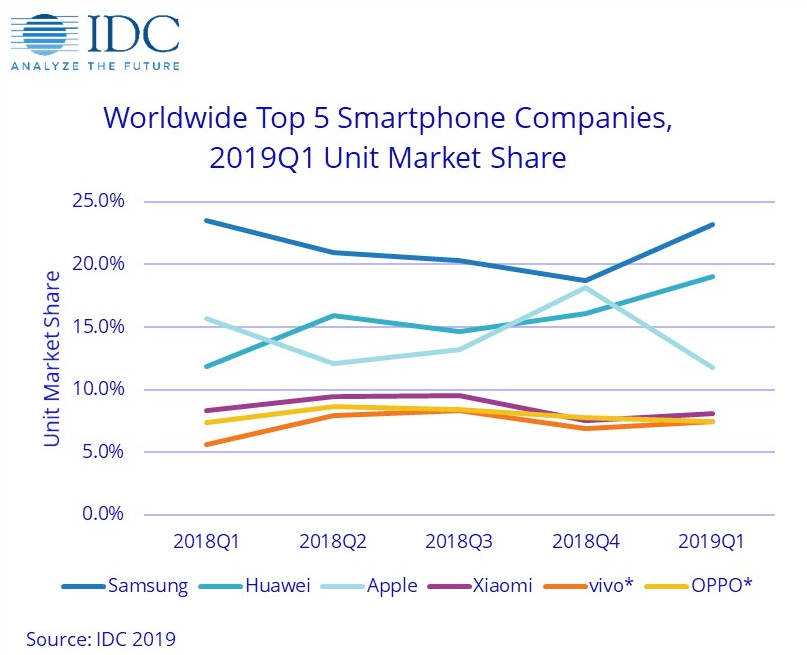
2019 will be another down year for worldwide smartphone shipments, as vendors shipped a total of 310.8 million units in 1Q19, marking a 6% drop year-over-year and the sixth consecutive quarter of decline, according to newly published figures from IDC.

Some highlights from IDC

  • Samsung saw volumes drop 8.1% in 1Q19 with shipments of 71.9 million. The newly launched Galaxy S10 series did sell well during the quarter, and the 5G variant is now shipping in Korea, with additional markets launching soon.
  • Huawei increased shipments and market share, moving its way into a clear number two spot.
  • Huawei saw year-over-year growth of 50.3% in 1Q19 with volumes of 59.1 million units and a 19.0% market share. 
  • Apple's Q1 shipments dropped to 36.4 million units representing a staggering 30.2% decline from last year. 
  • Xiaomi also experienced a decline in 1Q19 with volumes of 25.0 million, which was down 10.2% year over year. 
  • vivo returned to the top 5 of the smartphone market with volumes of 23.2 million and a market share of 7.5%, tying it with OPPO for the number 5 position. 
  • OPPO shipped 23.1 million smartphones in 1Q19, enough to capture a 7.4% market share, although volumes were down 6.0% from 1Q18.

https://www.idc.com/getdoc.jsp?containerId=prUS45042319


Equinix acquires Switch Datacenters' AMS1 data center

Equinix acquired Switch Datacenters' AMS1 data center business in Amsterdam, Netherlands, in an all-cash transaction for €30 million.

The facility, which will be renamed Equinix AM11 International Business Exchange (IBX) data center, is in close proximity to Equinix's existing campus in southeast Amsterdam. AM11 becomes Equinix’s ninth IBX data center in Amsterdam. The data center is a leased asset and adds approximately 250 cabinets of sold capacity and a total capacity for approximately 700 additional cabinets once the facility is completely built out. The site can also support the potential to expand into an adjacent building to accommodate future growth and approximately 1,300 additional cabinets.

Inphi posts Q1 revenue of $82.2M, up 37% yoy

Inphi reported Q1 2019 revenue of $82.2 million on GAAP basis, up 36.7% year-over-year, compared with $60.1 million in the first quarter of 2018.  The increase was due to higher demand for both telecom and datacenter products.

Gross margin under GAAP in the first quarter of 2019 was 57.9%, compared with 54.1% in the first quarter of 2018. The increase in gross margin primarily reflects a change in the product mix. There was a GAAP operating loss of $15.5 million or (18.8%) of revenue, compared to GAAP operating loss in the first quarter of 2018 of $28.0 million or (46.5%) of revenue. The decrease in operating loss was mainly due to higher revenue. GAAP net loss for the first quarter of 2019 was $22.7 million or ($0.51) per common share, compared with $23.0 million or ($0.53) per common share in the first quarter of 2018.

“Year-over-year revenue growth of 37% coupled with Non-GAAP gross and net operating margin expansion resulted in Q1 Non GAAP EPS that exceeded the midpoint of our outlook by $0.05,” said Ford Tamer President and CEO of Inphi Corporation. “Our strong Q1 benefited from robust demand for both Telecom products, Coherent M200 DSPs, TiAs and drivers as well as the Data Center 50, 100, 200 and 400G PAM4 DSPs, TiAs and drivers.  We also benefited from the start of the 5G backhaul infrastructure buildup.”