Sunday, December 10, 2017

Juniper Bots aim for the Self-Driving Network

Juniper Networks is introducing a series of new applications called Juniper Bots that are intended to simplify network operations by translating intent into automated workflows.

Leveraging both the Contrail and AppFormix platforms, the Juniper bots incorporate real-time analytics to translate higher-level business requirements (the "what") into automatic configuration changes across the network (the "how"). The first Juniper bots include:

  • Contrail PeerBot automates the traditionally cumbersome process of network peering -- managing multiple Border Gateway Protocol (BGP) routing and complex policy enforcement -- to simplify policy enforcement and on-demand scaling.
  • Contrail TestBot, an application that's part of Juniper's broad effort to help network operators embrace a DevOps approach for Continuous Integration/Continuous Deployment, automates the continuous auditing of design, provisioning, and deployment changes in the network.
  • AppFormix HealthBot is a machine learning fitness and health tracker for the network that leverages AppFormix to collect real-time network data and glean insight, HealthBot translates troubleshooting, maintenance, and real-time analytics into an intuitive user experience to give network operators actionable insights into the health of the overall network.

Also being introduced are Juniper Extension Toolkit (JET) enhancements that extend the current management and control API framework to the data plane. This will allow developers to create applications with direct data plane access on Juniper's vMX and MX Series 3D Universal Edge Routers.

"Juniper Bots bring us closer to our vision for The Self-Driving Network, one that requires less human intervention and the ability to focus on more strategic business initiatives. To move at the speed of business, network operators need to spend less time precisely managing manual network knobs and levers, and more time expressing intent," stated Sally Bament, vice president, service provider marketing, Juniper Networks.

Cisco to acquire Cmpute.io for cloud optimization tools

Cisco will acquire Cmpute.io, a start-up based in Bangalore that optimizes applications by moving workloads between private and multiple public clouds or region, based on current performance metrics and/or spot pricing.  Financial terms were not disclosed.

Cmpute.io, also known as 47Line Technologies, analyzes cloud-deployed workloads and consumption patterns. Its cost-optimization strategies help customers
minimize cloud instance overprovisioning.

Cmpute.io’s team and technology will join Cisco CloudCenter.

Saturday, December 9, 2017

HDMI 2.1 spec cranks up speed to 48 Gbps, support for 8K60

A newly released Version 2.1 of the HDMI Specification supports a range of higher video resolutions and refresh rates including 8K60 and 4K120, and resolutions up to 10K.

HDMI v2.10, which is backwards compatible, offers significantly increased bandwidth of up to 40 Gbps across the connection. Key attributes of the specification:

HDMI Specification 2.1 features include:

  • Higher video resolutions support a range of high resolutions and faster refresh rates including 8K60Hz and 4K120Hz. Resolutions up to 10K are also supported for commercial AV, and industrial and specialty usages.
  • Dynamic HDR 
  • The Ultra High Speed HDMI Cable supports the 48G bandwidth for uncompressed HDMI 2.1 feature support. The cable also features very low EMI emission and is backwards compatible with earlier versions of the HDMI Specification and can be used with existing HDMI devices.
  • eARC simplifies connectivity, provides greater ease of use, and supports the most advanced audio formats and highest audio quality. It ensures full compatibility between audio devices and upcoming HDMI 2.1 products.
  • Enhanced refresh rate features ensure an added level of smooth and seamless
  • motion and transitions for gaming, movies and video. They include:
  • Variable Refresh Rate (VRR) reduces or eliminates lag, stutter and frame tearing for more fluid and better-detailed gameplay.
  • Quick Media Switching (QMS) for movies and video eliminates the delay that can result in blank screens before content is displayed.
  • Quick Frame Transport (QFT) reduces latency for smoother no-lag gaming, and real-time interactive virtual reality.
  • Auto Low Latency Mode (ALLM) allows the ideal latency setting to automatically be set allowing for smooth, lag-free and uninterrupted viewing and interactivity.

“The HDMI Forum’s mission is to develop specifications meeting market needs, growing demands for higher performance, and to enable future product opportunities,” said Robert Blanchard of Sony Electronics, president of the HDMI Forum.

Crosslake Fibre plans subsea cable from Toronto to Buffalo

Crosslake Fibre, a new venture that plans to construct the first submarine cable across Lake Ontario from Toronto, Canada to Buffalo, New York, has secured an investment from Tiger Infrastructure Partners.

Crosslake intends to build a high fibre count network linking data centres in Toronto t networks in the United States. The 60-km subsea cable will be the first in Lake Ontario. Crosslake Fibre said intends to use horizontal directional drilling to land the submarine cable at each landing in order to minimize any impact to the shore end or beach. The ready-for-service (RFS) date for the system is September 2018.

“Crosslake will enable the purchase of new, diverse dark fibre between Canada and the U.S., allowing carriers to displace leased fibre and add diversity,” said Michael Cunningham, CEO of Crosslake. “We are excited to
partner with Tiger Infrastructure to grow the Crosslake platform.”

In November, Crosslake Fibre announced plans for a submarine cable system connecting cable landing stations in Wall, New Jersey to Long Island, New York.

Megaport activates Direct Connect to IBM Cloud

Megaport, which provides SDN-based Elastic Interconnect Services, has begun offering direct, secure connectivity to IBM Cloud from any of the 179 data centres globally where it is present.

"IBM Cloud has a long and rich history within the enterprise space," said Vincent English, Chief Executive Officer, Megaport. "Clients who want to build next-generation applications now have direct, scalable access to cloud infrastructure that is tuned for AI and big data. Our connectivity model bypasses the public internet and serves enterprises moving to the cloud while improving performance and network reliability to critical business applications. As a result, customers can optimise workloads and scale between on-premises infrastructure and the cloud."

"Enterprises have moved well past using the cloud simply for cost-savings, and are now embracing higher value cloud-native services to create new business opportunities," said Kit Linton, Vice President of Network, IBM Cloud. "Megaport is enabling direct connectivity to IBM Cloud Direct Link to provide a reliable way for global enterprises to expand their reach, drive innovation and embrace a cloud strategy that seamlessly connects public and private infrastructure."

Toshiba boosts conventional HDD to 14TB

Toshiba introduced an enterprise hard disk drive (HDD) with a record capacity of 14 TB and based on Conventional Magnetic Recording (CMR) technology. The drive uses a 9-disk, helium-sealed design and is aimed at cloud-scale and enterprise storage applications. A 12 TB, 8-disk version of the drive will also be available.


DE-CIX hits a peak load of 6 Tbps for first time

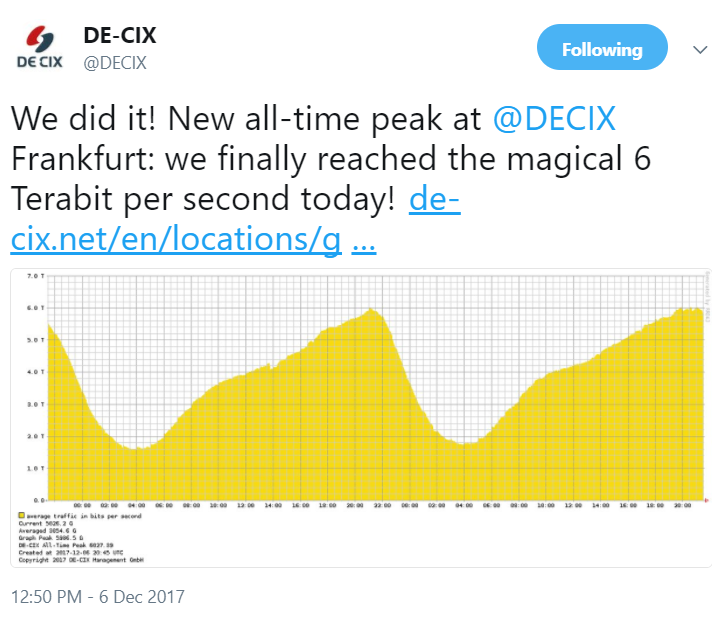
On December 6th, the DE-CIX Internet Exchange in Frankfurt, Germany hit exceeded the 6 Tbps threshold of peak load for the first time.

The DE-CIX Internet exchange in Frankfurt boasts over 700 networks connections. Access is available in 20+ data centers in the metro area. Exchange traffic flows over the DE-CIX Apollon platform.

Kansas City Power & Light picks Nokia

Kansas City Power & Light (KCP&L) has selected Nokia to enhance the microwave communications network that supports a range of mission-critical services for the utility's power transmission and distribution grid.

Nokia said that for this project it is introducing the latest microwave packet radio technology as an overlay to existing equipment.

KCP&L is deploying Nokia's Wavence microwave packet radio family of technologies (formerly known as the 9500 Microwave Packet Radio), which will enable the utility to support all of its grid control applications alongside its legacy data services using a single, converged network. The current deployment, covering 40 sites, is already underway and is to be completed before the end of 2017.  A second phase consisting of 29 additional sites will follow shortly after.

Thursday, December 7, 2017

IBM unveils POWER9 server with PCIe 4.0

IBM unveiled its next-generation Power Systems Servers based on its newly designed POWER9 processor and designed for compute-intensive AI workloads and frameworks, such as Chainer, TensorFlow and Caffe, as well as accelerated databases such as Kinetica.

The new POWER9-based AC922 Power Systems are the first to embed PCI-Express 4.0, next-generation NVIDIA NVLink and OpenCAPI, which combined can accelerate data movement, calculated at 9.5x faster than PCI-E 3.0 based x86 systems.

IBM calculates that its new POWER9 systems are capable of improving the training times of deep learning frameworks by nearly 4x.

“Google is excited about IBM's progress in the development of the latest POWER technology," said Bart Sano, VP of Google Platforms "The POWER9 OpenCAPI Bus and large memory capabilities allow for further opportunities for innovation in Google data centers." 

"We’ve built a game-changing powerhouse for AI and cognitive workloads,” said Bob Picciano, SVP of IBM Cognitive Systems. “In addition to arming the world’s most powerful supercomputers, IBM POWER9 Systems is designed to enable enterprises around the world to scale unprecedented insights, driving scientific discovery enabling transformational business outcomes across every industry.”


Broadcom hits revenue of $4.8 billion, up 9%

Broadcom reported Q4 2017 revenue of $4,844 million, an increase of 9 percent from $4,463 million in the previous quarter and an increase of 17 percent from $4,136 million in the same quarter last year.

Gross margin was $2,383 million, or 49.2 percent of net revenue, compared with gross margin of $2,149 million, or 48.2 percent of net revenue, in the prior quarter, and gross margin of $2,171 million, or 52.5 percent of net revenue, in the same quarter last year.

“On the heels of very strong fiscal 2017 financial results, and continuing momentum into the new fiscal year, we are increasing capital returns to our shareholders and have raised our interim quarterly dividend by 72%,” said Hock Tan, President and CEO of Broadcom Limited. “We also closed the acquisition of Brocade early in the first fiscal quarter of 2018, adding to our very successful track record of highly accretive M&A.”

MEF 3.0 Certifications - Career Opportunities


One of the challenges with SDN and NFV, especially with operators, is the need to transform the entire organization, says Marc Cohn. This video covers new certification programs being developed for MEF 3.0.  There are plans to broaden the certifications across multiple domains. One goal is to help people leverage this knowledge into career opportunities.

See video: https://youtu.be/JkQLqmThs1A


Fortinet presents Secure SD-WAN at #MEF17


Fortinet has just released an SD-WAN solution that provides tight integration of security from Layer 3 to Layer 7.  This makes connectivity to the cloud much more secure, says Sony Kogin, Director of Service Provider Marketing, Fortinet.

See video:  https://youtu.be/3ytpBXHB6u4


Defining Security as a Service - #MEF17


How do you provide services across secure Service Provider boundaries? Fortinet is working with other MEF members to define Security-as-a-Service, explains Richard Orgias, Director of Segment and Audience Marketing, Fortinet.

See video: https://youtu.be/wHwpqRUy2fc


T-Mobile US authorizes $1.5 billion stock repurchase program

T-Mobile US' Board of Directors authorized a stock repurchase program for up to $1.5 billion of T-Mobile’s common stock through December 31, 2018.

Deutsche Telekom is also expected to purchase another $500 million in T-Mobile's common stock on the common market.

 “Since launching Un-carrier, T-Mobile has delivered unmatched growth and continues to take share in a rapidly changing and competitive wireless industry. This repurchase program underscores our Board of Directors' and management team’s confidence in our business and our commitment to creating value for shareholders,” said John Legere President and CEO of T-Mobile. “Our strong balance sheet and cash flow generation give us the ability to return capital while continuing to make significant investments in our network and operations. 2018 is going to be another exciting year in wireless and we can’t wait to get started.”

Ciena posts quarterly revenue of $744 million, tax benefit of $1.13 billion

Ciena reported revenue of $744.4 million for its fourth quarter of fiscal 2017, ended 31-October-2017, as compared to $716.2 million for the fiscal fourth quarter 2016. For fiscal year 2017, Ciena reported revenue of $2.80 billion, as compared to $2.60 billion for fiscal year 2016.

Ciena's fiscal fourth quarter and fiscal year 2017 results reflect a tax benefit of $1.13 billion related to the reversal of a deferred tax asset valuation allowance. As a result, GAAP net income for Q4 was $1.16 billion, or $7.32 per diluted common share, which compares to a GAAP net income of $36.6 million, or $0.25 per diluted common share, for Q4 2016.

For fiscal year 2017, Ciena had a GAAP net income of $1.26 billion, or $7.53 per diluted common share, which compares to a GAAP net income of $72.6 million or $0.51 per diluted common share for fiscal year 2016.

Revenue by Geography
North America   $440.5
EMEA                $110.7
CALA                 $43.5
APAC                 $149.7

Separately, Ciena's Board of Directors authorized a program to repurchase up to $300 million of the company’s common stock through the end of fiscal 2020.


KPN appoints Maximo Ibarra as CEO

Royal KPN announced the appointment of Mr. Maximo Ibarro as CEO and as chairman of KPN's Board of Management. He replaces Mr. Eelco Blok in both positions.

Ibarra previously led the merger of Wind and Tre Italia, Italy's two biggest telcos. Previously he was CEO of Wind.

Wednesday, December 6, 2017

Broadband Forum targets PON Virtualization for 5G Fronthaul

The Broadband Forum and NTT are undertaking a project to standardize the virtualization of PON networks to support the delivery of Time Critical Applications (TCAs), such as 5G fronthaul.

The project, which was initiated by Forum member NTT, is called PON Abstraction Interface for TCAs. It looks at how SDN and NFV can be applied to Optical Line Terminals to disaggregate PON functions to functional modules with open interfaces. The first phase will define the disaggregation policy and functional requirements of interfaces to disaggregate PON functions which need time-critical processing, while the second phase will define the detailed specifications of the interfaces as Application Programming Interface (API) sets.

“As users’ usage changes, both in regard to the different services required and the amount of data coursing through fiber networks, operators need to update their PON networks, including by adding TCAs,” said Akihiro Otaka, Executive Manager at NTT Access Network Service Systems Laboratories. “This used to require the remake of PON equipment for each service, but should be done via a software upgrade in the near future to improve cost-effectiveness. With demand for this increasing, it is important we ensure there are standards in place to achieve a vendor-agnostic system and ensure mass deployment of this new system architecture, which is essential if we are to deliver agile and flexible next-generation broadband networks for emerging services.”

“As we work to meet the demand for new services, faster connectivity and more bandwidth, our focus is shifting from the fixed network to a holistic broadband network,” said Robin Mersh, CEO of Broadband Forum. “We know fiber will play a huge role in the delivery of 5G and this project looks to define that role and make it possible for operators to offer fronthaul services, among others, via their PON networks. This makes the work important not just for the broadband industry but the telecoms market as a whole and it can only be achieved on a wide scale through collaboration and standardization.”

MONET subsea cable enters service connecting U.S. and Brazil

The Monet subsea cable system, which links the U.S. and Brazil, is complete and ready for commercial service.

The 100Gbps-capable cable system offers an initial 64 Tbps of capacity.  The 10,556km cable has shore landings in Boca Raton, Florida; Fortaleza, Brazil; and Praia Grande, Brazil.

Monet is owned by Algar Telecom (Brazil), Angola Cables (Angola), Antel (Uruguay), Google and TE SubCom, a TE Connectivity Ltd. company.

Antonio Nunes, chairperson of the Monet Executive Committee said: “We are proud to have completed this project with SubCom in the most efficient manner possible. The open cable approach enabled each Monet party to meet its respective network objectives while still benefitting from the strengths of a joint build partnering model. Each of the parties, working with TE SubCom, was able to create a network that should meet our technology and cost needs well into the future.”

“The successful implementation of Monet is the result of excellent teamwork between TE SubCom and the purchasers to mitigate project risks. TE SubCom is proud to have delivered on time a flexible, highly reliable system to this distinguished group of customers,” stated Debra Brask, vice president of Project Management of TE SubCom.

Equinix Brings Submarine Cable Connections to its Data Centers

Equinix's data center in Miami will host the Florida cable landing equipment of the Monet submarine cable system.

The Monet submarine cable, which will deliver 60 terabits of capacity between the U.S. and Brazil, is owned by Algar Telecom (a Brazilian telecom company and ISP), Angola Cables, Antel (the Uruguayan telecom company) and Google, which is also the U.S. landing party for Monet. Construction of the system is underway and is expected to be completed in 2017.

The Monet cable will terminate in the U.S. at Equinix's MI3 International Business Exchange (IBX) data center. In Brazil, Monet will land in Fortaleza and Praia Grande near São Paulo. Landing facilities in those markets are to be provided by Angola Cables in Fortaleza and Google in Praia Grande.

Equinix said this represents an industry first for deploying an open submarine cable architecture together with an integrated cable landing station; colocation and interconnection inside a network-dense, multi-tenant data center.

Current submarine cable projects that Equinix is engaged with and has publically announced include:  Southern Cross Cable Network (California - Sydney); Aqua Comms (New York - London); Hibernia Express (New York - London); Cinia (Germany - Finland); Trident (Australia - Indonesia - Singapore); Globenet (Florida - Brazil); Asia Pacific Gateway (China - Hong Kong - Japan - South Korea - Malaysia - Taiwan - Thailand - Vietnam - Singapore); Hawaiki Cable Limited (U.S. – Australia – New Zealand); Gulf Bridge International (Middle East - Europe); FASTER (U.S. West Coast - Japan); Seaborn Networks (New York - Sao Paulo); and Monet (Florida - Brazil).

VeloCloud offers Seamless Addition of SD-WAN to AWS

VeloCloud Networks' Cloud-Delivered SD-WAN is enhancing the ability for enterprises to connect to Amazon Web Services (AWS).

Specifically, VeloCloud is leveraging AWS to offer a range of flexible deployment options for customers, including topology designs that require minimal changes to their existing networks. Enterprises now have the flexibility of including Amazon Virtual Private Cloud (Amazon VPC) as a part of VPN, either through globally distributed VeloCloud hosted Gateways and existing VPN hubs on AWS, or by deploying Virtual VeloCloud Edges on AWS. These solutions eliminate tunnel complexity and deliver security for both Internet only and Hybrid sites. Additionally, Service Providers or partners can host multi-tenant VeloCloud Partner Gateways on AWS for secure and reliable access to their hosted applications.

“VeloCloud SD-WAN has, from the beginning, been characterized by powerful optimization, performance and security capabilities combined with unmatched flexibility and simplicity for implementation and management of enterprise WAN,” said Steve Woo, VP of Products and Co-Founder of VeloCloud Networks. “The increasing integration of VeloCloud SD-WAN with AWS together with the uniquely flexible deployment options further differentiates our solution in the market.”

VMware to acquire VeloCloud for SD-WAN

VMware agreed to acquire VeloCloud Networks, a start-up offering SD-WAN technology for enterprises and service providers. Financial terms were not disclosed.

VeloCloud, which is based in Mountain View, California, says its SD-WAN solution is distinguished by supporting data plane services in the cloud, in addition to on-premise deployments; enabling policy-based access to cloud and data center applications. VeloCloud SD-WAN includes: a choice of public, private or hybrid cloud network for enterprise-grade connection to cloud and enterprise applications; branch office enterprise appliances and optional data center appliances; software-defined control and automation; and virtual services delivery. The solution aggregates multiple access lines (cable modem, DSL, LTE) into a single secure connection that is defined and controlled in the cloud.

VeloCloud was founded in 2013. The company is headed by Sanjay Uppal, who previously ran OnMobile Global.  He also spent time at Citrix through the acquisition he negotiated with Caymas where he was President and CEO. At Citrix, he defined the product strategy and go to market for the Access Management, Delivery Controller and WAN acceleration product lines.  VeloCloud co-founders also include Ajit Mayya (previously Sr. Director of Engineering in the Cloud and Infrastructure Management division of VMware) and Steve Woo (previously head of cloud strategy at Aerohive Networks).

VMware said the VeloCloud acquisition will enable it to build on the success of its NSX network virtualization platform to address end-to-end automation, application continuity, branch transformation and security from data center to cloud to edge.

GBI - Transforming Subsea Systems with SDN


GBI, which stands for Gulf Bridge International, is well-known for its subsea cable system extending from the Arabian Gulf to the United Kingdom to the west and Singapore to the east. In this video, Rick Hillson, VP of Next Gen Architecture for GBI, talks about transforming this system with #SDN and #NFV.

See video: https://youtu.be/O09truKmCkU