Wednesday, April 27, 2016

Verizon Deploys OpenStack NFV in 5 Data Centers

Verizon has completed a Network Function Virtualization OpenStack cloud deployment across five of its U.S. data centers.

Verizon said its NFV project, which began in 2015, created a production design based on a core and pod architecture that provides hyperscale capabilities. The project is based on OpenStack with Red Hat Ceph Storage and a spine-leaf fabric for each pod controlled through a Neutron plugin to Red Hat OpenStack Platform. The multi-vendor deployment leverages Big Switch’s Big Cloud Fabric for SDN controller software managing Dell switches, which are orchestrated by Red Hat OpenStack Platform.

Verizon said the OpenStack pod-based design that went from concept to deployment of more than 50 racks in five production data centers in less than nine months. Rollouts are currently in progress in additional domestic data center and aggregation sites, with international locations to be deployed over the next several months. The design also will be adopted in edge network sites by the end of the year.

Architecturally, the large scale NFV deployment had five key needs, which were identified early in the project:
  • Resiliency at Scale - The design followed a hyperscale-inspired “core and pod” approach with a 12-rack pod design replicated at data centers across the United States.
  • No Bandwidth Bottlenecks - A modern leaf-spine Clos design, using centralized SDN control designed to take the network from spine to leaf to vSwitch and avoid bandwidth bottlenecks.
  • Logical Network Design Flexibility - The pod design accommodates unique NFV workloads with unique logical network requirements that share the same physical leaf/spine fabric and vSwitches.
  • Reduced Operational Complexity - Operational complexity is reduced through a simplified lifecycle management of the network control systems relative to the OpenStack control systems.
  • Integrated Security and Visibility - The NFV Pod is designed to be compliant and secure against intrusions and other threats, monitoring fabric was used to monitor intra-pod traffic and inline traffic.

“Building on our history of innovation, this NFV project is another step in building Verizon’s next-generation network -- with implications for the industry. New and emerging applications are highlighting the need for collaborative research and development in technologies like NFV. We consider this achievement to be foundational for building the Verizon cloud that serves our customers’ needs anywhere, anytime, any app.”  Adam Koeppe, vice president, network technology planning, Verizon

http://www.verizon.com/about/news/verizon-launches-industry-leading-large-openstack-nfv-deployment

A 35 minute presentation from this week's OpenStack Summit in Austin is posted here: https://youtu.be/1aVB3QvEYcI


Verizon Reports 57 Incidents of Sabotage in 2 Weeks

Verizon reported a more than 100 percent increase in the number of suspected incidents of sabotage that have cut off thousands of Verizon customers from critical wireline services, since April 13.  The incidents include:

  • In Delaware, three separate incidents occurred this week in Hockessin at fiber hub locations; fiber cables were severed in multiple locations.
  • In New Jersey, there have been 17 incidents of suspected sabotage since April 13, primarily in the northern part of the state.
  • In New York, the second most impacted state, 15 incidents are under investigation.
  • In Pennsylvania, 10 incidents are under investigation, including suspected arson involving a fire-damaged terminal in Drexel Hill.
  • In Virginia, cables have been severed, or equipment stolen, in eight separate incidents.
  • In Maryland, fiber cables were ripped from a hub in Brandywine on April 22.

“These are criminal activities, affecting people’s safety and putting lives at risk. We are investigating all reports and pursuing all avenues to assist law enforcement in finding and convicting the perpetrators of these acts,” said Michael Mason, Verizon’s chief security officer.

Verizon said it normally experiences about a half dozen dangerous and reckless acts of destructive vandalism each year.

http://www.verizon.com/about/news/verizon-reports-57-suspected-incidents-network-sabotage-and-related-criminal-activity-past-two


  • On April 13, nearly 40,000 Verizon workers from Maine to Virginia, represented by the Communications Workers of America (CWA) and the International Brotherhood of Electrical Workers (IBEW), went on strike as of Wednesday morning at 6am. The parties have been unable to resolve differences since the last contract expired on August 1st, 2015.

Telia Carrier Lights 2nd West Coast Route with Infinera

Telia Carrier is adding a second low latency, high capacity route between Silicon Valley and Los Angeles, connecting the Internet Content superpowers of the Bay Area with the entertainment and media giants of Hollywood. The route uses the Infinera DTN-X platform.

In addition, Telia Carrier has lit up a 100G-enabled metro ring linking strategically important connection points in the San Francisco Bay Area. The Infinera TM-Series features multi-service capabilities including the ability to support MEF 2.0 certified Ethernet services, mobile fronthaul, wholesale bandwidth and metro aggregation. The solution offers a unified network management layer across DTN-X and TM-Series and programmable SDN application programming interfaces (APIs) to enable rapid service delivery.

Infinera noted that Telia Carrier now utilizes an end-to-end Infinera Intelligent Transport Network, from long-haul to metro, as the foundation of its leading ‘built from the ground-up’ network infrastructure. The company also cited a track record of supporting Telia Carrier with network ‘firsts.’ Telia Carrier was the first network operator in North America to deploy the Infinera DTN-X Family with Instant Bandwidth and the first network operator to test a terabit super-channel on a live network. Now Telia Carrier is the first announced provider to extend a nationwide DTN-X network by deploying Infinera’s TM-Series for Metro 100G at scale.

“The West Coast is a critical network segment in the U.S. and we are adding an additional route to further enhance customer experience in the region. The Infinera TM-Series makes the economics of 100G work. This metro solution brings with it the benefits of an integrated, low-power and space-saving design. More and more of our customers are doing the math and working out that now is the time to invest in 100G. And thanks to Infinera, we are ready for them,” said Mattias Fridström, Chief Technology Officer at Telia Carrier.

“Telia Carrier now has an end-to-end unified Infinera Intelligent Transport Network that is optimized for scale, operational simplicity, and to accelerate network service delivery to Telia Carrier’s customers,” said Bob Jandro, Senior Vice President, Worldwide Sales at Infinera. “Telia Carrier’s expanding deployment of Infinera’s end-to-end solutions underscores the value we bring to our customers across the globe.”

http://www.infinera.com
http://www.teliacarrier.com/


Facebook Reaches 1.65 Billion Monthly Users

With its record quarterly financial report, Facebook posted several other impressive growth metrics:


  • Monthly active users (MAUs) were 1.65 billion as of March 31, 2016, an increase of 15% year-over-year.
  • Daily active users (DAUs) were 1.09 billion on average for March 2016, an increase of 16% year-over-year
  • Mobile DAUs were 989 million on average for March 2016, an increase of 24% year-over-year
  • Mobile MAUs - Mobile MAUs were 1.51 billion as of March 31, 2016, an increase of 21% year-over-year.
  • 1 billion users on WhatsApp each month
  • 900 million users on Messenger each month
  • 400 million Instagram users each month


http://newsroom.fb.com/news/

AT&T Brings NetBond Connectivity to its Cisco WebEx Global Service

Starting in May, AT&T Conferencing with Cisco WebEx global conferencing solution will include AT&T NetBond connectivity for customers meeting eligibility requirements.

AT&T NetBond ensures improved network performance and security to cloud platforms.

In a blog posting, Vishy Gopalakrishnan, Product Marketing Management AVP at AT&T, observes that millennials are becoming a driving force for unified voice and collaboration solutions.

"For today’s mobile workers and those teaming up with peers around the globe, integrated communications tools are critical. As a new tech-loving generation enters the workforce and mobile workers multiply, providers must prepare to deliver more seamless, intuitive, and unified voice and collaboration solutions," writes Gopalakrishnan.

https://networkingexchangeblog.att.com/enterprise-business/the-mobile-generation-has-arrived

NHN Techorus Links Data Centers with Infinera Cloud Xpress

NHN Techorus Corp., a data center operator in Japan, has deployed the Infinera Cloud Xpress to interconnect its Tokyo data centers.

Working with Infinera’s partner, Nissho Electronics, Techorus selected the Infinera Cloud Xpress to serve the growing need for high capacity interconnectivity among Techorus locations, helping its customers to grow efficiently and connect to the metro Tokyo ecosystem of customers, partners and service providers.

Infinera’s unique photonic integrated circuit technology enables the Cloud Xpress to support up to one terabit per second (Tbps) of input and output capacity in just two rack units. With its small form factor and low power consumption, Cloud Xpress delivers a full 500 Gbps super-channel of wavelength division multiplexing (WDM) line-side bandwidth over 150 kilometers (km) without additional multiplexers or amplifiers, and up to 600 km with an amplified line system. Cloud Xpress also enables efficient scaling with simple provisioning and open interfaces to plug into existing cloud provisioning systems using open software defined networking (SDN) application programming interfaces (APIs). Instant Bandwidth allows the activation of WDM bandwidth in 100 Gbps increments with a few clicks of a mouse enabling rapid scale to meet continued customer demand.

http://www.infinera.com

6WIND Integrates with Mirantis OpenStack for NFV

6WIND announced integration with Mirantis OpenStack to simplify joint customer deployments for high performance data centers and Network Function Virtualization Infrastructure (NFVI).

Specifically, 6WIND Virtual Accelerator, which is hypervisor acceleration software, will integrate an OpenStack Fuel plugin for increased application throughput and efficiency in KVM environments. Both companies have worked together to release a Mirantis certified 6WIND Virtual Accelerator Fuel plugin. Developed in open source, Fuel provides an intuitive, GUI-driven experience for deployment and management of a variety of OpenStack distributions and plugins.

Based on DPDK, 6WIND Virtual Accelerator provides a packet processing solution for a full-featured and high performance virtual networking infrastructure allowing:

  • High performance I/Os leveraging DPDK, with multi-vendor NIC support
  • High performance virtual switching (Open vSwitch and Linux bridge) and networking (Overlays, Filtering/NAT, IP Forwarding, IPsec)
  • Support for existing workloads through standard Virtio drivers

“Many Network Operators are working with Mirantis OpenStack as they transition to NFV,” said Kamesh Pemmaraju, VP of Product Marketing at Mirantis. ”The partnership between Mirantis and 6WIND expands the use cases for OpenStack NFV by leveraging Fuel to automate hypervisor scaling for critical high performance virtual networking requirements.”

http://www.6wind.com

Red Hat Cites OpenStack Rollouts with Fastweb, Paddy Power Betfair, and Produban

Red Hat announced OpenStack rollouts with several organizations across Europe, including Fastweb, Paddy Power Betfair, and Produban.

  • Fastweb, a leading Italian telecommunications company, provides enterprise cloud-based information and communications technology (ICT) services to Italian businesses that lack internal resources to independently develop and support them. Fastweb has migrated to the Red Hat OpenStack Platform.
  • Paddy Power Betfair, one of the largest online betting companies, and the largest betting exchange in the world, uses technology as a strategic advantage to disrupt the betting industry. Paddy Power Betfair’s i2 program, which aims to create a greenfield private cloud platform for Paddy Power Betfair using Red Hat OpenStack Platform and software-defined networking (SDN) in order to support continuous delivery of Paddy Power Betfair’s applications. With its new OpenStack-based private cloud, Paddy Power Betfair can deliver a new network and hosting infrastructure based on IaaS principles, hosting all development, test and production applications, and the associated tooling in a single location. Using SDN, Paddy Power Betfair reports that it has been able to reduce its reliance on physical networking equipment and simplify network operations, enabling them to process more transaction volume per second with less server downtime.
  • Produban, Santander bank’s IT services company, specializes in the continuous design and IT infrastructure operation. Produban’s global footprint includes 10 datacenters to support all of Grupo Santander’s businesses, including Banco Santander, S.A., one of Europe’s largest banks and among the largest banks globally by market value. To support its global datacenters, Produban built a hybrid cloud infrastructure based on Red Hat OpenStack Platform, Red Hat Ceph Storage, Red Hat CloudForms, and software-defined technology from Nuage Networks, a Red Hat certified partner. Produban also deployed OpenShift Enterprise, Red Hat’s container application-development platform, as the default Platform-as-a-Service (PaaS) solution to develop and deploy its enterprise banking applications. The new solution meets Produban’s requirements for an open hybrid cloud that includes core infrastructure (IaaS), DevOps (PaaS), and multi-cloud management, all built on an underlying virtualized network.


http://www.redhat.com

Tuesday, April 26, 2016

Aviatrix Builds Cloud Native Networking for Scaling Virtual Private Clouds

Aviatrix, a start-up based in Santa Clara, California, unveiled a "Cloud Native Networking" solution that combines a software-defined network controller and software gateways to enable businesses to scale out virtual private clouds (VPCs) with VLAN-like segmentation of cloud instances and policy-based security. The idea is to make it easier to provision and manage VPCs that span public, private and hybrid clouds. The Aviatrix software provisions, orchestrates and connects secure tunnels across regions, eliminating manual configuration and reducing administrative complexity of cloud-to-cloud, user-to-cloud and site-to-cloud connectivity.

The upcoming Aviatrix 2.0 software, which will be generally available in June, enables virtual cloud provisioning for AWS, Microsoft Azure and Google Cloud.  Aviatrix could be used to link and manage resources in multiple clouds. The company said it has already established close partnerships with the big three cloud providers.

The solution consists of the Aviatrix web-portal-based controller, and one or more Aviatrix gateways deployed on the cloud or on-premises. The controller is the central point of configuration, orchestration, and monitoring for all functions and cloud services, while the gateway manages each VPC and performs encryption/decryption, packet forwarding, policy enforcements and logging capabilities. VLAN-like segmentation helps maximize application security by ensuring that each application is fully isolated and protected.

Aviatrix 2.0 key capabilities:

  • Encrypted Peering – Inter-region and inter-cloud encrypted peering lets enterprises use AWS and other cloud vendors for data replication, disaster recovery and high-availability.
  • Simplified hybrid deployments – Utilizing mixed layer 2 and layer 3 technology, enterprises can extend private LANs to public clouds within minutes, without additional hardware and any changes to existing network infrastructure.
  • Enterprise-class OpenVPN for AWS, Azure and Google Cloud – OpenVPN is the open source industry standard for secure remote access with the broadest range of devices. Built on OpenVPN, Aviatrix 2.0 enables user profile-based access controls that dynamically enforce security policies at the network perimeter; Multi-factor authentication with Active Directory, Duo Security, Google or Okta. Geo-aware OpenVPN access connects users to the nearest cloud region.
  • Cloud network visibility – Aviatrix 2.0 includes a centralized management console, user activity monitoring and routing diagnostics, as well as event logging to Elasticsearch, Sumo Logic and Splunk, and remote syslog server.
  • Expanded cloud platform support – Aviatrix Cloud Native Networking Software is now expanded to include Google Cloud, AWS GovCloud (US), Azure Resource Manager, and Azure China. Aviatrix 2.0 provides additional security by adding encryption over private, dedicated physical links such as Azure ExpressRoute and AWS Direct Connect.
  • Multi-account support – Aviatrix simplifies the connectivity between multiple user accounts to enable enterprises to have cost controls and accountability.
"Cloud native networking is designed to make networking as dynamic and disposable as compute and storage. Using virtualized versions from traditional network equipment vendors in the cloud is not the answer,” said Sherry Wei, Aviatrix co-founder and CTO. “We are focused on removing constraints and limitations on network design for cloud architecture in order to empower enterprises to realize the full potential of the cloud, whether public, private or hybrid and regardless of VPC numbers or locations.”

Aviatrix also announced the appointment of Steven Mih as chief executive officer. Mih most recently served as the SVP of worldwide field operations at Mesosphere, starting in early 2015. Prior to Mesosphere, Mih served as the SVP of worldwide sales at Couchbase, the fastest growing startup in the NoSQL database field.

http://www.aviatrix.com

IBM Boosts Support to OpenStack’s RefStack Project

IBM is confirming its lead role in the OpenStack RefStack Project, which was created last year as part of the OpenStack community’s effort to drive interoperability across clouds. The ability to move data and apps from one cloud to another is a major obstacle in the evolution of cloud and business.

IBM, which is the lead contributor to RefStack, said the project is a critical pillar of its commitment to ensuring an open cloud.

The specific upgrades to the upcoming RefStack release include:

  • User functionality and usability enhancements to allow easier, more streamlined visibility into test data for OpenStack release compatibility.
  • Tempest plug-in enablement to allow users to expand existing test suites to include external test cases.
  • Stability enhancements to expand the availability of the RefStack service and support a growing number of RefStack users.
  • Additionally, RefStack will soon enable vendor registration, allowing community members to easily correlate test results in RefStack’s central repository with specific OpenStack vendors – ensuring results are more transparent. 

“The OpenStack ecosystem is very rich and rapidly evolving, and provides an extremely strong foundation for real interoperability. However, achieving this will require deep, sustained collaboration across the open community,” said Angel Diaz, Vice President of Cloud Architecture and Technology at IBM. “We are ready and willing to work with every single OpenStack cloud provider on this, and are challenging the OpenStack community to collaborate with us. We are determined to provide customers with the flexibility they want – regardless of their provider – so that they have a global platform for business and innovation.”

http://www.ibm.com
https://refstack.openstack.org

Riverbed Launches its SteelConnect SD-WAN Solution

Riverbed Technology introduced its SteelConnect SD-WAN (software-defined wide area network) solution for networking in a cloud-centric world.

Riverbed said it is delivering an application-defined approach to networking with SteelConnect, which aims to unify network connectivity and orchestration of application delivery across hybrid WANs, remote LANs and cloud networks such as AWS (available today) and Microsoft Azure (later this year).

SteelConnect includes a fully integrated line of secure WAN gateways, remote LAN switches and Wi-Fi access points, all managed centrally through a cloud console with a graphical user interface.  The goal is to streamline and simplify the process of designing, deploying and managing distributed networks, enabling organizations to modernize their network architecture to realize the full potential of digital transformation.

“The market is going through one of the largest transformations ever, with organizations moving quickly to adopt more digital and cloud services and hybrid networks,” said Jerry M. Kennelly, Riverbed Chairman and Chief Executive Officer. “Unfortunately, legacy approaches to managing distributed networks and routing – which are hardware-bound, hard-coded, inflexible and error-prone – haven’t changed much in 20 years. We believe SteelConnect has the potential to disrupt the multi-billion dollar branch office router market and re-define networking as we know it today. With SteelConnect, we’re delivering an application-defined networking solution that leverages Riverbed’s application DNA and integrates industry-leading visibility, to provide the agility, simplicity and speed enterprises need to manage today’s complex cloud and hybrid architectures.”

“SteelConnect represents a complete rethink of how networks should be built and managed in today’s cloud-centric world,” said Paul O’Farrell, Senior Vice President and General Manager of Riverbed’s SteelConnect, SteelHead and SteelFusion business units. “SteelConnect provides a new experience of networking for both IT and business, where deploying and managing network services is as intuitive as downloading apps onto your smart phone and as instant as spinning up compute and storage resources into a public cloud.”

Key attributes of the Riverbed SteelConnect system:

  • Unified Connectivity & Management Across WAN, Remote LAN & Cloud Networks: SteelConnect provides a software-defined and application-defined connectivity fabric that spans WANs, remote office LANs and cloud infrastructure networks through a line of physical, virtual and cloud-based WAN gateways, as well as remote LAN switches and Wi-Fi access points.
  • Business-aligned Orchestration: Instead of managing networks through configuration of individual appliances, SteelConnect provides policy-based orchestration that is naturally aligned to the language and priorities of business: Applications, Users, Locations, Performance SLAs and Security requirements. An IT network architect can now easily set up global or local policies such as: send all video application traffic over the highest-capacity circuits; send software updates over Internet broadband circuits; or send all business traffic over secure VPNs. Previously network operators needed to enter hundreds or thousands of lines of CLI (command line interface) code to make network and application changes, which is both inefficient and prone to human error.
  • Cloud-based Management Experience: SteelConnect provides an intuitive graphical user interface that supports an agile and intent-based workflow for managing networks. With SteelConnect, operators can design every aspect of a distributed network before deploying any hardware. Zero-touch provisioning then provides instant deployment of physical devices into a network. Central management of global network policies enables agile and efficient updates to support business requirements.
  • Ubiquitous Visibility: SteelConnect provides complete visibility of all users and devices connected to a distributed network, and supports industry-leading NPM and APM capabilities from Riverbed SteelCentralTM natively integrated into the SteelConnect central management console.


http://www.riverbed.com/SteelConnect

AT&T Posts Q1 Revenue of $40.5 Billion

AT&T posted Q1 revenues of $40.5 billion and diluted EPS of $0.61 as reported; $0.72 diluted adjusted EPS, a 10.8% increase. The results include AT&T's acquisition of DirecTV. Compared with results for the first quarter of 2015, operating expenses were $33.4 billion versus $27.0 billion; operating income was $7.1 billion versus $5.6 billion; and operating income margin was 17.6% versus 17.1%.

“It was a good start to the year. We had solid financial results and executed well on our strategy to be the premier integrated communications provider for businesses and consumers,” said Randall Stephenson, AT&T chairman and CEO. “We’re seeing good momentum with our initial integrated wireless, video and broadband offers. And we’ll expand the integrated choices for customers in the fourth quarter when we launch our new video streaming services." “Our consolidated revenues, adjusted earnings and free cash flow continue to grow as margins continue to expand. And we’re putting up these numbers even as we invest in building our Mexico wireless business. In addition, DIRECTV merger synergies are on track to reach $1.5 billion or better by the end of the year.”

Some highlights:

  • 2.3 million North American wireless net adds driven by connected devices, Mexico and Cricket; 712,000 branded (postpaid and prepaid) phone net adds
  • Total churn of 1.42% in U.S., stable year over year; postpaid churn of 1.10%
  • At the end of the first quarter, AT&T had 54.7 million Consumer Mobility subscribers and added 92,000 total subscribers in the quarter with 500,000 prepaid subscribers and losses of 4,000 postpaid subscribers and 378,000 reseller subscribers.
  • At the end of the first quarter, AT&T had 75.8 million business wireless subscribers. The company added 133,000 postpaid subscribers and 1.6 million connected devices in the first quarter. Postpaid business wireless subscriber churn was 1.02%, compared to 0.90% in the year-ago quarter. 
  • Business Solutions revenues up 0.3% year over year; wireless revenues up 2.3%
  • Strategic business services revenues of $2.8 billion, up nearly $250 million
  • Total business broadband had a loss of 19,000 subscribers in the quarter
  • 328,000 U.S. DIRECTV net adds; total video subscribers decline slightly
  • Entertainment Group broadband grew with 186,000 IP broadband net adds


http://www.att.com

Radisys Brings Enhanced Voice Services Codec to Mobile Operators

Radisys has added Ultra HD Enhanced Voice Services (EVS) audio codec support to its MediaEngine Media Resource Function (MRF).

By leveraging the new EVS codec, mobile operators can use less spectrum to deliver HD Audio or can deliver Ultra HD Audio using the same spectrum required for HD Audio. In addition, advanced error resilience built into EVS makes it ideal for VoLTE, delivering the same voice quality as AMR wideband while using less bandwidth – even in the face of up to 3x more packet loss.

The company confirmed that it has been working with a leading mobile operator in the deployment of Voice over LTE (VoLTE) to roll out Ultra HD Audio to its subscriber base.

“At Radisys, we’re laser focused on helping mobile operators solve the tough challenges of next-gen networks, including how to solve the problem of scarce spectrum,” said Grant Henderson, vice president, MediaEngine and Corporate Marketing, Radisys. “By adding EVS codec support to our MediaEngine solution, we’ve provided mobile operators with an important tool to make their existing spectrum more efficient and to deliver an Ultra HD Audio experience.”

http://www.3gpp.org/news-events/3gpp-news/1639-evs_news
http://www.voiceage.com/EVS.html
http://www.radisys.com

Coho Data Adds OpenStack Support to its Cinder Storage

Coho Data, which specializes in scale-out flash storage for the enterprise, announced support for OpenStack on DataStream and that the Coho Cinder driver is part of the OpenStack Mitaka released earlier this month. The goal is OpenStack block storage infrastructure that dynamically scales both performance and capacity in response to application demands.

Coho said its unique per-virtual machine (VM) visibility feature for VMware vSphere environments also supports OpenStack environments. It provides OpenStack VM instance level real-time performance analytics through both Coho’s REST API and web-based Management UI to help organizations simplify performance troubleshooting.

“Most enterprise storage systems stand as a stark counterexample to the operational efficiency and elasticity of infrastructure OpenStack is designed to achieve,” said Andy Warfield, CTO, Coho Data. “Coho’s Cinder integration brings a block storage solution that effortlessly scales on demand and that integrates deeply with datacenter networking to continuously adapt performance in response to workload demands. I’ve been excited to see our system used to build successful enterprise private cloud environments for OpenStack customers and I look forward to continuing to broaden our support for other OpenStack APIs as we continue to work with this community.”

http://www.cohodata.com

Dell Pushes Ahead with its Open Networking Initiatives

Dell announced several steps in advancing its Open Networking initiatives:

  • Newly released Operating System 10 (OS10) aligns with community building and integration projects including Open Compute Project’s (OCP) Software for Open Networking in the Cloud (SONiC) and partners Ansible, F5 and Silverpeak. 
  • Dell OS10 and OCP SONiC– Dell, in conjunction with Microsoft Azure and other industry leaders, made foundational contributions to the newly-announced SONiC effort. The goal is to open source all the components needed to build fully-functional networking software. SONiC is a collection of software packages/modules that can be installed on Linux on a network hardware switch which makes it a complete, functional router. Dell has successfully integrated its OS10 base software to serve as a foundational element for SONiC.
  • Ansible – from app deployment to multi-tiered orchestration, Ansible Tower by Red Hat powers enterprise automation by adding control, security and delegation capabilities.
  • F5 – F5 with OS10 delivers load balancing over active-active clusters across network services for scale out deployments.
  • Silver Peak – Silver Peak provides optimized SD-WAN interconnects between the data center and branch offices across public and private clouds.
  • Two new in-rack switches are optimized to accelerate 10G deployments and harness the latest silicon-based features. The S4048T-ON and S6010-ON are ONIE-compliant to provide cloud and Web 2.0 customers an Open Networking environment with fully-tested and validated third-party operating systems. They include advanced features for VXLAN, larger tables and expanded buffering compared to other Dell models.
  • A new collaboration with  Aerohive will deliver cloud-managed solution that integrates and manages wired and wireless infrastructure. The co-branded solution incorporates Dell N-Series switches and Aerohive access points into Aerohive’s HiveManager NG – a next-generation cloud-based management solution. 


http://www.dell.com

Barracuda's Revenue Grows 16%

Barracuda Networks' revenue for the fourth quarter of its fiscal 2016 increased 16% to $83.7 million, compared with $72.2 million in the fourth quarter of fiscal year 2015. Appliance revenue was $21.7 million, compared with $20.9 million in the fourth quarter of fiscal year 2015, and recurring subscription revenue grew to $62.1 million, up from $51.2 million in the fourth quarter of fiscal year 2015, representing 74% of total revenue. GAAP net income was $3.2 million, or $0.06 per share, based on a diluted share count of 53.1 million, compared to a GAAP net loss of $68.4 million in the fourth quarter of fiscal 2015.

https://investors.barracuda.com

MACOM Files Patent Suit Against Infineon over GaN

MACOM Technology Solutions filed a legal claim against Infineon Technologies and International Rectifier (acquired by Infineon in 2015) concerning its rights to use the pioneering and patented gallium nitride on silicon (GaN) technology developed by Nitronex (acquired by MACOM in 2014) in MACOM’s core markets. GaN has potential applications in 4G/LTE and 5G base stations.

http://www.macom.com

Monday, April 25, 2016

Juniper Advances its Software-Defined Secure Networks Framework

Juniper Networks announced several cloud and virtualized service offerings as part of its Software-Defined Secure Networks (SDSN) framework, including a new compact and containerized virtual firewall called Juniper Networks cSRX. This  next-generation firewall is designed for advanced security services for Software Defined Networks. The cSRX, which Juniper describes as the industry's first virtual firewall in a containerized form factor, provides a way to wrap advanced security services around every workload and the ability to scale up to high multi-tenancy. Advanced security services in the cSRX include Content Security, AppSecure, and unified threat management (UTM).

The rollout also includes a multi-core version of the Juniper Networks vSRX virtual firewall that is expected to be capable of reaching 100 Gbps - 10 times greater than the nearest competitor and creates new possibilities for using agile and flexible virtual firewalls. The multi-core vSRX offers full routing, firewall and L4-L7 security features. The vSRX delivers high availability, granular security with segmentation capabilities between zones, organizations, lines of business and applications, as well as rich connectivity features like Network Address Translation (NAT), routing and VPN.
Working closely with Intel, vSRX leverages the Open Source Data Plane Development Kit (DPDK) software architecture

Both products are anticipated to enable the network to better detect and combat threats through increased performance, intelligence, and a higher density of services on the Intel Xeon processor family (x86 platform).

"As the security landscape continues to evolve, it is more important than ever to work together to combat cyber threats. These key additions to our security portfolio will further our Software-Defined Secure Networks vision and greatly benefit our customers. Our products provide the best opportunity to create secure networks through policy, detection and enforcement. We are excited to be releasing the most flexible firewall solutions in the market and continue to showcase our commitment to bringing SDSN to organizations across the globe," Kevin Walker, security CTO, Juniper Networks

http://www.juniper.net

Netronome Brings Hardware-Acceleration to OpenStack Networking

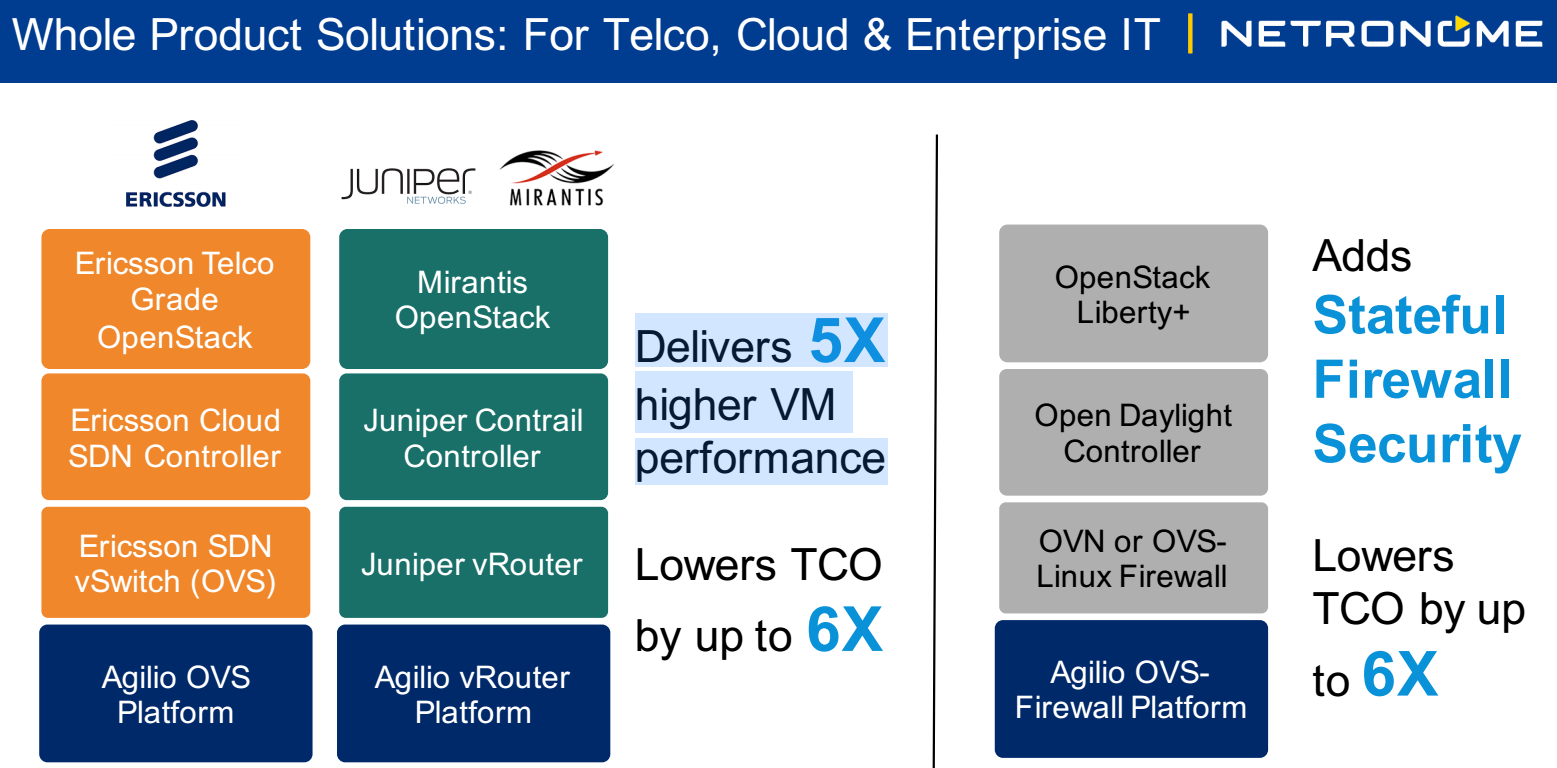
Netronome has tuned its Agilio Server Networking Platform for delivering hardware-acceleration for OpenStack networking, allowing data centers to accelerate applications such as network virtualization, security, load balancing and telemetry using different data plane options suitable for use cases spanning traditional IT to IaaS and Telco NFV workloads. Netronome's own testing has found a 5X boost in VM performance when network functions are offloaded to its Agilio interface cards.

At this week's OpenStack Summit in Austin, Netronome, in collaboration with Ericsson and Mirantis, is showcasing acceleration of open source datapath implementations, specifically, Open vSwitch (OVS), Stateful Firewall (Connection Tracking) and OpenContrail vRouter using Agilio CX intelligent server adapters. The company said this approach will be incorporated as an enhanced OpenStack networking plug-in architecture specification. As a result, critical networking functions that would otherwise hamper performance of the OpenStack implementation are offloaded to the Agilio platform, accommodating significantly more virtual machines per server leading to up to 6X lower TCO and higher services revenue per server compared to traditional NICs.

“The OpenStack platform has become the de facto cloud and SDN orchestration tool and server-based networking has become the cornerstone of pervasive SDN and cloud-based networks,” said Sujal Das, senior vice president and general manager, strategy and marketing at Netronome. “Our flagship Agilio product-based demonstrations and proposed open specification bring much needed hardware-based efficiency to that mix.”

“Mirantis OpenStack delivers comprehensive cloud orchestration tools that are optimized for Enterprise IT and NFV deployments,” said Kamesh Pemmaraju, vice president of product marketing at Mirantis. “Utilizing Netronome’s expertise in server-based networking and its Agilio intelligent server adapters, our joint pioneering work promises to provide the industry with new OpenStack networking capabilities that will enable rapid SDN deployments, delivering significantly higher networking performance and increases in server efficiency.”

Netronome plans to release beta releases of products that integrate OpenStack with Agilio Software for OVS, Stateful Firewall and OpenContrail vRouter, and an open enhanced OpenStack networking plug-in architecture specification in Q3 2016.The specification enhancements will propose extension of the current SR-IOV OpenStack plug-in mechanism for efficient packet delivery to virtual machines and add the OVS, Stateful Firewall and vRouter data paths implemented in intelligent server adapters such as Netronome’s Agilio CX products. Through support of innovative VirtIO extensions, hardware-based performance and efficiency benefits are delivered without compromising operational agility, while virtual machine migration capabilities needed for efficient server resource utilization are preserved.

http://www.netronome.com


Netronome's Agilio Server Networking Accelerates Cloud Data Centers

Netronome introduced its Agilio Server Networking Platform for transparently offloading server-based networking data paths, such as open virtual switch (OVS), Juniper Networks Contrail vRouter, and Linux firewall.

The company said its hardware and software-based Agilio platform delivers up to 5X higher throughput while reducing CPU requirements by up to 80 percent compared to traditional NICs and server-based networking implemented in software.

Server-based networking is being widely deployed in cloud data centers to handle virtualization, firewalls, load balancing, telemetry, zero-trust security using micro-segmentation, virtual network functions (VNFs) and application-based analytics. The big cloud providers (AWS, Microsoft Azure, Google) are using server-based networking in their mega data centers. Netronome's Agilio solution accelerates such server-based networking functions by offloading compute-intensive flow and tunnel processing from the CPUs.

The Agilio CX intelligent server adapters (ISAs) are based on Netronome's own flow processing silicon (NFP-4000) and software architecture (Agilio Software). The Agilio ISAs use onboard memory to support up to two million security policies, and deliver 28Mpps of throughput using hardware-based acceleration.

Nexenta Adds OpenStack & Docker Support for Scale-Out Storage

Nexenta announced significant updates to its block and object storage platform, including seamless integration with OpenStack and Docker environments.

The NexentaEdge is a software-only, scale-out, multi-service storage solution to deliver cluster-wide inline deduplication and compression, offering high-performance, simplified management of petabyte-scale repositories. With the latest updates, the block and object software-defined platform includes additional performance optimizations for all-flash and hybrid configurations, tightly integrates with the OpenStack ecosystem to simplify deployments in OpenStack clouds, and adds support for container-based deployments and Docker environments.

In addition to full iSCSI, NexentaEdge now supports native block device services, allowing hyperconverged OpenStack deployments to run Nova nodes directly on the NexentaEdge cluster. To fully automate deployment and configuration of NexentaEdge nodes in Canonical OpenStack environments, Juju Charms are available from the Canonical Juju Charms Store. All NexentaEdge Cinder drivers are also fully integrated in the OpenStack Mitaka release.

http://nexenta.com/NexentaEdge