Sunday, June 14, 2015

Cisco Prices $5 Billion of Senior Unsecured Notes

Cisco announced the pricing of five series of senior unsecured notes for an aggregate principal amount of $5 billion.

Of these notes, $900 million will mature in June 2018 and will bear interest at a floating rate equal to three-month LIBOR plus 31 basis points, $1.6 billion will mature in June 2018 and will bear interest at an annual rate of 1.650%, $1.5 billion will mature in June 2020 and will bear interest at an annual rate of 2.450%, $500 million will mature in June 2022 and will bear interest at an annual rate of 3.000% and $500 million will mature in June 2025 and will bear interest at an annual rate of 3.500%.

http://www.cisco.com

GSMA Urges Europe to Support 700MHz

The GSMA is calling on the European Commission to support Member States’ requests for release of the 700MHz band, preferably between 2018 and 2020 and potentially earlier for markets that are able to release it sooner, such as Finland, France, Germany and Sweden.  The industry association hopes the EC will accelerate the review of the sub-700MHz band, as the mobile and broadcast markets are evolving quite rapidly, as demonstrated by ongoing 5G research programmes in Europe.

Anne Bouverot, Director General of the GSMA, commented on the release of the European Commission’s (EC) summary of the results of the Lamy Report public consultation: “Allowing for flexible use of the UHF band will also mean the EC will be one step closer to achieving its Digital Agenda objectives of providing high-quality mobile broadband to European citizens.”

“A co-primary allocation will give Member States full flexibility to use UHF spectrum for both mobile and broadcast in the future. If mobile data continues to grow as predicted, national governments will retain the option of reallocating more spectrum to mobile if required. This flexible solution will protect consumer interests by empowering people in Europe to choose how they want to access content. It also supplies long-term guarantees for the future of digital terrestrial TV in European countries that rely on terrestrial broadcast services, ensuring a robust future for both industries."

http://www.gsma.com/

HGST Launches 10TB HDD

HGST, a Western Digital company, introduced the first enterprise-class 10TB (terabyte) hard disk drive (HDD) for next-generation active archive applications.

The host-managed Ultrastar Archive Ha10 SMR HDD is aimed at the densest server and storage systems.

The Ultrastar Archive Ha10 is the third of HGST's helium-based HDDs launched in less than two years. It leverages HGST's second generation HelioSeal platform and shingled magnetic recording (SMR). HGST said that by overlapping or "shingling" the data tracks on top of each other, higher areal density can be achieved within the same physical footprint.

The drive is rated at two million hours mean time between failure (MTBF), offers a five-year limited warranty, a 10-15 unrecoverable reduced bit error rate, rotational vibration safeguards, and 600K load/unload cycles.

The company noted that the initial rollout of the 10TB HDD is focused on cloud and OEM storage customers who have the in-house capability to develop the software required.

http://www.hgst.com/10TBnow

Hurricane Electric Connects 100 Internet Exchanges

Hurricane Electric has become the first Internet backbone in the world to connect to over 100 unique Internet exchanges.

Hurricane Electric said it runs the largest IPv6 network on the planet, as measured by the number of networks connected. Its fiber backbone has four redundant paths crossing North America, two separate paths between the U.S. and Europe, and rings in Europe and Asia. Hurricane Electric offers IPv4 and IPv6 transit solutions over the same connection at speeds including 10 Gbps and 100 Gbps Ethernet.

http://www.he.net

Elliott Sends Letter to Citrix Board of Directors

Elliot Management Corp. published an open letter to the Board of Directors of Citrix, saying it believes the company can achieve a notable increase in shareholder value by implementing a new management plan and undertaking structural reforms.

Elliot currently holds 7.1% of Citrix Systems' stock.

Specifically, Elliot said it believes that Citrix can achieve a stock price of $90 ~ $100+ per share by the end of 2016, which represents a rise of 50%, by improving its operational performance given that it great products in strong markets. One area of concern for Elliot is the company's cost structure, which has grown faster than revenues.

Elliot, which also criticized Citrix's product portfolio as too broad, is presenting a new operating plan for the company.

http://www.elliottmgmt.com

Raytheon Demos Advanced GPS OCX Capabilities

Raytheon demonstrated advanced capabilities of the Global Positioning System's Next Generation Operational Control System (GPS OCX)to key Defense Department and other stakeholders.

GPS OCX is the ground-based command and control system that will manage GPS satellites with significantly improved accuracy and precision, while providing higher levels of cyber protection.

"These successful demonstrations incorporating actual GPS OCX software reflect Raytheon's significant and continuing progress on this program and the growing maturity of this very complex system," said Dave Wajsgras, president of Raytheon's Intelligence, Information and Services. "Once delivered, this pathfinding, cyber-hardened ground system will significantly enhance the capabilities GPS brings to military, civil and commercial users worldwide," said Wajsgras.

http://raytheon.mediaroom.com/2015-06-12-Raytheon-Demonstrates-Advanced-GPS-OCX-Capabilities

Saturday, June 13, 2015

Verizon Delivers Secure Cloud Interconnect to CoreSite

CoreSite has joined Verizon Enterprise Solutions’ Secure Cloud Interconnect (SCI) service ecosystem.  Enterprises using cloud, hybrid cloud and colocations solutions from CoreSite will be able to tap into Verizon’s networking solution, which features dynamic bandwidth allocation, strong security (encryption), application performance throughput and quality of service options.

Service is available initially at four CoreSite data centers  in Los Angeles, New York/New Jersey, Chicago, and Silicon Valley with a fifth site in Northern Virginia expected to come online next month.

Verizon's SCI now provides connections to six cloud providers (Amazon, Google, HP, Microsoft, Salesforce and Verizon) and now three data center providers (Equinix, Verizon and CoreSite). SCI is built on Verizon’s Private IP network that offers any-to-any connectivity of IP via MPLS, while providing the security and reliability associated with private wide-area networking solutions. Using Verizon’s Mobile Private Networking service, SCI is further extended to users of its 4G LTE service.

“With Verizon’s SCI solution, our customers can tap directly into the leading enterprise-class cloud networking service to meet their performance and reliability objectives,” said Ben Green, VP of Network and Mobility for CoreSite. “The cloud offers a huge opportunity for organizations on so many levels especially with the ease of control offered by Verizon’s solution.”

“Verizon SCI now connects to CoreSite which gives our customers more choices when architecting their cloud and colocation solutions,” said Shawn Hakl, vice president of enterprise networking and innovation for Verizon. “CoreSite is a good fit for Verizon as they offer the security, expertise and right mix of customer locations that will enhance our customers’ experience.”

http://news.verizonenterprise.com/2015/06/secure-cloud-interconnect-coresite-verizon/

http://www.coresite.com/investors/coresite-information/press-releases


An Overview of Verizon's Secure Cloud Interconnect (SCI) @VZEnterprise


See video: https://youtu.be/JS5eU4_OcJc

Verizon's Secure Cloud Interconnect (SCI) allows direct connections into leading cloud providers (Amazon, Google, HP, Microsoft, Salesforce and Verizon) and three data center providers (Equinix, Verizon and CoreSite).


The service really represents an evolution of connectivity, says Shawn Hakl, VP of Product & Innovation at Verizon Enterprise.

Verizon's SCI now provides connections to six cloud providers (Amazon, Google, HP, Microsoft, Salesforce and Verizon) and now three data center providers (Equinix, Verizon and CoreSite). SCI is built on Verizon’s Private IP network that offers any-to-any connectivity of IP via MPLS, while providing the security and reliability associated with private wide-area networking solutions. Using Verizon’s Mobile Private Networking service, SCI is further extended to users of its 4G LTE service.

Thursday, June 11, 2015

AT&T and ONOS to Show Central Office Re-architected as Data Center (CORD)

At next week's Open Networking Summit (ONS2015) in Santa Clara, California, AT&T, ONOS project, PMC-Sierra and Sckipio will showcase the first public demonstration of the Central Office Re-architected as Data Center (CORD) proof-of-concept (POC).

The idea behind CORD is to use SDN and NFV to transform carrier functions into workloads that are hosted on common, commodity infrastructure. The CORD solution POC spans the Telco Central Office, access including Gigabit-capable Passive Optical Networks (GPON) and G.fast as well as home/enterprise customer premises equipment (CPE). CORD enables service providers to build an underlying common infrastructure with white boxes using ONOS (carrier-grade open source SDN Control Plane), OpenStack (virtual infrastructure management), and XOS (an open source service orchestration/management platform built on OpenStack) with a diversity of organizations building the services and solutions that ride above.

Key capabilities demonstrated at ONS will include:
  • Proof-of-concept Central Office: Highlights the open software and hardware building blocks for CORD - ONOS, XOS, OpenStack, white box switches, commodity servers, OpenFlow-enabled GPON OLT MAC from PMC, and OpenFlow-enabled G.fast distribution point unit (DPU) connected to a G.fast CPE bridge from Sckipio.
  • Service Provider-focused capabilities
  • SDN Control, orchestration and management with ONOS, OpenStack and XOS on commodity infrastructure
  • An open high-performance leaf-spine fabric
  • OpenFlow-enabled PON OLT MAC hardware enabling virtualization of the traditional OLT
  • OpenFlow-enabled G.fast DPU
  • Access-as-service, Subscriber-as-a-service, Internet-as-a-service Caching/Content delivery-as-a-service, Virtualized functions including Firewall, URL Filtering, Parental Control, BNG
  • Service Provider portal for intuitive provisioning, management, monitoring of infrastructure and services
  • Subscriber-focused capabilities
  • A simple CPE that replaces existing complex CPEs and can be managed by ONOS
  • Subscriber Services: Internet, Firewall, Parental Control
  • Subscriber portal for signing up for and managing services
  • Third-Party Provider-focused capabilities
  • Third-party provider services: Content delivery (Caching) for its own content in the Service Provider network
  • Third-party provider portal for signing up for and managing services
  • CORD POC software used for the demo at ONS 2015 will be available publicly in the ONOS "Drake" release that is slated for the end of August, 2015. Beyond the ONS demo, the CORD solution will undergo the next phase of development and advance to lab trials. A CORD "Pod" bundling together the software and hardware building blocks into a ready-to-use system, will be made available for service provider lab trials by the end of 2015.

"SDN and NFV are speeding up innovation, as seen in projects like CORD," said Tom Anschutz, Distinguished Member of Technical Staff at AT&T. "These technologies create systems that do not need new standards to function and enable new behaviors in software, which decreases development time. Faster development time leads to rapid innovation, something the industry needs to continue satisfying data-hungry customers."

"The first CORD proof-of-concept is a big step towards demonstrating AT&T and other providers' vision of reinventing the central office to bring data center economies of scale and cloud-style agility to their networks," said Guru Parulkar, Executive Director, ON.Lab and ONRC. "With CORD, service providers can architect their central offices using common, commodity infrastructure such as ONOS, OpenStack, XOS, white box switches and servers. CORD also represents an open and unique opportunity with AT&T as the leading service provider, ON.Lab and ONOS project as providers of open source software platforms, and merchant silicon vendors PMC-Sierra and Sckipio. This team plans to enhance the solution with new features and harden it, bring in new players and advance CORD from lab trials all the way to deployment."

http://onosproject.org
http://onlab.us


Key Themes for this Year's Open Networking Summit


See video: https://youtu.be/eEqhbmAza90

Ram Appalaraju previews key themes at next week's #ONS2015 in Santa Clara, California.

The range of technologies on display will include OpenFlow, OpenStack, Open Daylight, OPNFV, ONOS, as well as vendor-specific offerings such as Cisco's ACI and VMware's NSX.

http://opennetsummit.org/


AWS Offers 2.4 GHz Intel Xeon E5-2676 v3 Haswell processors

Amazon Web Services (AWS) announced M4 instances, the next generation of Amazon Elastic Compute Cloud (Amazon EC2) General Purpose instances.

M4 instances get a performance boost using custom 2.4 GHz Intel Xeon E5-2676 v3 Haswell processors. M4 also offers dedicated bandwidth to Amazon Elastic Block Store (Amazon EBS), and provides Enhanced Networking for higher packet per second (PPS) performance, lower network jitter, and lower network latencies.

AWS said M4 with Enhanced Networking delivers up to 4 times the packet rate of instances without Enhanced Networking, while ensuring consistent latency, even when under high network IO. Within Placement Groups, Enhanced Networking reduces average latencies between instances by 50 percent or more. M4 instances are well-suited for a wide variety of applications including relational and in-memory databases, gaming servers, caching fleets, batch processing, and business applications like SAP and Microsoft SharePoint. To get started with M4 instances, visit http://aws.amazon.com/ec2/.

“Amazon EC2 provides a comprehensive selection of instances to support virtually any workload, and we continue to deliver new technologies and high performance in our current generation instances,” said Matt Garman, Vice President, Amazon EC2, AWS. “M4 instances bring new capabilities to the General Purpose family through the use of a custom Intel Haswell processor and larger instance sizes. We are also pleased to deliver even better network performance with dedicated bandwidth to Amazon EBS and Enhanced Networking, an Amazon EC2 feature that we are providing, for the first time, to General Purpose Instances. With these capabilities, M4 is one of our most powerful instance types and a terrific choice for workloads requiring a balance of compute, memory, and network resources.”

http://aws.amazon.com

U.S. Court of Appeals Won't Block Open Internet Rules

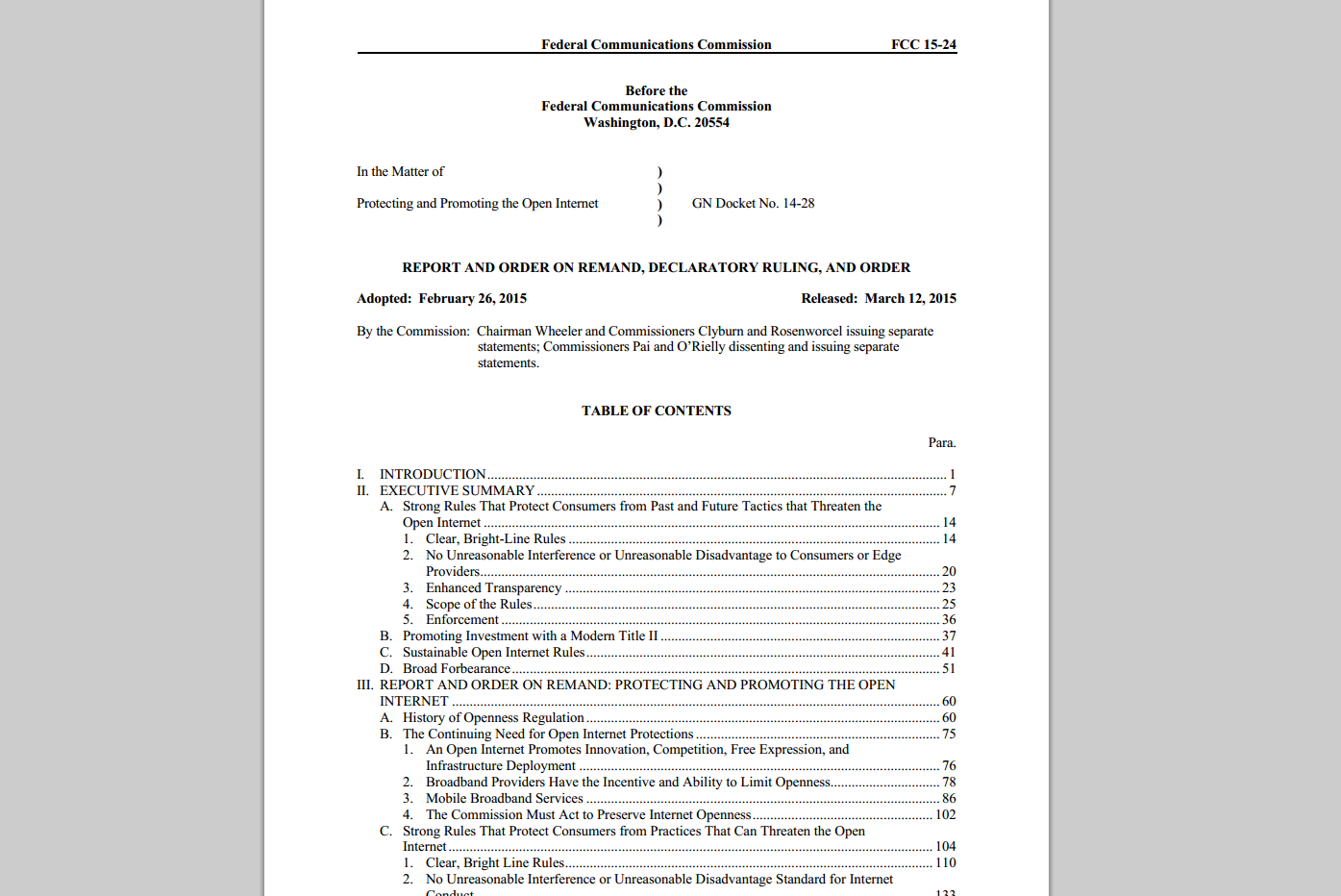
The U.S. Court of Appeals for the D.C. Circuit decided not to impose an injunction on the FCC's new Open Internet rules, allowing the new code to go into effect on June 12, 2015.  However, the court agreed to expedite the case.

FCC Chairman Tom Wheeler stated: “This is a huge victory for Internet consumers and innovators! Starting Friday, there will be a referee on the field to keep the Internet fast, fair and open. Blocking, throttling, pay-for-priority fast lanes and other efforts to come between consumers and the Internet are now things of the past. The rules also give broadband providers the certainty and economic incentive to build fast and competitive broadband networks.”

CTIA's President and CEO Meredith Attwell Baker stated: "While the stay decision is disappointing and a loss for consumers, securing a judicial stay is always a challenge given the extremely high standards. The case is just beginning and the stakes are high – the U.S. is the world's leader in the deployment and adoption of wireless broadband, due in large measure to decades of light-touch regulation. The wireless industry seeks to restore that approach so consumers can benefit from competition and innovation, rather than suffer the harmful consequences of the FCC's overreach that would imperil new services and inhibit investment. As we said from day one, CTIA and its member companies support an open Internet. We look forward to presenting our full case to the court."

http://www.fcc.gov
http://www.ctia.org/


In March, the FCC released its newly adopted Open Internet rules, which were approved by a 3-to-2 vote last month. The new rules aim to establish a legal standard for broadband provider practices to ensure that they do not unreasonably interfere with or disadvantage consumers' access to the Internet. At the time of the vote, FCC Commissioner Tom Wheeler said the order would establish three "bright line rules":
  • No Blocking: broadband providers may not block access to legal content, applications, services, or non-harmful devices.
  • No Throttling: broadband providers may not impair or degrade lawful Internet traffic on the basis of content, applications, services, or non-harmful devices.
  • No Paid Prioritization: broadband providers may not favor some lawful Internet traffic over other lawful traffic in exchange for consideration of any kind—in other words, no “fast lanes.”   This rule also bans ISPs from prioritizing content and services of their affiliates. It also prohibits practices that target specific applications or classes of applications.  
http://www.fcc.gov/openinternet

Pluribus Ports Open Netvisor Linux OS onto Dell’s ONIE compatible 10G/40G Switches

Pluribus Networks announced an agreement to port its Open Netvisor Linux operating system onto Dell’s family of Open Networking (ONIE compatible) 10G/40G switches, including the S6000-ON and S4048-ON.

Pluribus Open Netvisor Linux combines the benefits of Linux with a plug-and-play, application-aware fabric, advanced network flow programming and embedded analytics and visibility capabilities. It offers interoperability with the Layer 2 and IP/BGP infrastructure already in place, including all standard management interfaces familiar to Network Operations (NetOps) professionals while also offering Linux-based Development Operations (DevOps) tools to empower the modern cloud.

“Dell wants to fundamentally change the nature of networking by focusing on openness and the disaggregation of hardware and software. With this announcement, we are expanding the Dell open networking ecosystem, showing how multiple operating systems can now offer our customers choices that complement our open hardware solutions and are flexible enough to adapt to our customers’ requirements,” said Tom Burns, vice president and general manager, Dell Networking and Converged Infrastructure.

“With this combination of Pluribus and Dell, we are demonstrating that the value of SDN goes far beyond disaggregation of hardware and software alone. Cloud providers need security, monitoring and virtualization built in at the architectural level to enable them to compete with Amazon Web Services (AWS) and other hyperscale cloud providers, and that is exactly what we are delivering with Pluribus Open Netvisor Linux running on Dell’s line of OCP-compliant open networking hardware. Together, we are changing the game!” said Kumar Srikantan, president and CEO of Pluribus Networks.

http://www.pluribusnetworks.com

Hitachi Launches Private, Public, and Hybrid Cloud Platform.

Hitachi Consulting announced the launch of its private, public, and hybrid cloud platform.

The Hitachi Cloud Framework offers capabilities and services to support all levels of the data center -- from development and testing to operations and productionalized enterprise applications.

"We work to understand the security, data access and reliability pressures that today's CIO's face every day. We help companies extend private cloud environments to include a public, hosted platform for non-mission-critical workloads," said Jim Cole, Senior Vice President of Outsourcing Services, Hitachi Consulting. "Our new cloud service offers customers our proven expertise and capabilities while also extending the power of exceptional technology from Hitachi Data Systems. The combination gives our customers a wide range of choices to support the specific requirements of their business applications."

http://learn.hitachiconsulting.com/Cloud-Outsource

ViaSat Acquires Start-up Focused on Virtualization

ViaSat has acquired Engreen, a privately-held company based in San Jose, California that is focused on network virtualization.

Engreen's flagship virtualization product provides a path to enhance network management, lower capital expenses, energy and real estate, and minimize overall network complexity.

ViaSat said the technology will benefit its satellite broadband netwokr

"Our investment in Engreen reinforces our commitment to the global Ka-band satellite market," said Kevin Harkenrider, senior vice president, Commercial Networks, ViaSat. "This transaction will enhance our ability to rapidly create, deploy and manage services in our Flexible Broadband System."

Pawan Uberoy, Engreen CEO, commented, "There are multiple synergies in how ViaSat and Engreen approach network management leveraging enhanced virtualization capabilities. We are looking forward to joining ViaSat and adding value to its global customer base."

http://www.viasat.com

Sckipio G.fast Supports NETCONF and YANG

Sckipio Technologies' G.fast Distribution Point Unit (DPU) can now be SDN-controlled via the Network Configuration Protocol (NETCONF), using the standard G.fast YANG data model, and with traffic managed via OpenFlow. The support for NETCONF YANG and OpenFlow is part of Sckipio’s new G.fast Management Stack, the first management stack designed from scratch to enable software-defined network (SDN) control on G.fast devices.

“G.fast is the ultra-broadband access technology for the 21st century and demands a modern approach to device management,” said David Baum, co-founder and CEO of Sckipio. “Instead of simply supporting outdated, proprietary management approaches, Sckipio is giving OEMs and ultimately operators, complete control and management of G.fast equipment using open solutions.”

Sckipio state-of-the-art management platform and networking stack includes NETCONF YANG, CLI, SNMP, IGMP, DHCP, MSTP, Y.1731 and CFM support, and is designed to comply with all relevant Broadband Forum G.fast management specifications (WT-301, WT-318/355 drafts) as they are released.

The Sckipio G.fast Management Stack is available now and runs on the PMC-Sierra WinPath family of network processors.

http://www.sckipio.com

ABI Research: 1.37 Billion LTE Users by Year-end 2015

There will be nearly 1.37 billion 4G LTE subscribers worldwide by year-end 2015, up from nearly 650 million in 2014, according to a new forecast from ABI Research.

ABI Research predicts that the LTE subscriber base will exceed 3.5 billion by 2020, demonstrating a 5 year CAGR of 20.8%. The exponential rise in LTE points-of-presence covered justifies the need for sustained investment in LTE infrastructure, which is expected to grow nearly 10% year-on-year.

The report cites ongoing LTE infrastructure deployments in the United States, Asia and China, including plans for small cell rollouts and LTE-U.

https://www.abiresearch.com/

Viptela Signs Macnica and Nissho Electronic for SD-WAN in Japan

Viptela, which offers a software-defined WAN solution, announced partnerships with Macnica Networks and Nissho Electronics for the Japanese market.

These two leading solution providers will deploy Software-Defined Wide Area Networks (SD-WAN) for large enterprises using the Viptela Secure Extensible Network (SEN) platform. Viptela enables enterprises to combine multiple transports into a single, cloud-adaptable WAN that is centrally managed. The solution provides robust security and makes it possible to construct highly flexible and agile WAN environments with significantly lower operating costs.

Viptela disaggregates voice, video and data services from the physical network using a single overlay WAN that supports any number of different transport connections, and provides end-to-end encryption and device authentication. Viptela enables granular network segmentation for separation across different lines of business, partner networks, etc. with centrally managed policies to optimize application performance, meet enterprise security requirements and slash operational costs.

“Large enterprises in every market, including Japan, face the same WAN challenges caused by cloud computing, the rapid growth of data and video traffic, and the need to mix and match separate transport networks,” said Amir Khan, CEO of Viptela. “We are pleased to be working with Macnica Networks and Nissho Electronics to bring the business benefits of Viptela’s SD-WAN technology to enterprises in Japan.”

http://www.viptela.com

OIF Approves Thermal Interface Spec for Pluggable Optics Modules

The Optical Internetworking Forum (OIF) has approved a thermal interface implementation agreement (IA) for pluggable optics modules. The aim is to help optical module suppliers and system designers reduce heat and thermal management issues.

“When optical modules are mated with heatsinks, the goal is to remove over 90% of the heat through the interface area into the airflow stream via the heatsink,” said Torsten Wuth, of Coriant and the OIF Physical Layer User Group Working Group chair. “Nominal ranges of heat flux are defined as Power Density classes. The OIF agreement defines acceptable thermal impedances for the contact area for various pluggable module types and a method of measuring the impedance.”

The agreement summarizes the information to be provided by module suppliers to facilitate thermal integration of the module within the host system. It also defines the requirements and methods for testing a thermal interface between a pluggable optical module and the host-system heatsink.

http://www.oiforum.com/documents/implementation-agreements/

Wednesday, June 10, 2015

Blueprint: Hyper-Converged is Leading the Data Center Revolution

by Sachin Chheda, Senior Director, Product and Technical Marketing, Nutanix

Historically, provisioning and managing infrastructure in a data center has never been straightforward.  There is the need to organize the purchase of the servers; the acquisition of the storage, the choice of the network supplier - and all that before the choice of the software.
All that is changing: the notion that there’s a need to acquire an array of different products in order to manage a data center is fast disappearing. According to a survey from Gartner in 2014, 29% of enterprises are now looking to move to a converged infrastructure.

It used to be easy to deal with additional demands:  more compute power? Just stick an extra server in the rack. Additional storage?  Time for another storage array.  Network running slow?  Looks like it’s time for more bandwidth and so on. In today’s budget conscious times, this is not a worthwhile approach. The modern day business cannot simply throw money at the problem, which is why we’ve seen companies looking to virtualization and server consolidation in an attempt to cut down on their data center footprint.

In fact, the issue was not just about trying to match needs with your infrastructure but also coping with additional demands.  The infrastructure, especially storage had to be over-provisioned to cope with any peaks – and modernizing the infrastructure by opting for more virtualization has not helped this process, in fact it’s introduced even more over-provisioning as the existing storage components do not have the right levels of automation for optimal performance.

There’s a disconnect between the speed with which virtual provisioning works and the time it takes to provision an organization’s storage needs.  Just because a virtual machine can be brought online in a matter of minutes it doesn’t mean that the same follows for other parts of the infrastructure – setting up storage and networking will take large amounts of time. And this is a process that has been made worse by the growing use of fast flash storage, which has made networking effectively much more difficult.

Trying to combine legacy network storage infrastructure with virtualized servers is ensuring bottlenecks somewhere. Essentially, you’ll have a supercharged datacenter in the body of an old jalopy. In this scenario, the old approach of throwing more dollars at your infrastructure therefore is not solving the problem but is actually making things worse as the gap between virtualized servers and legacy hardware grows wider.

What does the CIO do? Welcome to the world of hyper-converged infrastructure. It’s an overloaded phrase, that sounds like it’s been cooked up by some imaginative publicity departments, but this is no over-hyped buzzword.  It’s a technology that provides a leap forward for those companies who want to cope with increasing demand on storage, handle today’s modern application workloads and manage the whole operation seamlessly, without busting the bank.

Most important of all, a hyper-converged system will provide enterprises with type of scalability and flexibility enjoyed by the software based architecture employed by Amazon Web Services (AWS), Google and Facebook.

These companies all faced a common problem: the need to scale quickly and efficiently to meet growing demand. They all tried to construct an architecture using existing technologies, but gave up as the legacy hardware centric kit could not cope with the demands: it was obvious that a new type of datacenter infrastructure was needed - one that did away centralized storage systems, as traditional SANs were one of the major inhibitors.

They did this in several ways; they made extensive use of software based functionality coupled with state of the art and run of the mill hardware and used REST APIs, a technology which helps organizations to cope more effectively with increased demand.  These were used to introduce a greater degree of automation into the process.

The operational efficiency of AWS, Google and Facebook is the bar that IT is now managed against. Web-scale methodologies of software-based distributed architecture are entering the enterprise market in the form of solutions that do not require a team of highly skilled experts to configure and maintain. Enterprises can stop being envious of hyperscale IT and start to look at ways to deploy the technology in their own datacenters.

Rather than construct an elaborate collection of server farms and storage arrays, the hyper-converged approach takes a single state-of-the-art x86 server combined with SSD and HDD storage. It doesn’t sound very complex but the secret sauce is in the software layer of the storage infrastructure. A hyper-converged solution for example, could provide an architecture that runs in conjunction with industry standard hypervisors including ESXi, Hyper-V and KVM. This datacenter infrastructure could deliver modular and linear scalability, better performance and simplified manageability for any virtualized workload at any scale. Another proof point is that, hyper converged solutions can go even farther  and offer integrated enterprise class availability features including VM-centric data protection and disaster recovery – enabling virtualized tier 0 and tier 1 workloads to be run on the same infrastructure supporting initiatives such as VDI and server virtualization.

One of the major initial stumbling blocks of hyper-converged infrastructure is that the initial pre-converged architecture failed to deliver on the promises it made. If you consider the examples where different vendors combined their proprietary offerings to create a converged stack, like Cisco, VMware and EMC  into VBlock and Cisco and Netapp into Flexpod, these products made promises about easier integration, but failed on a hardware level as each of the components was still too proprietary to deliver efficiency when pair with the others. True hyper-converged solutions use commodity hardware, and as discussed above, let the software do the hard work.

For example, the use of the wrong sort of converged architecture does nothing to do away with the need for SANs – and as we saw earlier, the more virtualization that’s introduced, the more requirement for additional storage, which often needed upfront to minimize disruption and re-architecting datacenter infrastructure . And this storage can lead to bottlenecks that reduce the efficiency of the infrastructure. It is therefore far better to opt for the hyper-converged approach that negates the need for upfront investment in a traditional SAN.

Companies are thinking more creatively about how to handle the increased storage workloads brought about by virtualization: there’s a growing need for more compute power, there’s an increasing need to keep costs low and bring greater efficiencies, but there’s no need to follow some of the old methods, nor opt for an implementation based around log-established SAN technology. The world of the data center is changing inexorably and CIOs need to seize the opportunity to bring their systems up to date, in many cases hyper-converged infrastructure will provide the future-proofed solution these companies demand.

About the Author

Sachin Chheda is Senior Director of Product and Technical Marketing at Nutanix.

About Nutanix

Nutanix delivers invisible infrastructure for next-generation enterprise computing, elevating IT to focus on the applications and services that power their business. The company’s software-driven Xtreme Computing Platform natively converges compute, virtualization and storage into a single solution to drive simplicity in the datacenter. Using Nutanix, customers benefit from predictable performance, linear scalability and cloud-like infrastructure consumption.


Got an idea for a Blueprint column?  We welcome your ideas on next gen network architecture.
See our guidelines.