Showing posts with label Spectrum. Show all posts

Monday, November 13, 2023

U.S. outlines National Spectrum Strategy

 The White House published a National Spectrum Strategy that aims to expand access to advanced wireless broadband networks and technologies, whether terrestrial-, airspace-, satellite- or space-based, for all Americans. 

The 23-page paper was developed by the National Telecommunications and Information Administration (NTIA), in collaboration with the FCC and in coordination with other Federal agencies.

The Strategy has four pillars

  • Pillar One: A Spectrum Pipeline to Ensure U.S. Leadership in Advanced and Emerging Technologies
  • Pillar Two: Collaborative Long-Term Planning to Support the Nation’s Evolving Spectrum Needs
  • Pillar Three: Unprecedented Spectrum Innovation, Access, and Management through Technology Development
  • Pillar Four: Expanded Spectrum Expertise and Elevated National Awareness

Significantly this Strategy identifies five spectrum bands in government hands totaling 2,786 megahertz of mostly mid-band spectrum for in-depth, near-term study to determine suitability for potential repurposing to address evolving needs,, including terrestrial wireless broadband, innovative space services, and unmanned aviation and other autonomous vehicle operations. This includes the following:

Lower 3 GHz (3.1-3.45 GHz)

  • The Department of Defense (DoD) has studied the potential for sharing 350 megahertz of spectrum with the private sector, determining that sharing is feasible with advanced interference-mitigation features and a coordination framework.
  • The Departments of Commerce and Defense will co-lead follow-on studies focusing on future use of the 3.1-3.45 GHz band, exploring dynamic spectrum sharing and private-sector access while preserving Federal mission capabilities
5030-5091 MHz
  •  The FCC, in coordination with NTIA and the Federal Aviation Administration, will facilitate limited deployment of UAS in this band, followed by studies to optimize UAS spectrum access while avoiding harmful interference to other operations.
7125-8400 MHz
  •  This 1,275 megahertz of spectrum will be studied for wireless broadband use, with some sub-bands potentially studied for other uses, while protecting incumbent users from harmful interference.
18.1-18.6 GHz
  • This 500 megahertz of spectrum will be studied for expanded Federal and non-Federal satellite operations, consistent with the U.S. position at the 2023 World Radiocommunication Conference.
37.0-37.6 GHz
  • This 600 megahertz of spectrum will be further studied to implement a co-equal, shared-use framework allowing Federal and non-Federal users to deploy operations in the band.
Sunday, January 16, 2022

Winning bidders in FCC's midband 5G spectrum auction

AT&T was the top winner in the FCC's "Andromeda" auction of flexible-use licenses in the 3.45 GHz band. Gross proceeds for the auction exceeded $22.5 billion. The list of winning bidders was published on Friday.

Auction 110 makes available 100 megahertz of mid-band spectrum for commercial use across the contiguous United States.  The spectrum licenses are divided into ten 10-megahertz blocks licensed by geographic areas known as Partial Economic Areas (PEAs).  License winners will operate within a cooperative sharing framework that will enable commercial use by an array of service providers, while also ensuring coexistence with federal incumbents where and when they require continued access to the band.  

“Today’s 3.45 GHz auction results demonstrate that the Commission’s pivot to mid-band spectrum for 5G was the right move,” said FCC Chairwoman Jessica Rosenworcel.  “I am pleased to see that this auction also is creating opportunities for a wider variety of competitors, including small businesses and rural service providers.  This is a direct result of the Commission’s efforts to structure this auction with diversity and competition front of mind.  Enabling commercial use of this spectrum is important to America’s continuing economic recovery and 5G leadership, and I look forward to the continued collaboration between the FCC, NTIA, and other federal agencies to find innovative ways to make spectrum available for next generation commercial and government services.”  

Additional notes:

  • Thirteen of the twenty-three companies with winning bids in Auction 110 qualified as small businesses or as entities serving rural communities.  
  • Compared to the prior 5G auction, this auction saw a substantial increase in the number of winning bidders per market: over one-third of the top 100 markets have at least four winning bidders, compared with 10% of the top 100 markets for Auction 107. 
  • Notably, the 3.45 GHz auction closed as one of highest grossing auctions in the FCC’s history. 
  • Collectively, the 3.45 GHz band and the neighboring 3.5 GHz and 3.7 GHz bands represent 530 megahertz of mid-band spectrum for 5G, the next generation of wireless services.  Wider 5G deployment means that more people in more places will be more connected.  

http://www.fcc.gov/auction/110

Sunday, August 1, 2021

Canada completes 3500 MHz band auction

The government of Canada raised a record C$8.9 billion (US$7.2 billion) through the auction of 1,504 licenses of 3500 MHz spectrum. The following provisional results were announced.

https://www.ic.gc.ca/eic/site/smt-gst.nsf/eng/sf11722.html

Sunday, July 11, 2021

GSMA calls on regulators to open more 5G spectrum

The GSMA is calling on national telecoms regulators to make an average of 2 GHz of mid-band spectrum available in the 2025-2030 time frame to guarantee the IMT-2020 requirements for 5G.  Without the additional spectrum, GSMA believes it will be impossible to realise the full potential of 5G in some cases. In others, the number of antennas and base stations needed will lead to higher carbon emissions and consumer prices. 


The GSMA is also asking regulators to:

Carefully consider 5G spectrum demands when 5G usage increases and advanced use cases will carry additional needs;

Base spectrum decisions on real-world factors including, population density and extent of fibre rollout; and

Support harmonised mid-band 5G spectrum (e.g., within the 3.5 GHz, 4.8 GHz and 6 GHz ranges) and facilitate technology upgrades in existing bands.

https://www.gsma.com/newsroom/press-release/gsma-calls-for-2-ghz-of-mid-band-spectrum-to-meet-un-targets/

Wednesday, April 28, 2021

UK completes spectrum auction for 700 MHz and 3.6-3.8 GHz

Ofcom completed the assignment stage for its recent auction of 700 MHz and 3.6-3.8 GHz bands in the UK.  Here are the results:

  • EE Limited – 723-733 MHz and 778-788 MHz;738-758 MHz; and 3680-3720 MHz.
  • Hutchison 3G UK Limited – 713-723 MHz and 768-778 MHz.
  • Telefónica UK Limited – 703-713 MHz and 758-768 MHz; and 3760-3800 MHz.
  • Vodafone Limited – 3720-3760 MHz.


Winners of spectrum in the 3.6-3.8 GHz band also had the opportunity to negotiate their spectrum positions among themselves. This stage was an important step towards helping companies bring their spectrum holdings in the wider 3.4-3.8 GHz band closer together by giving them the opportunity to discuss post-auction trades to consolidate spectrum won in the 3.6-3.8 GHz band and airwaves they already held in the 3.4-3.6 GHz band. Telefónica UK Limited and Vodafone Limited entered into an agreement during the negotiation period.

https://www.ofcom.org.uk/about-ofcom/latest/features-and-news/final-spectrum-auction-results

Sunday, April 25, 2021

Five carriers acquire spectrum in Australia's mmWave auction

Five companies have won spectrum in the Australian Communications and Media Authority’s latest spectrum auction in the 26 GHz band.

Winners include:

  • Dense Air Australia Pty Ltd won 2 lots for $28,689,900
  • Mobile JV Pty Limited won 86 lots for $108,186,700
  • Optus Mobile Pty Ltd won 116 lots for $226,203,100
  • Pentanet Limited won 4 lots for $7,986,200
  • Telstra Corporation Limited won 150 lots for $276,576,200

Of the 360 lots available in the auction, 358 were sold, realising a total revenue of $647,642,100, equivalent to almost $0.0127/MHz/pop.

“This outcome represents another significant milestone for 5G in Australia. The successful allocation of this spectrum will support high-speed communications services in metropolitan cities and major regional centres throughout Australia,” said ACMA Chair Nerida O’Loughlin.

Licences won at auction will come into force later this year, for a 15-year term ending in 2036.

Full results are here:

https://www.acma.gov.au/auction-summary-26-ghz-band-2021

Wednesday, March 17, 2021

UK completes 5G spectrum auction

Ofcom, the official telecoms regulator for the UK,, completed an auction of 200 MHz of spectrum split across two bands:

  • 80 MHz of spectrum in the 700 MHz band. These airwaves consist of 2x30 MHz of paired frequency spectrum, and 20 MHz of supplementary downlink spectrum. The 700 MHz airwaves are ideal for providing wide area coverage – including in the countryside.
  • 120 MHz of spectrum in 3.6-3.8 GHz band. These important airwaves are part of the primary band for 5G and capable of boosting mobile data capacity, carrying lots of data-hungry connections.


Four companies – EE Limited, Hutchison 3G UK Limited, Telefónica UK Limited and Vodafone Limited – took part in the principal stage of the auction, which involved them bidding for airwaves in 34 ‘lots’ to determine how much of the available spectrum they each secured. Principal stage bidding has now ended and Ofcom has published the results.

Results of the principal stage

  • EE Limited has won 2x10 MHz of paired frequency spectrum in the 700 MHz band at a cost of £280,000,000; 20 MHz of supplementary downlink spectrum in the 700 MHz band at a cost of £4,000,000; and 40 MHz in the 3.6-3.8 GHz band at a cost of £168,000,000.
  • Hutchison 3G UK Limited has won 2x10 MHz of paired frequency spectrum in the 700 MHz band at a cost of £280,000,000.
  • Telefónica UK Limited has won 2x10 MHz of paired frequency spectrum in the 700 MHz band at a cost of £280,000,000; and 40 MHz in the 3.6-3.8 GHz band at a cost of £168,000,000.
  • Vodafone Limited has won 40 MHz in the 3.6-3.8 GHz band at a cost of £176,400,000.

The total revenue raised from the principal stage is £1,356,400,000. The money raised by this auction will be passed on to HM Treasury.

https://www.ofcom.org.uk/about-ofcom/latest/features-and-news/spectrum-auction-principal-stage-results

FCC to auction 3.45-3.55 GHz for 5G

The FCC adopted rules to reallocate 100 megahertz of spectrum in the 3.45 GHz band for flexible use wireless services.  The FCC's action also establishes a framework for the 3.45 GHz band that will enable robust commercial use by an array of service providers, while also ensuring that federal incumbents are still protected from harmful interference where and when they require continued access to the band. 

Collectively, the 3.45 GHz band and the neighboring 3.5 GHz and 3.7 GHz bands represent 530 megahertz of contiguous mid-band spectrum for 5G, the next generation of wireless services.  5G networks will kickstart the next big digital transformation and connect more people and more things in more places.


Last year’s Consolidated Appropriations Act required the Commission to commence a system of competitive bidding for licenses in the 3.45-3.55 GHz band by the end of this year.  The action taken today positions the agency to meet this obligation, and it marks progress towards fulfilling Congress’s directive in the MOBILE NOW Act for the FCC to work with NTIA to evaluate the feasibility of allowing commercial use in the 3.1-3.55 GHz band.  


Sunday, March 14, 2021

AT&T to spend $6-8 billion deploying newly acquired C-band spectrum


In an Analyst & Investor Day presentation, AT&T updated its 5G strategy for deploying 5G in both sub-6 (5G) and mmWave (5G+) spectrum bands in 2021.

Some highlights:

  • AT&T will begin offering 5G access to consumers on its current unlimited wireless plans at no additional cost.
  • AT&T secured 80mhz of spectrum and a 29% share of the available licenses in the recent C-band auction. The company plans to begin deploying the first 40 MHz of this spectrum by the end of 2021. AT&T expects to spend $6-8 billion in capex deploying C-band spectrum, with the vast majority of the spend occurring from 2022 to 2024. Expected C-band deployment costs are already included in the company’s 2021 capex guidance and in its leverage ratio target for 2024.
  • Funding C-band spectrum. AT&T’s investment in C-band spectrum via Auction 107 totals $27.4 billion, including expected payments of $23 billion in 2021.
  • AT&T currently has 70% of its low and mid-band spectrum in service. 
  • In 2021, AT&T plans to increase its fiber footprint by an additional 3 million customer locations across more than 90 metro areas.
  • AT&T's 5G+ service is now available in parts of 38 cities in the U.S.
  • AT&T plans to deploy 5G in 17 venues across the country by the end of 2021 including stadiums, arenas and practice facilities.
  • AT&T plans to deploy 5G at 8 U.S. airports by the end of this year.
  • AT&T has begun offering fixed 5G wireless solutions for businesses.
  • AT&T is working with cloud service providers to deliver optimized network routing to localized edge computing zones that can support latency-sensitive applications without dedicated on-premises hardware.
  • AT&T expects between 120 million and 150 million worldwide HBO Max and HBO subscribers by the end of 2025, up from the 75-90 million projected in October 2019.
  • AT&T recently announced plans to spinoff its U.S. video business operations into a newly formed entity jointly owned with TPG Capital.
  • Between 2016 and 2020, AT&T’s total investment in the United States, including capital investment and acquisitions of spectrum and wireless operations, was more than $105 billion.

“Connectivity is at the heart of everything we do - 140 years and counting. From our fiber network backbone to the layers of wireless spectrum technology, we provide 5G network coverage that delivers the speeds, security and lower latency connections that customers and businesses need,” said Jeff McElfresh, CEO – AT&T Communications.

https://about.att.com/story/2021/att_analyst_day.html


Wednesday, March 10, 2021

T-Mobile US pleased with its spectrum position

T-Mobile US confirmed that it invested just over $9.3 billion in the FCC’s C-Band auction, selectively acquiring additional mid-band spectrum, even s its competitors spent record-breaking amounts in the auction. 

T-Mobile won an average of 40 MHz of C-Band in key areas home to nearly 225 million people, which it will deploy to add additional depth to its already strong Ultra Capacity 5G, bringing even greater speed and performance. In the mid-band range, C-Band offers a great mix of coverage and speed, but there are some key differences from 2.5 GHz, the mid-band spectrum T-Mobile is primarily using to roll out Ultra Capacity 5G. Most notably, it doesn’t travel as far. T-Mobile engineers estimate it will require 50% more cell sites for meaningful and continuous coverage, and in some areas, for example in-building, the required densification can be 4x higher than 2.5 GHz. That’s why T-Mobile strategically invested in C-Band to supplement its much broader 2.5 GHz footprint in select urban and suburban areas where it already has a dense network. This will allow for the spectrum to quickly be deployed and provide a more meaningful performance boost for customers.

“T-Mobile customers are the clear winners in this auction. Our already industry-leading 5G network enabled us to be highly selective and strategic, concentrating our wins in top markets nationwide,” said Mike Sievert, CEO of T-Mobile. “As I predicted last fall, the other guys spent an unbelievable amount — because they had to. And even then, the truth is that C-Band is best for urban areas because it doesn’t propagate as well as T-Mobile’s substantial existing mid-band frequencies. For us, C-Band makes a great story even better, and we are incredibly pleased with our clear success in this auction. Our competitors had no choice but to go all in with a break-the-bank attempt to remain relevant in the 5G era.”

“Simply put, Verizon and AT&T bet on the wrong horse — went all in on millimeter wave — and now they’re scrambling … and writing big checks … to try to catch up. Meanwhile we’re on track to deploy Ultra Capacity 5G nationwide before they can even get their hands on C-Band,” said Neville Ray, President of Technology at T-Mobile. “There’s only one true 5G leader in the US, and that is T-Mobile. All of America wins with better connectivity, more competition, and value that we’re able to bring to consumers and businesses — forcing the other guys to do better for their customers as we always have.”

http://www.t-mobile.com/coverage/coverage-map

Wednesday, February 24, 2021

C-band auction: Verizon $45B; AT&T $23B; T-Mobile $9B

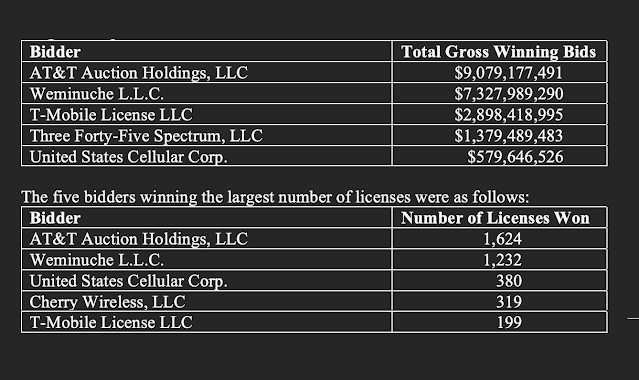
Verizon was the top bidder with a commitment of over $45 billion in the FCC's recent C-band auction.

Auction 107 net winning bids totaled $81,114,481,921 and gross winning bids totaled $81,168,677,645.  Twenty-one bidders won all of the available 5,684 licenses.

“It is essential to America’s economic recovery that we deliver on the promise of next-generation wireless services for everyone, everywhere,” said FCC Acting Chairwoman Jessica Rosenworcel.  “This auction reflects a shift in our nation’s approach to 5G toward mid-band spectrum that can support fast, reliable, and ubiquitous service that is competitive with our global peers.  Now we have to work fast to put this spectrum to use in service of the American people.  Special thanks go to our great FCC auctions team, and their colleagues in the Wireless Telecommunications and International Bureaus, among others, for this success.”

The five bidders with the largest total gross winning bid amounts from both the clock and assignments phases were as follows:


Full results are here:

Tuesday, February 23, 2021

Rosenworcel proposes more mid-band spectrum for 5G

FCC Acting Chairwoman Jessica Rosenworcel is proposing 100 megahertz of mid-band spectrum in the 3.45-3.55 GHz band would be made available for auction and 5G deployment across the contiguous United States.  The Acting Chairwoman also shared with her colleagues a proposed Public Notice seeking comment on procedures for this auction (Auction 110), in which bidding would begin in early October 2021.


The proposed new rules, if adopted, would allocate the 3.45-3.55 GHz spectrum band for flexible-use service.  It would establish a framework for coordination of non-federal and federal use and establish a band plan, as well as technical, licensing, and competitive bidding rules for the band.  Lastly, it would complete the relocation of non-federal radiolocation operators to the 2.9-3.0 GHz band and the sunset of amateur use in the 3.3-3.5 GHz band.

The draft order will be considered at the FCC's March 17th Open Meeting.

“The promise of 5G means new and improved services and applications for consumers and businesses alike.  This means not only faster download speeds, but also enabling digital tools we can’t even imagine yet,” said Rosenworcel.  “We need to deliver the 5G that the American people were promised.  That means a 5G that is fast, secure, resilient, and—most importantly—available across the country.  This important auction is a crucial step toward making that a reality.  I hope my colleagues will join me in supporting this proposal.”


Tuesday, January 5, 2021

Bidding on 3.7 GHz spectrum tops $78 billion

The FCC's ongoing auction of spectrum in the 3.7–3.98 GHz band has topped $78 billion - the highest-grossing spectrum auction in American history.

Auction 107 offers flexible‐use overlay licenses for spectrum in the 3.7–3.98 GHz band (3.7 GHz Service) throughout the contiguous United States, subject to clearing requirements. A total of 57 applicants were cleared to participate in the auction. Bidding commenced on December 8.

https://auctiondata.fcc.gov/public/projects/auction107

Tuesday, December 8, 2020

FCC's C-Band spectrum auction gets underway

 The FCC kicked off its auction of 280 megahertz of prime mid-band spectrum in the 3.7-3.98 GHz band—a portion of the C-band.  This is the FCC’s largest mid-band 5G spectrum auction to date.

“This is a big day for American consumers and U.S. leadership in 5G,” said FCC Chairman Ajit Pai.  “By freeing up this wide swath of critical mid-band spectrum, the FCC is paving the way for Americans to receive fast 5G wireless services.  Together with the recent success of our 3.5 GHz band auction, our work to auction the 2.5 GHz and 3.45 GHz bands in 2021, and the other ground-breaking spectrum auctions we’ve held since 2017, our 5G FAST Plan is in full swing.  American consumers and businesses will benefit from this FCC’s efforts for years to come.” 


Chairman Pai proposed and instituted a plan to repurpose the C-band quickly.  As a result, this mid-band spectrum will be available to deliver next-generation connectivity to American consumers and businesses years ahead of schedule.  The FCC successfully secured commitments from fixed satellite companies to move quickly out of the 3.7-3.98 GHz band and into the upper portion of the C-band, which will free up this crucial mid-band spectrum for 5G wireless services. 

The first round of the clock phase of the auction started on December 8th at 10 a.m. ET.  This auction will offer 5,684 new flexible-use overlay licenses based on Partial Economic Areas (PEAs) for spectrum in the 3.7–3.98 GHz band.  This spectrum holds the potential to be prime spectrum for 5G services given its combination of geographic coverage and capacity, and the FCC’s auction procedures will ensure the assignment to auction winners of contiguous spectrum blocks allowing wide channel bandwidths that support 5G deployment. 

Satellite operators currently using the C-Band have agreed to repack their operations out of the band’s lower 300 megahertz (3.7-4.0 GHz) into the upper 200 megahertz (4.0-4.2 GHz).  The first phase of this transition—the clearing of 120 megahertz of spectrum from 3.7-3.82 GHz in 46 of the nation’s top 50 PEAs—will conclude by December 5, 2021.  The second phase—clearing the lower 120 megahertz of spectrum in the remaining PEAs, plus an additional 180 megahertz from 3.82-4.0 GHz nationwide—will conclude by December 5, 2023.  


Sunday, October 4, 2020

France completes auction of 3.4 – 3.8 GHz band spectrum

France completed a multi-stage auction of 3.4 – 3.8 GHz band spectrum for 5G services.

At the close of the main auction, the winning bidders have committed to paying a total €2,786,000,000 for the 310 MHz of spectrum to be awarded.

Now that the amount of spectrum to be awarded to each of the winning bidders is known, a “positioning” auction will be held in October to determine how their frequencies will be positioned in the 3.4 – 3.8 GHz band. This auction will give the winning bidders an opportunity to express their preferences regarding their position on the band, and their position with respect to the other winning bidders. Once this final stage has been completed, Arcep will award the winning bidders licences to use 3.4 – 3.8 GHz band frequencies.

https://www.arcep.fr/actualites/les-communiques-de-presse/detail/n/5g-011020.html

Wednesday, September 2, 2020

Verizon is biggest winner in 3.5 GHz spectrum auction

The FCC posted the winning bidders in its recently completed auction of 70 megahertz of Priority Access Licenses (PALs) in the 3550-3650 MHz band (Auction 105).

Auction 105 gross proceeds reached $4,585,663,345, with net proceeds totaling $4,543,232,339.  A total of 228 bidders won 20,625 of 22,631, or more than 91.1%, of available licenses. 


The full auction results are posted here: https://docs.fcc.gov/public/attachments/DA-20-1009A2.pdf

Wednesday, May 13, 2020

FCC opens some 900 MHz spectrum

The FCC will make six megahertz of 900 MHz band spectrum available for wireless broadband technologies and services.  The 900 MHz band is currently designated for narrowband land mobile radio communications and primarily used by land transportation, utility, manufacturing, and petrochemical companies. 

The six megahertz will be available for broadband licenses on a county-by-county basis while reserving the remaining four megahertz of spectrum for continued narrowband operations.
provide crucial services to the American public.

Specifically, the Commission approved a Report and Order, an Order of Proposed Modification, and two Orders that realign the band and establish a transition mechanism based primarily on negotiations between prospective broadband licensees and existing narrowband incumbent licensees.  The item also establishes rules to prevent broadband applicants from receiving windfalls and includes application requirements and operating and technical rules applicable to the new 900 MHz broadband licenses.

In addition, the item would modify the Association of American Railroads’ existing nationwide ribbon license in the 900 MHz band to facilitate the transition of the band without disruptions to railroads’ operations, and to enable significant railroad safety upgrades.

As part of today’s action, the Commission also announces a partial lifting of the 900 MHz application freeze to permit existing licensees to file applications to relocate their narrowband operations as part of a transition plan.

FCC Chairman Ajit Pai writes: "900 MHz users are enthusiastic about the possibilities that reliable broadband will open for them.  Broadband access will enable industries to leverage technologies for applications like private LTE networks—next-generation networks that can enable Voice over LTE, grid resiliency and monitoring, wildfire mitigation, enhanced cybersecurity, and more.  Utilities are eager to use broadband to modernize the electric grid.  Southern California Edison, a utility in a state hard-hit by fires in recent years, predicts that broadband will enable innovative monitoring technologies that will help utilities detect and extinguish fires caused by downed power lines." 

Tuesday, February 4, 2020

CTIA: More mid-band spectrum is needed

CTIA published a new study that compares spectrum released in 14 countries and concludes that U.S. policymakers need to move quickly to bring more licensed mid-band spectrum to power 5G networks.

“This report highlights that U.S. policymakers need to deliver the mid-spectrum they have identified—and do so quickly,” said Meredith Attwell Baker, CTIA President and CEO. “We need 350 MHz of spectrum auctioned in 2020. America’s national spectrum strategy—FCC Chairman Pai’s 5G Fast Plan—has been instrumental to date, and I’m confident we’ll make more licensed spectrum available to continue successfully building the U.S. 5G economy.”

Analysys Mason looked at spectrum released between 2017 and 2020, as well as the licensing approach used for each band, and key findings from the benchmarked countries include:

  • While nearly all spectrum in other countries has been made available on an exclusively licensed basis, the U.S. is an “outlier” in the amount of unlicensed and shared spectrum being made available.
  • The U.S. is the only country that has released mid-band spectrum in the 3 GHz range on a shared or unlicensed basis.
  • European countries are making only the lower part (5.925-6.425 GHz) of the 6 GHz band available for unlicensed use.
  • Following U.S. leadership on high-band, most countries have begun to make or will make a significant amount of high-band spectrum available.
  • With the 600 MHz auction, the U.S. was one of the first countries to release low-band spectrum suitable for 5G.

https://www.ctia.org/news/report-international-comparison-licensed-unlicensed-and-shared-spectrum-2017-2020


Tuesday, November 12, 2019

Ericsson, Swisscom, and Qualcomm test 5G spectrum sharing

Ericsson, Swisscom, and Qualcomm carried out an over-the-air spectrum sharing 5G data call at Swisscom’s Digital Lab on October 31. The call was enabled by Ericsson Spectrum Sharing (ESS).

Ericsson and Qualcomm had previously achieved the first 5G data call using Ericsson Spectrum Sharing on a 3GPP Frequency Division Duplex (FDD) low band.

Ericsson Spectrum Sharing, part of Ericsson Radio System, enables a quick, flexible, and cost-effective upgrade to 5G within existing 4G carriers. Based on traffic demand, the solution will dynamically share spectrum between 4G and 5G carriers, making the switch within milliseconds to minimize spectrum wastage and provide the best end-user performance.

Swisscom, with Ericsson as its sole 5G vendor, was the first communications service provider in Europe to launch commercial 5G services in April 2019 – on the 3.6 GHz band. Swisscom is targeting 90 percent population coverage by the end of 2019.

Patrick Weibel, Head of 5G Program, Swisscom, says: “Dynamic Spectrum Sharing (DSS) allows Swisscom to best leverage the existing frequency spectrum and infrastructure for 4G and 5G customers, depending on their needs. Spectrum sharing will ensure that Swisscom can provide extensive 5G coverage to its customers as soon as possible.”

Hannes Ekström, Head of Product Line 5G RAN, Ericsson, says: “With Ericsson Spectrum Sharing, service providers can reuse their Ericsson Radio System investments on bands currently used for LTE to support a fast introduction of 5G. This first ESS 5G data call by Swisscom, on commercial platforms, is an important step toward enabling cost-efficient, nationwide 5G coverage and services.”

Monday, October 28, 2019

C-Band Alliance proposes to clear 300 MHz of spectrum for 5G

The C-Band Alliance (CBA), which is backed by Intelsat, SES, Eutelsat, and Telesat, announced a commitment to clear 300 MHz of C-band spectrum to support fast 5G wireless deployment throughout the continental U.S.

The CBA proposal, which is detailed in a filing with the FCC, encompasses 300 MHz of spectrum including a 20-MHz guard band to protect existing satellite services from 5G interference.

Further enhancing its plan to clear spectrum quickly, the first tranche—which clears spectrum within 18 months of an FCC order in 46 top metropolitan zones—is now increased to 120 MHz, inclusive of the 20-MHz guard band. The second tranche of the remaining spectrum will be made available within 36 months from a CBA-led auction, providing cleared spectrum throughout the entire continental U.S.

Speaking on behalf of the C-Band Alliance, Intelsat CEO Stephen Spengler said, “Throughout this nearly two-year process, we have sought to work collaboratively as peers, to be responsive to the goals of U.S. policy makers seeking spectrum for 5G, and to work closely with our customers to protect their transmissions and understand their current and future network needs. Over this time, compression technology has continued to commercialize. We are confident that we can deliver a solution that not only maximizes the clearing of mid-band spectrum to enable 5G in the U.S., but also fully funds a spectrally-efficient, next-generation compression infrastructure for programming distribution in the U.S. This solution represents unprecedented coordination among satellite operators, our customers, and the FCC, and we look forward to delivering to the U.S. an accelerated 5G deployment and the innovation and high-technology job growth that the deployment of 5G is expected to generate for the U.S. economy.”

https://c-bandalliance.com/