Tuesday, April 23, 2024

HPE Aruba debuts Wi-Fi 7 Access Points

 Hewlett Packard Enterprise (HPE) has introduced new Wi-Fi 7 access points (APs) through its Aruba Networking division, offering up to 30% greater capacity compared to similar products. These APs enhance network security and improve location-based services, supporting enterprise needs in AI, Internet of Things (IoT), and security applications.

The APs utilize HPE's patented ultra tri-band hardware technology to maximize efficiency in the 5GHz and 6GHz bands, reducing contention and increasing performance. Managed by HPE Aruba Networking Central, the APs incorporate built-in support for various IoT protocols, including Zigbee and Bluetooth, eliminating the need for separate IoT network overlays. This integration facilitates secure connectivity for a growing array of IoT devices at the network edge, such as cameras and sensors.

Moreover, these APs are part of a broader ecosystem involving over 350 HPE technology partners, enhancing the ability of organizations to process and utilize IoT-generated data for AI applications. This includes developing predictive maintenance, digital twins, and personalized customer experiences, thereby enabling effective use of AI data lakes for real-time business insights.

Key features:

  • More Wi-Fi performance: UTB filtering eliminates channel interference on adjacent channels in 5GHz and 6GHz bands, maximizing performance and capacity, giving organizations the flexibility to use both bands simultaneously.
  • Enhanced wireless security: Policy-based access control and Layer 7 application firewalls build upon a foundation of security-first wireless features such as HPE Aruba Networking Central Client Insights for improved IoT visibility and automated Dynamic Segmentation to deliver role-based access for users and IoT devices. Additional features include new link level encryption (MACsec) capabilities, which extend wired data protection to the AP, and a personal wireless network mode that provides secure, self-service onboarding of user devices in group environments such as college campuses.
  • Eliminate IoT Overlay Networks: HPE Aruba Networking Central’s IoT Operations dashboard streamlines device onboarding and eliminates high-overhead vendor-specific IoT overlay networks, allowing APs to act as a connector and local processing element for IoT devices to communicate directly with third-party IoT services.
  • Wider support for IoT protocols: Dual dedicated Bluetooth and Zigbee radios provide support for high-density IoT environments, and dual USB ports provide robust connectivity for a broad range of IoT devices using proprietary protocols. The AP’s integrated, non-permanent external antennas are designed for challenging radio frequency (RF) environments.
  • AP as a data processing solution: The HPE Aruba Networking 730 Series APs feature twice as much SDRAM and Flash memory than previous HPE models, enabling application-specific containers to run on the APs themselves, resulting in streamlined data transmissions and local processing of data for more rapid response to real-time conditions such as temperature or motion.
  • Precision location services: The HPE Aruba Networking 730 Series APs are also the first to leverage the new Wi-Fi location standard, for improved location-aware services that deliver precision within one meter, for real-time, immersive, and industrial use cases, as well as support for the IEEE 802.11az standard to help enable self-location networks. Additional features include a Global Navigation Satellite System (GNSS) receiver and a barometric sensor for floor-level mapping, which incorporate Bluetooth Low Energy (BLE) 5.4 for bi-directional IoT location data that can boost user engagement and track valuable assets to reduce loss.
  • Sustainability and energy savings: An AI-powered, dynamic power save mode helps lower energy footprint and costs for enterprises.

“With more than two decades of Wi-Fi innovation leadership, HPE Aruba Networking continues our commitment to delivering customers the reliable, secure, high-performance connectivity they need to meet their business objectives, which can range from immersive fan experiences to automated manufacturing processes,” said Stuart Strickland, wireless chief technology officer, HPE Aruba Networking. “Our Wi-Fi 7 APs go far beyond improvements in performance and efficiency to become an intelligent IoT hub, securing the network, distributing the workload, characterizing the environment, and providing a foundation for business and operational analytics.”


Wi-Fi 7, known technically as IEEE 802.11be, brings several significant improvements over its predecessor, Wi-Fi 6:

  • Higher Data Rates: Wi-Fi 7 is expected to offer significantly higher data rates, potentially up to 30 Gbps, which is nearly three times faster than Wi-Fi 6. This is achieved through more efficient use of spectrum, higher-level modulation schemes (4096-QAM), and increased bandwidth (up to 320 MHz).

  • Improved Latency: Wi-Fi 7 aims to reduce latency significantly, which is crucial for applications requiring real-time responses such as gaming, virtual reality, and video conferencing. Techniques like Multi-Link Operation (MLO) allow devices to transmit data over multiple frequency bands simultaneously, reducing delay and improving reliability.

  • Greater Efficiency in High-Density Environments: With the growing number of devices per household and per enterprise, Wi-Fi 7 introduces enhancements that manage crowded networks more efficiently. Features like improved spatial reuse protocols help to minimize interference and manage airtime fairness better among multiple devices.

  • Enhanced Reliability: Wi-Fi 7 incorporates advanced technologies to improve signal reliability and resilience, even in environments prone to interference and physical obstructions. This includes more robust error correction and packet recovery mechanisms.

  • Increased Bandwidth and Spectrum Utilization: By supporting wider channels (up to 320 MHz) and additional spectrum in the 6 GHz band (on top of existing 2.4 GHz and 5 GHz bands), Wi-Fi 7 can handle more data simultaneously, providing a broader highway for information flow.

  • Backward Compatibility: Like previous Wi-Fi generations, Wi-Fi 7 is designed to be backward compatible with older Wi-Fi standards, ensuring that new devices can still communicate with older ones without requiring a complete network overhaul.

  • Multi-Link Operation (MLO): This feature allows devices to use multiple Wi-Fi bands or channels simultaneously, which can boost throughput, balance traffic loads more efficiently, and enhance robustness against interference.


Vantage Data Centers secures another $3B in loans

Vantage Data Centers has secured a $3 billion green loan to fund the ongoing development of its North America data centers. So far this year, Vantage has announced a total of nearly $10 billion in financing to drive the company’s continuing global growth.

The loan was provided by a bank syndicate led by structuring bank Wells Fargo Securities, LLC and joint bookrunners TD Securities, Truist Securities, Inc. and Scotiabank.

The financing is a revolving credit facility with an initial collateral pool of eight leased and greenfield sites in both new and existing markets totaling nearly 1.4GW of IT capacity. Compared to typical project-specific construction loans, this model enables faster time-to-market for Vantage and its customers. Additionally, the loan affords Vantage the ability to add more North American assets to this credit facility in the future. Currently, Vantage’s North America platform includes 12 campuses across the United States and Canada.

“For the past several years, Vantage has prioritized innovative funding avenues to support our rapid expansion, and this revolving multi-asset development financing is no exception,” said Christophe Strauven, senior vice president, capital markets at Vantage. “We are dedicated to meeting our customers where they need us most. Our decision to pursue a flexible revolving credit facility allows us to access capital quickly and, therefore, begin development much earlier than project-specific loans, enabling Vantage to meet the ambitious timelines our customers require for critical IT capacity across North America.”

 In addition to today’s announcement, the company also announced a $6.4 billion equity investment led by DigitalBridge and Silver Lake in January, followed by a $64 million loan to support the development of Vantage’s first campus in Taiwan in March.

https://vantage-dc.com/data-center-locations

false

Comcast's Xfinity Mobile hotspots deliver up to 1 Gbps

Comcast reports that its new “Xfinity Mobile” hotspots enable customers on its Xfinity Mobile and Comcast Business Mobile devices to access Internet speeds over WiFi up to 1 Gbps. 

“We’re supercharging hotspots to unlock the full potential of our customers’ mobile devices and give you the boost you need, when you need it, to download a large file, stream a live sporting event, or host an important video call,” said Kohposh Kuda, senior vice president, Xfinity Mobile, Comcast. “A billion devices connect to WiFi over our network because it delivers a superior experience. We’ve invested billions of dollars in a network that can support the massive growth in data consumption and our WiFi Boost upgrade is a huge win for our mobile customers.”

  • Currently, 90 percent of the mobile data traffic on Xfinity Mobile devices travels over WiFi, not cellular. 
  • Comcast has over 23 million WiFi hotspots.
  • Comcast has invested more than $20B over the past five years to upgrade and expand the Xfinity network and introduce new innovative features like WiFi Boost to support the constantly increasing number of connected devices consumers use both inside and outside of the home.


false

Comcast Business launches Managed Detection and Response

Comcast Business introduced a Managed Detection and Response (MDR) solution that combines an advanced security analytics platform and Security Operations Center (SOC) to help medium and large enterprise customers detect, analyze, and mitigate cyber threats in an ever-evolving and challenging threat landscape.

Managed Detection and Response is a cybersecurity service that combines technology and human expertise to perform cyber threat hunting, monitoring, and response. One of the primary benefits of MDR is that it helps rapidly identify and limit the impact of threats without the need for additional staff and resources.

Highlights

  • 24/7 Monitoring and Response – Around the clock monitoring and fast response to security incidents.
  • Advanced Threat Detection – AI and machine learning to identify and address known and emerging threats, like Advanced Persistent Threats (APTs) and zero-day exploits.
  • Expertise and resources – Security Operations Center (SOC) with security professionals with extensive knowledge and industry certifications.
  • Fast Incident Response – 24/7 monitoring for quick and effective response to security incidents.
  • Compliance – Reporting to help businesses with important documentation often requested for compliance audits.

https://business.comcast.com/enterprise/products-services/cybersecurity-services

false

Lightpath launches Enhanced DDoS Protection

Lightpath introduced its next-generation network safeguard against a growing list of DDoS (Distributed Denial of Service) attack types.     

Lightpath's LP DDoS Shield utilizes advanced DDoS detection and mitigation technology from Radware, a leading provider of cybersecurity solutions. Radware's automated DDoS defense includes patented algorithms and AI-powered technology to more quickly detect, identify, and mitigate zero-day attacks, the hardest to defend against, as well as IoT-based, Burst, DNS and TLS/SSL attacks, phantom floods, and more. In addition, the solution offers customers complete visibility and reporting through a private portal.

As new types of DDoS threats appear, the solution leverages Radware's behavioral-based technology and global footprint to accurately identify the attacks and automatically generate signatures in real-time. The new signatures are then automatically distributed and enabled to keep customers protected.

"At a time when DDoS attacks are increasing in size, scale, and sophistication, enhanced DDoS protection is fundamental to our commitment to providing customers with a solution for secure, reliable, and future-ready connectivity," stated Tim Haverkate, SVP of Commercial Operations for Lightpath. "LP DDoS Shield dramatically improves the protections that we can offer our customers to help protect them against DDoS threats thanks to its advanced, dynamic technologies."

Monday, April 22, 2024

Cignal AI: the 800 GbE optical market is ramping up fast

 Datacom optical component revenue grew for the 4th straight quarter with the explosion of demand for optics used in AI clusters, according to the most recent 4Q23 Optical Components Report from research firm Cignal AI. Nvidia, Coherent, and Innolight lead in 800GbE Datacom module shipments for hyperscale AI applications. Acacia and Marvell lead in shipments of high-performance coherent interfaces based on large volumes of 400ZR pluggables.

“Datacom shipments, especially 800GbE optics, are ramping up fast and shipped units are forecast to reach 8 million in 2024," said Scott Wilkinson, Lead Analyst for Optical Components at Cignal AI. "Telecom is slowly recovering from a bottom in Q3, but no immediate reversal is in sight.”

More Key Findings from the 4Q23 Optical Component Report:

  • Datacom revenue reached record levels, up 11% YoY, and module shipments grew rapidly in the last 2 quarters of 2023 as AI demand accelerated. For all of 2023, total Datacom revenue was down -4%, weighed down by poor performance at the start of the year.
  • After a sharp drop at the start of 2023, 400GbE port shipments recovered and grew over 50% YoY in 4Q23.
  • The high-speed Datacom optical component market is forecast to exceed $10 billion by 2025.
  • Coherent port shipments increased QoQ, but they were down slightly YoY. 400ZR/ZR+ shipments grew 25% QoQ.
  • The market for embedded and pluggable coherent optical modules is forecast to exceed $6 billion in 2024.
  • Huawei, Infinera, Acacia, and Nokia shipped Gen120P 1.2T high speed coherent ports for revenue in 4Q23, which is the first quarter of production shipments for this new technology.
  • Cignal AI's 2024 forecast for 800GbE modules was increased 8% based on accelerating demand, and initial forecasts of 1600ZR modules were also added to the Optical Components report this quarter.

https://cignal.ai/

Intel Foundry advances in DoD's RAMP-C

Intel has been awarded Phase Three of the U.S. Department of Defense’s (DoD) Rapid Assured Microelectronics Prototypes - Commercial (RAMP-C) program. This development marks a crucial step in testing and deploying defense industrial base (DIB) product prototypes. Announced via the National Security Technology Accelerator’s consortium-based program, this phase emphasizes Intel's readiness in process technology and the ability to meet high-volume manufacturing demands with its Intel 18A technology.

The latest phase of RAMP-C allows for the commencement of manufacturing both commercial and DIB product prototypes using Intel’s advanced 18A process technology. Kapil Wadhera, Intel's vice president for Foundry Services and general manager of the Government Engagements and Business Operations Group, noted that for the first time in decades, U.S. government and defense customers will access leading-edge technology concurrently with commercial markets. 

RAMP-C is strategically designed to reinstate the U.S. as a leader in cutting-edge semiconductor technology by fostering a robust, resilient, and trusted commercial foundry ecosystem. Here are some key points about the program and Intel’s involvement:

  • Phase Three Focus: Extensive testing of DIB product prototypes using Intel 18A process technology.
  • Collaboration: Intel Foundry works with major industry players such as Microsoft, Nvidia, IBM, and others to support the design and manufacturing of advanced integrated circuits.
  • Future Milestones: Dr. Dev Shenoy of the DoD highlighted that RAMP-C aims to showcase prototype production on Intel 18A by 2025, significantly enhancing processing capabilities for military applications.
  • Security and Performance: The program addresses the critical need for secure and highly performant microelectronics in U.S. military systems.
  • Industry Integration: Intel has created the U.S. Military, Aerospace, and Government (USMAG) Alliance to ensure functional and operational security requirements are met through a dedicated semiconductor IP ecosystem.

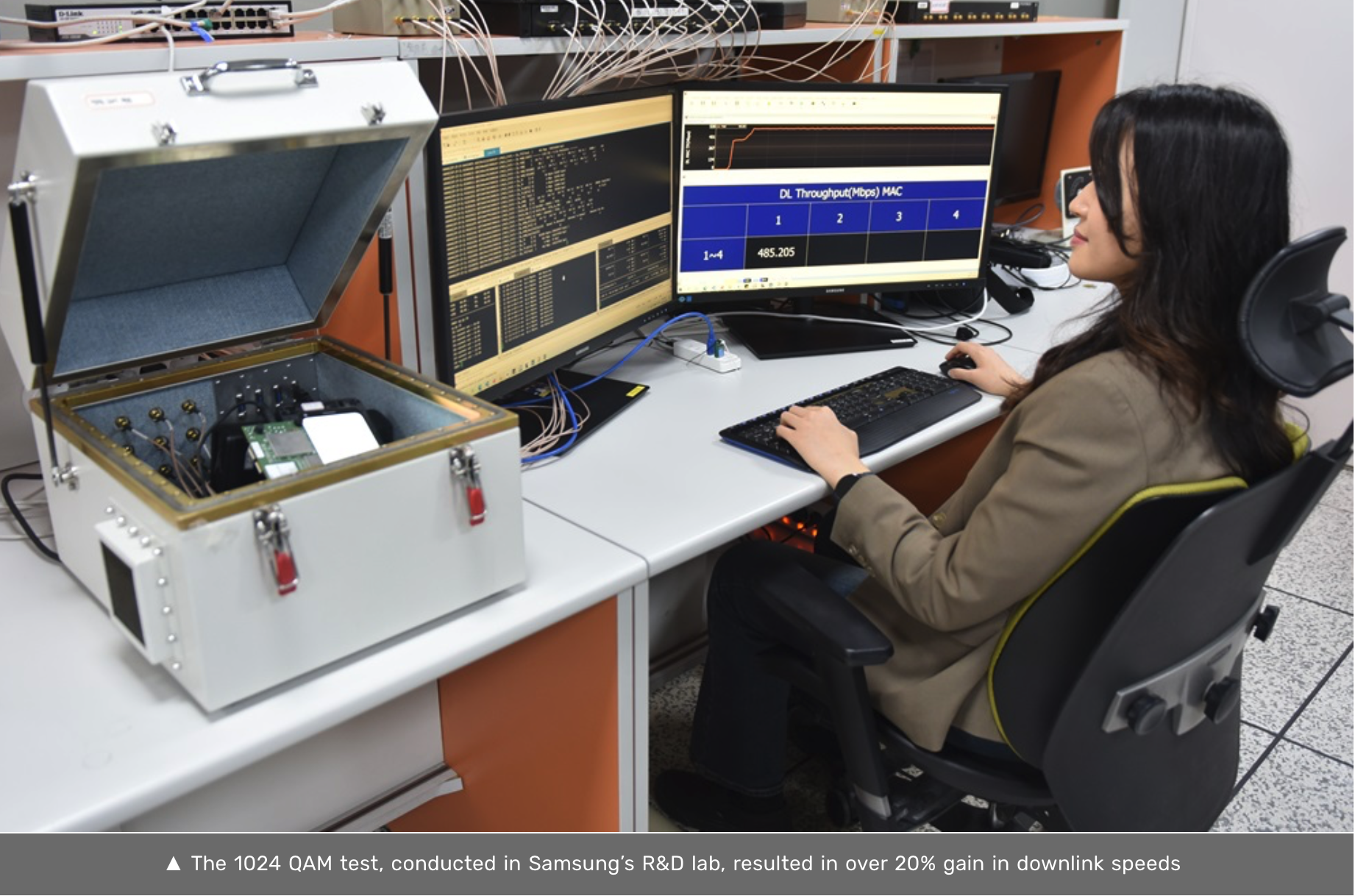
Samsung: 1024 QAM boosts downlinks by 20%

Samsung Electronics and Qualcomm Technologies have successfully completed tests for 1024 Quadrature Amplitude Modulation (QAM) on both Frequency Division Duplex (FDD) and Time Division Duplex (TDD) spectrum bands. This accomplishment is notable as it marks the first time 1024 QAM has been achieved in an FDD band, a significant step in advancing 5G technology. The tests, which were conducted in Samsung’s R&D lab in Korea, utilized Samsung’s 5G vRAN software and radios, along with a Qualcomm Snapdragon® X75 5G Modem-RF System equipped test device.

In the recent tests, using a 20MHz bandwidth on the FDD spectrum, the technology achieved downlink speeds up to 485Mbps, which is more than 20% higher than the speeds achievable with the currently widespread 256 QAM. 


Looking ahead, Samsung said it will continue its testing on 1024 QAM with traditional RAN systems and plans to make the technology commercially available within the year. This ongoing collaboration between Samsung and Qualcomm is part of a broader effort to push the limits of 5G technology, which also saw them achieving the world’s first simultaneous 5G 2x uplink and 4x downlink carrier aggregation for FDD spectrum last year.

Key Points:

  • First in FDD: Samsung and Qualcomm achieved an industry first by successfully testing 1024 QAM for the FDD spectrum.
  • Enhanced Speeds: Tests showed a 20% increase in downlink speeds compared to existing 256 QAM, reaching up to 485Mbps.
  • Future Availability: Samsung plans to commercialize the 1024 QAM technology later this year, following additional tests on traditional RAN systems.
  • Continued Collaboration: The companies continue to collaborate on advancing 5G capabilities, building on previous achievements like 5G carrier aggregation.

Verizon posts flat Q1 revenue of $33.0 billion

 Citing price increases and a substantial cut in CAPEX,  Verizon reported operating revenue of $33.0 billion, up 0.2 percent from first-quarter 2023. Consolidated net income was $4.7 billion, compared to consolidated net income of $5.0 billion in first-quarter 2023. Consolidated adjusted EBITDA of $12.1 billion, up from $11.9 billion in first-quarter 2023. Earnings per share of $1.09, compared with earnings per share of $1.17 in first-quarter 2023.

Some highlights

Total wireless service revenue in first-quarter 2024 was $19.5 billion, up 3.3 percent year over year, driven primarily by pricing actions implemented in recent quarters, higher premium price plan adoption, and growth of our fixed wireless subscriber base.

First-quarter 2024 capital expenditures were $4.4 billion, compared to $6.0 billion in first-quarter 2023.

  • Verizon's total unsecured debt as of the end of first-quarter 2024 was $128.4 billion, a $0.1 billion decrease compared to fourth-quarter 2023, and $3.6 billion lower year over year.
  • Consumer wireless service revenue in first-quarter 2024 was $16.1 billion, up 3.4 percent year over year, driven by growth in Consumer wireless postpaid average revenue per account (ARPA) from pricing actions and continued FWA adoption. 
  • Consumer wireless retail postpaid churn was 1.03 percent in first-quarter 2024, and wireless retail postpaid phone churn was 0.83 percent. 
  • In first-quarter 2024, Consumer reported 158,000 wireless retail postpaid phone net losses, representing an improvement of 105,000 from first-quarter 2023 net losses of 263,000, driven by improvements in both gross adds and churn. This represents Verizon Consumer's best first-quarter performance since 2018. 
  • Consumer postpaid phone gross additions in first-quarter 2024 increased 5.3 percent year over year, driven by the continued success of myPlan and last year's go to market improvements. 
  • Consumer reported 216,000 wireless retail prepaid net losses in first-quarter 2024. Wireless retail prepaid net losses excluding SafeLink Wireless, Verizon's brand offering access to government-sponsored connectivity benefits and programs, were 131,000. 
  • Consumer reported 203,000 fixed wireless net additions and 49,000 Fios Internet net additions in first-quarter 2024. Consumer Fios revenue was $2.9 billion in first-quarter 2024. 
  • Total Verizon Business revenue was $7.4 billion in first-quarter 2024, a decrease of 1.6 percent year over year, as increases in wireless service revenue were more than offset by decreases in wireline revenue and wireless equipment revenue. 
  • Business wireless service revenue in first-quarter 2024 was $3.4 billion, an increase of 2.7 percent year over year. This was driven by continued strong net additions in the quarter for both mobility and fixed wireless, as well as benefits from pricing actions implemented in recent quarters. 

For 2024, Verizon continues to expect the following: 

  • Total wireless service revenue growth2 of 2.0 percent to 3.5 percent.
  • Adjusted EBITDA growth of 1.0 percent to 3.0 percent.
  • Adjusted EPS1 of $4.50 to $4.70.
  • Capital expenditures between $17.0 billion and $17.5 billion. 
  • Adjusted effective income tax rate1 in the range of 22.5 percent to 24.0 percent.

euNetworks adds metro fiber network in Brussels

euNetworks Ghas added a new duct and fibre-based network in Brussels to its Pan-European network footprint. This new addition takes the company’s owned and operated metropolitan network count to 18 in Europe. This is the latest of the company’s investments in digital infrastructure in the Benelux region, following the addition of a duct-based fibre network in Belgium through acquisition in April 2023.

Last year, the 1,660 kilometres of fibre network acquired added unique routes in Brussels and long haul routes across Belgium, delivering a solid complement to euNetworks’ in-place network in the region. It also presented compelling additional investment opportunities for euNetworks in the long haul, in adjacent geographies and in building a new Brussels city network to give customers a truly end-to-end experience.

Since then, euNetworks has invested further in the Brussels metropolitan area, overbuilding acquired duct, purchasing additional cable and duct, and building additional high fibre count connectivity and diversity between key data centre sites, clusters and network aggregation points to deliver this new Brussels footprint.

Brussels Metro:

  • 41 kilometres of duct and high-fibre count network
  • Connects 5 data centres day 1, including LCL Brussels-North, Digital Realty BRU1, BRU3 & BRU4, AtlasEdge Brussels BRU001
  • With multiple, diverse entry points to these on-net data centres
  • Additional data centres are in the pipeline to be connected to support customer demand
  • Dark Fibre, Long Haul and Metro Wavelengths and Ethernet-based services are available across this footprint, with four diverse 100G Ethernet nodes to be installed, delivering resiliency and redundancy
  • Seamless connectivity between Brussels connected data centres and other regional data centre clusters and hubs in Ghent, Antwerp, Charleroi and Saint Ghislain
  • With multiple diverse long haul connectivity options from Brussels

“Belgium is a growing digital hub, with significant investment in the region to support emerging technology trends such as IoT and GenAI, which drive Cloud adoption and strategies,” said Paula Cogan, Chief Executive Officer of euNetworks. “Our Brussels and wider Belgium investments strengthen our leadership in European critical infrastructure as we focus on the ongoing densification of the high-bandwidth demand region of FLAP (Frankfurt, London, Amsterdam and Paris). We continue our approach to deliver a differentiated proposition to the market, offering unique and scalable network routes to our customers between key data centres. We also have a strong pipeline of ongoing investment to continue to support their growing bandwidth needs, further capitalising on the investment we made last year. I’m very proud of what the team have accomplished in a relatively short timeframe, delivering our eighteenth metro network to market. We’ve also expanded our local operations and sales presence, enabling strong support for our customers locally as they move forward with their infrastructure investments.”

https://eunetworks.com/

Network-as-a-Service (#NaaS) in 2030 - Which vendors survive?

Welcome to 2030, where Network-as-a-Service has revolutionized the way we do business!

With #NaaS, businesses can scale their network on-demand, ensuring they always have the speed and capacity needed without hefty upfront costs. Gone are the days of managing cumbersome and disjointed network hardware. Everything is built to work together and transparently managed behind-the-scenes.

From retail to manufacturing, businesses enjoy enhanced connectivity that allows them to serve customers faster and innovate continuously.

Scaling has never been easier, leading to higher productivity and cost efficiency.

With built-in advanced security features, automatic updates, and AI management, Network-as-a-Service is the backbone of business operations.

Which networking companies led the transition? What’s common in their success strategies?

https://youtu.be/bGVqI1UQpKo

Join our 2024 NaaS showcases, and download our reports. https://nextgeninfra.io

Want to be involved our video series? Contact info@nextgeninfra.i

false

Sunday, April 21, 2024

Cisco Steps Up in AI Security Battle with New Hypershield

Cisco introduced a cloud-native, AI-powered approach to highly distributed security for AI-scale data centers that’s built into the fabric of the network.

Cisco Hypershield is a new security product that integrates deeply with network infrastructure, promising enhanced protection for AI-scale data centers. 

Hypershield combines Cisco's advancements in network security with strategic partnerships, such as with NVIDIA, to optimize AI-driven security capabilities. The system offers visibility into operations across environments, whether in cloud setups or traditional data centers, through innovative use of lightweight monitoring tools that do not interfere with core operations.

Key features of Cisco Hypershield include:

  • Autonomous Network Segmentation: It dynamically updates security protocols based on real-time network flow and application behavior analysis.
  • Proactive Vulnerability Management: The system identifies and mitigates potential exploits before they become active threats.
  • Seamless Security Upgrades: Hypershield tests and implements upgrades without impacting system uptime, ensuring continuous protection.

Here is a blog by Jeetu Patel, Cisco's EVP and General Manager, Security & Collaboration

https://blogs.cisco.com/news/cisco-hypershield-security-reimagined-hyper-distributed-security-for-the-ai-scale-data-center

China Mobile, Qualcomm, and ZTE achieve 5.4Gbps

ZTE, in collaboration with China Mobile's Zhejiang Branch and Qualcomm, achieved a 5.4Gbps peak data rate during a field test in Jiaxing. This test is notable as the world’s first end-to-end field application of 3CC CA (three Carrier Component Carrier Aggregation) combined with 1024QAM (1024-state Quadrature Amplitude Modulation).

The field test utilized advanced 5G-A features, showcasing their potential to enhance the performance and efficiency of commercial 5G networks. It also emphasized the importance of 5G-A technology in enabling rapid and effective collaboration across the telecom industry, impacting system products, commercial chips, and terminals:

  • Industry firsts: Successful combination of 3CC CA with 1024QAM in an end-to-end test.
  • Enhanced user experience: Peak single-user downlink rate surpassed 5.4Gbps.
  • Spectrum efficiency: 1024QAM technology improves data transmission efficiency by 25% over previous technologies.

Looking ahead, China Mobile's Zhejiang Branch, ZTE, and Qualcomm Technologies will continue their partnership to pioneer innovations and expand the use of 5G technologies. Their efforts are directed towards enabling a range of emerging services such as VR experiences, ultra-high-definition broadcasting, and advanced 3D applications, paving the way for a transformative impact on the digital economy and society.

Intel installs ASML's first High Numerical Aperture EUV system

Intel Foundry has received and assembled the industry’s first High Numerical Aperture (High NA) Extreme Ultraviolet (EUV) lithography system, a next-generation lithography system developed by ASML.

The ASML TWINSCAN EXE:5000 High NA EUV tool was installed at the Intel R&D site in Hillsboro, Oregon. It is currently undergoing callibration testing in preparation for production of Intel’s future process roadmap.

Intel says the new tool provides the ability to dramatically improve resolution and feature scaling for the next generation of processors, enabling Intel Foundry to continue process leadership beyond Intel 18A.

ASML recently announced it has printed the first-ever 10 nanometer (nm) dense lines in the High NA lab at the company’s headquarters in Veldhoven, Netherlands. These are the finest lines ever printed, setting a world-record resolution for an EUV lithography scanner. This demonstration validates the innovative High NA EUV optics design from ASML partner Zeiss.

The TWINSCAN EXE:5000 system was transported to Oregon in more than 250 crates inside 43 freight containers. These were loaded onto multiple cargo planes that landed in Seattle. They were then transferred to 20 trucks for the drive to Oregon. The total weight of each new system is more than 150 metric tons. 

More About High NA EUV: High NA EUV lithography is an evolutionary step beyond EUV lithography, which uses a wavelength of light (13.5nm) that does not naturally occur on Earth. The light is created by a powerful laser hitting a droplet of tin heated to a temperature of almost 220,000 degrees Celsius — almost 40 times hotter than the average surface temperature of the sun. This light reflects off a mask containing a template of the desired circuit pattern, and then through an optical system built with the most accurate mirrors ever fabricated.

Numerical Aperture (NA) is a measure of the ability to collect and focus light. By changing the design of the optics used to project a pattern onto a wafer, High NA EUV technology enables a significant step forward in resolution and transistor size. The ability to create transistors at these smaller dimensions also requires new transistor structures and improvements in other process steps that Intel is developing in parallel to the integration of the first High NA EUV system.


Oracle plans big cloud infrastructure expansion in Japan

Oracle plans to invest more than $8 billion over the next 10 years to meet the growing demand for cloud computing and AI infrastructure in Japan.

To help customers and partners address the digital sovereignty requirements in Japan, Oracle will significantly expand its operations and support engineering teams with Japan-based personnel.

Oracle plans to increase local customer support of its public cloud regions in Tokyo and Osaka and its local operations teams for Oracle Alloy and OCI Dedicated Region. This will enable governments and businesses across Japan to continue to move their mission-critical workloads to the Oracle Cloud and embrace sovereign AI solutions.

In addition, Oracle announced a collaboration with Fujitsu Limited to deliver sovereign cloud and AI capabilities that help address the digital sovereignty requirements of Japanese businesses and the public sector. Fujitsu will deploy Oracle Alloy, a cloud infrastructure platform that provides more than 100 Oracle Cloud Infrastructure (OCI) services, including generative AI, as part of its Fujitsu Uvance Hybrid IT portfolio, which supports customers with on-premises and cloud-based infrastructure. This will enable businesses and the public sector to utilize sovereign cloud infrastructure and sovereign AI directly from data centers operated by Fujitsu in Japan. Oracle is a leading hyperscaler capable of delivering AI and a full suite of 100+ cloud services locally, anywhere. Based on the knowledge accumulated through use cases in the Japanese market, Fujitsu will actively consider expanding Oracle Alloy to other markets.

“We are dedicated to meeting our customers and partners where they are in their cloud journey,” said Toshimitsu Misawa, member of the board, corporate executive officer and president, Oracle Corporation Japan. “By growing our cloud footprint and providing a team to support sovereign operations in Japan, we are giving our customers and partners the opportunity to innovate with AI and other cloud services while supporting their regulatory and sovereignty requirements.”

https://www.oracle.com/news/


Friday, April 19, 2024

Telefónica celebrates 100th anniversary

On 19-April-2024, Telefónica commemorated its 100th birthday and Spain’s King Felipe VI joined Telefónica’s Chairman José María Álvarez-Pallete in festivities in Madrid.

Telefónica published a video that highlights the profound transformation that Spanish society and the Spanish economy have undergone over the last 100 years, in which the company has been a direct witness and main player in this modernization. During the video, Don Felipe recreates, together with the company, the historic moment when his great-grandfather Don Alfonso XIII inaugurated Telefónica’s headquarters in Madrid’s Gran Vía.

At that time, H.M. King Alfonso XIII watched the growth of Madrid from the terrace of the Telefónica building on Gran Vía with Estanislao de Urquijo, who was the company’s chairman. 

In this video, Don Felipe appears next to the current chairman of Telefónica, José María Álvarez-Pallete. 100 years ago, the King’s call to the President of the United States, Calvin Coolidge, opened a new era of communication in Spain; and on this occasion Don Felipe glimpses Telefónica’s bid to lead the digital era with the switch-on of its intelligent telecommunications network, the most state-of-the-art in Europe and one of the best in the world, after saying goodbye to the legacy of copper.

https://youtu.be/f0st7WGDQnE?feature=shared


TSMC's Q1 revenue rises 13% yoy despite smartphone slowdown

TSMC reported announced consolidated revenue of NT$592.64 billion, net income of NT$225.49 billion, and diluted earnings per share of NT$8.70 (US$1.38 per ADR unit) for the first quarter ended March 31, 2024. Year-over-year, first quarter revenue increased 16.5% while net income and diluted EPS both increased 8.9%. 

  • Compared to fourth quarter 2023, first quarter results represented a 5.3% decrease in revenue and a 5.5% decrease in net income. 
  • In US dollars, first quarter revenue was $18.87 billion, which increased 12.9% year-over-year but decreased 3.8% from the previous quarter. 
  • Gross margin for the quarter was 53.1%, operating margin was 42.0%, and net profit margin was 38.0%.
  • In the first quarter, shipments of 3-nanometer accounted for 9% of total wafer revenue; 5-nanometer accounted for 37%; 7-nanometer accounted for 19%. 
  • Advanced technologies, defined as 7-nanometer and more advanced technologies, accounted for 65% of total wafer revenue.

“Our business in the first quarter was impacted by smartphone seasonality, partially offset by continued HPC-related demand,” said Wendell Huang, Senior VP and Chief Financial Officer of TSMC. “Moving into second quarter 2024, we expect our business to be supported by strong demand for our industry-leading 3nm and 5nm technologies, partially offset by continued smartphone seasonality.”

Updated guidance for Q2
  • Revenue is expected to be between US$19.6 billion and US$20.4 billion; 
And, based on the exchange rate assumption of 1 US dollar to 32.3 NT dollars, 
  •  Gross profit margin is expected to be between 51% and 53%; 
  • Operating profit margin is expected to be between 40% and 42%.

Zayo appoints Colman Deegan to head European operations

Colman Deegan has been appointed CEO of Zayo Europe.

Deegan spent more than two decades at Vodafone where he held senior leadership positions such as Group M&A Director, CFO at Vodafone India and Italy as well as CEO of Vodafone Turkey. Most recently, as Vodafone Spain’s CEO, he led a successful operational turnaround in one of the most competitive markets.

Steve Smith, CEO Zayo Group, says, “Colman’s experience and proven track record as a CEO leading large teams and businesses makes him perfectly equipped to take our European business to new heights, together with our outstanding local team. Colman will drive Zayo forward, strengthening our partnerships with data centres, hyperscalers, and enterprises across Europe. Under Colman’s leadership, we are confident that we will achieve our bold ambitions and maximise our impact in the European market.”

https://www.zayo.com

Thursday, April 18, 2024

Nokia's Q1 sales drop 19% yoy as mobile operators reduce spending

Nokia reported Q1 2024 sales of EUR 4.667 billion, a drop of 19% yoy in constant currency (-20% reported). Q1 comparable diluted EPS amounted to EUR 0.09; reported diluted EPS of EUR 0.08.

Highlights

Mobile Networks Division

The Mobile Networks division faced significant challenges in the first quarter, with net sales falling by 37% in constant currency, primarily due to reduced spending in North America and India. The slowdown in India was anticipated following the rapid deployment of 5G in the first half of 2023, and the outlook for the region remains unchanged for the full year. However, the division experienced a robust gross margin of 42%, a notable improvement from 34% in the previous year. This improvement was partly due to a favorable shift in regional and product mix and partly due to exceptionally low indirect costs of sales. The division expects the first quarter to be the lowest point in demand, with activities expected to pick up progressively through the rest of 2024.

Network Infrastructure Division

The Network Infrastructure division of Nokia has shown promising signs of recovery, continuing the momentum of improved order intake from the end of the previous year into the first quarter. This uptick in orders contributed to year-on-year growth and an increased backlog. Specifically, the Fixed Networks segment has a positive outlook for 2024, often being an early indicator of market recovery. Conversely, the Optical Networks segment may experience a slower recovery. Despite broader economic challenges, the division is optimistic about returning to net sales growth in 2024, particularly with a stronger performance expected in the second half of the year.

Nokia Technologies Division

Nokia Technologies had an exceptionally strong start to the year, underscored by several significant patent licensing agreements. These deals boosted the division's annual licensing net sales run-rate from between EUR 0.9 to 1.0 billion in the fourth quarter of the previous year to approximately EUR 1.3 billion in the first quarter. The division also recorded over EUR 400 million in catch-up net sales during this period. With the smartphone licensing renewal cycle now complete and no major renewals on the horizon for several years, Nokia Technologies is poised for a period of stability. Looking forward, the division plans to focus its efforts on expanding into new growth areas, aiming to elevate its annual licensing net sales run-rate to between EUR 1.4 to 1.5 billion in the mid-term.

Cloud and Network Services Division

The Cloud and Network Services division began the year slowly, impacted by the challenging spending environment. Nevertheless, the division is witnessing improving order intake and momentum in its pipeline. A significant development has been progress with the Network as Code platform, which enables operators to monetize their 5G investments by offering developers advanced API access to the network. This platform has already attracted 11 operators, with many more in active discussions, promising new revenue streams and strategic growth in the future.

"We have been executing quickly on the operating model changes we announced back in October along with our cost savings roadmap. These actions, combined with our expectation for improved net sales growth in the second half of the year, supported by our order backlog, mean we are solidly on track to achieve our full year comparable operating profit outlook of EUR 2.3 to 2.9 billion and free cash flow conversion of 30% to 60%," stated Nokia CEO Pekka Lundmark.


false

Napatech expands IPU Portfolio with 400GbE powered by Altera and Intel

Napatech disclosed the expansion of their IPU product line to include 400 GbE solutions based on the latest generation of technology from Intel and Altera.

In 2023, Napatech developed the F2070X product line of production-grade hardware with turnkey software that delivers a 200 Gbps SmartNIC or IPU for a variety of top applications, services, and use cases. The products are based on Altera’s industry-leading IPU Platform F2000X-PL, anchored by the successful joint effort that delivered F2070X solutions optimized for leading data center use cases that include network, storage, and security offload and acceleration. Strong customer demand and early design-win success have resulted in initial orders for the F2070X, speaking to the value of Napatech’s turnkey solutions.

The next stage of the collaboration is a logical continuation, scaling the platform by 2X in throughput and the option for the 400 Gbps IPU, defined by Altera’s Hot Springs Canyon architecture. It is packed with the latest technology from Intel and Altera, including the Intel Xeon D processor and Agilex 7 I-Series FPGA. The products also feature an innovative, disaggregated design that unlocks new network architectures, applications, and services. It allows deployment as a SmartNIC that can be expanded to IPU configurations with an optional processor. The disaggregation also provides flexible combinations of FPGA and processor resources that deliver customers the optimal mix of functionality, performance, size, cost, and power while supported in standard, high-volume servers from leading OEMs.

The new SmartNIC and IPU solutions, based on the Hot Springs Canyon architecture, are designed for the highest volume and growth segments for programmable NICs. These include modern cloud and edge computing applications and services, AI infrastructure, disaggregated storage, hybrid multi-cloud enterprise business applications such as data analytics and cybersecurity, and other high-volume, distributed use cases. 

Altera and Napatech collaborated on the detailed specifications of the Hot Springs Canyon architecture and initial product designs in partnership with a tier-1, global server OEM that continues to lead in enterprise and cloud data centers. Consequently, this next phase of the partnership again includes significant contributions by all parties reflecting the shared commitment to bringing this differentiated solution to the market.

“Through generations of innovation, Altera and Intel have earned the trust and confidence of cloud, enterprise, and telecom data center operators,” said Jarrod Siket, chief marketing officer at Napatech. “Napatech continues to benefit from their product and technology leadership, as well as sales, marketing, and business development strengths, that help to unlock Napatech’s strategic value for our customers and shareholders.”

“Together with Napatech, we extend the success of Altera’s 3rd generation IPU platform from a majority of the global hyperscale, next wave and AI specialty cloud service providers into the wider public, private, and on-premise data center markets for cloud and enterprise market segments,” said Jim Dworkin, Vice President and General Manager of the Cloud & Enterprise Acceleration Division at Altera. “We are pleased to see Napatech continuing to expand its IPU and SmartNIC portfolio with market-leading hardware and software providing customers with best-in-class, turnkey data center networking, storage, security, and telemetry solutions based on Altera technology.”

https://www.napatech.com/media/press-releases/napatech-expands-ipu-portfolio-with-400gbe-solution-powered-by-altera-and-intel/

false