Thursday, February 1, 2024

Nubis and Alphawave Semi demo Optical PCI Express 6.0

At this week's DesignCon in Santa Clara, California, Nubis Communications and Alphawave Semi demonstrated PCI Express 6.0 over an optical link at 64GT/s per lane. 

In the demo, the Alphawave Semi PCIe Subsystem with PiCORE Controller IP and PipeCORE PHY directly drives and receives PCIe 6.0 traffic through a Nubis XT1600 linear optical engine over a PCIe 6.0 optical link at 64GT/s per fiber. Optical output waveform was measured on a Tektronix sampling scope with a high-speed optical probe. The demo was staged at the Tektronix booth.

The Nubis XT1600 optical engine supports up to 16 lanes of high-density PCIe Gen 6.0 or 100 Gbps/lane Ethernet optical connectivity without incorporating retimers.

PCIe over optics could be used togreatly expand the reach and flexibility of the interconnect for memory, CPUs, GPUs, and custom silicon accelerators.

“Our high level of integration with 16 lanes full-duplex in a single low-power, low-latency optical engine is a great match to the maximum bandwidth of PCIe x16 for next-generation compute and storage deployments,” said Scott Schube, VP of Marketing at Nubis Communications. “Our demonstration of the Nubis XT1600 linear optical engine and Alphawave Semi’s PCIe 6.0 Controller and PHY IP showcases the viability of a PCIe® 6.0 x8 link over optical fiber at 64 GT/s.”

“AI applications are reshaping data center networks, with hyperscalers deploying increasingly large clusters of disaggregated servers distributed over longer distances. This shift has generated heightened interest in PCIe over Optics among several of our customers,” said Tony Chan Carusone, CTO at Alphawave Semi. “Through our collaboration with Nubis, we’re pleased to demonstrate how we’re leveraging Alphawave Semi’s leadership in connectivity IP and silicon to enable PCIe optical connectivity solutions that accelerate high-performance AI computing and data infrastructure.”


https://awavesemi.com/press-release/nubis-communications-and-alphawave-semi-showcase-first-demonstration-of-optical-pci-express-6-0-technology/

AWS posts sales of $24.204 billion, up 13% yoy

AWS generated sales of $24.204 billion in Q4 2023, up 13% year-over-year.AWS segment operating income was $7.2 billion, compared with operating income of $5.2 billion in fourth quarter 2022.

For full year 2023, AWS segment sales increased 13% year-over-year to $90.8 billion. AWS segment operating income was $24.6 billion, compared with operating income of $22.8 billion in 2022.

A few customer highlights from AWS:

  • Amgen expanded its work with AWS to create generative artificial intelligence (generative AI)–based solutions, using Amazon SageMaker to help discover, develop, and accelerate the manufacturing of medicines for patients suffering from serious illnesses. Amgen will also use AWS’s global infrastructure and advanced services to power a new digital data and analytics platform.
  • Salesforce, which runs the vast majority of its cloud computing workloads on AWS, significantly expanded its global partnership with AWS. For the first time, Salesforce products are now available in the AWS Marketplace, giving customers streamlined purchasing options. This expansive partnership makes it easier for customers to bring AWS data into Salesforce products and deepens data and AI integrations between AWS’s and Salesforce’s products. Salesforce will support Amazon Bedrock as part of Salesforce’s open model ecosystem strategy and will expand its use of AWS, including compute, storage, data, and AI technologies.
  • Hospitality company Accor S.A. expanded its relationship with AWS to launch a generative AI Travel Assistant using Amazon Bedrock and Amazon SageMaker. The Travel Assistant aims to reinvent the guest experience by enhancing travel planning and booking, while reducing call volumes at Accor’s contact center.
  • Financial services provider Mitsubishi UFJ Financial Group (MUFG) signed a multiyear global agreement with AWS as its preferred cloud provider to innovate personalized financial services and use Amazon Bedrock to experiment with more than 100 potential generative AI use cases. By moving from on-premises data centers to AWS, MUFG reduced the cost of operating its standard IT infrastructure by 20%. Using Amazon QuickSight, MUFG lowered operational costs by approximately 70% compared to legacy technology.
  • Merck will work with AWS and Accenture to move a substantial portion of Merck’s IT infrastructure to AWS as its preferred cloud services provider. Merck is using services, including high-performance computing on AWS and AWS HealthOmics to speed drug discovery and accelerate therapeutic discovery and Amazon SageMaker for generative AI and machine learning (ML) to improve product manufacturing and availability.
  • Ecommerce retailer The Very Group expanded its collaboration with AWS, which included the launch of a Gen AI Innovation Lab. The lab will trial new generative AI retail solutions built on Amazon Bedrock to deliver interactive and personalized digital shopping experiences.
  • Automaker SAIC MOTOR selected AWS as its strategic cloud provider for its i-SMART connected vehicle platform. SAIC MOTOR is using AWS’s global infrastructure services to enhance the driving experience and build an elastic and agile connected vehicle architecture that can scale globally. SAIC MOTOR will use Amazon Bedrock to personalize the in-vehicle experience and to automatically diagnose vehicle issues.
  • Multinational telecom Axiata Group Berhad selected AWS as its primary cloud provider to accelerate its digital transformation across its operating companies by using AWS’s generative AI and ML capabilities, including Amazon Bedrock and Amazon SageMaker. By the end of 2024, Axiata will migrate more than 650 services spanning customer service, enterprise resource planning, and human resources, along with 80 ML applications.

Japan's OPTAGE tests Nokia’s symmetrical 25G PON

OPTAGE Inc. will use Nokia’s fiber solution to conduct Japan’s first field trial of a symmetrical 25G Passive Optical Network (PON) service. 

The trial paves way for 25G PON-based services OPTAGE plans to launch in FY2024 and commercial services hereafter. Nokia’s solution is based on the Quillion chipset which enables service providers to use multiple PON technologies at the same time on the same fiber. 

Masahiko Nabe, President & Representative Director at OPTAGE Inc., said: “We are continuously looking for new technologies to enhance our services. This trial with Nokia reiterates our commitment to provide the best possible experience to our subscribers. We are confident that once deployed, Nokia’s field-proven 25G PON solution will allow us to provide our customers with the fastest, most reliable broadband symmetrical service in Japan.”

Tetsuo Kamoshita, Japan Country Manager at Nokia said: “Our 25G PON solution allows service providers like OPTAGE to maximize the use of the existing fiber network to deliver ultra-fast broadband access. We are thrilled to support OPTAGE in conducting Japan and Asia Pacific’s first field trial of symmetrical 25G PON with live subscribers. Once deployed, OPTAGE will be able to quickly scale its fiber network to meet the growing capacity needs of its customers while ensuring exceptional network performance.”

https://www.nokia.com/about-us/news/releases/2024/02/01/nokia-and-optage-conduct-japans-first-field-trial-of-symmetrical-25g-pon/

https://optage.co.jp/en/company/

Dell'Oro: Smart NIC Market to Exceed $5B by 2028

The Smart NIC market is predicted to exceed $5 billion by 2028, according to a new report from Dell'Oro Group. Accelerated computing will continue to push the boundaries in server connectivity, demanding port speeds of 400 Gbps and higher speeds.

“The Ethernet Adapter market is poised for a compound annual growth rate of 13 percent, fueled by the increasing adoption of higher-speed ports and Smart NICs within data center infrastructures,” said Baron Fung, Senior Research Director at Dell’Oro Group. “The hyperscale cloud service providers will drive rapid development in server connectivity, including increasing the adoption of customized Smart NICs and DPUs, and server port speeds reaching 800 Gbps in the next several years for accelerated computing. The rest of the market, which lags the hyperscale market in the deployment of these technologies, will still be an attractive market for the open vendors offering off the shelf solutions,” added Fung.

Additional highlights from the January 2024 Ethernet Adapter and Smart NIC 5-Year forecast report include:

  • Total Ethernet Controller and Adapter market, not counting the AI back-end network market, is forecast to exceed $8 billion by 2028.
  • The majority of the accelerated servers will have server access speeds of 400 Gbps and higher by 2028.
  • Smart NICs are expected to cannibalize Standard NICs during our forecast period.

https://www.delloro.com/news/smart-nic-market-to-exceed-5-billion-by-2028/

Dell'Oro: Campus switch sales to surpass $100 billion

Well in excess of $100 B will be spent on campus switches over the next five years, according to a new report from Dell'Oro Group. After experiencing three strong years in campus switch sales, we foresee a significant correction in 2024, followed by a subsequent period of improved growth trajectory throughout our forecast horizon.

“Backlog normalization, capacity digestion, and spending optimization are all expected to hit the market in 2024,” said Sameh Boujelbene, Vice President at Dell’Oro Group. “Additionally, the recently announced HPE/Juniper acquisition may further depress sales performance this year and possibly even next year, since customers will be awaiting more clarity on post-acquisition roadmaps. We currently project a double-digit decline in campus switch sales in 2024.

“Despite such a steep anticipated sales decline in 2024, our analysis showed that the pandemic has effectively accelerated the growth in the campus switch market between 2019 and 2024, compared to the preceding five years.  This positive impact was propelled by several factors including an accelerated pace of digital transformation, a greater portion of high-priced Power-Over-Ethernet (PoE) devices, and the need for faster network speeds. We predict these factors will persist in the campus switch market and will drive better days ahead of us,” added Boujelbene.

Additional highlights from the Ethernet Switch – Campus 5-Year January 2024 Forecast Report:

  • The integration of Artificial Intelligence capabilities will remain pivotal for vendors striving to enhance their competitive positioning in the market. Nonetheless, the challenge lies in whether these vendors can effectively monetize these features or opt to leverage them for expanding and/or retaining their customer base.
  • 5/5.0 Gbps is expected to comprise less than 15 percent of campus switch sales by 2028.
  • PoE ports are forecast to comprise more than half of total campus switch port shipments by 2028.
  • IT/OT convergence is expected to increase over our forecast horizon, but adoption may take time given the very long 10-30-year lifecycle of industrial networking equipment.

https://www.delloro.com/news/campus-switch-sales-to-surpass-100-b-between-2024-and-2028/

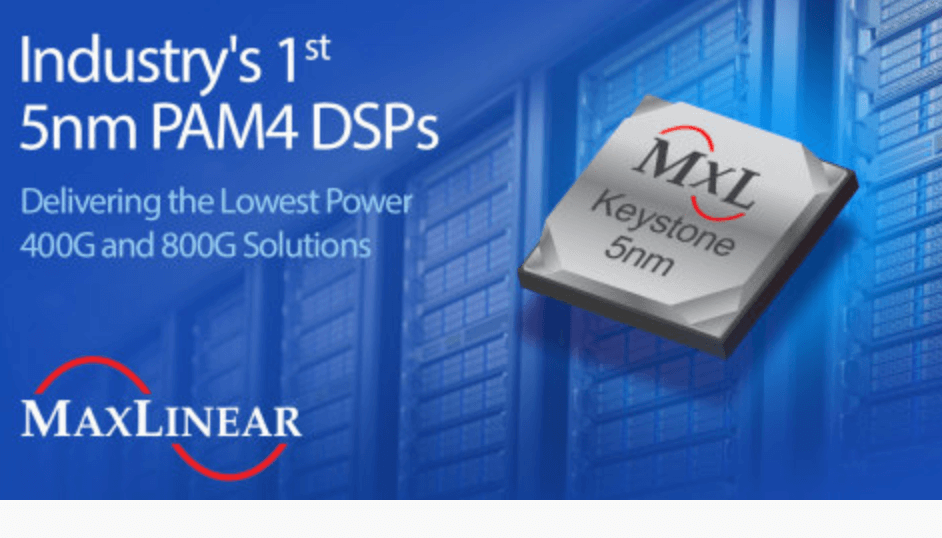
MaxLinear launches Product Design Kit for Active Electrical Cables

MaxLinear product design kit (PDK) to optimize performance and accelerate the time to market for high-speed Active Electrical Cables (AEC) using its 5nm PAM4 DSP, Keystone. 

The Keystone 5nm DSP family caters to 400G and 800G applications, featuring a groundbreaking 106.25Gbps host side electrical I/O, aligning with the line side interface rate. Available variants support single-mode optics (EML and SiPh), multimode optics (VCSEL transceivers and AOCs), and Active Electrical Cables (AECs), offering comprehensive solutions with companion TIAs.

Host side interfaces cover ethernet rates of 25G, 50G, and 100G per lane over C2M, MR, and LR host channels. The line side interfaces, tailored for 100G/λ DR, FR, and LR applications, also support these rates. These devices boast extensive DSP functionality, encompassing line-side transmitter DPD, TX FIR, receiver FFE, and DFE.

“MaxLinear is focused on providing not only industry-leading interconnect technologies but also a comprehensive suite of tools to support our manufacturing and design partners,” said Drew Guckenberger, Vice President of High Speed Interconnect at MaxLinear. “Our development kit for our Keystone products provides them with a path to take products to market more quickly and more cost-effectively.”

https://www.maxlinear.com/news/press-releases/2024/maxlinear-launches-product-design-kit-for-active-electrical-cables-using-keystone-pam4-dsp

Wednesday, January 31, 2024

Keysight's 800GE Layer 1-3 platform hits 51.2 Tbps test load

Keysight Technologies' AresONE-M 800GE Layer 1-3 Ethernet performance test platform set a new benchmark for validating Ethernet silicon switches by processing  1.2 Tbps of traffic across 64 x 800GE links while measuring loss, latency, and jitter.

The tests were conducted on the Marvell Teralynx 10 Ethernet switch chip.

Highlights from the validation include:

  • High throughput and high speed – The Keysight AresONE-M 800GE generated 51.2 Tbps of traffic, sending it successfully through the Teralynx 10 switch to test its limits. The test validated an 800GE interface speed based on 112G SerDes, which facilitates faster data transfer between devices and extended reach in data center interconnects or telecommunications networks that run data-intensive AI applications.
  • Scalability – Eight AresONE-M 8-port chassis were chained together, providing an industry first 64 x 800GE link configuration to achieve a high scale test bed running at 800GE line rate.
  • Low latency – Low latency is critical for achieving the shortest job completion time for AI training and other highly distributed applications. These AI workloads depend on the switching fabric to provide the lowest possible latency — and to do so predictably.
  • Performance analysis – Beyond the need for high bandwidth and low latency, measuring the performance of all 64 x 800GE links was an important aspect of the testbed, providing deeper, actionable analytics around loss, latency, and jitter at line rate. 

Rishi Chugh, Vice President of Product Marketing, Network Switching, Marvell, said: “To definitively measure and validate the low-latency capabilities of Teralynx 10, Marvell turned to Keysight and its industry-leading AresONE-M 800GE test equipment. Their thorough evaluation and collaboration with our team made the process smooth and ensured the integrity of the strong results we achieved.”

Ram Periakaruppan, Vice President and General Manager, Network Test & Security Solutions, Keysight, said: “The switching fabric is a vital component of the back-end network architecture used for AI training. AI training workloads trigger a huge increase in traffic volume and compared to front-end networks, are persistently pushing this higher traffic volume around the clock. At these sustained rates, benchmarking low latency becomes very critical for ensuring that the AI training algorithms achieve the most efficient job completion time.”

Keysight intros 800GE test platform 

Keysight Technologies introduced its AresONE-M 800GE Layer 1-3 Ethernet performance test platform, supporting data center interconnect speeds from 10GE to 800GE. 

The new Keysight AresONE-M 800GE enables design engineers and data center operators to validate networking equipment interoperability and bandwidth performance while supporting the transition to 400GE and 800GE networks with the capability to also test slower, legacy Ethernet speeds.

Highlights of the AresONE-M 800GE:

  • Ethernet speeds – 1x800GE, 2x400GE, 4x200GE, and 8x100GE.
  • PAM4 and NRZ signaling support – Features 106.25 Gb/s host electrical lane signaling with the ability to downshift to the lower electrical lane speeds of 53Gb/s and 25Gb/s for 400GE and 100GE speeds.
  • Single test platform – Supports all required forward error correction (FEC) types and a full array of in-depth link tuning, stability, reliability, and performance measurement statistics.
  • Complete 800GE high-scale protocol emulation and performance testing – Provides the protocol support required to test enterprise, metro, and cloud-capable Layer 2 and Layer 3 switching and routing network equipment through the IxNetwork software application.
  • Highest port density available today for 800GE test systems – Supports 8 ports in a single, 2-rackmount unit chassis with additional configurations for 2 and 4 ports.

The AresONE-M 800GE uses an integrated physical layer Digital Signal Processor (DSP) from Credo Technology Group for fast and efficient data transfer with low latency that enables data transit requirements of hyperscalers, enterprises, 5G carriers, and service providers. The Credo chip also optimizes power consumption to reduce operational costs, minimize heat dissipation, and meet energy-efficient standards for advanced networks.

Google Cloud opens in Johannesburg

 Google activated its new Johannesburg cloud region in South Africa.  

The Johannesburg region is connected to Google’s secure network, including the recently-completed Equiano subsea cable system that connects Portugal with Togo, Nigeria, Namibia, South Africa, and St. Helena.

With this opening, Google now operates  40 cloud regions and 121 zones, which together deliver Google Cloud services to over 200 countries and territories worldwide.


https://cloud.google.com/blog/products/infrastructure/heita-south-africa-new-cloud-region

Lumen expands NaaS with Ethernet On-Demand and IP-VPN

Lumen Technologies introduced two Network-as-a-Service (NaaS) offerings: Lumen Ethernet On-Demand and Lumen IP-VPN (Internet Protocol Virtual Private Network) On-Demand. 

These services are designed to provide private cloud connections, ensuring data protection and enhanced security, vital for businesses handling substantial amounts of sensitive data.

The new private Ethernet and IP-VPN Network-as-a-Service connections bring several advantages to Lumen's customers. These include enhanced security through encrypted data on private connections, compliance with strict data protection regulations, cost efficiency by accessing cloud resources on demand without the need for expensive hardware, scalability in bandwidth management, and reliable connections across multiple business locations. Furthermore, Lumen is set to bolster its secure on-demand experience by introducing DDoS (distributed denial-of-service) protection to its Lumen Internet On-Demand solution. This upcoming feature will be powered by threat intelligence from Lumen's Black Lotus Labs.

"Many businesses face a dilemma between security and innovation. They need to protect their data with robust and flexible network solutions, but they also want to leverage the cloud and AI for productivity and growth," said Miriana Martinova, Lumen SVP of Product Management. "Lumen NaaS Private Connections resolves this challenge by offering both performance and enhanced security over their network connections. Financial and healthcare companies can protect their data from breaches, cyberattacks, or unauthorized access across any cloud environment, with confidence in Lumen's secure, resilient, and global network."


Dell'Oro: AI infrastructure is delaying front-end networks

AI infrastructure build-outs, also known as 'Back-End Networks', are causing budget cuts and project delays in general-purpose infrastructure, or 'Front-End Networks', according to a new report from Dell'Oro Group. Despite these project delays, 800 Gbps port shipments are forecast to quadruple in 2024.

"Recent interviews with major Cloud service providers (SPs) unveiled multiple projects experiencing delays or being put on hold due to a shift in focus to AI infrastructure build-outs," said Sameh Boujelbene, Vice President at Dell'Oro Group. "Project delays and budget cuts have led to a shift of the 800 Gbps adoption timeline by approximately a year for certain major Cloud SPs. Consequently, our forecast for sales of switches deployed in front-end networks has been revised downward compared to our July 2023 report.

"Despite project delays, 800 Gbps port shipments are expected to quadruple in 2024, driven mainly by the anticipated adoption by a major Cloud service provider, specifically Amazon; and propelled by the availability of 51.2 Tbps chips in the market. 800 Gbps will be adopted in both back-end as well as front-end networks. While our traditional data center switch report focuses on front-end networks, we delve into back-end network deployment in our recently published advanced research report 'AI Networks for AI Workloads'," added Boujelbene.

Additional highlights from the Ethernet Switch—Data Center 5-Year January 2024 Forecast Report:

  • 1600 Gbps is expected to start shipping in 2025/2026. Together with 800 Gbps, these high speeds are expected to comprise nearly 40 percent of the data center switch ports by 2028.
  • Linear Drive Optics, an alternative to Co-packaged optics, are expected to gain material traction during our forecast horizon.
  • SONiC adoption is expected to accelerate, achieving a 10-20 percent penetration rate in Tier 2/3 Cloud SPs and large enterprises by 2028.

https://www.delloro.com/news/ai-infrastructure-focus-is-delaying-front-end-network-deployments/

Qualcomm posts higher revenues and earnings

Qualcomm reported quarterly revenue of $9.935 billion, up 5% compared to $9.463 billion for the same period a year earlier. Net income amounted to $2.767 billion, up 24% compared to a year earlier.

“We are extremely pleased to report strong quarterly results, with revenues and EPS exceeding the high end of our guidance,” said Cristiano Amon, President and CEO of Qualcomm Incorporated. “Looking ahead, we are building on this momentum with our leading Snapdragon platforms and technology differentiation in connectivity, computing and on-device generative AI, across Handsets, Automotive, PC, XR and Industrial IoT.”


https://investor.qualcomm.com/financial-information/historical-financial-results

MaxLinear sees promise in wireless and optical datacenter

MaxLinear reported net revenue of $125.4 million, down 8% sequentially and down 57% year-over-year. Non-GAAP diluted earnings per share was $0.01, compared to $0.02 in the prior quarter, and $1.07 in the year-ago quarter.

For the full Fiscal Year 2023, MaxLinear reported net revenue of $693.3 million, down 38% over fiscal 2022. GAAP gross margin was 55.6%, down from 58.0% in the prior year, and non-GAAP gross margin was 60.8%, down from 61.6% the prior year.

“As we look ahead, we believe 2024 will be the start of an exciting period of growth and opportunity for MaxLinear. Market headwinds of the past year in broadband and connectivity are likely to become tailwinds over time when customer inventory rationalization winds down and incentive programs begin to provide new market stimulus. Most importantly, the investments we made in product innovations in wireless and optical datacenter network infrastructure, Wi-Fi, ethernet, and fiber broadband access gateways are beginning to open up new and significant revenue opportunities that are expected to drive our growth for many years to come,” commented Kishore Seendripu, Ph.D., Chairman and CEO.

https://investors.maxlinear.com/

Extreme Networks expects more normalized revenue/earnings

 Extreme Networks reported quarterly revenue of $296.4 million, down 6.9% year-over-year. SaaS ARR $158.0 million, up 37.4% year-over-year. Non-GAAP diluted EPS amounted to $0.24, compared to $0.27 in the prior year quarter. 

"The integration of AI, security and analytics into a single platform is a key differentiator for Extreme and helped drive 37% subscription ARR growth in the quarter. We enhance network security, visibility and performance through our AIOps and machine learning capabilities and Zero Trust security posture. With our One Network, One Cloud strategy, we make networking simple and flexible and help customers drive meaningful impact across their organizations. Meanwhile competitors in our space remain challenged by portfolio integration and rationalization," said Ed Meyercord, President and Chief Executive Officer.

"The networking industry, like much of IT, is exiting the final stage of the COVID-induced era of supply chain constraints, which is still impacting our business. As a result, our distributors and partners have lowered inventory purchases, which we expect to accelerate in the third quarter. We expect to emerge in the fourth quarter at a more normalized level of revenue and earnings. Our bookings trends and funnel of new opportunities are a better reflection of customer demand. We’re seeing stabilization across EMEA and growth in APAC. And, we remain focused on innovation with this week’s introduction of new Wi-Fi 7 access points and 4000 Series Universal Switches, which help highly distributed enterprise organizations improve network connectivity, security and application performance. These trends, and our expanded go to market opportunities, give us confidence that we are positioned for a return to meaningful growth in FY25," concluded Meyercord.


https://investor.extremenetworks.com/events-presentations

NETGEAR's Patrick C.S. Lo steps down

NETGEAR that Patrick C.S. Lo, current Chief Executive Officer and Chairman of the board, is retiring from his position at NETGEAR and from the company’s Board. Lo will remain as a strategic advisor to support a seamless leadership transition through July 2024. 

NETGEAR's Board has appointed Charles (CJ) Prober, a senior technology executive, to succeed him effective immediately. Prober is also joining NETGEAR’s Board of Directors. is experience spans leadership positions at top consumer and technology brands, including roles as President of Life360, CEO at Tile (acquired by Life360), Chief Operating Officer at GoPro, and SVP of Digital Publishing at Electronic Arts (EA).

“As co-founder of NETGEAR, and leader for nearly three decades, it goes without saying that Patrick Lo’s impact on the company is undeniable. His vision for delivering the future of connectivity through advanced networking products and solutions has shaped who we are as a company, and we celebrate all he has accomplished,” said Thomas H. Waechter, NETGEAR Lead Independent Director. “CJ has the full confidence of the Board. We look forward to working with him and the NETGEAR leadership team to take the company forward for its next phase of innovation.”

“When Mark Merrill and I founded NETGEAR 28 years ago, the internet was beginning to show its impact on the world,” said Lo. “We seized the opportunity, and we’ve been innovating and leading the industry in the creation of advanced networking technologies for homes and businesses around the world ever since. We’ve pushed the boundaries of what can be experienced in a connected world, and I am all for the next chapter of the NETGEAR story.” 

  • Separately, NETGEAR released preliminary financial figures, saying it currently expects net revenue for the fourth quarter of 2023 to be between $179 million and $189 million, compared to prior guidance of $175 million to $190 million for the fourth quarter of 2023. The company continued to experience strong underlying demand in the premium portion of its CHP product portfolio, riding on the success of its Orbi WiFi 7 launch which continued through the holiday season. The Company is also encouraged that its retail channel partners maintained their inventory positions as expected. The Company continued to work with its SMB channel partners to optimize their inventory carrying levels. The uncertain macro environment created by high interest rates, geopolitical tensions, and stagnant GDP growth in certain markets continued to weigh on the Company’s SMB business as expected.


Dell'Oro: Wi-Fi 7 Sales Will Lift the Market

Sales of Wi-Fi 7 Access Points (APs) will reach nearly three quarters of total APs revenues by 2028, according to a new report from Dell'Oro Group.  The introduction of Wi-Fi 7 to enterprises will be one of the few bright spots for vendors in 2024, in a market that is expected to contract by 9 percent.

“There has been a flurry of vendors announcing new Wi-Fi 7 APs in January,” said Siân Morgan, Wireless LAN (WLAN) Research Director at Dell’Oro Group. “We expect that Wi-Fi 6E APs will still outsell Wi-Fi 7 in 2024, but adoption of Wi-Fi 7 will be responsible for all of the revenue growth by 2025.

“However, total WLAN AP revenues are expected to decrease in 2024. After the backlog-driven revenues of 2023, enterprises are busy digesting all the equipment they received.  It’s going to take a few more quarters of downturn before the market begins to expand again,” continued Morgan.

Additional highlights from the Wireless LAN 5-Year January 2024 Forecast Report:

  • The geographic balance of WLAN revenues changed in 2023, with North America and Europe taking share from China.
  • Wi-Fi 6E adoption is still growing but is forecasted to peak in 2024.
  • Average Selling Prices for APs are expected to contract, putting further pressure on vendor revenues.
  • HPE’s announced intent to purchase Juniper Networks has increased expectations of revenues from Public Cloud-Managed WLAN.
  • The first AP shipments of the standard expected to be branded as ‘Wi-Fi 8’ are expected in 2028. 

https://www.delloro.com/news/wlan-vendors-headed-for-rocky-waters-as-market-set-to-contract-9-percent-in-2024/

Tuesday, January 30, 2024

OIF kicks off Interoperable 1600ZR+ project

OIF kicked off two new projects:

  • Interoperable 1600ZR+ - the project complements the 1600ZR project unveiled last September (2023). Responding to market demand for higher-performance (ZR+) modes, OIF is working towards integrating these modes into its application scope for 1600 Gb/s interfaces.
  • Retimed Tx Linear Rx Specs EEI Project - focused on developing specifications for Retimed Tx Linear Rx (RTxLRx). The initial applications target Ethernet and AI/ML, operating at 200G/lane over 500m single mode fiber (SMF) and 100G/lane over 30m multimode fiber (MMF), with potential for alternate applications. The project aims for full plug and play functionality in both electrical and optical domains, meeting the industry demand for power and latency savings. RTxLRx addresses constraints found in Linear Pluggable Optics (LPO) and provides flexibility, making it a candidate when LPO is not suitable.

“OIF recognizes the importance of consolidated requirements in the ZR/ZR+ space to streamline development costs and enhance industry collaboration,” said Karl Gass, OIF PLL WG – Optical Vice Chair. “This project reinforces OIF’s role as the forum for coherent line interface discussions and demonstrates leadership by facilitating the evolution of next-generation technologies.”

At its recent Q1 2024 Technical and MA&E meeting in Jacksonville, Florida, OIF re-elected the Physical and Link Layer (PLL) Working Group (WG) Chair and released a white paper focused on advancing plug and play for Common Management Interface Specification (CMIS) modules. The meeting also featured Andrew Schmitt, Cignal AI as a guest speaker.

“OIF is an excellent forum for establishing standards on rapidly emerging technologies, and it is well-positioned to tackle the tough problems network operators and their suppliers face,” said Schmitt. “This meeting’s kick off of the 1600ZR+ process - a third generation follow up to the hugely successful 400ZR project - marks a major milestone for the industry. Further increasing the ease of deployment for 400ZR technology via CMIS is also a very valuable endeavor. I’m excited about these OIF initiatives and very pleased to offer Cignal AI’s current perspective on the market to such a capable and effective audience.”

OIF kicks off new projects: 224G PAM4, 1600ZR

OIF has kicked off four new projects:

224G PAM4 protocol agnostic link training for electrical interfaces project

Electrical interface link training holds considerable significance throughout the industry. This project will define communication method, messaging format and contents, training patterns, states and sequences, diagnostics and fault handling, etc. for link training of a 224G PAM4 class electrical link. The objective is to enhance overall link performance, a critical factor, particularly under challenging conditions, to establish a functional connection.

As part of this initiative, the CEI (Common Electrical IO) framework will be expanded with an additional tool to encompass a comprehensive solution, reinforcing OIF's leadership in the electrical/SERDES domain.

“This project is critical for OIF, yielding a standardized solution that seamlessly fosters SERDES interoperability and implementation, transcending the boundaries of specific applications,” said David Stauffer, OIF Physical & Link Layer Working Group Chair and Kandou Bus, S.A. “Through collaborative efforts with other industry groups, we aim to forge a consistent industry-wide solution that simplifies implementation.”

1600ZR Project

The 1600ZR project will define a power optimized solution for a multi-vendor interoperable 1600 Gbps coherent optical interface, with a focus on Data Center Interconnect (DCI) scenarios. This Implementation Agreement (IA) will create a comprehensive electrical/protocol/optical framework that facilitates realization into pluggable modules. It will also establish a reference point for additional applications that contribute to the growth of the coherent ecosystem.


Microsoft reports a 30% growth in Azure and other cloud services

Microsoft reported revenue of $62.0 billion for the December quarter, up 18% (up 16% in constant currency), and net income of $21.9 billion, up 33% compared to same period a year earlier. Diluted earnings per share was $2.93 and increased 33%, and increased 26% non-GAAP (up 23% in constant currency).

"We’ve moved from talking about AI to applying AI at scale," said Satya Nadella, chairman and chief executive officer of Microsoft. "By infusing AI across every layer of our tech stack, we’re winning new customers and helping drive new benefits and productivity gains across every sector.”

“Strong execution by our sales teams and partners drove Microsoft Cloud revenue to $33.7 billion, up 24% (up 22% in constant currency) year-over-year,” said Amy Hood, executive vice president and chief financial officer of Microsoft.


Revenue in Productivity and Business Processes was $19.2 billion and increased 13% (up 12% in constant currency), with the following business highlights:

  • Office Commercial products and cloud services revenue increased 15% (up 13% in constant currency) driven by Office 365 Commercial revenue growth of 17% (up 16% in constant currency)
  • Office Consumer products and cloud services revenue increased 5% (up 4% in constant currency) and Microsoft 365 Consumer subscribers grew to 78.4 million
  • LinkedIn revenue increased 9% (up 8% in constant currency)
  • Dynamics products and cloud services revenue increased 21% (up 19% in constant currency) driven by Dynamics 365 revenue growth of 27% (up 24% in constant currency)

Revenue in Intelligent Cloud was $25.9 billion and increased 20% (up 19% in constant currency), with the following business highlights:

  • Server products and cloud services revenue increased 22% (up 20% in constant currency) driven by Azure and other cloud services revenue growth of 30% (up 28% in constant currency)

Revenue in More Personal Computing was $16.9 billion and increased 19% (up 18% in constant currency), with the following business highlights:

  • Windows revenue increased 9% with Windows OEM revenue growth of 11% and Windows Commercial products and cloud services revenue growth of 9% (up 7% in constant currency)
  • Devices revenue decreased 9% (down 10% in constant currency)
  • Xbox content and services revenue increased 61% (up 60% in constant currency) driven by 55 points of net impact from the Activision acquisition
  • Search and news advertising revenue excluding traffic acquisition costs increased 8% (up 7% in constant currency)

Google Cloud generated sales of $9.2 in Q4, loss of $863M

In its quarterly financial report, Alphabet said Google Cloud generated quarterly sales of $9.192 billion compared with $7.315 billion a year earlier, an increase of 26%. The quarterly operating loss for Google Cloud narrowed to ($863 million), compared with a loss of ($1.237 billion) a year earlier.

In January 2023, Google completed an evaluation of how long their servers and network equipment last. As a result, they extended the expected lifespan of their servers from four to six years, and for some network equipment from five to six years. This new accounting estimate, effective from fiscal year 2023, led to a decrease in depreciation expenses by $983 million and $3.9 billion. Consequently, net income increased by $765 million and $3.0 billion, which translates to earnings of $0.06 and $0.24 per basic share, and the same per diluted share, for the three and twelve months ending December 31, 2023, respectively.

AMD posts strong Q4 sales, weaker outlook

AMD reported Q4 2023 2023 revenue of $6.2 billion, gross margin of 47%, operating income of $342 million, net income of $667 million and diluted earnings per share of $0.41. On a non-GAAP basis, gross margin was 51%, operating income was $1.4 billion, net income was $1.2 billion and diluted earnings per share was $0.77.

For the full year 2023, the company reported revenue of $22.7 billion, gross margin of 46%, operating income of $401 million, net income of $854 million and diluted earnings per share of $0.53. On a non-GAAP basis, gross margin was 50%, operating income was $4.9 billion, net income was $4.3 billion and diluted earnings per share was $2.65.

“We finished 2023 strong, with sequential and year-over-year revenue and earnings growth driven by record quarterly AMD Instinct GPU and EPYC CPU sales and higher AMD Ryzen processor sales,” said AMD Chair and CEO Dr. Lisa Su. “Demand for our high-performance data center product portfolio continues to accelerate, positioning us well to deliver strong annual growth in what is an incredibly exciting time as AI re-shapes virtually every part of the computing market.”

 “AMD executed well in 2023 despite a mixed demand environment,” said AMD EVP, CFO and Treasurer Jean Hu. “We drove year-over-year revenue growth in our Data Center and Embedded segments and successfully launched our AMD Instinct MI300 GPUs positioning us for a strong product ramp in 2024.”


Segment Summary

  • Data Center segment revenue in the quarter was $2.3 billion, up 38% year-over-year and 43% sequentially driven by strong growth in AMD Instinct™ GPUs and 4th Gen AMD EPYC™ CPUs.
  • For 2023, Data Center segment revenue was $6.5 billion, an increase of 7% compared to the prior year, driven by strong growth in AMD Instinct GPUs and 4th Gen AMD EPYC CPUs.
  • Client segment revenue was $1.5 billion, up 62% year-over-year driven primarily by an increase in AMD Ryzen™ 7000 Series CPU sales.
  • For 2023, Client segment revenue was $4.7 billion, down 25% compared to the prior year, due to a decline in the PC market.
  • Gaming segment revenue was $1.4 billion, down 17% year-over-year and 9% sequentially, due to a decrease in semi-custom revenue, partially offset by an increase in AMD Radeon™ GPU sales.
  • For 2023, Gaming segment revenue was $6.2 billion, down 9% compared to the prior year primarily due to lower semi-custom sales.
  • Embedded segment revenue was $1.1 billion, down 24% year-over-year and 15% sequentially primarily due to customers reducing their inventory levels.  
  • For 2023, Embedded segment revenue was $5.3 billion, up 17% compared to the prior year, primarily due to the inclusion of a full year of revenue related to the acquisition of Xilinx completed in February 2022.

For the first quarter of 2024, AMD expects revenue to be approximately $5.4 billion, plus or minus $300 million. Sequentially, AMD expects Data Center segment revenue to be flat, with a seasonal decline in server sales offset by a strong Data Center GPU ramp. Client, Embedded and Gaming segment sales are expected to decline sequentially, with semi-custom revenue expected to decline by a significant double-digit percentage. Non-GAAP gross margin is expected to be approximately 52%.

https://ir.amd.com/news-events/press-releases/detail/1180/amd-reports-fourth-quarter-and-full-year-2023-financial


Juniper posts Q4 revenue of $1.365B

Juniper Networks reported Q4 2023 revenue of $1,364.8 million, a decrease of 6% year-over-year, and a decrease of 2% sequentially. Non-GAAP net income was $196.9 million, a decrease of 8% year-over-year, and an increase of 2% sequentially, resulting in non-GAAP diluted earnings per share of $0.61.

Full-Year 2023 net revenues were $5,564.5 million, an increase of 5% year-over-year. Non-GAAP net income was $736.4 million, an increase of 15% year-over-year, resulting in diluted earnings per share of $2.26, an increase of 16% year-over-year.

Juniper names Chris Kaddaras as Chief Revenue Officer

“We delivered record revenue results in 2023 and grew our business on a year-over-year basis for a third consecutive year,” said Juniper’s CEO, Rami Rahim. “These results reflect the strength of our enterprise business, which not only delivered a second consecutive year of solid double-digit revenue growth, but also achieved positive product order growth in the fourth quarter and on a full-year basis.”


Product orders at Juniper:

  • Increased by double digits sequentially.
  • Declined by single digits year-over-year.

Enterprise orders:

  • Showed strong growth, increasing in the mid-teens year-over-year.

Backlog situation:

  • Ended the year with a backlog of approximately $570 million.
  • Slightly elevated compared to pre-pandemic levels.

Revenue by vertical in Q4:

  • Enterprise: Largest vertical, up 8% year-over-year but down 9% sequentially.
  • Cloud: Declined 17% year-over-year, increased 18% sequentially.
  • Service Provider: Declined 15% year-over-year, 4% sequentially.

Customer solution revenue:

  • AI-Driven Enterprise: Grew 1% year-over-year, declined 16% sequentially.
  • Mist and other Mist Cloud products: Grew approximately 40% year-over-year.
  • Cloud-Ready Data Center: Declined 30% year-over-year, grew 6% sequentially.
  • Automated WAN Solutions: Down 5% year-over-year, up 4% sequentially.

Total Software and Related Services revenue:

  • $360 million, an 18% increase year-over-year.

Annual Recurring Revenue (ARR):

  • Grew 30% year-over-year.
  • Ended the year at $384 million.

Total Security revenue:

  • $161 million, down 5% year-over-year but up 1% sequentially.

Customer composition in Q4:

  • Top 10 customers: Four from Cloud, three from Enterprise, three from Service Provider.
  • Accounted for 36% of total revenue, compared to 34% in Q4'22.

https://investor.juniper.net/investor-relations/financial-reports/default.aspx