Wednesday, February 3, 2021

Google's Dunant subsea cable ready for service with up to 250 Tbps

Google's new Dunant transatlantic submarine cable system has been declared ready for service. 

Dunant is the first long-haul subsea cable to feature a 12 fiber pair space-division multiplexing (SDM) design, which will enable it to deliver record-breaking capacity of 250 terabits per second (Tbps) across the Atlantic Ocean. Subcom was the prime contractor for the project.

SubCom is the first to market using SDM technology to increase cable capacity in a cost-effective manner with additional fiber pairs (twelve, rather than six or eight in past generations of subsea cables) and power-optimized repeater designs. While previous subsea cable technologies relied on a dedicated set of pump lasers to amplify each fiber pair, the SDM technology used in Dunant allows pump lasers and associated optical components to be shared among multiple fiber pairs. This ‘pump sharing’ technology enables more fibers within the cable while also providing higher system availability. 

“Google is dedicated to meeting the exploding demand for cloud services and online content that continues unabated,” said Mark Sokol, senior director of Infrastructure, Google Cloud. “With record-breaking capacity and transmission speeds, Dunant will help users access content wherever they may be and supplement one of the busiest routes on the internet to support the growth of Google Cloud. Dunant is a remarkable achievement that would not have been possible without the dedication of both SubCom and Google’s employees, partners, and suppliers, who overcame multiple challenges this year to make this system a reality.”

“Our congratulations to Google on the completion of the Dunant submarine cable system,” said David Coughlan, CEO of SubCom. “It is a privilege to partner once again with Google to achieve a technology milestone that, not so long ago, was out of reach. Our companies not only delivered another well-provisioned, high-bandwidth, low-latency, and highly secure connection between the U.S. and Europe, but we did so during a global pandemic that required unprecedented levels of cooperation, flexibility, and dedication.”

http://www.subcom.com


Orange expands transatlantic capacity with 2 new cables

Orange announced ready-for-service status on the new Dunant cable system linking France and the United States and also unveiled for another new transatlantic cable system that could be ready as early as next year.The Dunant cable, which is a joint project with Google, is now ready for service for its wholesale and business customers. Dunant boasts 12 fibre pairs with over 30 Tbps of capacity each.The next submarine cable, called AMITIÉ, will take...

Google’s transatlantic Dunant cable has landed in Saint-Hilaire-de-Riez, in the Vendée region of France. The terrestrial stage of the laying of this cable is proceeding. As the “Landing Party” and owner of the French part of the cable, Orange has completely refurbished the historic station in Saint-Hilaire-de-Riez, which was no longer in use, to house the terminal equipment for the Dunant system. This area is a strategic location, close to the main...

Orange and Telxius to backhaul Google's Dunant transatlantic cable

Orange and Telxius will provide terrestrial backhaul extensions in France and in the US for Google's Dunant submarine cable, which is expected to enter service in late 2020. Under this agreement, Orange and Telxius offer co-location services at their respective Cable Landing Stations in Saint-Hilaire-de-Riez (France) and Virginia Beach (US). From its Saint- Hilaire-de-Riez (85) Cable Landing Station, Orange will enable terrestrial connection to...


Linux Foundation targets cellular core network stack with Magma

The Linux Foundation is launching an open source industry collaboration focused on enabling a converged cellular core network stack, starting with the Magma open source software platform. 

Magma, which was previously open sourced by Facebook in 2019,  will now be managed under a neutral governance framework at the Linux Foundation.

Arm, Deutsche Telekom, Facebook, FreedomFi, Qualcomm, the Institute of Wireless Internet of Things at Northeastern University, the OpenAirInterface Software Alliance, and the Open Infrastructure Foundation, will join the collaboration as founding members to accelerate the path to production use cases at scale. 


Magma features an access-agnostic mobile packet core, advanced network automation and management tools, and the ability to integrate with existing LTE networks with use cases across both virtual and container Network Functions (xNFs) including fixed wireless access, carrier Wi-Fi, private LTE and 5G, network expansion, and mobile broadband. 

A number of Magma community members are also collaborating in the Telecom Infra Project (TIP)’s Open Core Network project group to define, build, test, and deploy core network products that leverage Magma software alongside disaggregated hardware and software solutions by the TIP Open Core ecosystem.

“Arm is synonymous with a diverse technology ecosystem that underpins the compute, connectivity, and security required for solutions spanning cloud to edge to endpoint devices,” said Chris Bergey, senior vice president and general manager, Infrastructure Line of Business, Arm. “Together with the Linux Foundation and Facebook Connectivity, Magma is helping to solve the very real challenge of providing feature-rich, cost effective access for worldwide mobile networks.”

“Bringing Magma to the Linux Foundation is a huge milestone as the Magma ecosystem of developers continues to grow,” said Dan Rabinovitsj, vice president for Facebook Connectivity. “We are excited to see the contributions and innovations from this collective group of industry players, and we look forward to celebrating Magma’s success as the project continues to scale.” 

“Qualcomm Technologies strongly supports the evolution of the Magma core network efforts into a broader coalition among the key founding and contributing projects,” said Douglas Knisely, engineer, principal, Qualcomm Technologies, Inc. and OSA Advisory Board member. “This effort builds on the collaboration activities and code contributions from OAI into the Magma project and promotes the harmonization of a common 5G Core Network reference architecture, internal structure, APIs, and interfaces for all of the emerging 5G open source projects in the industry.”

https://www.linuxfoundation.org/press-release/linux-foundation-launches-industry-collaboration-with-magma-to-accelerate-deployment-of-wireless-networks/

https://www.magmacore.org/

PacketLight releases 400G muxponder

PacketLight Networks released a new 400G muxponder that can aggregate any mix of 10/25/100GbE, 16/32G FC, and OTU2/2e/4 services into one 400G coherent uplink.

The new PacketLight PL-4000M Muxponder can be used for DCI, metro, short-, and long-haul applications. It provides full demarcation between the service and the OTN/DWDM uplink and offers complete interoperability with third-party switches and routers. The product delivers full visibility and performance monitoring of both the line optical transport layer (OTN) and service interfaces. It also offers high levels of security with embedded Layer-1 GCM-AES-256 optical encryption using elliptic curve Diffie-Hellman key exchange.

PacketLight said its device reduces the total transport solution costs, as it takes up minimal rack space and lowers the power consumption per transmitted bit. 

“The PL-4000M is based on the latest standard technologies of OTN 400G mapping and pluggable, compact coherent 400G modules in both CFP2 and QSFPDD form factors,” says Koby Reshef, CEO of PacketLight Networks. “It provides added value for service providers and high-end enterprises to build their next generation network or expand their existing network’s capacity.”

http://www.packetlight.com

Ireland's Tyndall National Institute opens wireless laboratory in Dublin

Ireland's Tyndall National Institute has opened a wireless communications laboratory in Dublin to research future deep technologies: Future RF, Future Access, Future Protocols, Future AI, and Future Quantum. The new facility, which is the first for Tyndall outside of Cork, will see the creation of 50 new research jobs by 2025.

The announcement comes one year on from the launch of the ambitious Tyndall 2025 plan, which aims to double the size and impact of the national ICT research institute.

The Wireless Communications Research Laboratory will be headed up by industry thought leader and acclaimed scientist Dr Holger Claussen, along with Dr Lester Ho and Dr Senad Bulja. All three are former researchers with the prestigious multi award-winning Nokia Bell Labs Ireland, where they created the foundations for many of Nokia’s next generation products and pioneered Small Cell Networks, now a $6.7bn/a market.

The team will initially be based at CONNECT – the world leading Science Foundation Ireland Research Centre for Future Networks and Communications, hosted at Trinity College Dublin. The CONNECT Centre includes Ireland’s top telecommunications researchers in ten higher education institutes around Ireland, including University College Cork.

CEO of Tyndall National Institute, Professor William Scanlon, whose own research and academic background is in the area of wireless communications, welcomed the recruitment of this world-class research team. 

“Building on such high calibre international talent will ensure that Ireland becomes a leader in the future of communications innovation. Dr Claussen and his team will be instrumental in developing ground-breaking wireless technologies and will allow Ireland to take the lead in solving the fundamental problems in wireless communications across many domains such as industry 4.0 machine-communications, virtual and augmented reality, and mobile broadband. This new location and team will help us realise our Tyndall 2025 strategy for research excellence and ambitious growth.”

Commenting, Head of the newly formed Wireless Communications Laboratory Dr Holger Claussen said, “My team and I are excited to continue with our innovative work in shaping the future of wireless networks to enable exponential growth in mobile data traffic and reliable low latency communications on behalf of Tyndall and Ireland”.

https://www.tyndall.ie/news/tyndall-national-institute-expands-with-new-wireless-communications-laboratory-in-dublin/

Reuters: A second SolarWinds vulnerability

Chinese hackers may have exploited a second vulnerability in SolarWind's Orion platform to gain access to the National Finance Center, a federal payroll agency inside the U.S. Department of Agriculture, according to Reuters. The intrusion apparently occurred independently of the Russian hackers who gained access to hundreds of U.S. government and Fortune 1000 networks.


It is not clear yet how many other organizations may have been impacted by this second attack vector. SolarWinds has not yet commented on the matter.

https://www.reuters.com/article/us-cyber-solarwinds-china/exclusive-suspected-chinese-hackers-used-solarwinds-bug-to-spy-on-u-s-payroll-agency-sources-idUSKBN2A22K8

Spectrum Enterprise debuts Managed Network Edge based on Cisco Meraki

Spectrum Enterprise, a part of Charter Communications, introduced a Managed Network Edge (MNE) service based on the Cisco Meraki cloud-based platform.

The MNE base solution includes Managed Routing, Security and software-defined wide area network (SD-WAN) powered by Cisco Meraki. In addition, proactive monitoring, 24/7/365 support, service level agreements (SLAs) and professional installation and a single, integrated user portal for real-time monitoring are all part of the base MNE solution. Additional, extensible services include: WiFi, network switches and smart cameras. MNE is offered as a packaged solution that integrates connectivity and Unified Communications (UC) options, and can be delivered nationally. 

“The ongoing pandemic has made connectivity a critical infrastructure for businesses, especially as they digitize and transform their networks to meet the changing needs of their customers and employees,” said Satya Parimi, Group Vice President, Product, Spectrum Enterprise. “Managed Network Edge is a flexible solution that allows for a layered approach to adding modular network services and a choice of connectivity and management options – all delivered by a single service provider to ensure end-to-end performance.” 

“Businesses are accelerating the move towards a digital-first model faster than ever before because of the pandemic, resulting in the need to support a hybrid workforce long-term,” said Lawrence Huang, Vice President of Product Management, Cisco Meraki. “Together, Spectrum Enterprise and Cisco Meraki are helping to improve the client and user experience by simplifying IT operations and making it easier to integrate solutions that connect employees, applications, devices and locations.” 


https://enterprise.spectrum.com/

Lumen teams with VMware to drive innovation at the Edge

Lumen Technologies is working with VMware to fast-track the design, development, and delivery of edge computing and more secure, work-from-anywhere solutions. 

The teams will focus initial efforts on co-developing solutions for the Lumen portfolio of managed services in key areas including:


  • Edge Computing: Certifying the integration of the VMware Tanzu Basic edition with the Lumen Edge Bare Metal service and Lumen Dynamic Connections. This combination will enable businesses to create a more secure software supply chain to rapidly deploy new edge-native workloads, on-demand, closer to the point of digital interaction.
  • Work-from-anywhere: Adding VMware’s Secure Access Service Edge (SASE) platform – inclusive of VMware SD-WAN and VMware Workspace ONE – to the Lumen solutions set. Many organizations now manage distributed workforces, making legacy solutions – including hub-and-spoke-based VPNs – obsolete. This initiative will help customers more seamlessly adopt SASE architecture to achieve the reliability and performance of a traditional network, as well as deliver superior customer and employee experiences, in a Zero Trust model.
  • Security: Integrating VMware Carbon Black Cloud Endpoint and VMware Carbon Black Cloud Workload with intelligence data from Black Lotus Labs, the threat research arm of Lumen. Enterprises will be better positioned to defend against cyber-threats, right from the end point, using the combination of security analytics derived from one of the world’s most deeply peered networks and industry-leading endpoint protection and datacenter virtualization.

“Resilient edge computing solutions will drive the next wave of digital innovation for the enterprise and customers need the right capabilities to effectively create, deploy, and manage applications in this new environment,” said Jeff Storey, president and chief executive officer, Lumen Technologies. “This deliberate move to invest in and accelerate our efforts with VMware will allow us to quickly bring to market software-defined solutions that address the real issues our customers face as they move applications to the edge. That is powerful.”

  • In September 2020, CenturyLink changed its name to Lumen Technologies.

Orange launches 5G Labs initiative

Orange is launching a series of 5G labs in France and abroad to help local authorities and companies - start-ups, SMEs, big companies - regardless of their sector to leverage the opportunities with 5G.

In France, seven sites will host all the companies and local authorities, regardless of their sector. The Orange 5G Lab site in Châtillon (Paris region) is opening today. The others will gradually open in six other French towns: Lille, Lyon-Charbonnières, Marseille, Paris-La Défense, Rennes and Toulouse.

Certain sites will specialise in a specific field but will not be devoted exclusively to this area. For example, the Lyon lab, located at the Campus Région du Numérique at Charbonnières-les-Bains, will be focused on Industry 4.0, and the CÅ“ur Défense site in the Customer Innovation Centre will be more focused on Orange Business Services’ major clients.

The initiative will also be rolled out in European countries where the Group has a presence during the first half of 2021. An Orange 5G Lab will open in Bucharest in Romania in partnership with the University Politehnica of Bucharest to foster the development of commercial projects, research and innovation. In Belgium, the lab will be located near the Orange Industry 4.0 campus in the Port of Antwerp. 

“We believe that 5G will drive business competition and regional development. This is why Orange is involved in a co-innovation approach focused on 5G to create the uses of the future. Having a local presence close to these players is a key part of the Orange 5G Labs initiative, to support the digital transformation of economic players and to help everyone take advantage of 5G’s potential,” said Michäel Trabbia, Chief Technology and Innovation Officer at Orange.

https://5glab.orange.com/fr/

ADTRAN reports revenue of $130 million

ADTRAN reported Q4 2020 revenue of $130.1 million, up from $115.8 million for the same period a year earlier. Net income for the fourth quarter of 2020 was $6.1 million and earnings per share, assuming dilution, was $0.13 per share. Non-GAAP net income was $5.2 million and non-GAAP earnings per share, assuming dilution, was $0.11 per share.


ADTRAN Chairman and Chief Executive Officer Tom Stanton stated, “We saw substantial growth in our Tier-2 and Tier-3 service provider segments in the U.S. and a solid increase in fiber deployments in Europe. We expect that our fiber access solutions will continue to be adopted by customers around the world.”

ADTRAN also announced that its Board of Directors declared a cash dividend for the fourth quarter of 2020 of $0.09 per common share.

https://investors.adtran.com/Interactive-Financials/default.aspx

MaxLinear posts Q4 revenue of $195 million

 MaxLinear reported net revenue of $194.7 million for Q4 2020, up 24% sequentially, and up 178% year-on-year.  Non-GAAP diluted earnings per share was $0.39, compared to diluted earnings per share of $0.32 in the prior quarter, and diluted earnings per share of $0.16 in the year-ago quarter.

“In the fourth quarter, we posted record revenue, up 24% sequentially, due to stronger-than-expected demand for broadband access and connectivity products. The fourth quarter represented the first full of quarter of ownership of the Intel and NanoSemi assets, with which we are making tremendous progress on the respective integration efforts. Despite intensifying supply chain challenges, our cash flow from operations approximated $74.3 million with non-GAAP gross margin of 57.8% in the quarter. We are making tremendous progress with integration efforts of our recent acquisitions. With this backdrop, along with contributions from our expected revenues from our PAM4 DSP product for the 400G optical data center market and 5G wireless backhaul, we are very confident in the Company’s outlook entering 2021,” commented Kishore Seendripu, Ph.D., Chairman and CEO.


Tuesday, February 2, 2021

Arista intros Multi-Domain Macro-Segmentation Service

Arista Networks introduced a Multi-Domain Macro-Segmentation Service ifor integrating security policy with the network through an open and consistent network segmentation approach across network domains. 

The service, which is enabled through Arista EOS (Extensible Operating System) and CloudVision capabilities, includes a new group segmentation approach, MSS-Group, intended to simplify access control for users and IoT devices in enterprise workspaces. Available on EOS-based switches, MSS-Group implements security policy enforcement based on logical groups rather than traditional approaches based on interfaces, subnets or physical ports. 

Arista said the implicit trust associated with network location needs to be replaced with continuous, proactive network monitoring with behavioral-based situational analysis for asset visibility and rapid incident response. Arista’s zero trust security approach is designed to address this evolution, combining network-based multi domain segmentation, situational awareness and visibility for all network resources, and AI-driven network detection and response.

https://blogs.arista.com/blog/time-for-zero-trust-networking-is-now


Pacific Gas and Electric sells tower rights for $973 million

Pacific Gas and Electric (PG&E), the leading electric utility in northern California, agreed to its license agreements with wireless providers that attach their equipment to certain electric transmission towers and other utility structures to SBA Communications for $973 million. 

The sale of these licenses applies to over 700 towers. PG&E is not selling any transmission towers as part of this transaction.

PG&E is also entering into a strategic relationship with SBA, through SBA's wholly owned subsidiary, to sublicense and market equipment at additional attachment locations on up to 28,000 transmission towers across PG&E's extensive network. Through this arrangement, PG&E will receive a portion of future revenues from these sublicensed equipment attachment locations.

"This transaction adds a significant portfolio of high quality, exclusive locations to our outstanding existing US macro tower portfolio and SBA expects these assets to generate approximately $39.5 million in Tower Cash Flow in their first full year in our portfolio," said Jeff Stoops, President and Chief Executive Officer of SBA Communications. "As 5G network deployments are now a reality, we are excited to use our vast experience and industry leading position in order to facilitate the future additional use of these assets by wireless service providers for the collective benefit of the wireless industry, PG&E and SBA. We are also particularly pleased about the opportunity to work closely with PG&E over the coming years to maximize wireless deployments across their extensive network of transmission towers."

OIF publishes results of Transport SDN API interoperability demo

OIF published the results of its 2020 Transport SDN Application Programming Interface (API) Interoperability Demonstration, which was a ten-week long interoperability testing exercise that was held in Telefonica’s lab in Madrid.

The interoperability testing involved three phases over ten weeks, Sept – Nov 2020:

  • Phase 1: Open Networking Foundation (ONF) T-API NBI testing, Scope: ONF T-API v2.1.3 reference implementation agreement TR-547
  • Phase 2: Open terminals testing including discovery, provisioning, service de-activation and streaming telemetry
  • Phase 3: End-to-end disaggregation demo, Scope: evaluation and demonstration of end-to-end use cases

Findings and results of the testing include:

  • Vendor products demonstrate a high level of maturity and support of operator-favored use cases, based on T-API version 2.1.3 and OpenConfig APIs. Vendors have adopted the ONF 2.1.3 Reference Implementation Agreement (ONF TR-547) rapidly and with few deviations.
  • Inconsistent interpretation of the Internet Engineering Task Force (IETF) RESTCONF standard was one interoperability issue identified, especially standard authentication. Clarification to RESTCONF provisioning behavior and implementation scalability were also identified as issues.  
  •  A particularly good level of compliance to the OpenConfig models was demonstrated by implementations, however, some areas such as key exchange algorithms for IETF NETCONF and complex use cases for device provisioning and commissioning did generate issues.


Participating vendors included ADVA, Ciena, Cisco Systems, Infinera and Nokia. Network operator Telefónica hosted the demo. China Telecom, Telia Company and TELUS participated as consulting network operators.

“Interoperable transport SDN APIs are essential capabilities to enable open optical networks,” said Mauro Costa, Head of planning, strategy & architecture, Telia Company, a consulting network operator for this year’s demo. “International co-operations, like this one with OIF, allow the industry to progress at a high pace and Telia Company welcomes the opportunity offered by this interoperability demo. It reinforces that we are advancing in the right direction and that the maturity of the APIs implementation for optical SDN architecture is improving.”

The whitepaper is posted here:

https://www.oiforum.com/documents/oif-2020-transport-sdn-api-interop-demo-white-paper/

Cloud pioneer Andy Jassy to take over as CEO of Amazon

 Andy Jassy will take over as Chief Executive Officer of Amazon in Q3 2021, replacing Jeff Bezos who will transition to the role of Executive Chair.

Jassy, who currently serves as CEO of Amazon Web Services (AWS), has played a key role in the development of cloud services.

Some highlights for AWS for Q4 2020:

  • AWS announced new commitments and migrations spanning major industries, including financial services with JPMorgan Chase, Itaú Unibanco (Latin America’s largest bank), Standard Chartered Bank, and Nationwide; media and entertainment with Metro-Goldwyn-Mayer (MGM), Thomson Reuters, and ViacomCBS; technology with Arm and Twitter; travel with Boom Technology, Inc. (Boom Supersonic) and Star Alliance (the world’s largest airline alliance); retail and e-commerce with Mercado Libre (Latin America’s largest online commerce and payments provider) and Zalando (Europe’s largest online fashion and lifestyle platform); power and utilities with Siemens Smart Infrastructure (a Siemens AG business group that focuses on energy distribution and intelligent buildings); and automotive with The BMW Group, as well as a multi-year, global agreement to develop and market BlackBerry’s Intelligent Vehicle Data Platform, IVY.
  • AWS continued to expand its infrastructure footprint around the world, announcing the AWS Asia Pacific (Hyderabad) Region, available by mid-2022, and the AWS Europe (Zurich) Region and AWS Asia Pacific (Melbourne) Regions, available in the second half of 2022. 
  • AWS provides 77 Availability Zones (AZs) within 24 geographic regions, with announced plans for 18 more Availability Zones in six more AWS Regions, including regions in Indonesia, Japan, and Spain, as well as the recently pre-announced regions in India, Switzerland, and Australia.
  • New AWS Local Zones in Boston, Houston, and Miami place AWS infrastructure close to end users in metropolitan centers, so customers can access low-latency compute, storage, and database services without needing to provision or maintain datacenter space. AWS also announced the availability of AWS Local Zones in 12 additional cities (Atlanta, Chicago, Dallas, Denver, Kansas City, Las Vegas, Minneapolis, New York, Philadelphia, Phoenix, Portland, and Seattle) coming in 2021.
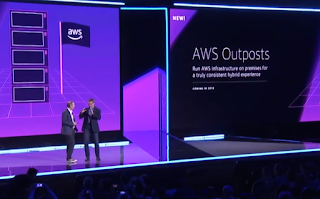
  • AWS announced two new smaller AWS Outposts form factors (1U and 2U servers) that give customers access to AWS on-premises in space-constrained locations, such as branch offices, factories, hospitals, cell towers, or retail stores.
  • Introduced first cloud-based Mac instances (EC2 Mac instances for Amazon Elastic Compute Cloud).
  • Introduced five new EC2 compute services, including Graviton2-powered C6gn instances that provide 40% better price performance for networking and compute-intensive workloads over comparable current generation x86-based instances, AMD-powered G4ad Graphics Processing Unit (GPU) instances that offer the industry’s best price performance for graphics-intensive applications, M5zn instances that deliver the fastest Intel Xeon Scalable processors in the cloud, Intel-powered D3/D3en instances that offer the highest storage capacity for local HDD storage in the cloud, and memory-optimized R5b instances that deliver the fastest block storage performance available for Amazon EC2.
  • Introduced nine new capabilities for Amazon SageMaker that make it even easier for developers and data scientists to prepare, build, train, deploy, and manage machine learning models.
  • Introduced five new services for industrial customers that use machine learning to improve operational efficiency, quality control, security, and workplace safety. Amazon Monitron and 
  • Introduced Amazon EBS io2 Block Express volumes, which deliver the first storage area network (SAN) built for the cloud, with up to 256,000 input/output operations per second (IOPS), 4,000 MB/second throughput, and 64 TB of capacity.
  • Introduced four new container services to help customers develop, deploy, and scale modern applications in the cloud and on-premises: Amazon Elastic Container Service (ECS) Anywhere and Amazon Elastic Kubernetes Service (EKS) Anywhere enable customers to run Amazon ECS and Amazon EKS in their own data centers, AWS Proton automates container and serverless application development and deployment, and Amazon Elastic Container Registry (Amazon ECR) Public provides developers an easy and highly available way to share and deploy container software publicly.
  • The next version of Aurora Serverless, Aurora Serverless v2, scales to hundreds of thousands of database transactions in a fraction of a second, delivering up to 90% cost savings compared to provisioning infrastructure for peak capacity.
  • Introduced AWS announced the general availability of Amazon EC2 P4d instances, the next generation of accelerated computing instances powered by NVIDIA A100 Tensor Core GPUs and AWS petabit-scale networking. P4d instances provide up to 3x faster time to train and 60% lower cost than previous generation instances for machine learning training and high-performance computing in the cloud. EC2 P4d instances are also the only instances in the cloud to feature UltraCluster capability, enabling customers to scale to 2x the computing power as any other cloud provider.
  • AWS announced AWS Trainium, an AWS-designed machine learning training chip that will deliver the most cost-effective training in the cloud. AWS Trainium will deliver the most teraflops of any machine learning training instance in the cloud, support all major frameworks (including TensorFlow, PytTorch, and MXnet), and use the same Neuron SDK used by AWS Inferentia (an AWS-designed chip for machine learning inference acceleration), making it easy for customers to get started training quickly with AWS Trainium. AWS Trainium is coming to Amazon EC2 and Amazon SageMaker in the second half of 2021.

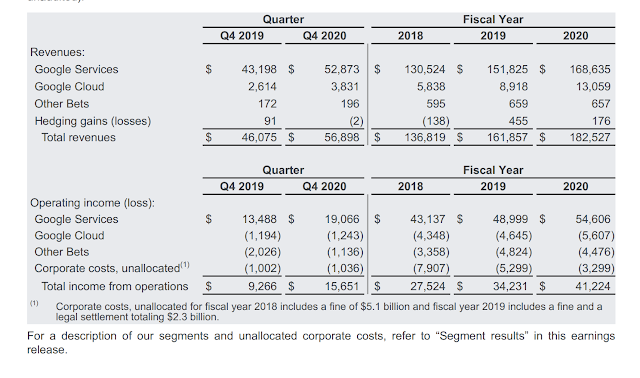
Google Cloud topped $13B in 2020 revenue, $5.6B loss

Alphabet disclosed the following financial metrics for Google Cloud.

Google Cloud includes Google’s infrastructure and data analytics platforms, collaboration tools, and other services for enterprise customers. Google Cloud generates revenues primarily from fees received for Google Cloud Platform services and Google Workspace (formerly known as G Suite) collaboration tools.


https://abc.xyz/investor/static/pdf/2020Q4_alphabet_earnings_release.pdf?cache=9e991fd

Lumentum reports record revenue, strength in telecom and lasers

Lumentum Holdings reported net revenue for its fiscal second quarter of 2021 of $478.8 million, with GAAP net income of $83.2 million, or $1.06 per diluted share. Net revenue for the fiscal first quarter of 2021 was $452.4 million, with GAAP net income of $67.1 million, or $0.86 per diluted share. Net revenue for the fiscal second quarter of 2020 was $457.8 million, with GAAP net income of $49.1 million, or $0.63 per diluted share.

"Combining the positive momentum from the prior quarter, with strengthened demand in Telecom and Lasers, we achieved new record revenue and non-GAAP gross margin, operating margin, and earnings per share in the second quarter," said Alan Lowe, President and CEO. "We are well positioned to grow revenue and earnings into the future. We have developed a broad portfolio of new products that address upcoming growth catalysts, completed our exit of low margin product lines that would have been a headwind to future growth, and lowered our fixed costs to enable stronger operating leverage and profitability as we grow."

https://www.lumentum.com/en/media-room/news-releases/lumentum-announces-fiscal-second-quarter-2021-financial-results

Viavi posts sales of $299.9 million, down 4.4%

Viavi Solutions reported net revenue of $299.9 million for its second fiscal quarter ended January 2, 2021, down $13.8 million or 4.4% year-over-year.


“Fiscal Q2 delivered better than expected revenue and profitability, exceeding our guidance, with non-GAAP operating margin at 22.3% and non-GAAP EPS at $0.23. OSP experienced stronger than expected demand from both Anti-Counterfeiting and 3D Sensing products. NSE revenue rebounded sequentially, driven by the continued recovery of service provider activities and the continued strength in Lab & Production demand,” said Oleg Khaykin, VIAVI’s President and Chief Executive Officer.

“For Q3, we expect OSP demand to remain unseasonably strong, reflecting stronger demand for 3D Sensing products and especially strong demand for Anti-Counterfeiting products. NSE revenue is expected to be higher year-on-year, driven by continued recovery in Field Instruments demand and continued strength in Lab & Production.”

Khaykin added, “Calendar 2021 is expected to be a revenue recovery year driven by the secular demand strength in 5G Wireless, Fiber, 3D Sensing and Anti-Counterfeiting.”


Comcast Business leverages Cisco Meraki for teleworker VPNs

Comcast Business is using Cisco Meraki to expand its Comcast Business Teleworker VPN solution for enterprises.

Comcast Business Teleworker VPN with Cisco Meraki is an enterprise-class, cloud-native platform, which can be paired with Comcast’s Managed VPN Aggregation service to provide an enterprise-grade VPN gateway at business locations or hosted in Comcast's Secure Gateway Service centers. These are paired with remote, all-in-one devices, that provide cloud security and wireless and wired connectivity options at home locations – all centrally managed on the Cisco Meraki cloud platform. With these components in place, enterprises can securely connect home-based devices, including laptops, desktops, VoIP phones, printers and more to the corporate network.


The centrally managed remote access VPN solution enables enterprises to provide remote employees the same corporate network experience and service they have in the office. 

“The global pandemic has fast-tracked secure, remote workforce connectivity to the top of the priority list for today’s enterprise IT decision makers,” said Amit Verma, Vice President Solution Engineering and Technology, Comcast Business. ”When combined with our Teleworker Broadband solution, the Comcast Business Teleworker VPN solution with Cisco Meraki allows enterprises to gain peace of mind while providing their employees with a secure, independent Internet connection that does not interfere or compete with their at-home Internet – freeing up home bandwidth for remote learning, entertainment and more.”


Windstream Enterprise gains MEF 3.0 SD-WAN Certification

Windstream Enterprise (WE) has attained MEF 3.0 SD-WAN services certification for its VMware-powered SD-WAN, validating conformance to the industry’s first global standard defining SD-WAN and its service attributes. This recognition from MEF entrusts Windstream Enterprise with shaping the direction and growth of the SD-WAN services market through industry standardization and certification of services, technologies and professionals.

“We congratulate Windstream Enterprise on its MEF 3.0 SD-WAN certification,” said Nan Chen, president of MEF. “End-users who purchase SD-WAN from a certified MEF 3.0 service provider can have confidence they will receive services that conform to MEF’s industry-leading global standard. MEF certification is an important step in advancing SD-WAN market growth and driving adoption of productivity-enhancing services and technologies that will progress digital transformation.”


The acknowledgment from MEF via this certification, performed by Spirent, assures that Windstream Enterprise customers are receiving an SD-WAN solution that meets the highest standard for maximum agility and integrity possible.

“We are proud to be recipients of MEF’s 3.0 SD-WAN services certification as resounding validation of Windstream Enterprise’s best-in-class SD-WAN offerings,” said Mike Frane, vice president of product management. “Industry standardization of SD-WAN is making it easier to integrate work across multiple types of underlying services. Ultimately, the combination of standardized and orchestrated overlay and underlay services will help deliver exceptional experiences, improved service capabilities and guaranteed resiliency to our customers.”


FireEye posts Q4 sales of $248 million, up 5% yoy

FireEye reported Q4 2020 revenue of $248 million, up 5% yoy. Non-GAAP net income was $0.12 compared to $0.07 a year earlier.

During Q4, FireEye uncovered the supply chain compromise in the SolarWinds Orion platform. 


“Our record fourth quarter and 2020 results demonstrated that we are gaining momentum in our Platform, Cloud Subscription, Managed Services and Professional services categories. The combined revenue from these two categories accounted for 55% of total revenue in 2020 and increased 23% from the full year 2019,” said Kevin Mandia, FireEye chief executive officer.

“We continue to transform our business and believe we are well-positioned as organizations shift to intelligence-led security focused on security effectiveness. Our vision is to become a seamless extension of our customers’ security operations by delivering our threat intelligence and expertise gained on the frontlines through the Mandiant Advantage platform,” added Mandia.